Aiper × IDC White Paper
From single-device intelligence to the Smart Yard Ecosystem:
explore innovation and trends defining the new era.
Smart Yard Enters a New Era
AI and Ecosystem Collaboration Define a New Industry Paradigm
Overview
The smart home industry is undergoing a paradigm shift from "single-device intelligence" to "ecosystem intelligence". Intelligent capabilities and cross-device ecosystem collaboration have become core drivers of industry development. According to the latest IDC industry report, the global smart home market exceeded USD 269 billion in 2025, and global shipments across all cleaning-robot categories surpassed 32 million units, a 20% year-on-year (YoY) increase. Amid this broad-based growth, the private outdoor smart yard segment stands out. Shipments of robotic lawn mowers and pool robots exceeded 6.2 million units, with YoY growth above 18%, making the segment a new growth engine for the smart home. As the pioneering category of smart yard intelligence, robotic pool cleaners show the strongest growth momentum. Global annual shipments are projected to surpass 6.3 million units by 2030, making robotic pool cleaners a core enabler of the smart yard ecosystem.
USD 269B+
Global smart home market, 2025
32M+
Cleaning robots shipped worldwide, 2025
6.2M+
Robotic lawn mowers and pool robots shipped, 2025
6.3M+
Projected annual pool robot shipments by 2030
Chapter 1The Rise of Ecosystem-Driven Smart Yard Care
Intelligence and ecosystem integration now set the direction of the smart home. After more than 20 years of development, indoor cleaning robots have matured into a USD 17.7 billion market, deeply embedded in whole-home smart ecosystems. The yard has lagged behind, held back by three structural gaps: complex outdoor environments, uneven category maturity and an early stage of user adoption.
Robotic pool cleaners are the first to break through. Rising private pool ownership in North America and Europe is fueling demand, and global shipments exceeded 4.2 million units in 2025, with a forecast of more than 6.3 million by 2030. Pool robots are carrying AI vision, path planning and autonomous navigation outdoors, and in doing so they provide reusable technical frameworks for mowers, irrigation and other yard hardware.
+50%
growth in global annual shipments of robotic pool cleaners, 2025-2030
Calculated from IDC figures:
4.2M+ units (2025) and 6.3M+ units (2030 forecast)
Users now expect integrated, multi-scene smart experiences. Indoor appliances already work as one ecosystem, but the yard remains fragmented. This gap between indoors and outdoors is the industry's next major opportunity, moving the smart home toward "effortless intelligence".
A holistic ecosystem solution would be fantastic. Integrating pool cleaning, lawn mowing and irrigation would be like moving from smart homes to smart courtyards.

Chapter 2Users Expect Effortless Automation and Seamless Integration
Drawing on IDC research with pool owners and yard-care users, this chapter maps what households struggle with today and what they expect next. The message is clear. Users do not want another tool. They want yard care that runs itself.
Pool care. Pool upkeep remains one of the most time-consuming yard chores. More than 70% of users clean their pools at least once a week, testing water and dosing chemicals accurately are difficult, and today's robots still fall short on cleaning efficiency, coverage and battery runtime. Buyers rank ease of use first, followed by cleaning efficiency and price. For them, ease of use means far more than simple operation: they want autonomous path planning, one-touch start, remote control and multi-function cleaning of the whole pool. Mobile apps are emerging as a weak link, as many robots remain unconnected and few users engage regularly with the apps they do have.
86%
Prioritize Ease of Use
87%
Want Whole-Pool Cleaning
75%
Want Water Quality Monitoring
63%
Prefer an All-in-One Smart Yard Solution
Source: IDC, 2026
Irrigation. The same pattern holds in the garden. Over 68% of households still rely on traditional irrigation systems despite water waste and uneven watering. Yet nearly 95% view smart irrigation positively, valuing systems that adjust watering automatically to plant needs and weather.
95%
hold positive attitudes toward smart irrigation
84%
want irrigation schedules to adapt to weather forecasts
63%
high-value yard owners prefer all-in-one smart yard solutions
Source: IDC, 2026
Chapter 3From Standalone Devices to Ecosystem Intelligence
Using pool robots as a case study, this chapter traces four generations of smart yard technology. The first leap was cordless freedom, and the second was AI-powered vision. The shift now underway combines two advances: AI that can sense, analyze, optimize and act on its own, and devices that work together as one system. Each generation emerged to solve the limitations of the one before it.

- 1st Gen
Initial Stage
1970s-2020s
Corded, random-collision cleaning with low coverage, cable risks and constant manual supervision.
- 2nd Gen
Automation
2022-2024
Cordless lithium power and basic path planning freed users from cables, but exceptions still needed manual help.
- 3rd Gen
Perception
2025
AI vision recognizes debris and obstacles for targeted cleaning, but intelligence stays confined to single devices.
- 4th Gen
Ecologicalization
2026
AI with device-cloud collaboration connects cleaning, water care and irrigation for minimal-intervention yard care.
Adaptive AI enables devices to understand their environment and make adaptive decisions. It anticipates needs, adapts operations across pool cleaning, water quality management, and irrigation, and analyzes users' operational history to deliver smarter, more efficient care with less effort.
Smarter Pool Cleaning: Detects debris and adjusts cleaning power, speed, and intensity for better results.
Proactive Water & Irrigation Management: Monitors environmental conditions to optimize water treatment, irrigation, and resource use.
Personalized, Hands-Free Automation: Analyzes users' operational history to automatically optimize schedules and operations.
Device–cloud collaboration connects standalone devices into a unified Smart Yard Ecosystem through shared information, centralized control, and AI-driven coordination. By enabling devices to work together, it simplifies management, optimizes operations, and delivers seamless, automated yard care.
Seamless Device Connectivity: Enables data sharing and coordinated operations across pool and yard devices.
Unified Management: Brings device control, monitoring, and settings into one app for a simpler experience.
Intelligent Ecosystem Coordination: Combines cloud analytics and AI to orchestrate devices based on environmental conditions and user needs.
What users gain:
Cleaning Coverage
<80% → 95%+
Average coverage, from 2nd- to 3rd-generation pool robots
Battery Runtime
2 → 4+ hours
Enough to clean pools of up to 150 m² in a single cycle
Time Saved
4–6 hours
Less yard upkeep through ecosystem integration
Cost Savings
20–30%
Lower maintenance costs for electricity, chemicals and servicing
Chapter 4Aiper, a Pioneer of the Smart Yard Ecosystem
As the world's No. 1 smart robotic pool cleaner brand, Aiper is advancing smart yard technology through two key innovations: Adaptive AI and Aiper Intelligence of Things (AIoT). The ecosystem follows a unified Sense–Analyze–Coordinate–Unify approach.
Adaptive AI: Enables robotic cleaners to visually perceive their surroundings through AI-powered cameras, analyze pool conditions, and adapt cleaning strategies in real time for more precise, efficient, and autonomous pool care.
AIoT: Extends intelligence across the Smart Yard Ecosystem through cloud-based connectivity, unified management, and AI-driven coordination, connecting pool cleaning, water quality management, and irrigation for seamless automation.
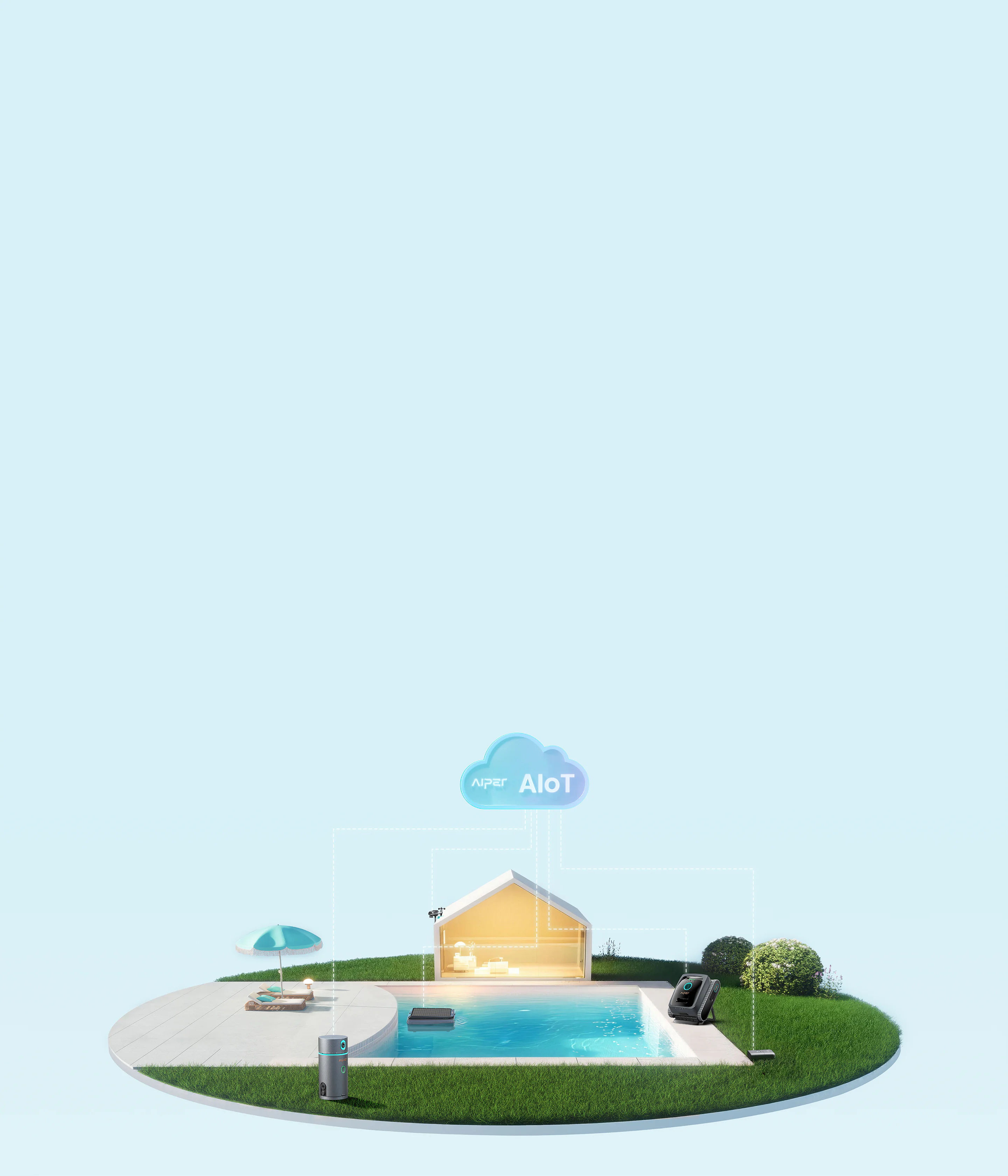
Aiper Smart Yard EcosystemHow Aiper AIoT works
Sense
Collect environmental readings through continuous environmental sensing.
Analyze
Turn sensor readings into intelligence with AI-powered analysis and prediction.
Coordinate
Synchronize devices through shared intelligence and automation.
Unify
Connect the entire outdoor experience through one ecosystem.
For example, connected weather and soil sensors can help adjust irrigation schedules to avoid unnecessary watering, while coordinated routines enable smarter pool and garden maintenance with less user involvement.
Together, these innovations accelerate the shift from individual device intelligence to ecosystem-level intelligence, simplifying outdoor maintenance and enabling more reliable, efficient, and carefree outdoor living.