How to Get Rid of Grubs in Your Lawn (and Tell if You Really Have Them)


To get rid of grubs, confirm the count first, then match the product to the season: chlorantraniliprole in late spring as prevention, or trichlorfon in late summer if damage is already active.
Half the people treating their lawn for grubs don’t have a grub problem.
A grub is just the larval stage of a lawn beetle — Japanese beetle, chafer, or June bug — living in the soil and eating grass roots before it grows wings and flies off. What most people actually have instead is a drought problem, a fungus problem, or a dog that pees in the same spot. Pesticide goes down anyway, money gets spent, and the brown patches stay brown — which is exactly why getting rid of brown spots starts with diagnosis.
Finding one grub while you’re pulling weeds doesn’t mean grubs are your problem, and treating on a hunch is the single most common way people waste a season’s chemical budget. It takes real density to cause dieback.
The Two-Minute Count That Settles It
Before you buy anything, you need to know what you’re actually looking at. The real test takes about two minutes, and it’s the same method university extension programs recommend, including UNH Extension’s grub-scouting guidance.
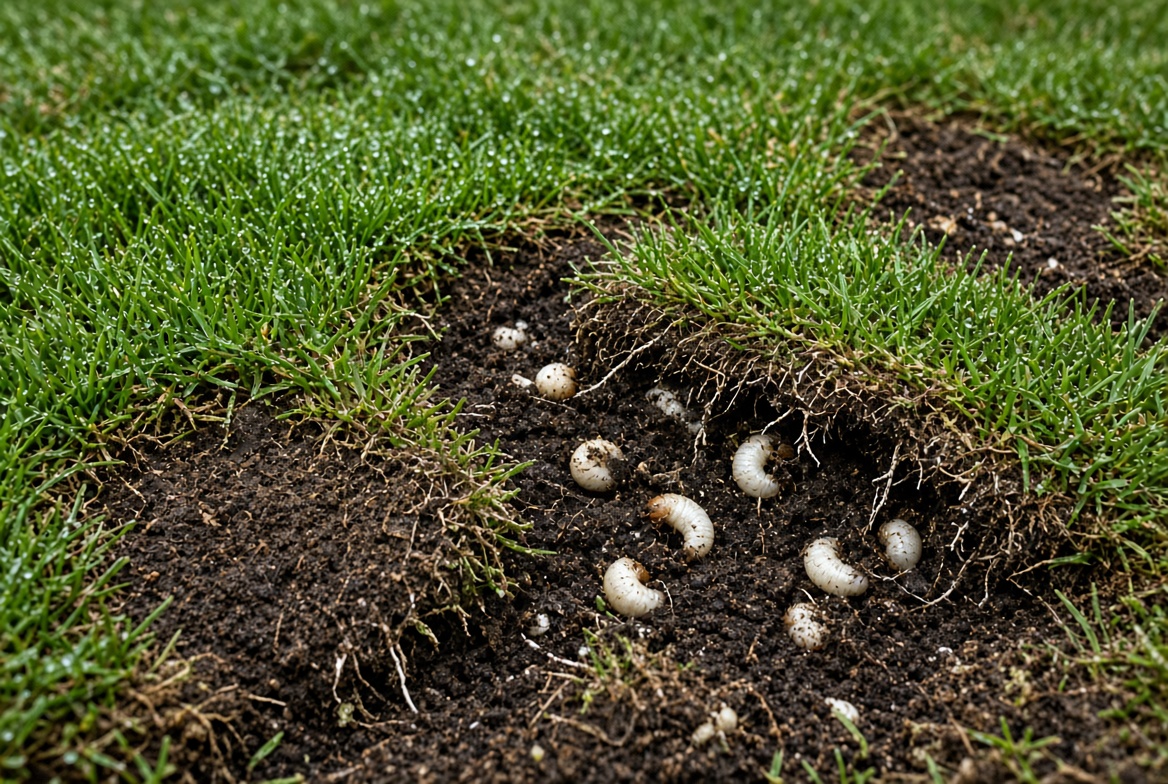
Cut a one-square-foot flap of turf with a shovel, peel it back like a carpet, and count the white C-shaped larvae in the soil underneath. Five or fewer per square foot is normal, every lawn has some. Six to nine is borderline. Ten or more is a genuine infestation worth treating.
That’s the whole diagnostic. Skip it, and you’re guessing.
What Grub Damage Actually Looks Like
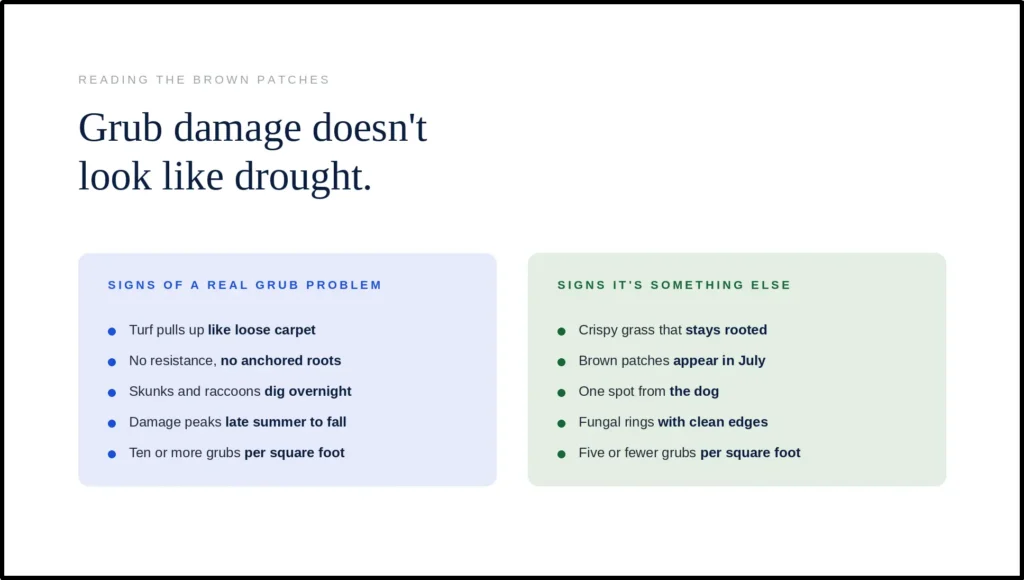
Grubs eat grass roots, so damaged turf pulls up like a loose toupee.
No resistance, no anchored roots, just a mat of dead grass lifting cleanly off the soil. This is the giveaway that separates grub damage from drought stress, where the grass stays rooted even when it’s crispy.
That’s not the only way a lawn fails, though, and mixing it up with the other two wastes just as much money as skipping the test entirely. Grab a handful of grass and pull like you’re trying to lift a doormat:
- Turf lifts as one piece with no roots underneath → grubs.
- Roots are still anchored but the blades themselves look chewed or clipped off near the surface → sod webworms or cutworms, not grubs. Different pest, different product.
- Nothing moves, the grass is just crispy and won’t budge → drought stress or dormancy, not a pest at all.
The other tell is wildlife.
Skunks, raccoons, crows, and moles tear up lawns hunting grubs. If you wake up to a yard that looks like someone went at it with a garden fork overnight, something is eating well down there. Canada geese cause a different kind of damage — their grazing pulls grass out by the roots and their droppings can turn a lawn unsanitary in a matter of days. If geese have taken a liking to your yard, read our guide on how to keep geese off your lawn.
Birds working a single patch repeatedly is a softer signal but worth noting.
Damage typically shows up in late summer through fall, when grubs are largest and feeding hardest. A lawn that browned out in July is almost certainly not grubs, it’s heat and water.
Which Grub You Have
Four species cause most lawn damage in the US, and they don’t all respond to the same treatment.
The tell is on the grub’s rear end. Straighten one out and check the underside of the last body segment with a hand lens. The shape of the slit there and the spines in front of it form a pattern called the raster, and each species has its own.
- Japanese beetle: V-shaped row of spines. The adult is the half-inch metallic green beetle that strips rose and grape leaves in July. Eggs go down July through August. This is the only species milky spore works on.
- European chafer: Y-shaped slit with two parallel rows of spines. The adult is a plain tan beetle most people never notice. It lays eggs two to three weeks before Japanese beetle, feeds later into fall and earlier in spring, and tolerates dry soil, so it damages unwatered lawns where Japanese beetle eggs would have dried out.
- Masked chafers: No clear pattern, just scattered hairs. Adults are chestnut brown, half an inch long, and swarm porch lights in June and July. Native and common across the Midwest and South.
- May and June beetles: Much larger, up to an inch and a half, with two neat parallel rows of spines. These take two to three years to mature, so the same grubs feed on the same lawn for several seasons, and a single spring preventive application will miss the older ones.
If your test flap turns up grubs of two different sizes or patterns, you have a mixed population. That’s common. Treat on the count, and skip milky spore unless every grub you find is Japanese beetle.
When Should You Treat for Grubs?
Grub control products fall into two categories, and using the wrong one at the wrong time wastes the application entirely.
Preventive Products
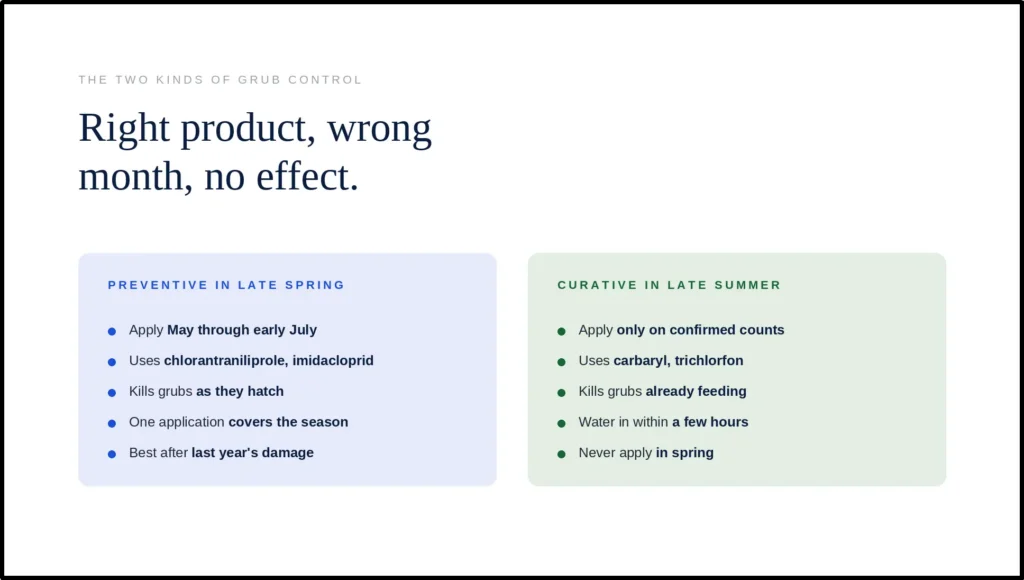
Preventive products (chlorantraniliprole, imidacloprid, and less commonly thiamethoxam or clothianidin) go down in late spring to early summer, roughly May through early July, in most of the country. They get taken up by the roots, so grubs that feed later in the season are poisoned from the inside as they hatch. Apply these in the fall, and you’re months late, the grubs are already large, and the chemistry doesn’t work as well on mature larvae.
Curative Products
Curative products (carbaryl, trichlorfon) kill grubs that are already there and actively feeding. Apply these in late summer or early fall when you’ve confirmed an active infestation. They’re harsher, work fast, and need watering in immediately after application, a quarter to half an inch of water within hours, or they break down on the surface before reaching the soil.
One common mistake: reaching for a general-purpose insecticide like bifenthrin because it’s already in the garage. It won’t touch grubs. Bifenthrin binds tightly to soil particles and stays in the top layer, so it never reaches the root zone a few inches down where grubs actually feed. Grub control needs an active that either gets absorbed by the roots (preventive) or moves down through the soil profile (curative) — bifenthrin does neither.
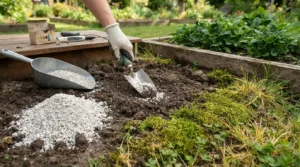
However you apply, spread the granules evenly with a lawn spreader and water the entire lawn, not just the brown patches, to push the product down to root level. Curatives need that quarter to half an inch of water within hours of application, or they break down on the surface before reaching the soil.
Here is what those actives are sold as, and when each one goes down:
| Active Ingredient | Sold As | Category | Application Window |
|---|---|---|---|
| Chlorantraniliprole | Scotts GrubEx1, Acelepryn | Preventive | April–early July |
| Imidacloprid | BioAdvanced Season-Long Grub Control, Merit | Preventive | June–mid-July |
| Carbaryl | Sevin (check label for carbaryl) | Curative | August–September |
| Trichlorfon | Dylox 6.2, BioAdvanced 24 Hour Grub Killer Plus | Curative | August–early October |
Chlorantraniliprole (Scotts GrubEx1, Acelepryn) has the widest window of the four. It takes a few weeks to move into the root zone, so early beats late, and it carries the lowest toxicity to bees, pets, and people on this list.
Imidacloprid (BioAdvanced Season-Long Grub Control, sold to professionals as Merit) works best applied as close to egg-laying as possible. It is toxic to pollinators, so mow flowering clover and dandelions first and keep it away from beds in bloom.
Carbaryl: Sevin was the original carbaryl brand, but some products sold under the Sevin name contain actives that don’t work on grubs. Read the label and buy a granule that lists carbaryl, and water it in the same day you apply it.
Trichlorfon (Dylox 6.2, BioAdvanced 24 Hour Grub Killer Plus) is the fastest kill, often within a day, as long as the grubs are still feeding near the surface. Water it in within a few hours of spreading.
Don’t apply curative products in spring. Grubs come up to feed briefly, then pupate into beetles. You’d be poisoning the lawn to kill insects that are about to leave on their own.
Do Natural or Biological Grub Treatments Work?
Beneficial nematodes, specifically Heterorhabditis bacteriophora, are microscopic worms that hunt grubs in the soil.
They work, but the conditions have to be right: soil temperature above 60°F, moist soil before and after application, and application in the evening or on an overcast day because UV light kills them. Buy them from a supplier with refrigerated shipping, not off a shelf where they’ve been sitting at room temperature for six months. Of the natural options, nematodes are the most consistent.
Milky spore is a bacterial disease that targets Japanese beetle grubs specifically and does nothing for European chafers, masked chafers, or June beetles. It’s also slow: the spores spread as infected grubs die and release more spores into the soil, so it typically takes two to three seasons of application to build a colony strong enough to matter. If you don’t know which species you have, or you’re expecting results this year, milky spore isn’t the right tool.
Neem oil and Bacillus thuringiensis (Bt) products are sometimes marketed as grub control. Both are real, both are far weaker and less consistent against grubs than nematodes or a properly timed chemical application, and neither is a substitute for either.
What to Actually Do
If your grub count is under ten per square foot and the lawn looks fine, do nothing. Healthy turf tolerates a low grub population without visible damage.
If you have confirmed damage and counted high numbers in summer or early fall, use a curative product, water it in properly, and overseed the dead patches once the grubs are dead. Don’t reseed before treatment, you’ll just feed the next generation.
If you had grub damage last year and want to prevent a repeat, use a preventive product the following spring. One application, timed correctly, handles the whole season.
How Do You Repair the Lawn After Grub Treatment?
Grub-killed turf won’t green up on its own. The roots are gone.
How Do You Confirm the Grubs Are Dead?
Wait a week to ten days after a curative application, then peel back a test flap. Dead grubs turn brown and soft. If the count has dropped, start the repair.
Clear and Prep the Soil
Rake out the dead mat and any turf the skunks flipped. Rootless grass left in place will smother new seed. Rough up the bare soil about an inch deep with a garden rake.
Reseed or Resod
Seed with a grass that matches the rest of the lawn, at the overseeding rate on the bag. Early September to early October is the best window in most of the country, the same window our cool-season lawn care calendar recommends for fall overseeding. The soil is still warm, and the beetles are done laying.
Patches wider than a couple of feet with nothing living in them come back faster from sod. Lay it on the loosened soil, water it in, and keep it wet for two weeks. For grub damage that has spread into genuinely large bare areas rather than isolated spots, our guide to fixing large bare spots in a lawn covers the full recovery process step by step.
Turf that wildlife tore up but that still has roots can be pressed back down, watered, and left alone. It usually knits back in within a few weeks.
Feed and Water the New Grass
Apply a phosphorus-rich starter fertilizer to push root development, not a high-nitrogen blend that just grows leaf. A root biostimulant — seaweed extract or fulvic acid — speeds recovery further by helping new roots establish before the first frost. Water lightly twice a day until the seedlings are up, then go back to deep, infrequent watering.
Keep mowing at three to four inches. Scalping new grass undoes the whole job.
The Lawn Itself Does Most of the Work
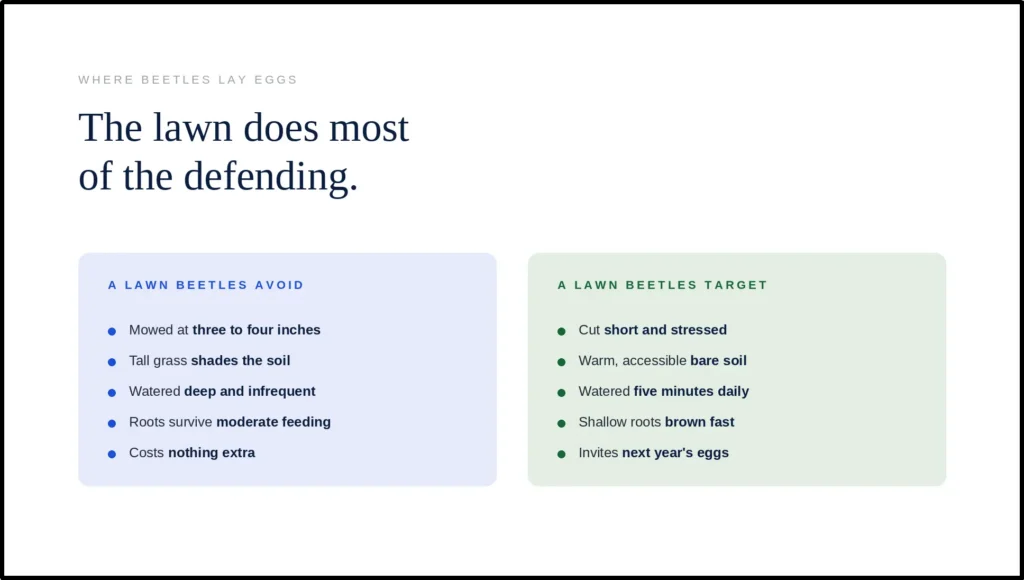
Beetles lay eggs in short, stressed, dry lawns because the soil is warm and accessible.
Tall grass, mowed at three to four inches, shades the soil and discourages egg-laying. Deep, infrequent watering builds root systems that survive moderate grub feeding without browning.
A lawn that gets mowed too short and watered five minutes a day is the lawn beetle’s target.
The single best long-term grub strategy is mowing higher and watering deeper, and it costs nothing. Keeping your lawn healthy starts with reducing stress across the whole yard. Aiper’s smart irrigation system can help you achieve precise moisture control, making it easier to maintain deep-root hydration while automating your seasonal watering schedule for a resilient, thriving landscape.
Common Questions
Only where roots survived. Thinned turf fills in from the edges over a season. Turf that peeled up like carpet needs seed or sod.
Yes, on their own schedule. Each year’s grubs pupate in spring and fly off as beetles in summer. The damage they caused stays, and those beetles lay next year’s eggs in the same lawn.
The grubs are harmless. A dog that digs a few up and eats them will be fine. The treatments are the concern: keep pets off the lawn until granules are watered in and the grass has dried, and follow the re-entry time on the label.
Beetles. Japanese beetles, European chafers, masked chafers, or June bugs, depending on which species is in your lawn.
Under the right soil temperature and moisture, they can cut counts substantially, but results are less consistent than a correctly timed preventive. Use them if you want to avoid insecticide and can meet the conditions.
For curatives, usually. Once soil cools, grubs move down out of reach. Note the damaged areas, repair them, and put a preventive down next spring.
No, not reliably. A soapy water drench irritates grubs enough to bring them toward the surface, which is useful for confirming they’re there, but it doesn’t kill them at the density needed to stop damage. Treat it as a detection trick, not a treatment.
Trichlorfon (Dylox, BioAdvanced 24 Hour Grub Killer Plus) is the fastest-acting option, often killing grubs within a day of a properly watered-in application. It only works on active infestations, not as prevention.
Not necessarily. Preventive actives work by poisoning grubs after they feed on treated roots, which takes time, and wildlife can keep digging for weeks while grub numbers decline. Cut a fresh test flap eight to ten weeks after application: if the count is dropping compared to your baseline, the product is working. Only add a curative if a fresh count is still at or above the treatment threshold late in the season.
Products aimed at surface-feeding insects like sod webworms, or general-purpose sprays, are built to kill on contact at the leaf and thatch layer. They’re not formulated to move down through the soil profile to where grubs actually feed, so even a thorough application can leave the grub population untouched. Check the label specifically for “grub” in the target pest list, not just “lawn insects.”
No, and there’s no reason to. One correctly timed preventive application protects the entire feeding season because the active stays in the root zone until it degrades. Reapplying more often doesn’t add protection, it adds unnecessary cost, chemical load, and pollinator exposure.
Yes. These windows are written for most of the US with a typical spring, but they shift earlier the further south and warmer you are. Warm-season lawns in the Gulf South should treat preventives at the early end of the window and curatives can start as early as late July. Cool-season lawns further north should lean toward the late end of each window. When in doubt, soil temperature is a better trigger than the calendar: preventives go down once soil holds steady around 50°F and above.
Overseeding and grub granules can be combined safely, the granules don’t affect seed germination, and dethatching is fine before or after. A pre-emergent herbicide like prodiamine is the one to keep separate: it blocks root development in anything germinating, including grass seed, so don’t combine a pre-emergent application with overseeding the same season.
Skip anything containing imidacloprid if you have blooming clover, dandelions, or nearby garden beds, mow flowering weeds down before applying any neonicotinoid, and water granules in immediately so the active moves into the soil rather than sitting on leaf surfaces where foraging bees can contact it. Chlorantraniliprole carries a lower bee toxicity profile if you need a preventive near blooming plants.
Get more pool and lawn care guides from Aiper on Google