How to Raise pH in a Pool Using Soda Ash (Step-by-Step)

Pool water rarely goes out of balance all at once.
It drifts. A bit of rain, heavier chlorine use, more swimmers than usual, and pH starts slipping without you noticing. By the time you test, it’s already below the safe range.
Once it drops below about 7.2, chlorine becomes less effective, surfaces start taking damage, and the water feels sharper than it should. So the goal is to correct pH without pushing something else out of balance. The same soda-ash math works in reverse for pool owners who instead need how to lower pH in a pool that’s drifted too high.
How To Test Your Pool Water Before Using Soda Ash
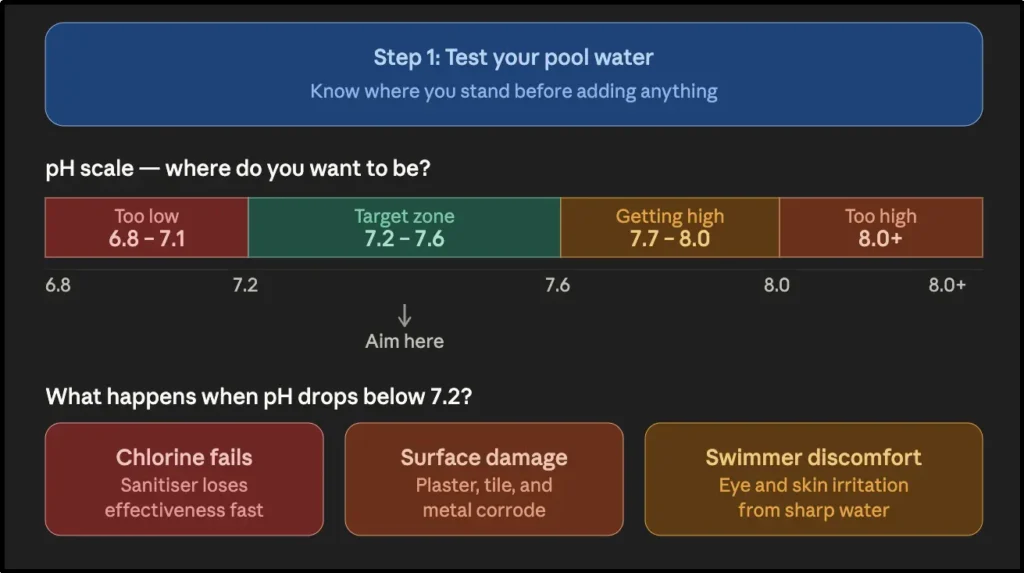
Start with a proper reading.
You’re aiming for roughly 7.2 to 7.6. If you’re below that, soda ash is the right tool, but it doesn’t act in isolation. It raises pH and total alkalinity together. Not sure which chemical to reach for? Soda ash vs baking soda for your pool maps each powder to the number it moves.
That second effect is where most problems come from.
If alkalinity is already sitting high, adding soda ash fixes pH but quietly pushes alkalinity further out. Knowing the difference between Alkalinity and pH is crucial here; that’s when water turns cloudy or becomes harder to stabilise later. You don’t always see it immediately, but it shows up.
So even if you don’t have a full test kit, at least be aware: this isn’t a single-variable adjustment.
When To Use Soda Ash (And When Not To)
People mix these up constantly.
- Soda ash is used because it moves the pH quickly and noticeably. Baking soda barely shifts pH, it mainly affects alkalinity.
- If pH is already low, baking soda won’t get you back into range unless you add a lot of it. And by then, alkalinity is already overshot.
Soda ash does the job directly. That’s why it’s used.
How Much Soda Ash You Actually Need
This is where most pool corrections go wrong.
There are rough benchmarks, but they only work if you respect their limits. Around 6 ounces per 10,000 gallons will raise pH by about 0.2, while a full pound is often used when pH is clearly below range. To find your baseline, you can calculate pool pH to see exactly where your water stands before dosing.
That sounds simple, but the important part is what you don’t do.
You don’t add everything at once.
Even though some guides give upper limits, adding too much in a single treatment is the fastest way to cloud the pool or overshoot pH entirely.In practice, you’re always working in controlled increments.
Step-by-Step Process for Adding Soda Ash Correctly
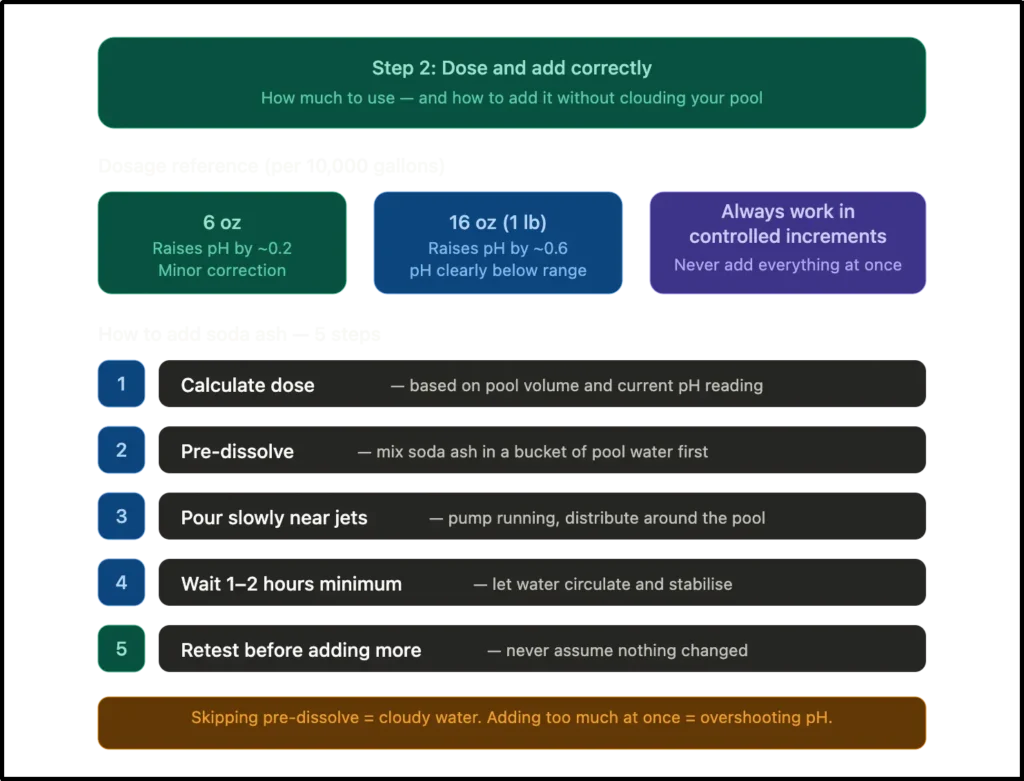
Raising pH with soda ash isn’t complicated, but it is easy to get wrong. Most problems (cloudy water, overshooting pH, constant readjustments) don’t come from the chemical itself. They come from how it’s added.
- Calculate your dose based on pool size and current pH. If you don’t know your exact volume, use a tool to calculate pool volume—if you’re just estimating, that’s how overcorrection happens.
- Pre-dissolve the soda ash in a bucket of pool water before adding it. Skipping this is what leads to clouding and residue settling on the floor.
- Keep the pump running and pour the solution slowly around the pool, ideally near return jets. The goal is immediate circulation, not concentrated pockets.
- Let the water circulate for at least 1–2 hours, then wait several hours before retesting. It needs time to stabilise.
Retest before adding more. Most overshooting happens when people assume nothing changed and dose again too quickly.
What to Avoid When Adjusting Pool pH with Soda Ash
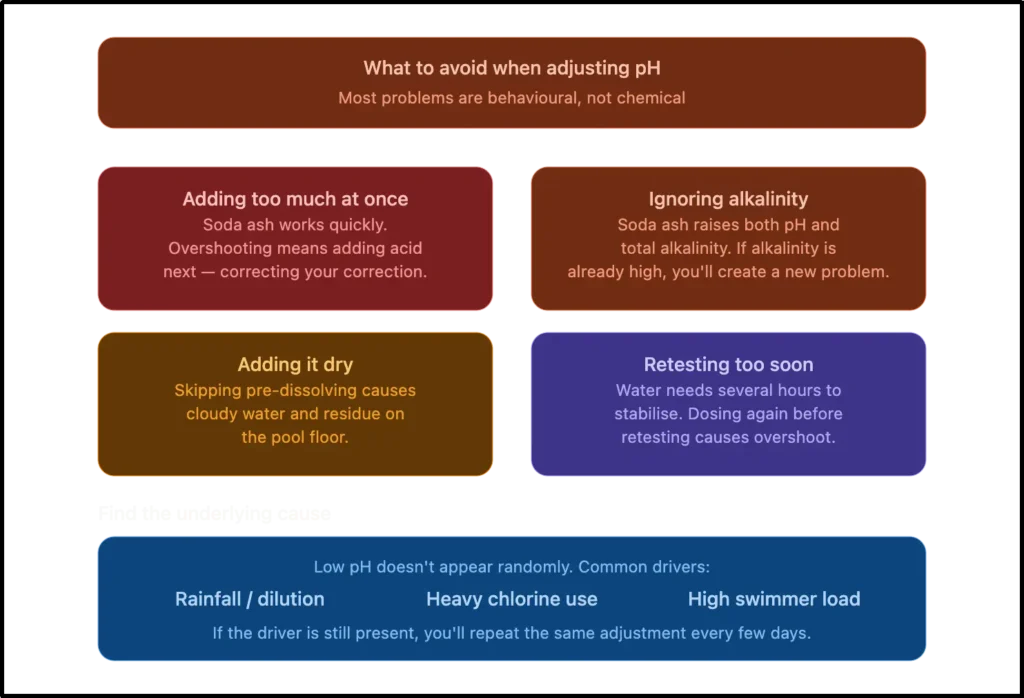
Most issues are behavioural.
- Adding too much at once is the most common one. Soda ash works quickly, so overshooting means you’re adding acid next. Now you’re correcting your correction.
- Ignoring alkalinity is another. Because soda ash raises both, you can fix pH while quietly creating a second imbalance.
- Then there’s adding it dry. That’s what causes clouding and uneven distribution. It looks like a minor shortcut, but it changes how the chemical dissolves and spreads.
- There’s the underlying cause. Low pH doesn’t usually appear randomly. It comes from dilution, heavy chlorine use, or organic load. If that driver is still there, you’ll keep repeating the same adjustment every few days.
How This Actually Works Day to Day
Most pH corrections aren’t dramatic.
You’re not dumping in chemicals and fixing everything in one pass. You’re making a controlled adjustment, letting the water respond, then adjusting again if needed.If you’re already thinking about reducing that manual work, it’s worth looking at how Aiper robots approach pool maintenance. Their cordless robotic cleaners are designed to handle the physical side of upkeep, so water care stays the only thing you need to manage.
FAQs
Soda ash is used to move the pH level of pool water quickly and noticeably when it drifts below the safe range. It directly raises both the pH and total alkalinity together.
Soda ash raises pH. (It is often the primary ingredient in commercial “pH Up” products).
Soda ash (sodium carbonate) is the direct and effective chemical used to raise low pool pH.
Around 6 ounces of soda ash per 10,000 gallons will raise your pool’s pH by about 0.2. If your pH is clearly below the safe range, a full pound is often used as a baseline.
No. You should always work in controlled increments. Adding too much in a single treatment is the fastest way to cloud your pool or overshoot your target pH.
First, calculate your dose based on your exact pool volume. Next, pre-dissolve the soda ash in a bucket of pool water. With the pump running, slowly pour the solution around the pool, ideally near the return jets for immediate circulation.
Yes. Soda ash does not act in isolation; it raises both pH and total alkalinity simultaneously. If your alkalinity is already high, adding soda ash can push it further out of balance, leading to cloudy or unstable water.
After pouring, let the water circulate for at least 1–2 hours, and then wait several hours in total before retesting to allow the water chemistry to fully stabilize.
No. They have different primary effects. Soda ash moves pH quickly and directly. Baking soda, on the other hand, mainly affects total alkalinity and barely shifts pH unless you add an excessive amount (which risks overshooting your alkalinity).
Clouding is usually behavioral. It happens if you add too much soda ash at once, skip the pre-dissolving step (adding it dry), or if the addition pushes an already-high alkalinity level completely out of balance.
You will overshoot your target pH. Because it works so quickly, overcorrecting means you will have to add acid next, leaving you stuck in a cycle of “correcting your correction.”
Get more pool and lawn care guides from Aiper on Google