Black Algae: Why It Survives Chlorine and How to Actually Kill It

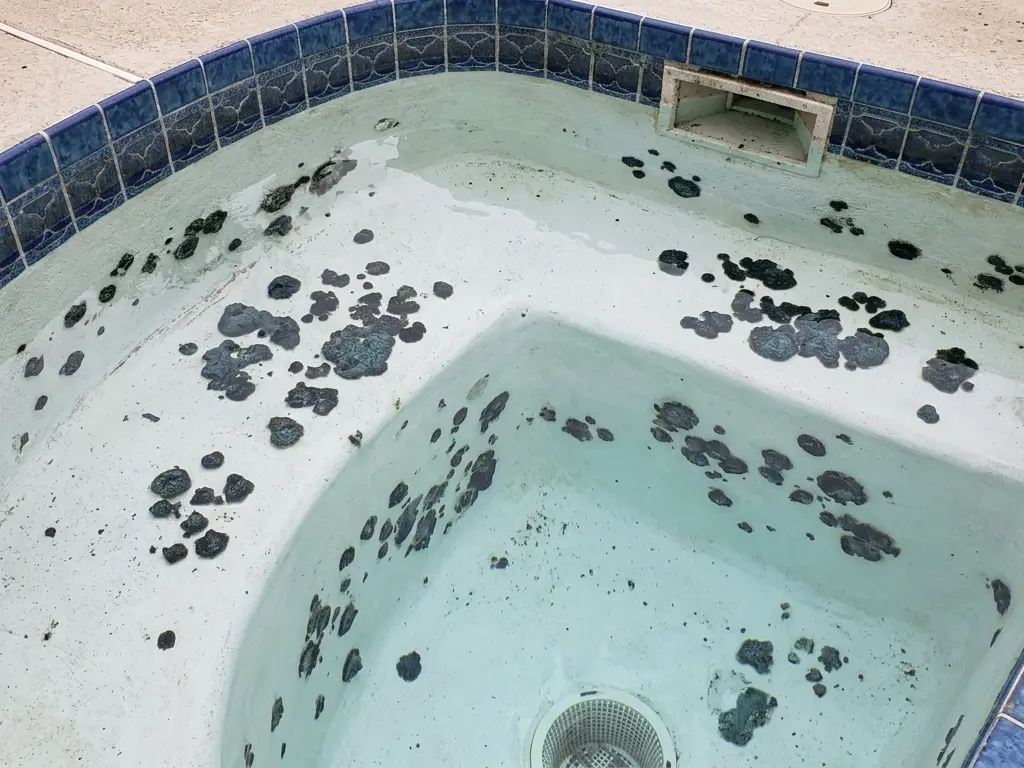
There’s a particular frustration that comes with finding those dark, almost black spots dotted along your pool walls and floor, especially after you’ve already shocked the pool twice.
You brush them. They come back. You shock again. Still there.
And if you’ve made the mistake of assuming they’re just stubborn green algae that needs a bigger dose, you’ve probably wasted half a summer and a fair amount of money finding out that you were wrong.
Black algae isn’t algae in the way most pool owners understand algae — and plenty of green water isn’t algae either, which our guide to why your pool is green without algae untangles. It behaves differently, it survives differently, and killing it requires understanding what you’re actually dealing with, not just throwing more chlorine at it and hoping.
What Black Algae Actually Is
The word “algae” is doing a lot of misleading work here. Black algae is actually a cyanobacterium, a photosynthetic bacterium that’s been around for billions of years and has evolved to survive conditions that would kill most microorganisms.
It’s not a plant, not a fungus, not a standard algae bloom. It’s a colony-forming bacteria that builds protective structures specifically designed to resist chemical attack.
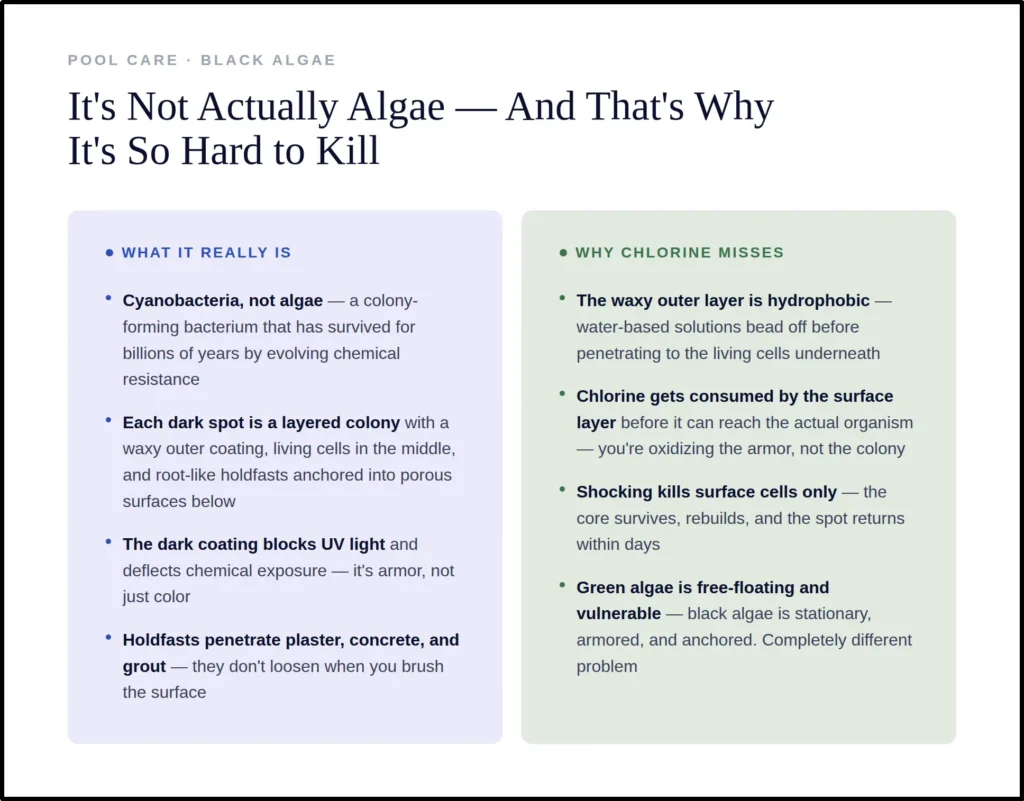
Each visible spot is not a single organism. It’s a layered colony:
- The outer surface, the dark, waxy layer you can see, contains pigments that block UV light and deflect chemical exposure.
- Below that is the living mass of the colony.
- Below that is the penetrating base, where root-like structures called holdfasts anchor directly into porous surfaces like concrete, plaster, and grout.
Those holdfasts don’t float free when you brush the surface. They’re embedded.
This is the thing most people miss: the visible part of a black algae spot is essentially armor. The actual living organism is sitting behind and beneath it.
What Black Algae Looks Like — And What It’s Not
Black algae shows up as dark blue-black or near-black spots, usually between the size of a pencil eraser and a quarter, sitting on walls, the floor, steps, and especially in grout lines and rough patches of plaster. The giveaway is the texture: the spots feel slightly raised and rough, almost like tiny scabs on the surface. They don’t wipe away.

Run a fingernail over one. If it smears into green and the water around it clouds up, that’s ordinary green algae. Black algae holds its shape — you have to grind at it to break the surface, and the water stays clear while you do.
Two things get mistaken for black algae all the time, and treating the wrong one wastes a weekend:
- Metal stains — copper, iron, and manganese leave flat, even dark discoloration with no raised bump. Rub a vitamin C tablet on the stain: if it lifts or lightens, it’s metal, not algae, and no amount of shock will remove it.
- Black mold — looks like a smooth, flat dark film, and chlorine kills it easily. If a normal chlorine dose clears it up, it was never black algae.
The rule of thumb: green algae brushes off and clouds the water; metal stains have no texture and fade with acid or vitamin C; black mold dies with a normal chlorine dose. Black algae is the one that’s raised, won’t brush off, won’t bleach — and needs the full sequence below.
Why Chlorine Doesn’t Work (On Its Own)
Standard pool chlorine works by oxidizing organic matter. It essentially burns through cell walls and kills microorganisms on contact.
Against green algae, a free-floating single-celled organism, this works fine.
But against black algae, it mostly just reacts with the outer protective layer and gets consumed before it ever reaches the living cells underneath.
The waxy coating on black algae is hydrophobic. Water-based solutions, including your chlorinated pool water, bead off it rather than penetrating.
You’d need sustained, extremely high chlorine contact at the actual cell membrane level to do meaningful damage.
But because the protective structure keeps chlorine from reaching that membrane, you’re essentially running a sprinkler over a waxed car and wondering why the engine isn’t getting wet.
That’s also why shocking helps temporarily, and then the spots return. The shock kills exposed cells at the very surface of the colony — and adding algaecide and shock at the same time is a question worth getting right before you dose. The core survives. The colony rebuilds.
How It Gets Into Your Pool
Usually tracked in. Swimmers who’ve been in a lake, river, or contaminated body of water can carry it on their skin or swimwear.
It can also come in on pool equipment, a brush, a net, or a float that was used somewhere else and not dried or sanitized properly — and once airborne pests arrive, a net is your first defense against flying ants swarming into the pool water. Once it finds a rough, porous surface, and it’s looking for exactly that, it anchors and starts building.
Concrete and plaster pools are significantly more vulnerable than vinyl or fiberglass.
The microscopic texture of plaster gives holdfasts purchase that a smooth liner doesn’t provide.
That doesn’t mean you can’t get black algae in a vinyl pool, but when you see it primarily in grout lines, on steps, along rough patches where the plaster has degraded, that’s not a coincidence. That’s where it’s finding the grip it needs.
Direct sun exposure helps it too. Cyanobacteria photosynthesize. A sun-drenched shallow end with deteriorating plaster is essentially an ideal habitat.
The Brush Is Not Optional
Before you put anything else in the water, you have to physically breach the protective layer on every spot. A stainless steel brush (not nylon, steel) is used with real pressure directly on each colony.
You’re not trying to scrub it off the wall. You’re trying to crack and abrade that outer waxy coating so that when chemical treatments go in, they have an actual path to the living cells.
This step is where most treatments fail. People brush lightly, dump in algaecide, and consider it done. But a light brush over black algae barely disturbs the surface layer. You want to see the dark coating disrupted, ideally some cellular material disturbed and loose.
It’s not a pleasant process. For heavy infestations with deep penetration into old plaster, you’ll need to put real effort into every single spot, and large colonies will need multiple passes.
Brush immediately before adding any chemical treatment, while those disrupted cells are exposed.
The Chemicals That Actually Kill Black Algae
Brushing breaks the shell. Chemicals do the killing. But not all of them are equal against black algae — and this is where the “black algae killer” products people search for usually fall short.
Silver algaecide is the closest thing to a targeted weapon for black algae. Most store-brand algae killers are copper or quaternary ammonium formulas, which are fine for green algae but weak against black algae’s waxy layer. Silver-based algaecides (look for “silver” in the active ingredients) penetrate that layer far better and are the standard recommendation when black algae is the confirmed problem.
Cal-hypo granules sprinkled directly on the spots do what liquid shock can’t: they sit on the colony and release a sustained, high-concentration chlorine right at the surface. After brushing, dust each spot with calcium hypochlorite granules and let them dissolve in place.
Remove phosphates first, then add an enzyme. If phosphates are feeding the colony, every round of chlorine gets spent on food before it reaches the algae. Test phosphates; if they’re above about 100 ppb, treat with a phosphate remover. An enzyme product then breaks down the dead algae and organic film left behind, so your next chlorine dose actually does its job.
The combination that works is the steel brush, the silver algaecide, and the cal-hypo spot treatment — not a single bottle labeled “killer” on its own. Any one of them alone leaves enough of the colony behind to rebuild.
The Treatment Sequence That Actually Works
Here’s a play-by-play of what works.
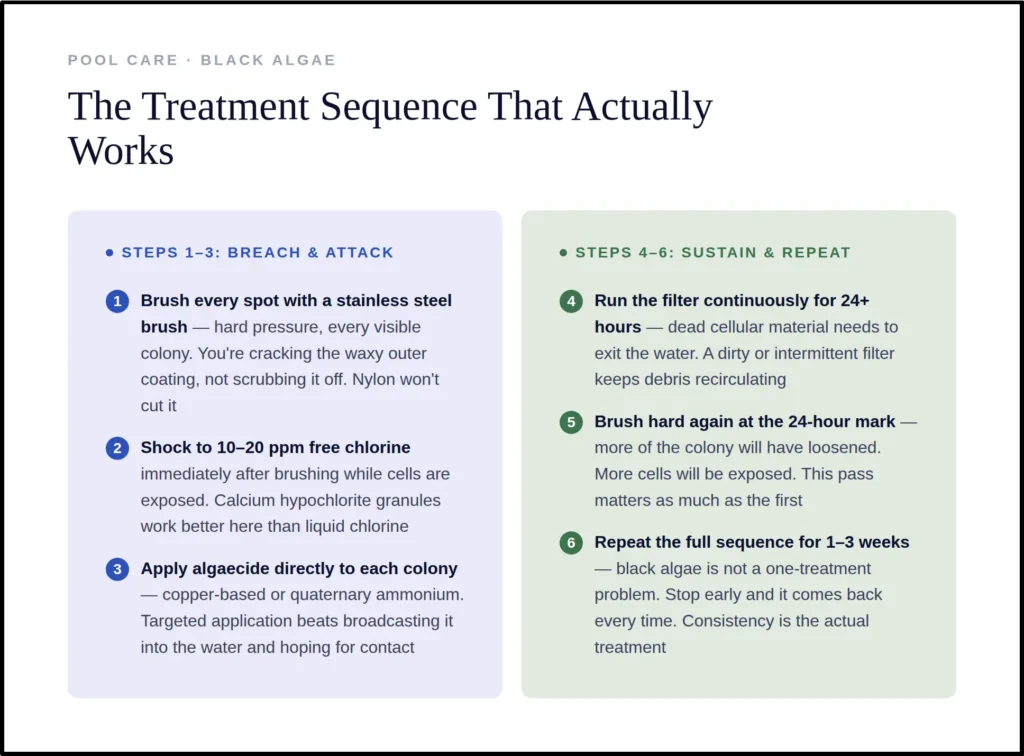
Step one: Brush every spot
Steel brush, high pressure, every visible colony. Don’t miss the grout lines or the undersides of steps.
Step two: Bring chlorine to the shock level
You want free chlorine in the range of 10–20 ppm for treatment purposes. Normal chlorination (1–3 ppm) is the maintenance level.
You need a shock level to have any fighting chance against the exposed cells. Calcium hypochlorite shock, the granular kind, is typically more effective here than liquid chlorine for this purpose, though both can work.
Step three: Apply algaecide directly
Specifically, a quaternary ammonium algaecide, or better yet, a copper-based algaecide, applied directly to the spots if your pool allows for it.
For pools where you can get close enough, a concentrated algaecide applied directly to each colony with a brush or applicator stick is dramatically more effective than broadcasting it into the water and hoping dilution does the work.
Step four: Run the filter continuously
24 hours minimum. Dead and dying cellular material needs to get out of the water — the same organic matter that draws bees and other insects to your pool in summer. A filter that’s been running intermittently or is due for cleaning will keep debris recirculating and give surviving colonies material to feed on.
Step five: Brush again
At the 24-hour mark. More material will have loosened. More of the colony will be exposed. Brush hard again.
Step six: Repeat
Black algae is not a one-treatment problem. You’re looking at a week to three weeks of consistent treatment, depending on severity. If you treat once, see improvement, and stop, it comes back. Every time.
Chlorine Tablets Pressed Directly on Spots
Worth mentioning separately because it works, and most people don’t know how to do it.
Trichlor tablets, the compressed pucks, pressed directly against a black algae colony and held there or wedged in place for hours, deliver a sustained, high-concentration chlorine dose directly to the colony surface.
The slow dissolution releases chlorine at the point of contact rather than into the bulk water.
You can use a gloved hand to rub a tablet directly on the spot, or wedge a chunk of tablet against the colony overnight.
This isn’t a replacement for the full treatment sequence, but it’s genuinely effective as a targeted adjunct, especially for spots in grout lines or in corners that are hard to hit with water circulation.
Wear gloves. Trichlor is concentrated and caustic.
Treating Black Algae on Vinyl, Fiberglass, and Saltwater Pools
Everything above assumes a plaster, gunite, or concrete pool — where black algae is most common, and where the aggressive tools are safe. On other surfaces, you have to dial it back.
Vinyl and fiberglass pools need a nylon brush, not steel. A stainless steel brush will gouge a vinyl liner and scuff fiberglass until it’s cloudy and rough — which, ironically, gives black algae even more surface to grip. Nylon can’t crack the waxy layer as aggressively, so you’ll brush more often and lean harder on the chemical steps.
The same caution applies to pressing trichlor tablets directly on spots. Rubbing a puck onto a colony only works on white plaster or concrete. On colored plaster it bleaches the pigment out; on a vinyl liner it can stain or even melt the surface. On vinyl and fiberglass, skip the direct tablet method entirely and rely on shock, silver algaecide, and persistent brushing.
Saltwater pools get black algae too — the cell simply can’t produce chlorine fast enough to outpace an established bloom. Treat it exactly like a chlorine pool, but keep your CYA in the 30–50 ppm range so the chlorine the cell does make holds up, and use granular shock for the treatment dose rather than pushing the cell past its limits.
For above-ground pools, the surface restrictions are the same as vinyl (most are vinyl), and the small water volume is actually an advantage: a severe, recurring outbreak can be drained, acid-washed, and refilled for less than the cost of months of chemicals.
Why It Comes Back
If black algae keep returning to the same spots after treatment, there are usually two explanations.
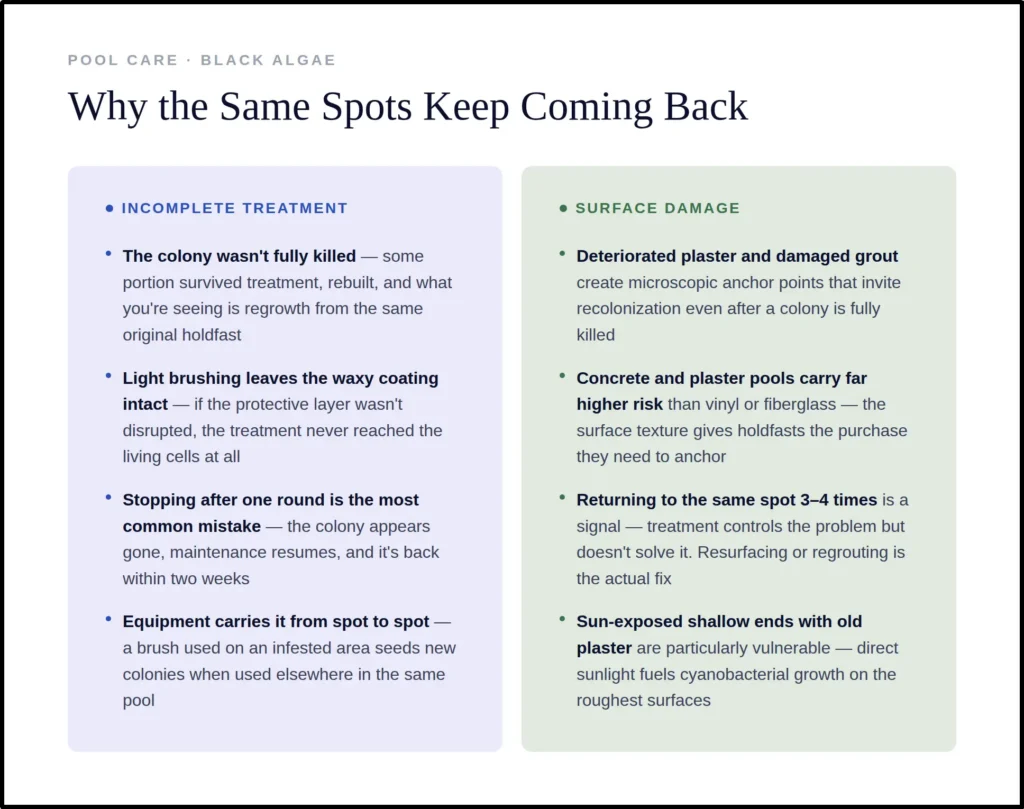
The first is incomplete treatment. The colony wasn’t fully killed. Some portion survived, rebuilt, and you’re seeing regrowth. Go back to the full sequence. Brush harder. Sustain higher chlorine levels for longer.
The second is structural. Badly degraded plaster, deep grout damage, and pitting in the pool surface create conditions that essentially invite recolonization even after you’ve killed what was there.
The holdfasts are gone, but the microscopic structure that made the surface hospitable hasn’t changed. A new cell finds the same foothold, and the cycle starts again.
In cases like this, treatment buys time but doesn’t solve the problem. At some point, resurfacing or regrouting is the actual fix.
Not the answer most people want to hear, but if you’ve treated a spot three or four times and it keeps coming back in the same location, the surface is the issue.
Can You Swim in a Pool With Black Algae?
Short answer: yes, but you shouldn’t treat it as fine. Black algae itself isn’t the kind of bacteria that makes you sick — the real risk is what its presence tells you. A pool that’s grown black algae has been under-sanitized, which means other, less visible contaminants may be riding along.
Anyone with sensitive skin, an open cut, or a weakened immune system should stay out until it’s treated. And never swim during the shock phase — at 10–20 ppm the chlorine is doing its job, and you don’t want it doing anything to your skin and eyes. Wait until free chlorine drops back to 1–3 ppm.
Sanitizing Equipment After Treatment
Any brush, net, or tool that contacts a black algae colony is now a vector.
Dried cyanobacteria can remain viable for extended periods:
- Rinse everything with a diluted bleach solution after every session, or replace inexpensive items like brushes.
- If you’ve been using the same pole and brush in an infested pool and then brought it inside to brush the steps, you may have just seeded a new colony from the old one.
This sounds paranoid until you’ve watched black algae appear in a spot that was definitely clean two weeks ago, right where you were working.
Keeping It Out Going Forward
Preventive maintenance here is less about chemistry and more about surface integrity and equipment hygiene.
Rough, porous plaster surfaces are the real risk factor. A pool in good surface condition with consistent chlorination is genuinely resistant to black algae establishment.
Consistent brushing as part of routine pool maintenance (walls and floor, not just vacuuming the bottom) disrupts early-stage colonies before they get the chance to anchor properly.
If you catch it at two or three spots when they’re small and the protective layer is just beginning to form, it’s a much more manageable problem than waiting until you have thirty dark patches embedded across your shallow end.
Test and balance weekly. Maintain pH between 7.4 and 7.6. At higher pH, chlorine’s effectiveness drops considerably, and that buffer you thought you had disappears. A pool running at 7.8 or 8.0 with what seems like adequate chlorine is actually significantly under-protected.
A few specifics keep black algae from ever getting a foothold again:
- Keep pH on the low side. Chlorine is far more effective at 7.2–7.4 than at 7.8. If you’re fighting recurrence, aim for the bottom of the range.
- Backwash and clean the filter on schedule. A dirty filter recirculates dead algae and organic matter, which is exactly what a surviving colony feeds on.
- Test phosphates if it keeps coming back. Above 100 ppb, remove them — starving the colony works better than out-dosing it.
- Keep the salt cell running consistently if you have one; gaps in chlorine production are when black algae slips back in.
Robotic cleaners like Aiper’s pool cleaners maintain the kind of regular surface disruption and consistent circulation that makes it significantly harder for early colonies to establish. Brushing isn’t something that happens often enough when it’s purely manual.
A robot that runs two or three times a week means the pool surface is getting regular mechanical attention, regardless of whether you remember to do it — and it’s a big part of keeping worms out of your swimming pool.
Frequently Asked Questions About Black Algae
Most pools take one to three weeks of consistent treatment. Black algae is not a one-dose fix. The spots may look gone within days, but keep up the brushing and shock routine for another full week after the last visible spot disappears, or the colony rebuilds.
Black algae won’t structurally weaken the shell on its own, but its holdfasts burrow into plaster and grout. If the same spot keeps coming back, the surface itself has likely degraded and needs resurfacing or regrouting. Repeated treatment only buys time.
No. A salt chlorine generator produces chlorine too slowly to outpace an established bloom. Treat a saltwater pool the same way, but use granular shock for the treatment dose and keep CYA at 30-50 ppm so the chlorine holds.
Yes. Dried cyanobacteria stays viable on brushes, nets, floats, and toys for months. If you don’t sanitize your equipment after treatment, you can reintroduce it the following spring. Rinsing tools in a bleach solution matters as much as treating the pool itself.
No. Black algae is a cyanobacterium that forms raised, rough spots and resists normal chlorine. Black mold is a smooth, flat film that a standard chlorine dose kills easily. They look similar but need completely different treatments.
Get more pool and lawn care guides from Aiper on Google