Salt Water Pool vs Chlorine: The Real Comparison

Most people switch to saltwater expecting to leave chlorine behind entirely. Whatever the chlorine source, the pool chlorine vs bleach concentration gap is worth knowing before you dose.
They don’t.
A saltwater system passes an electrical current through salt dissolved in your pool water, through electrolysis, and that reaction produces chlorine continuously.
It’s still chlorine doing the sanitizing. The difference is in how it arrives and how the water behaves as a result.
That distinction matters more than most pool guides let on.
The Real Reason Saltwater Feels Different
In a traditional chlorine pool, you’re chasing a moving target.
You dose with tablets, liquid, or granular chlorine, levels spike, then they fall. In summer heat with heavy use, a pool can burn through sanitizer faster than expected.
Underdose and you’re green by Thursday. Add too much, and swimmers are climbing out with burning eyes halfway through the afternoon — and wondering how long chlorine lingers in your hair afterward.
Saltwater pools produce chlorine at a low, steady rate. The concentration barely fluctuates. No spikes, no valleys, no Friday afternoon emergency run to the pool store.
That’s the real reason the water feels softer, because you’re never swimming in water that just absorbed a concentrated dose.
There’s a tradeoff, though. Salt systems can’t respond fast. A storm rolls through, you host thirty people on a Saturday, temperatures sit at 95°F for a week, and the generator can’t ramp up quickly enough to compensate. Most saltwater owners keep granular shock on hand for exactly this reason — and yes, you can put shock in a saltwater pool safely when you dose it right.
What It Costs: Upfront and Over Time
The entry cost gap is real.

A quality salt chlorine generator, properly sized for your pool, runs $500 to $1,500 installed. Larger pools or premium brands push that higher. A traditional chlorine setup is close to nothing upfront: a basic feeder and a bucket of tablets, and you’re running.
But traditional chlorine is expensive to maintain.
Tablets, shock, algaecide, and stabilizer in a hot climate with a pool that gets used costs you about $400 to $600 a year in chemicals.
Saltwater reduces that substantially. You’re buying salt, which is cheap, and occasionally supplementing with pH adjusters and algaecide. The ongoing savings are real. If you’re weighing alternative sanitizers, seeing how bromine compares to chlorine in a pool settles that question before you switch.
What most saltwater cost comparisons leave out is the cell, the component you also remove and protect when you’re winterizing a salt water pool for the off-season. The electrolytic cell, the component inside the generator that actually produces the chlorine, wears out.
Every three to five years, it needs replacing. Depending on the system, that’s $200 to $700. It doesn’t eliminate the long-term savings, but it meaningfully narrows them.
How is Maintenance Different?
This is where the “saltwater is low maintenance” pitch starts to oversell itself.
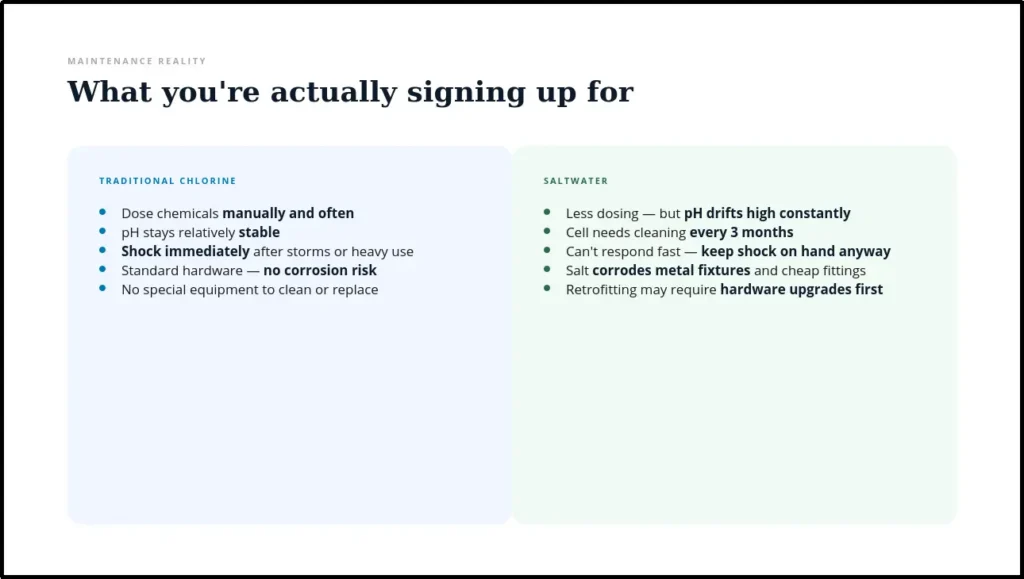
Yes, you’re adjusting chemicals less often. But saltwater pools drift high on pH, which means adding muriatic acid more frequently than you would with a traditional pool.
The cell needs periodic cleaning to prevent calcium buildup, which reduces efficiency and shortens its life.
And saltwater is corrosive. Metal fixtures, certain coping materials, and cheap equipment degrade faster.
If you’re retrofitting an existing pool, some hardware may need replacing before a salt system makes sense.
Converting an Existing Pool
It’s doable. It’s not trivial.
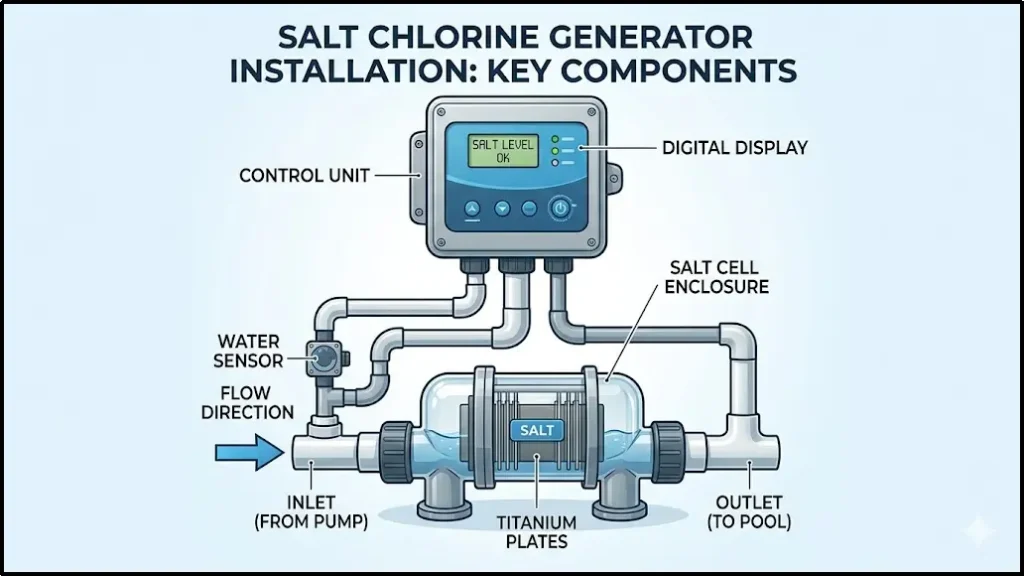
Beyond the generator itself, you need a compatible pump and filtration system and may need to swap out metal components vulnerable to salt corrosion.
The generator has to be correctly sized, this is where a lot of conversions go wrong.
An undersized unit can’t keep up in peak season, so owners start supplementing with traditional chlorine anyway, which eliminates most of the benefit they switched to.
If you’re building new, sizing is straightforward. Retrofitting requires an honest assessment of what your current equipment can handle.
Which One Is Actually Worth It
For people who swim regularly, saltwater is a genuinely better experience.
The water feels different in a way that’s noticeable, the day-to-day chemistry load is lighter, and over several years, the cost difference starts to favor the salt system.
Traditional chlorine is cheaper to get into and works perfectly well when maintained properly. The chemistry isn’t inferior. The experience is just less forgiving when life gets busy and maintenance slips.
Neither system eliminates pool work. One just changes what that work looks like.If you want to spend less time manually vacuuming and more time keeping the pool consistently clear, Aiper offers robotic pool cleaners designed to simplify routine upkeep across different pool types.
Get more pool and lawn care guides from Aiper on Google