How to Backwash a Pool Filter

Most pool owners learn about backwashing the hard way, usually when the pressure gauge has been creeping up for weeks, the water’s looking cloudy, and someone finally mentions that maybe the filter needs attention.
By then, you’ve probably been running the pump harder than necessary and wondering why your electric bill went up.
Backwashing isn’t complicated, but the rules change completely depending on what kind of filter you have. Backwashing is unique to sand and DE systems, a difference sand vs cartridge pool filter walks through alongside cartridge rinsing.
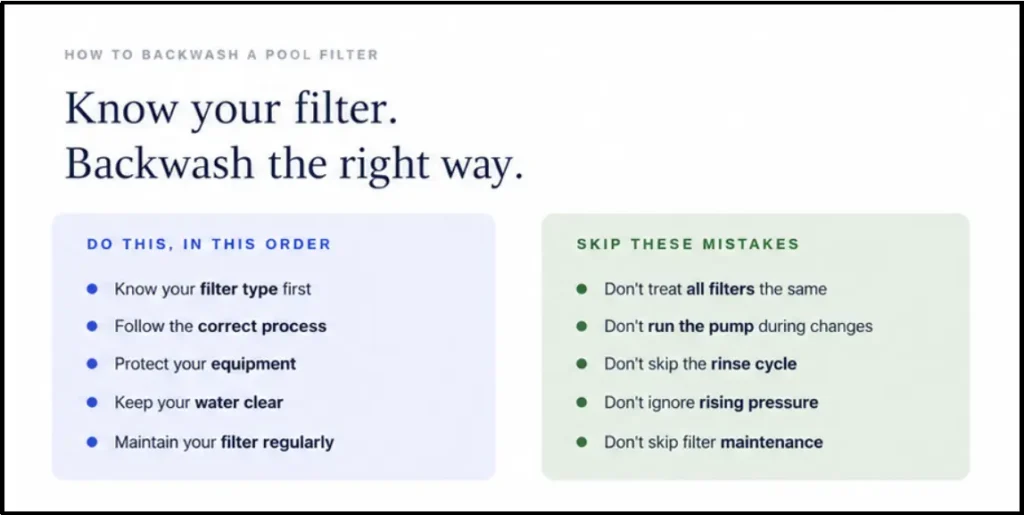
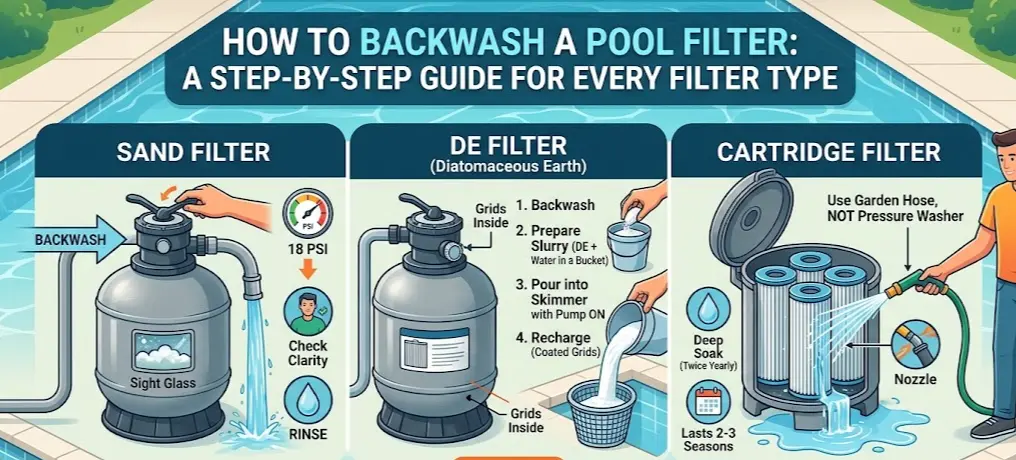
Sand, DE, and cartridge filters each ask for something different — and sand filters are picky about the media, covered in our guide to the best sand for a pool filter. Treat them the same and you’ll either damage equipment or send a cloud of debris straight back into your pool.
Sand Filters
This is the one most people picture when they hear backwash. You’re reversing the flow of water through the sand bed to flush out everything it’s been catching for the past few weeks — and while you’re thinking about flow, aiming your pool return jets correctly for circulation decides how well the filtered water actually circulates.
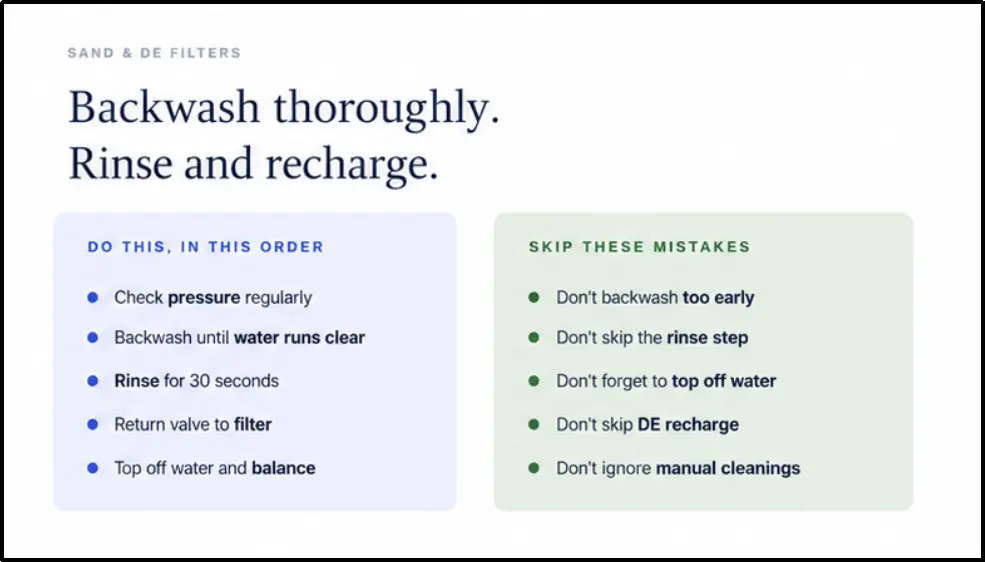
Watch the pressure gauge. When it climbs 8 to 10 PSI above your clean starting pressure, it’s time.
Backwashing a sand filter that doesn’t need it actually makes it work worse — and backwashing is no substitute for changing the sand in a pool filter on schedule. A slightly dirty sand bed filters better than a perfectly clean one because the trapped debris helps catch finer particles.
- Shut the pump off first. Turning a multiport valve while the pump is running will destroy the gasket inside, and you’ll find out about it when water starts shooting out of the waste line at full pressure.
- Move the handle to “Backwash,” prime the pump, then turn it back on.
- Run it until the sight glass shows clear water, usually two to three minutes, sometimes longer if you’ve been putting it off.
- Shut the pump off again, switch to “Rinse,” run it for about 30 seconds, shut off, and return to “Filter.” Skipping the rinse cycle sends a cloud of dirty water back into your pool the moment you start filtering again.
Your pool will lose a few hundred gallons every time you do this, and you’ll need to top the pool back up afterward and rebalance your chemistry.
If you’re not sure exactly how much water you just sent down the waste line, the pool volume calculator is worth bookmarking. Knowing your true gallonage matters more after a backwash than at almost any other time, because every chemical adjustment you’re about to make depends on it.
DE Filters
DE filters have a multiport valve too, and the backwash procedure looks almost identical to a sand filter on the surface.
That’s where the similarity ends.
After you finish backwashing, you have to add fresh DE powder back into the system. The grids inside need a coating of diatomaceous earth to actually filter anything.
Without it, you’re just pumping water through bare fabric grids, which clogs them with fine debris and shortens their life considerably.
How much DE?
- Check the label on your filter housing. A standard 48-square-foot filter takes about 6 cups.
- Mix it with water in a bucket first to make a slurry, then pour it slowly into the skimmer with the pump running.
- You’ll see the pressure climb back up a couple of PSI as the powder coats the grids. That’s the system telling you it’s ready to filter again.
Here’s something the manuals don’t emphasize enough: DE filters need to be opened and manually cleaned a couple of times a year, regardless of how diligent you are with backwashing.
Old DE cakes onto the grids in patches that water flow alone won’t dislodge. If your pressure refuses to drop back down after a proper backwash and recharge, that’s your sign.
One thing worth checking if you’ve inherited a pool or recently switched filter types: make sure the DE filter you have is actually sized correctly for your pool.
An undersized filter will need backwashing twice as often and never quite catch up. The pool filter size calculator gives you the surface area you should be running based on your pool’s volume and turnover rate.
Cartridge Filters
Cartridge filters don’t backwash.
This trips people up constantly. There’s no multiport valve, no waste line, nothing to reverse.
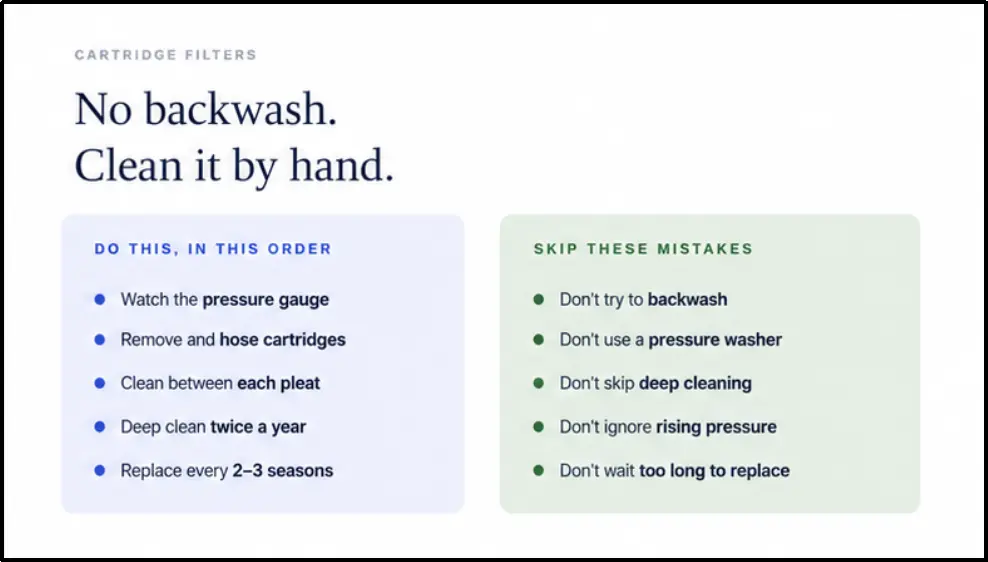
When the pressure climbs 8 to 10 PSI above clean, you shut down the pump, open the housing, and physically remove the cartridges to hose them off.
Use a garden hose with a regular nozzle, not a pressure washer.
- Pressure washers will tear the pleats and create channels that let unfiltered water slip past.
- Spray from the top down, working between each pleat, until the water running off is clear.
- This takes longer than people expect, usually 15 to 20 minutes per cartridge if you’re being thorough.
- Twice a year, soak them in a cartridge cleaner solution overnight to break down the oils and sunscreen residue that hosing alone won’t remove. This is non-negotiable if you want them to last.
A neglected cartridge starts filtering poorly long before it looks bad. By the time the pleats are visibly grey, you’ve been swimming in water that’s been doing a mediocre job for months.
Cartridges typically last two to three seasons with proper care. Skip the deep cleans, and you’ll be buying new ones every year, which adds up fast on larger systems that use four cartridges at a time.
After Any Backwash or Cleaning
Whatever filter you have, the chemistry shifts the moment you finish.
Sand and DE filters send hundreds of gallons of treated water out the waste line, which means your chlorine, your stabilizer, and your salt (if you have a saltwater system) all just dropped.
Cartridge cleaning displaces less water but still disturbs things.
Test your water before you do anything else. Then refill, and dose based on the new volume — not what you remember adding last time.
For saltwater pools, especially, this is where people get into trouble; adding salt by guesswork after a heavy backwash season is how you end up either corroding equipment or running the generator at full tilt with nothing to convert.
The pool salt calculator takes the math out of it once you’ve tested.
Keeping your filter clean matters, but so does everything happening around it. Aiper robotic pool cleaners help reduce the debris load hitting your filtration system in the first place, which means fewer pressure spikes, cleaner water, and less frequent maintenance.
Get more pool and lawn care guides from Aiper on Google