How to Shock a Pool Properly: Timing, Dosing, and Safety

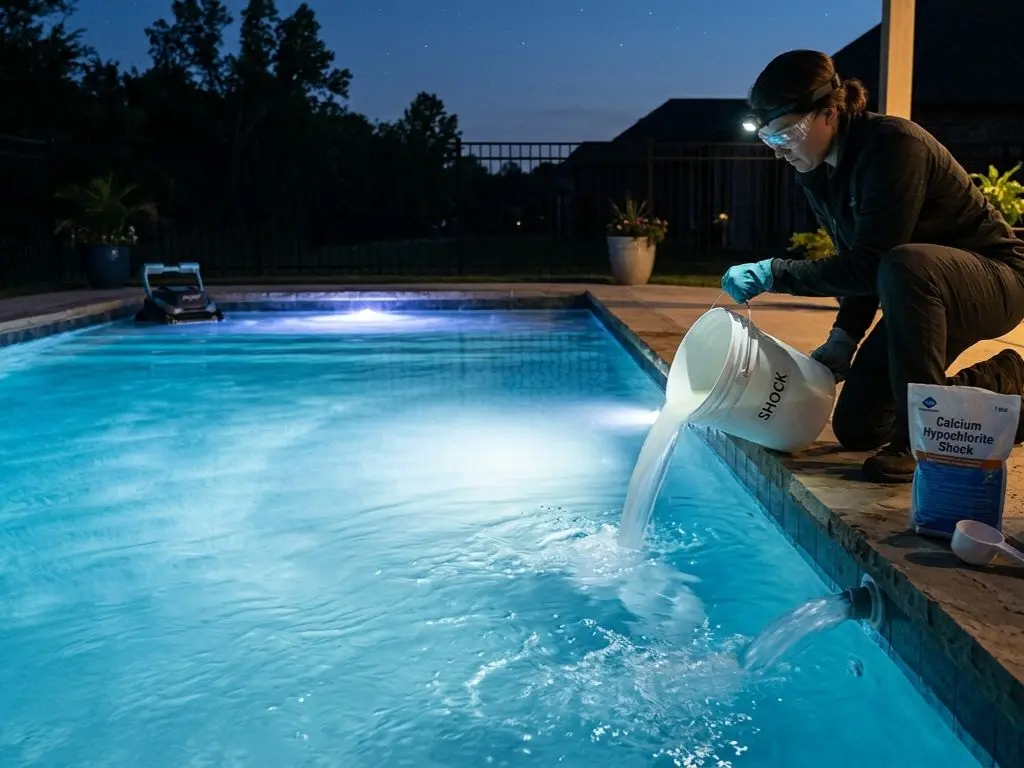
It’s late July. You had people over yesterday, kids in and out all afternoon, a dozen adults in sunscreen and sweat.
This morning, the water’s hazy, and there’s that sharp smell everyone blames on too much chlorine.
That smell isn’t from excess chlorine. It’s from chloramines, what forms when chlorine bonds with sweat and body oils and gets used up. Your sanitizer is gone. The water looks treated. It isn’t.
That’s the moment most people finally shock their pool — between shocks, some owners keep costs down with the BBB pool method and its three-ingredient routine. But by then you’re already behind. For regular chlorination between shocks, liquid pool chlorine versus household bleach compares the two liquid options dose for dose — and a look at what separates bromine from chlorine in pools covers the sanitizer decision too, while why pool shock differs from everyday chlorine dosing rounds out the comparison.
When You Actually Need to Shock
The party scenario above is obvious. What people miss are the quieter triggers.
- Heavy rainfall is one, a big storm dilutes your chemistry and pushes runoff contaminants straight into the water.
- A week of 95°F heat with heavy use.
- The morning after the Fourth of July.
- Opening day in spring, when algae has had months to establish itself under a cover.
These all warrant a shock, and most of them happen before the water looks wrong.
During swimming season, every couple of weeks is a reasonable baseline.
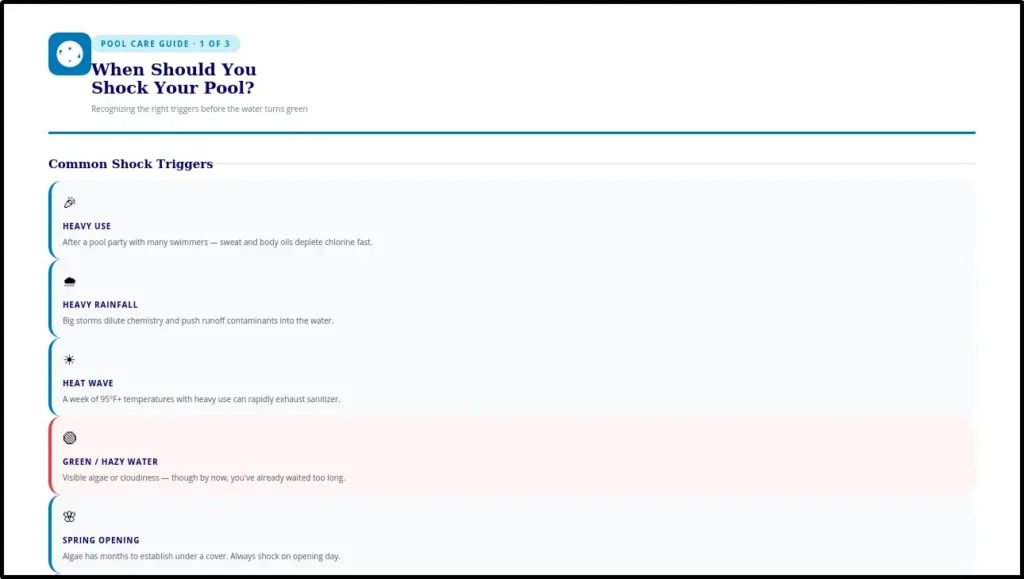
But the calendar shouldn’t be your only signal. When free chlorine drops below 1 ppm, when combined chlorine climbs above 0.5 ppm, when the water clouds up or starts smelling, those are your real triggers.
Don’t wait for green water. Green water means you have already waited too long.
The One Timing Rule That Actually Matters
Do it at night. This is the difference between a treatment that works and one that half-works.
Calcium hypochlorite, the most common granular shock, is unstabilized.
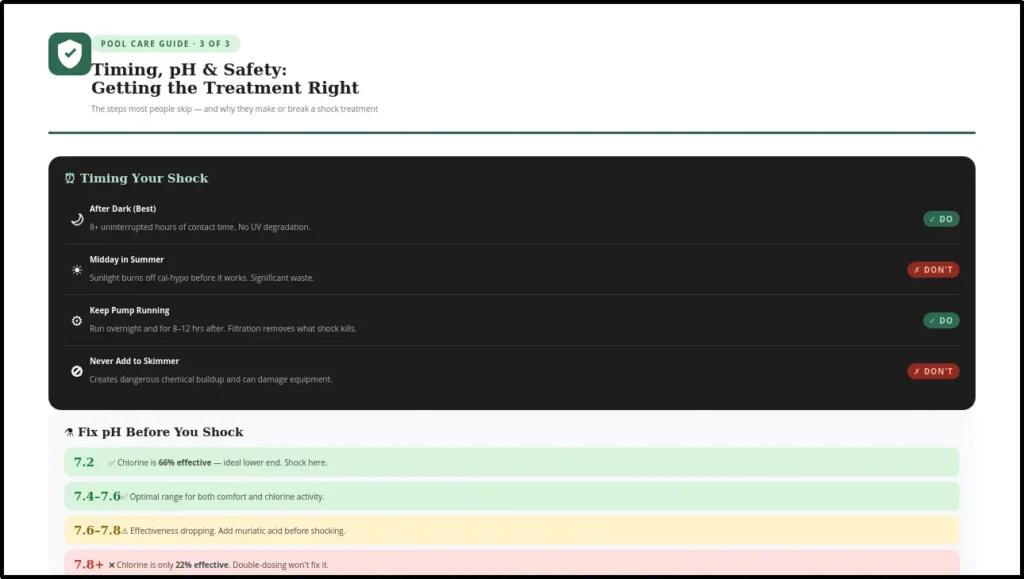
It has no UV protection built in. Sunlight degrades it fast. Shock at 2 pm on a clear August day, and a significant portion burns off before it does anything useful. Wait until after dark, keep the pump running overnight, and by morning, it’s had eight uninterrupted hours of contact time.
Sort Your pH Out First
This is the step that causes the most failed shock treatments and the most skipped.
At pH 7.8, chlorine is only 22% effective.
At 7.2, it’s 66%.
That’s not a minor difference. You can add double the recommended dose into a pool sitting at 7.9 and still wake up to cloudy water, then assume the shock didn’t work, when the pH was the actual problem the whole time. Understanding the foundational difference between pool Alkalinity and pH is key to keeping these elements balanced.
Test first. Get pH to 7.2–7.6. If your parameters are off, you may need to lower pool pH or raise pool pH using the appropriate chemical adjustments before you open a single bag of shock. Likewise, checking your total alkalinity is a crucial prerequisite; if it’s too high, you must take steps to lower pool Alkalinity to keep your pH from constantly fluctuating.
To get exact baseline readings and chemical recommendations before dosing, you can easily calculate pool pH and calculate pool Alkalinity using specialized online diagnostic tools.
Then skim, brush the walls, and vacuum the floor. Shock treats what it reaches.
Dosing And Why Green Water Changes Everything
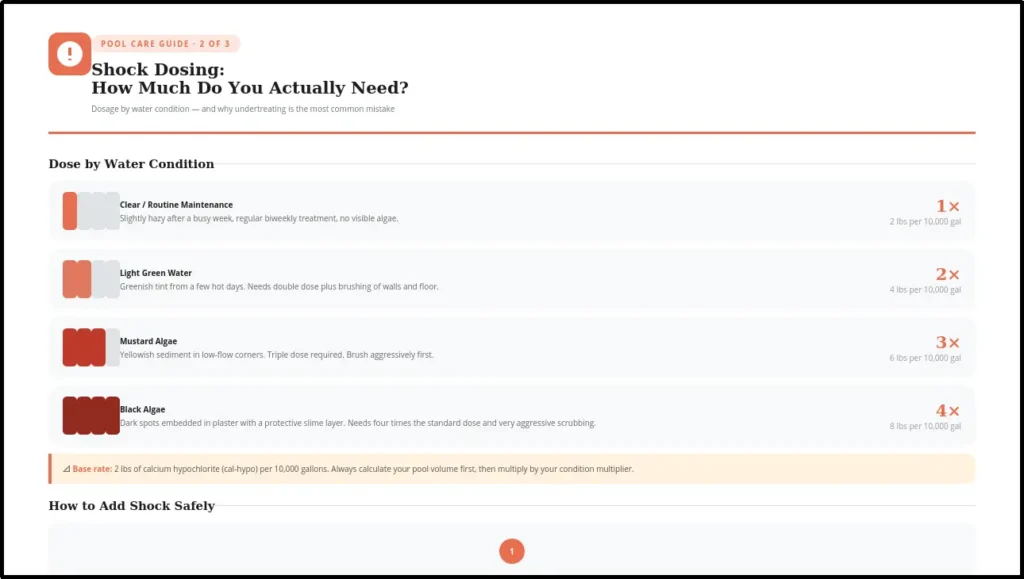
Two pounds of cal-hypo per 10,000 gallons is your starting point for normal conditions. Routine maintenance, slightly hazy water after a busy week, that’s your number.
Before adding any chemicals, make sure you accurately calculate pool gallons so you don’t accidentally under-dose or over-treat your water.
Green water is a completely different problem.
- Light green from a few hot days needs double the dose plus brushing.
- Mustard algae, which is that yellowish sediment collecting in low-flow corners, needs triple, and removing mustard algae completely from your pool means holding that level for days.
- Black algae, the dark spots embedded in plaster with a protective slime layer, needs four times the standard dose and aggressive scrubbing.
Undertreating algae is one of the most common mistakes people make — including getting the order wrong when you’re adding algaecide and shock to the pool together. You use half the dose, think you’ve handled it, and three days later it’s back. Dose for what you actually have.
And if the water has been badly neglected, to hit breakpoint chlorination, where chloramine bonds actually shatter, you need to add ten times the current combined chlorine level.
How to add it:
- Dissolve granular shock in a bucket of pool water first.
- Then walk the perimeter slowly and pour it around the edges with the pump already running. Don’t dump it in one spot.
- Don’t add it to the skimmer, that creates dangerous chemical buildup and can damage equipment.
- Run the pump and filter for at least 8–12 hours after.
The shock kills the contaminants. The filtration removes them. You need both working together, not just one.
Prioritize Safety
Here’s what you need to keep in mind:
- Wear goggles and chemical-resistant gloves.
- Always add shock to water, never water to shock, the reaction goes wrong fast if you do it backwards.
- Never mix different shock products, even if they’re both chlorine-based. Never add shock directly into a chlorinator, and when the season ends, follow our guide to winterizing a saltwater pool without damaging the cell before the first freeze.
- Keep kids and pets away while you’re working. Don’t lean over the bucket while stirring.
- With chlorine-based shock, wait 8–24 hours before anyone swims. Non-chlorine oxidizing shock allows re-entry in 15–30 minutes.
Either way, test before people get in. Free chlorine needs to be back below 4 ppm. That number matters more than whatever the clock says.
What to Do This Week
Test free chlorine, combined chlorine, and pH. If combined chlorine is above 0.5 ppm, free chlorine is below 1 ppm, or you’ve had a storm or a party in the last few days, plan to shock tonight.
Grab cal-hypo if you don’t have it. Calculate your dose by pool volume, dissolve it in a bucket after dark with the pump running, and pour it around the perimeter. Test again in the morning.
Most pool problems don’t start with one bad day. They build from weeks of small imbalances nobody caught early enough.
If you’re spending more time reacting to cloudy water, algae, and chemical swings than actually enjoying the pool, it’s usually a sign that the maintenance routine is becoming too manual.
Keeping debris under control before it breaks down in the water makes shocking less frequent and chemistry easier to stabilise. Tools from Aiper can help automate a lot of that day-to-day cleaning work, especially during heavy swimming season when pools get overwhelmed faster than most people expect.
Get more pool and lawn care guides from Aiper on Google