How to Heat a Pool: Every Option Compared

Most people don’t think about pool heating until the first cold snap. That’s April up north, or September if you’re in the southern hemisphere.
The water drops to 62°F (17°C), and suddenly the question becomes urgent. What’s the cheapest way to make this thing usable for more of the year?
There’s no single right answer. The best heater for a small spa in Phoenix is a terrible choice for a 30,000-gallon inground pool in Pennsylvania.
Here’s the honest version of every option. What each costs to run, how fast it works, and where it falls apart.
Quick Answer: How to Heat a Pool Without Wasting Money
- Cheapest way: a solar cover. $50–300, and it pays for itself in under a month.
- Fastest way: a gas heater. Heats in hours, but $300–500 a month to run.
- Best for most people: a heat pump plus a solar cover — about $4,000–6,000 up front and ~$120 a month.
- DIY option that actually works: a black-hose solar coil — +4–8°F (2–4°C) a day on a small or above-ground pool, for $30–125.
The Math: How Much Heat Does Your Pool Actually Need?
Before you spend a dollar, know what you’re moving: heat, measured in BTUs. One BTU raises one pound of water by 1°F.
A gallon of water weighs 8.33 pounds. So every gallon needs 8.33 BTUs to warm up one degree.
A 20,000-gallon (75,700-liter) pool raised 10°F (5.5°C) needs about 1.67 million BTUs. That’s the target, no matter which heater you buy.
- Gas heater (250,000 BTU/hr): about 8 hours on paper. In practice, 12–24 hours.
- Heat pump (~120,000 BTU/hr): about 14 hours on paper. In practice, 24–48 hours — a heat pump alone won’t give you a warm pool overnight.
- Solar panel (80 sq ft / 7.4 m²): roughly 64,000–80,000 BTUs on a full sun day. About 3°F (1.7°C) on a big pool, closer to 7°F (4°C) on a 10,000-gallon above-ground pool.
This is also why evaporation matters more than the heater. An uncovered pool loses 70–80% of its heat to evaporation.
A solar cover blocks roughly 95% of that evaporation. It’s the highest-return thing you can buy.
If you want proof this holds up in real life: a 120-volt heat pump on an 8,500-gallon (32,200-liter) pool lifted it from 59°F (15°C) to 73°F (23°C) in 28 hours. That’s about 35,000 BTUs per hour delivered — right in line with the numbers above.
Three-Year Cost: The Table That Changes Most Decisions
| Method | Up-front | Monthly | Speed | 3-yr total | Best for |
|---|---|---|---|---|---|
| Solar cover | $50–300 | $0 | +10–15°F (5.5–8°C) / season | ~$150 | Everyone — buy this first |
| DIY black hose | $30–125 | ~$0 | +4–8°F (2–4°C) / day (small pool) | ~$125 | Small / above-ground |
| Solar panels | $2,000–7,000 | $0 | +3–7°F (1.7–4°C) / day | $2k–7k (pays back 2–7 yrs) | Sunny climates |
| Heat pump | $2,500–5,000 | ~$120 | 24–48h per 10°F (5.5°C) | ~$6,800 | Regular residential |
| Gas | $1,500–4,000 | $300–500 | 12–24h per 10°F (5.5°C) | $9,000+ | Fast heat / winter |
Notice the gas heater. It looks cheapest up front, and it’s the most expensive by year three.
Costs are in USD and approximate; they shift with regional energy prices.
Gas Heaters
Gas heaters are the workhorses. Natural gas or propane, a burner, a heat exchanger, and water heat up quickly.
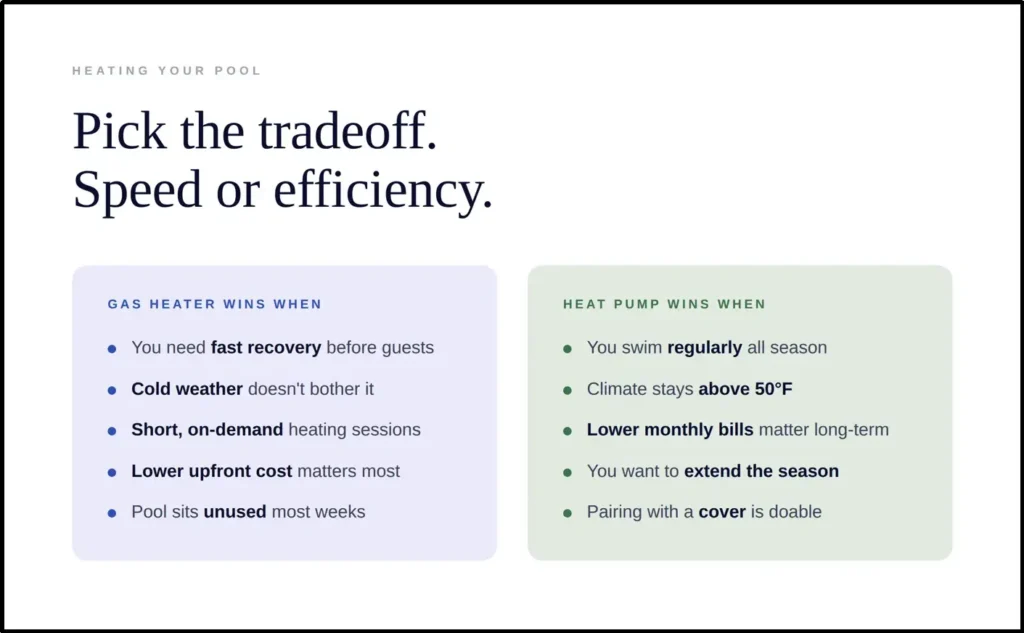
If you need to take the pool from 65°F to 85°F before guests show up on Saturday, this is the only category that can do it without planning days ahead.
The upfront cost is reasonable, usually $1,500 to $4,000 for the unit itself, plus installation.
The running cost is where it stings. Heating a 20,000-gallon pool with natural gas can easily run $300–$500 a month during shoulder season.
With propane, it’s often closer to double that.
What gas does well: speed and indifference to weather. Unlike a heat pump, a gas heater doesn’t care how cold the air gets.
It’ll heat your pool in February if you want it to. That’s mostly a question of whether your wallet can keep up.
Lifespan is the other catch. Most gas heaters last 5–10 years.
Heat exchangers corrode, especially if your water chemistry has been neglected. Plan on replacing one eventually.
Over three years, a $2,000 gas heater running $400 a month in the shoulder season adds up to more than $9,000. Worth remembering when a cheap unit looks like a bargain.
Heat Pumps
Heat pumps are what most people end up with if they’re heating a residential pool for regular use. Climate changes the math, so see heat pump versus gas heater payback by climate for the full comparison.
They pull heat from the air and transfer it to the water — the same principle as a household AC unit running in reverse.
They’re slow, and they’re efficient. They work well in the climates where most people actually swim.
Expect $2,500 to $5,000 for the unit, and roughly a third to a quarter of the running cost of gas.
The catch is temperature. Modern heat pumps work down to around 40°F (4°C), but they lose efficiency fast.
Below 35°F (2°C), they’re nearly useless. Older or basic models should be treated as 50°F (10°C) and up.
In a warm climate like Florida or Queensland, this is a non-issue. In a cooler climate like Ohio or the UK, your swim season is what it is — a heat pump extends it by a few weeks, not months.
They’re also slow to recover. If you drop the cover and the water loses 5 degrees overnight, a heat pump might take a full day to bring it back.
That’s why people who use heat pumps run them continuously during the season. They rely on a cover to hold the gains overnight.
Solar Heaters
Solar is the cheapest option to run and the most temperamental to rely on.
Roof-mounted or ground-mounted panels heat water as your pump circulates it. On a sunny day, they work beautifully — provided the jets push water across the pool rather than in circles, which is exactly what setting pool return jet direction and placement walks through.
On a cloudy day, they do nothing.
Upfront cost varies wildly, anywhere from $2,000 for a basic setup to $7,000+ for something properly sized.
Operating cost is essentially zero beyond the pump electricity you’re already paying for. Payback period typically lands somewhere between 2 and 7 years, depending on how much you’d otherwise spend on gas or electric heating.
The honest version: solar is great as a supplement and unreliable as a sole heat source unless you live somewhere with consistent sun and don’t mind the pool being cold the week of the family barbecue.
People who get the most out of solar usually pair it with a cover, which doubles its effective output.
Solar Covers and Liquid Covers
This isn’t technically heating, but it belongs in the conversation because covers do more for pool temperature than most people realize.
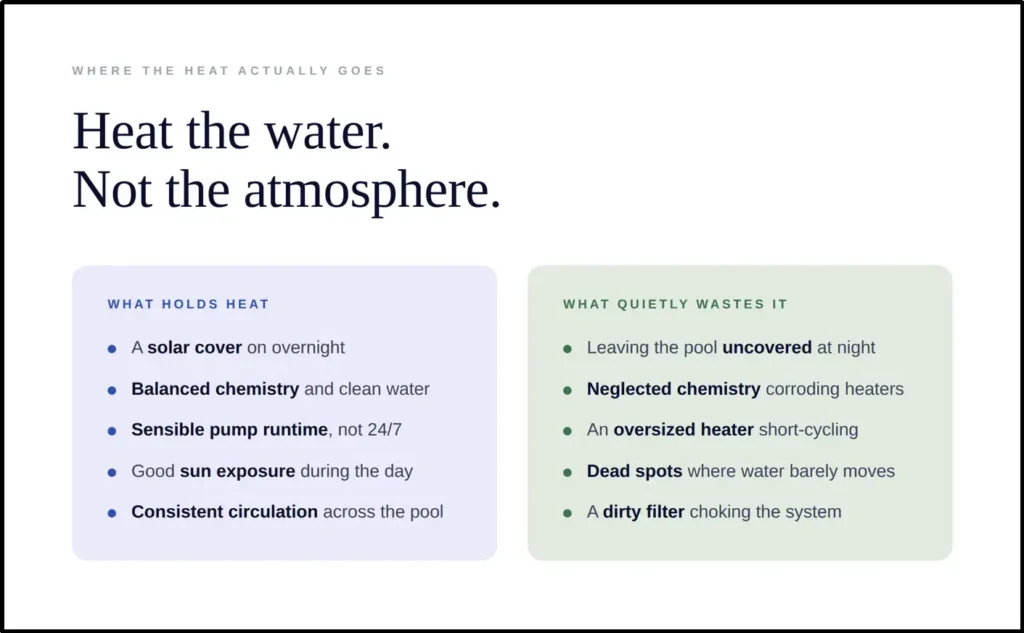
An uncovered pool loses the majority of its heat to evaporation overnight. A solar cover, like a thick bubble-wrap-style sheet that floats on the surface, cuts that loss dramatically.
It also adds 10–15°F (5.5–8°C) of passive heating over the course of a season.
A cover for an average pool costs $50–$300. It’s the highest-ROI thing you can buy for pool heating.
If you’re spending money on gas or electricity to heat your pool without a cover, you’re heating the atmosphere.
Liquid solar covers — the chemical surfactants you pour into the pool — are real, and they work to some extent.
Figure 1–2°F (0.5–1°C) at most — a real effect, but nowhere near enough to cut a gas bill. Better than nothing if you can’t deal with dragging a sheet on and off the water.
Electric Resistance Heaters
These are mostly for spas and very small pools. Heating a full-sized pool with resistance heat is the most expensive option on this list by a wide margin, because electricity is purchased at retail rates and converted directly to heat with no efficiency multiplier.
Skip these for anything larger than a stock-tank pool unless you have a specific reason.
How to Heat a Pool Without a Heater (DIY Methods That Actually Work)
If your budget is tight, you don’t have to buy a heater at all. Here’s what actually works — and the popular advice you should ignore.
The Black-Hose Solar Coil
This is the DIY method pool owners talk about most, and it’s real. Coil 150–500 feet of black irrigation tubing on a sunny roof, deck, or driveway.
Connect it to a small submersible pump, and circulate pool water through it. On a sunny day it adds 4–8°F (2–4°C) to a small or above-ground pool, for $30–125 total.
The one thing nobody online agrees on is flow rate. It’s the difference between a setup that works and one that just looks impressive.
Some say run the water fast. Some say slow it down so it absorbs more heat.
Here’s the truth: what matters is the temperature difference between the tube and the water. Not how hot the water feels coming out.
Run it slow, and the outlet water gets scorching hot. But the tube heats up and radiates that heat right back into the air — you lose more than you gain.
Run it fast enough that the hose never feels hot to the touch. More of the sun’s heat keeps transferring into the water.
Hot water trickling out is a party trick. Warm water flowing fast is a heater.
Two warnings that only come from experience.
- Never let the pump stop while the hose is in the sun. Stagnant water in a hot black hose builds pressure and can burst the tubing — pool owners have watched it happen.
- Skip the black garbage bags. They barely work.
- Don’t shut off your pump to hold in heat. Stopping circulation for days is how you get algae and green water.
Other Low-Cost Moves Worth Doing
- A ready-made solar mat: if you’d rather not build anything, a $20–50 solar mat daisy-chained with a small 12V pump does the same job for under $125.
- A wind break: a fence or hedge around the pool cuts evaporative heat loss on breezy days.
- A darker pool finish: only if you’re resurfacing anyway, but a dark surface absorbs noticeably more sun.
Which Heater Should You Buy?
Here’s the honest recommendation, broken down by your actual situation. Because “it depends” isn’t a useful answer.
- Above-ground or small pool, tight budget: a solar cover first, then a black-hose coil. You can meaningfully warm a small pool for under $150.
- Inground pool, regular use, mild-to-warm climate: a heat pump plus a solar cover — though heating an inground pool changes the math once plumbing and square footage enter the picture. The best balance of up-front cost and monthly bill.
- You need it warm by the weekend, or you swim in a cold climate: gas, ideally natural gas if it’s available at the property. It’s the only thing that heats on demand and doesn’t care about the weather.
- Sunny climate, patient owner: solar panels with a cover. Free to run, but treat it as a slow drift, not a thermostat.
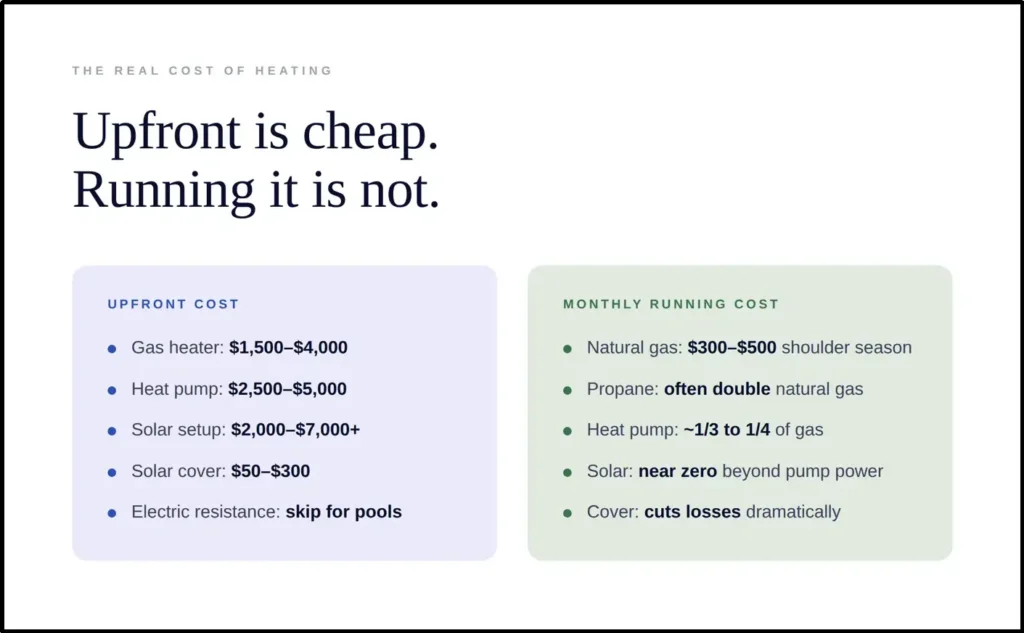
Skim the running-cost numbers, and the up-front numbers don’t matter nearly as much as people assume.
A $2,000 gas heater that costs $400 a month will cost more in three years than a $5,000 heat pump that costs $120 a month. Most heating decisions get made on the wrong axis — up-front cost instead of total cost.
The Heater Matters Less Than Most People Think
Pool heating works better when you stop thinking about the heater as the entire solution.
The heater is only one part of the system. Heat retention matters just as much — even more so when warming an above-ground pool without a big heater, since shallow water sheds heat faster.
Remember the number: an uncovered pool loses 70–80% of its heat to evaporation. That’s why a $60 cover can save you more than a $4,000 heater ever will.
A pool with a good cover, balanced water chemistry, sensible pump runtime, and decent sun exposure holds temperature far more efficiently than one losing heat overnight. That changes operating costs fast.
And in practice, that is where most pool owners either save money or quietly waste it.
Frequently Asked Questions
A solar cover ($50–300). It isn’t a heater in the traditional sense, but it stops evaporation — where most heat goes — so it’s the highest-return purchase. For actively adding heat on a budget, a DIY black-hose coil is the next step up.
Yes — a solar cover plus a black-hose or solar-mat coil will add 4–8°F (2–4°C) a day on a sunny, small pool. No DIY method matches the speed or consistency of a real heater; they’re supplements, not replacements, for a large inground pool.
Figure 24–48 hours to raise a typical pool by 10°F (5.5°C), longer in cool air. Heat pumps are efficient but slow — built to run continuously, not to heat on demand.
78–82°F (26–28°C) for swimming, 82–86°F (28–30°C) for kids or older swimmers, and 78–80°F (26–27°C) for laps. Every degree above 82°F (28°C) meaningfully raises your heating cost.
Only as a last resort — it slows evaporation and might add 1–2°F (0.5–1°C), but it won’t meaningfully cut a gas bill. A physical solar cover does the same job far better.
The good news is that you don’t need to overcomplicate it. Once the whole system works together, most modern heating options perform well for the right climate and usage pattern.
If you want to get the most out of whichever setup you choose, Aiper offers pool maintenance tools and smart cleaning systems. They help keep water circulation, cleanliness, and overall pool performance consistent with far less manual work.
Get more pool and lawn care guides from Aiper on Google