How to Measure Pool Depth

Pool depth is measured vertically from the surface of the water straight down to the pool floor at that point — not from the top of the coping or deck, and not the wall height of an above-ground pool. On a sloped in-ground floor, measure the shallow end and deep end separately, then average the two if you need one number, for example to calculate your pool’s volume in gallons. The full method, including where people usually go wrong, is below.
The most common mistake is measuring from the wrong reference point: using the top of the deck instead of the waterline, or reading an above-ground pool’s printed wall height as if it were the actual water depth. Both give you a number that’s off by several inches before you’ve even started.
What Do You Need to Measure Pool Depth?
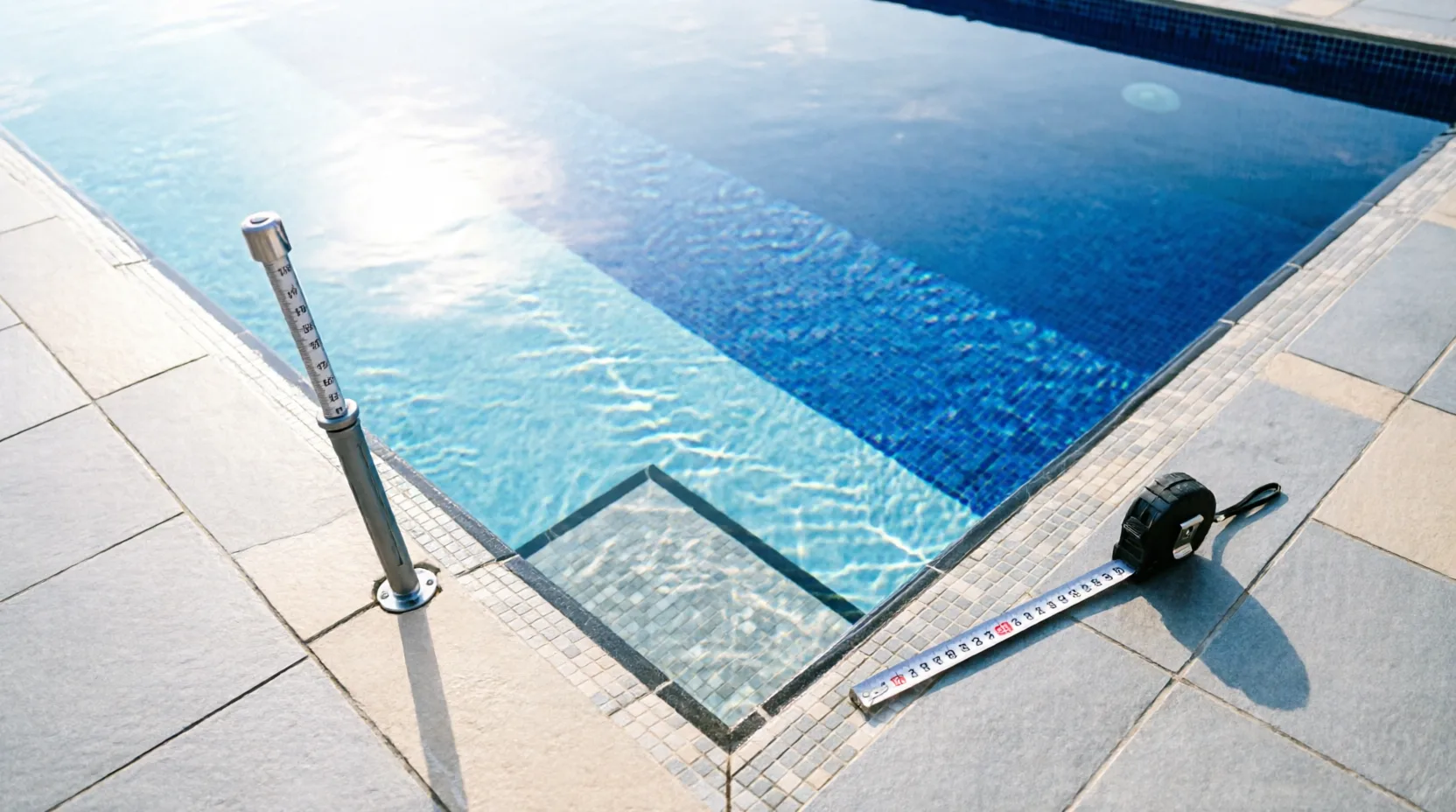
A rigid tape measure or folding carpenter’s rule works for above-ground pools, since a fabric tape sags once it’s wet and gives an inaccurate reading. For in-ground pools where you can’t lower a rigid rule straight down at the deep end, a telescoping pool measuring pole (sometimes called a “piper” or leveling pole) or a weighted string with depth markings does the job. Keep a notepad handy if the floor isn’t a simple two-slope shape, since you’ll want more than two readings.
Where Do You Actually Measure Pool Depth From?
Depth is measured from the surface of the water straight down to the floor directly beneath that point — not from the coping, not from the deck, and not including any freeboard (the dry wall height above the waterline on an above-ground pool). This is also where most confusion comes from: pool owners measuring for a vinyl liner replacement are often asked for the wall height (top of the bead track down to the floor), which is a different number than water depth. If you’re getting quotes or ordering parts, confirm which of the two numbers the supplier actually wants before you hand it over. Depth planning also factors into which shell material makes sense in the first place, a decision our gunite pool versus vinyl liner comparison covers alongside cost and lifespan.
How Do You Measure Depth on a Sloped or Hopper-Bottom Pool?
Find the shallow end and deep end first, then measure straight down at each point rather than estimating from the pool edge. If the pool has a shelf or a distinct break where the slope starts, take a third reading right at that transition — a straight line between shallow and deep end readings can miss a shelf entirely and throw off any volume math built on just two numbers. Built-in steps, benches, and swim-outs are a separate trap: they occupy real depth at whatever level they’re installed, so a reading taken directly over one isn’t representative of the surrounding floor. Take that measurement a foot or two to the side of any built-in feature instead.
| Pool Type | Typical Shallow End | Typical Deep End |
|---|---|---|
| Play/family pool (no diving) | 3 to 3.5 ft | 5 to 6 ft |
| Diving pool | 3 to 3.5 ft | 8 to 9 ft |
| Above-ground pool | Uniform floor, common wall heights 48/52/54 in (water depth runs 4 to 6 in less) | |
These are typical ranges, not a code requirement — always measure your own pool rather than assuming it matches a standard figure.
How Do You Measure Depth on an Above-Ground Pool?
The wall height printed on the box, such as 48, 52, or 54 inches, is not the water depth. Above-ground walls include 4 to 6 inches of freeboard above the waterline, so a 54-inch wall typically holds around 48 inches of water. That gap is mechanical, not cosmetic: skimmers are factory-mounted a few inches below the top edge, and filtration only works properly when the waterline sits at the midpoint of that opening — fill past it and the pool risks overflowing during rain or heavy splash-out, fill below it and the pump starves for water. Measure with a rigid rule straight down from the actual water surface to the liner floor at the center of the pool, since above-ground floors can settle unevenly over a season or two and the true depth can drift from what the wall height suggests.
How Do You Turn Shallow and Deep Readings Into an Average Depth?
For a simple two-slope pool, average depth is just the shallow end reading plus the deep end reading, divided by two. For a pool with a shallow shelf, tanning ledge, or hopper section, a straight two-point average tends to overstate the shallow volume and understate the deep end, so take three or four readings along the slope and average those instead for a more accurate number. Once you have shallow and deep-end figures, plug them directly into the pool volume calculator to get total gallons without doing the geometry by hand.
Do Pool Depth Markers Have to Match Your Actual Measurement?
Most local health and safety codes require depth markers at the shallow end, the deep end, and at the point where the slope changes, and they require those markers to reflect the pool’s actual depth within a small tolerance, commonly plus or minus 3 inches under many US state codes. Liners stretch, sand and gravel bases compact, and floors settle over time, so a marker that was accurate at installation can drift out of tolerance within a few years. It’s worth re-measuring and comparing against your markers periodically, especially on an older pool or one that’s been resurfaced.
Frequently Asked Questions
What is the standard depth of a pool?
Most residential pools built without diving in mind range from about 3 to 3.5 feet at the shallow end to 5 to 6 feet at the deep end. Pools built for diving go deeper, typically 8 feet or more, since diving safety codes require significantly more clearance under a board.
Is a 7-foot-deep pool deep enough to dive into?
Not from a standard diving board. Most manufacturers and local safety codes call for at least 8 to 9 feet of water directly under and in front of a diving board. Seven feet is fine for jumping in from the pool edge, but not for board diving.
How deep is 52 inches in a pool, in feet?
52 inches works out to about 4.33 feet. That’s a common wall height for round and oval above-ground pools, though as covered above, the actual water depth runs 4 to 6 inches shallower than the wall height itself once the skimmer-driven freeboard is accounted for.
Does a 15×30 pool have one standard depth?
No. A 15-by-30 footprint describes surface size only. Depth is a separate design choice that varies by model, anywhere from a uniform 4 feet to a sloped design running from 3 to 8 feet, depending on whether the pool is built for diving.
Accurate depth numbers matter for chemical dosing too, not just volume math, since treatment amounts scale directly with gallons — and volume is step one when heating an above-ground pool with a solar cover. Once your measurements are locked in and your water is balanced, an Aiper robotic pool cleaner keeps the floor and walls clean without you ever needing to take another measurement.
Get more pool and lawn care guides from Aiper on Google