The Complete Lawn Weed Identification and Removal Guide

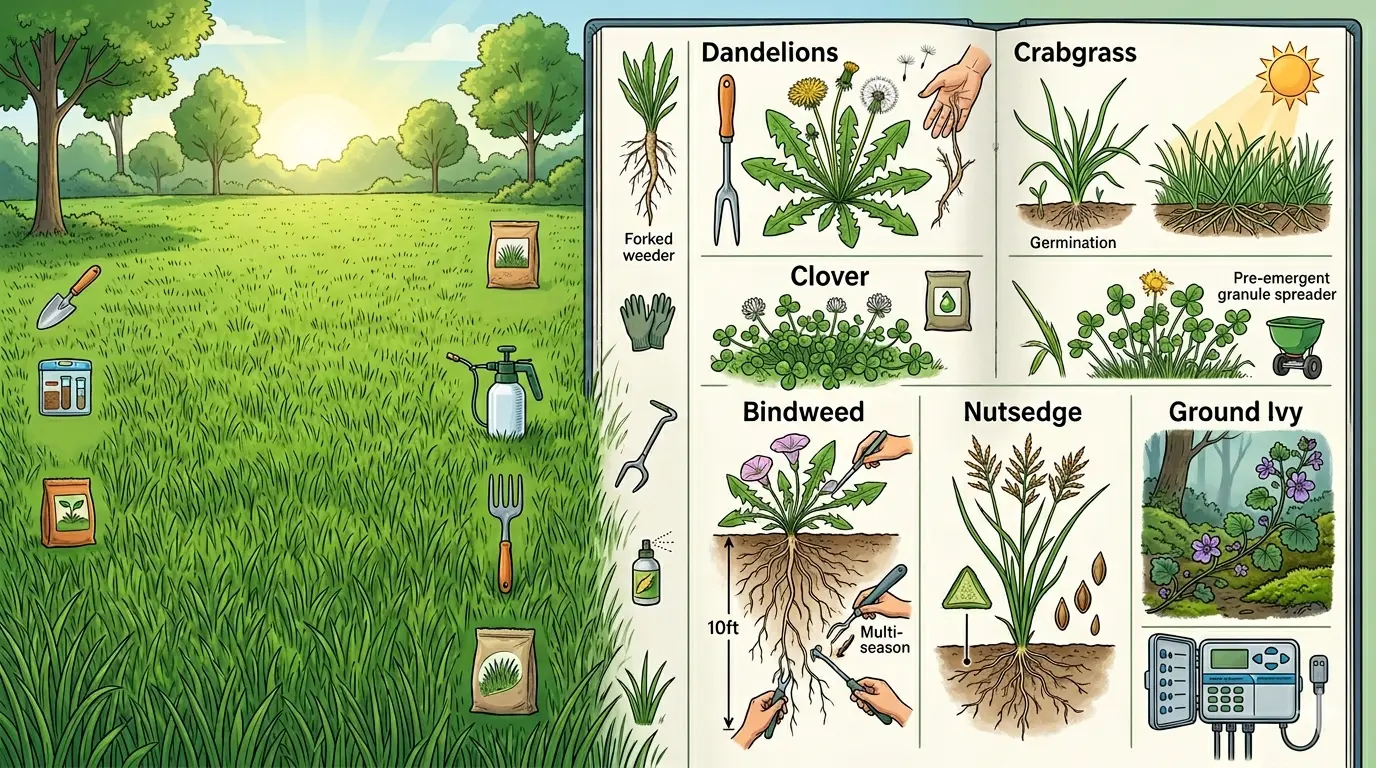
Weeds don’t show up randomly. They show up where there’s thin turf, compacted soil, the patch you always mow too short, or the corner that stays wet. The weed is a symptom. Most people spend years treating symptoms. Johnsongrass follows that same pattern, moving into the weakest part of the lawn first — see our guide to getting rid of johnsongrass in a lawn for how to remove it for good.
Get that right first, and half of this becomes irrelevant.
Dandelions
Everyone knows what they look like in flower. That’s already too late.
Catch the rosette, flat, toothed leaves low to the soil, hollow stem that bleeds white sap, in early spring before the flower stalk goes up.
The taproot is the whole problem. Snap it, and it regrows from whatever’s left. You need a dandelion weeder, the long forked one, used right after rain. Dry ground means a broken root means you’re back here in two weeks.
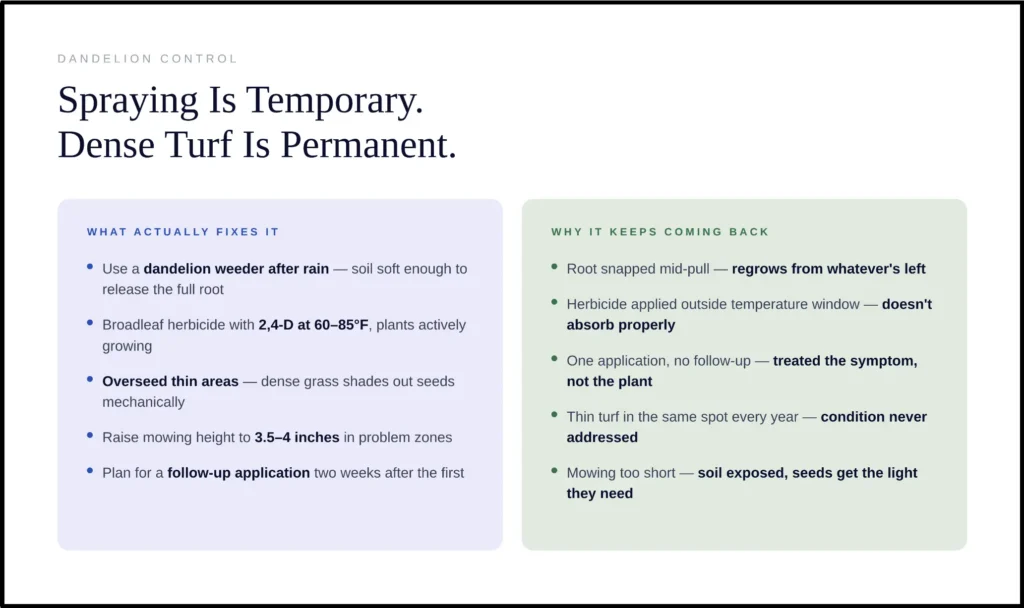
Broadleaf herbicide with 2,4-D works for volume. But the timing has to be right, 60 to 85°F, plants actively growing, otherwise it doesn’t absorb properly.
One application rarely finishes the job. Plan for a follow-up.
If dandelions keep returning in the same spot every year, stop buying herbicide and start overseeding. That area has thin turf. Dense grass physically blocks germination. The herbicide is a temporary fix for a permanent condition.
Crabgrass
The most mismanaged weed in most lawns. People see it in July and try to treat it in July. That’s not how this works.
Crabgrass is a summer annual. It germinates from seed every spring when soil temperature hits around 55°F. Your window is before that point.
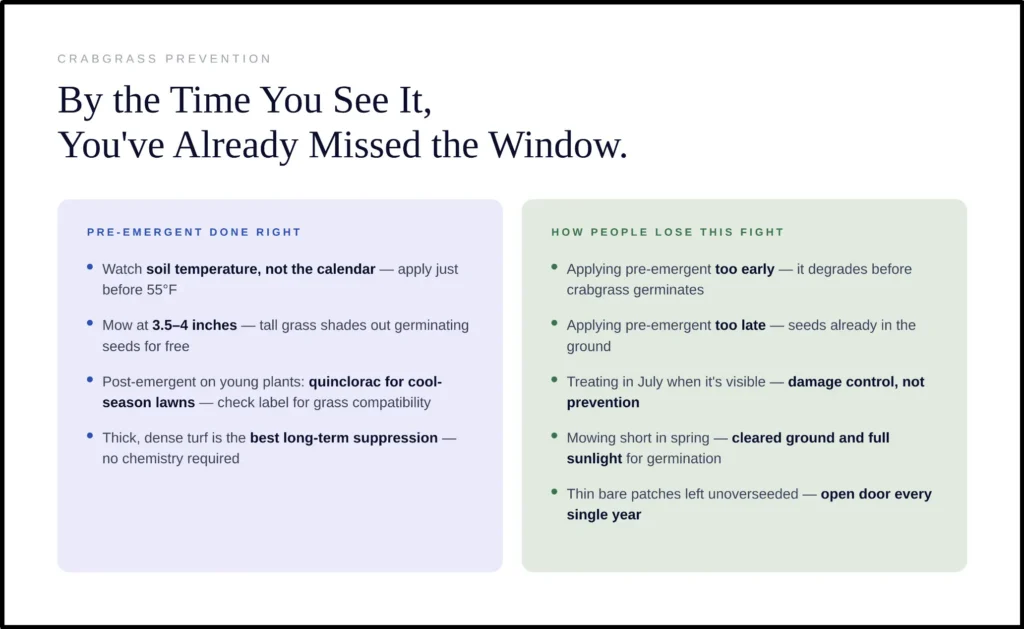
Pre-emergent herbicide applied just ahead of that threshold is the only thing that works at scale, after germination you’re in damage control, not prevention.
- Soil temperature, not calendar date, is what you’re watching
- Too early: the pre-emergent degrades before germination happens
- Too late: seeds are already in the ground, you’re onto post-emergent options, which are weaker and harder on surrounding grass
- Quinclorac handles established plants in cool-season lawns — but check the label, some formulations damage specific grass types
The free prevention that most people ignore: mow at 3.5 to 4 inches. Crabgrass needs light to germinate. A lawn kept at that height shades the soil surface enough to suppress a significant percentage before any chemistry gets involved. Scalped lawns in spring are open ground for it.
Clover
Clover is not really a weed problem. It’s a fertility problem wearing a weed costume.
It fixes nitrogen from the air. It colonizes lawns that are underfed because it can generate what struggling grass can’t. If clover is spreading across a large portion of your lawn, almost certainly you have a nitrogen deficiency. Get a soil test before you buy anything.
Herbicide removes it. Products with clopyralid or MCPP outperform standard 2,4-D on clover specifically.
But spray a well-fertilized lawn, and clover doesn’t come back. Spray an underfed one, and you’ll be spraying again next year.
Bindweed
This is the one that breaks people.
Field bindweed roots go ten feet down. It spreads by seed and by root fragment. every piece you leave in the ground becomes a new plant. The vines climb anything nearby, small white or pink trumpet flowers, and arrowhead leaves. It shows up in thin turf, disturbed soil, and garden edges.
You will not eliminate bindweed in one season. We want to be direct about that because people spend money and effort expecting a result that isn’t coming.
Repeated glyphosate or triclopyr through the growing season, applied every time new growth appears, gradually starves the root system. It takes multiple seasons.
The people who beat bindweed are the ones who treated it consistently for two or three years without declaring victory early. Everyone else has bindweed.
Nutsedge
Most people find out about nutsedge the hard way: they spray it with broadleaf herbicide, nothing happens, they spray it again, still nothing, and they assume their product is bad.
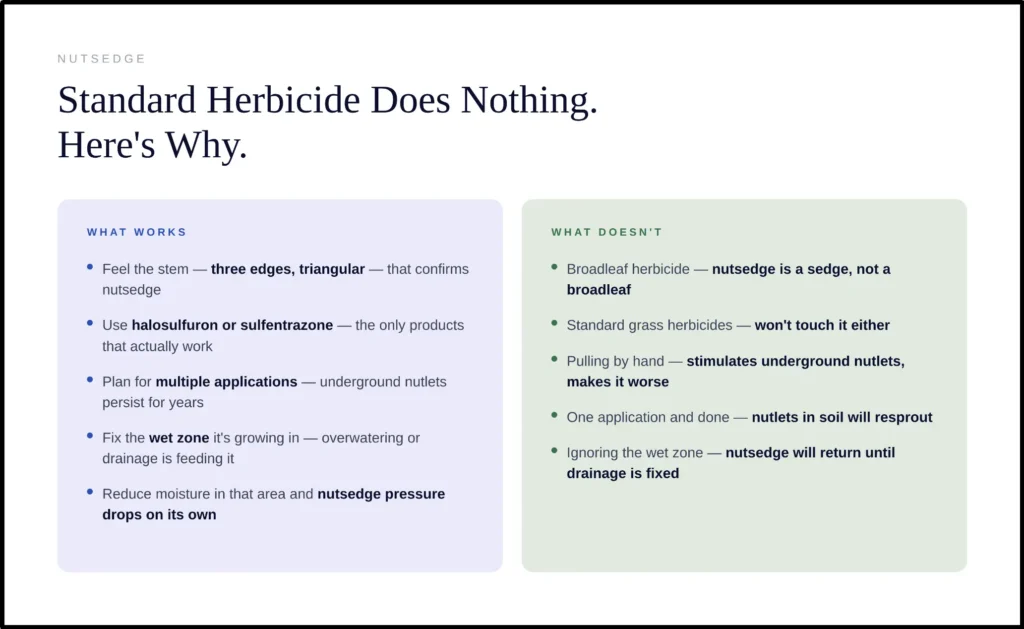
It’s not a broadleaf. It’s a sedge. Standard lawn herbicides don’t work on it. The stem is triangular. Run your fingers along it, and you’ll feel the three edges.
Don’t pull it. Pulling stimulates the underground nutlets and makes the infestation worse.
Halosulfuron or sulfentrazone are what actually work. You’ll need multiple applications. And if nutsedge is concentrated in one part of the lawn, that part is staying wetter than the rest.
Chickweed, Thistle, Ground Ivy
Chickweed is a winter annual. It germinates in the fall and spreads fast in early spring before most people notice it.
If you see weak sprawling stems, small oval leaves, and tiny white star flowers, pull it young when the soil is moist. Let it flower, and you’ve already planted next year’s crop. Pre-emergent in late summer stops it before it starts, which is the smarter play.
Thistles are biennials, and the window to deal with them easily is the first year, when they’re a flat spiny rosette low to the ground. Dig them out or spray them there.
Once the stalk goes up in year two, cut it before it flowers. One plant produces thousands of seeds, and you do not want to learn that lesson firsthand.
Ground ivy is the shaded, damp corner weed. With creeping stems, scalloped leaves, and a faint smell of mint when you crush them. It roots wherever the stems touch soil, which is why it spreads so fast.
Triclopyr works better on it than 2,4-D. Fall applications outperform spring ones. And honestly, if it’s under a tree where grass was never going to thrive anyway, replanting that area with something shade-tolerant is a better use of your time than fighting ground ivy indefinitely. Sometimes the weed is right.
Why Your Weed Problem Doesn’t Go Away
Bare soil gets colonized within weeks. Thin turf almost as fast.
Every weed in this guide exploits a specific weakness: low nitrogen, compaction, shade, moisture, or low mowing height. Treat the weed without fixing the weakness, and you’ll treat the same ground again next season and the season after that.
What we mean by this is:
- Dense grass mowed at the right height blocks weed germination mechanically.
- A lawn fertilized according to actual soil test results,
- Soil aerated when compaction builds.
Spot treat before you broadcast treat. Weed pressure is almost always concentrated in specific zones that reflect specific conditions. Find the zone, fix the condition. Otherwise, you’re managing symptoms forever.
Watering Wrong Creates Half Your Weed Problems
The problem is that most lawns aren’t uniform. A shaded corner needs a fraction of what a south-facing slope needs. Slopes drain before flat sections.
One setting for everything creates overwatered zones and underwatered zones simultaneously, and both conditions feed different weeds.
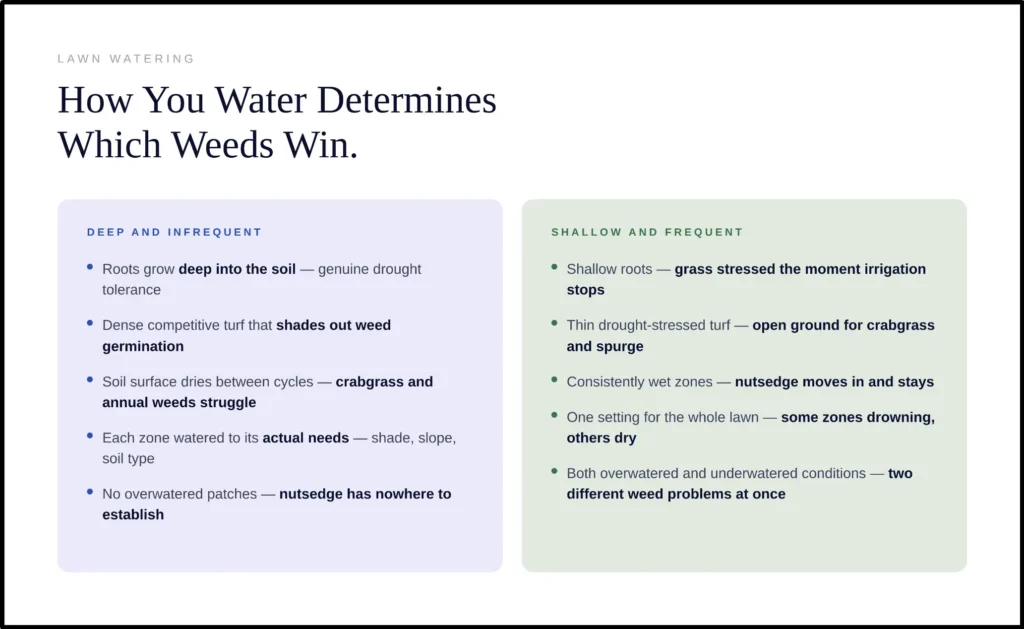
The Aiper IrriSense 2 runs up to 10 independent zones across 4,800 square feet, each on its own schedule. Weather-Sense adjusts automatically, so there’s no watering after rain and no dry patches when the weather shifts.
The nutsedge zone that stays too wet and the crabgrass patch that dries out too fast are usually in the same lawn. Fix the irrigation, and you address both at once.
Get more pool and lawn care guides from Aiper on Google