

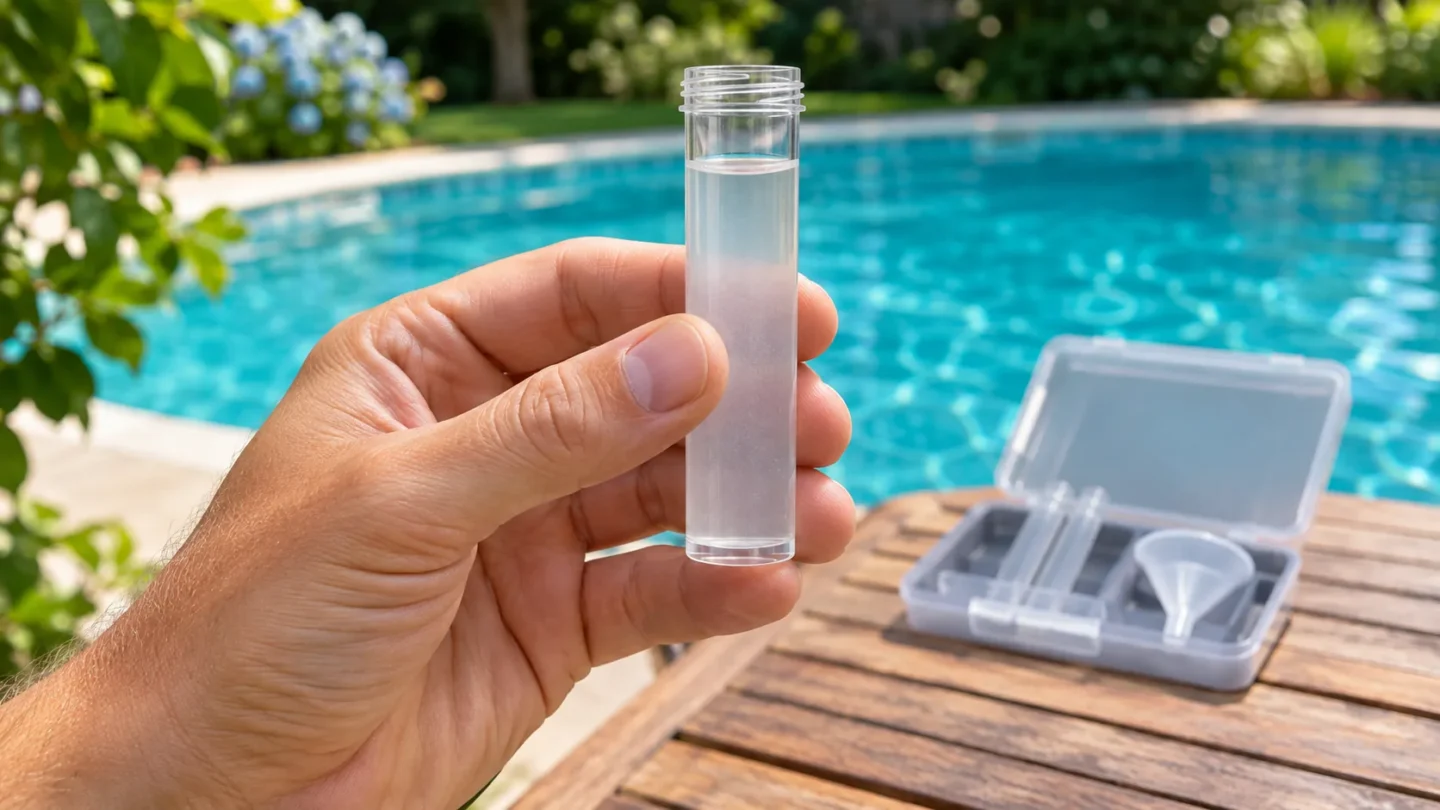
If you use liquid chlorine in an outdoor pool and a water test shows low cyanuric acid (CYA), you can keep using liquid chlorine. Add pool stabilizer separately to bring CYA up to the target for your pool. If the same test also shows free chlorine near zero, address that reading before anyone swims. Stabilizer helps protect chlorine from sunlight, but it supplies no disinfectant.
Should I use pool stabilizer or chlorine tablets to raise CYA?
Look at the active ingredient on the products you already use. It tells you which readings a dose will change.
| What you have | What it adds to the water |
|---|---|
| Pool stabilizer or conditioner sold specifically to raise CYA | Raises CYA on its own. Useful when your usual chlorine routine works and you only need to adjust stabilizer. |
| Stabilized chlorine labeled trichlor or dichlor | Adds both chlorine and CYA. Include any tablets or granular doses you have used recently when deciding whether you need extra stabilizer. |
| Liquid pool chlorine (sodium hypochlorite) | Adds chlorine without adding CYA. You can adjust the two readings independently. |
For example, if free chlorine is already where you want it but CYA is low, a dedicated stabilizer lets you correct that one reading. With stabilized tablets, each dose you add for chlorine also adds more CYA. Check the active ingredient on the package to see which type you have.
How do I know how much my CYA level needs to rise?
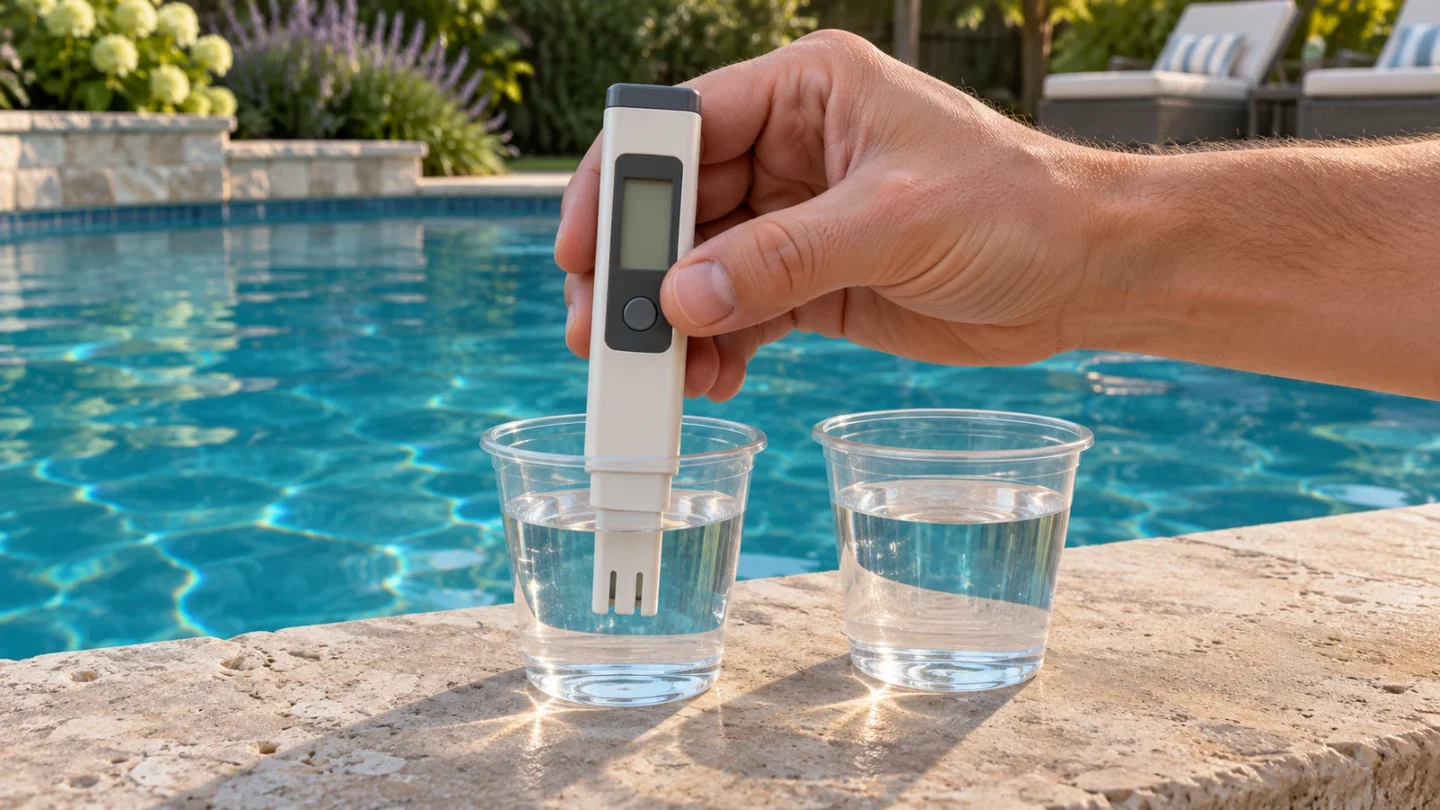
Write down your CYA test result in parts per million (ppm), the date, and when you last added stabilizer. If the kit’s lowest mark is 30 ppm and your result falls below it, record “below 30.” That could mean 20 ppm or it could mean considerably less. Before calculating a full dose, confirm the starting level with a test that can measure the lower range or have a water sample tested.
Next, find the target specified for your pool. If you have a saltwater chlorine generator, check the guidance for that model. Once you have a reliable reading and a target, subtract the current reading from the target to get the rise you need. If you are already above target, see the guide to lowering CYA.
How much stabilizer should I add to my pool?
Suppose your pool holds 10,000 US gallons, your test reads 20 ppm, and you have confirmed that 40 ppm is an appropriate target for your system. Here is how those numbers translate into a dose.
- In the pool stabilizer calculator, select US gallons and enter 10,000 for pool volume, 20 for current level, and 40 for target level.
- On a product label with a table headed “desired increase,” use the 20 ppm increase and the 10,000-gallon pool size. For example, Robelle’s granular stabilizer chart lists 1 lb 10 oz by weight for that combination.
- Match the estimate to the product in your hand. A scale measures a dry dose in ounces by weight; a liquid label may give fluid ounces by volume. For a liquid conditioner, use the dose and concentration on that bottle.
The example target and dry weight belong to this example. For your own pool, use your measured starting level, pool volume, and product label.
How do I add the stabilizer I bought?
The CDC advises home pool owners to follow the directions on each chemical label. Before measuring your dose, check where to add the stabilizer, how long to circulate the water, and when to test again. Keep the label handy at the pool and keep different pool chemicals separate.
Write down how much stabilizer you added and when. If the label gives a circulation time, use it to plan how long to run the pump. Look for a separate instruction about when to take your next water sample. If the label gives no retest interval, check with the manufacturer before deciding on a second dose.
When should I retest, and what if my CYA is still low?
If you added stabilizer yesterday and the product calls for a later test, wait until that interval has passed before deciding on another dose. While you wait for the stabilizer to disperse, keep testing free chlorine and pH as the CDC recommends for home pools.
If CYA is still low at the scheduled retest, check the test-kit procedure, the pool volume and units you entered, and the amount you actually added. Also note any water you drained and replaced between tests. Once you confirm the new reading, calculate only the remaining increase. In the example above, a retest of 35 ppm leaves a gap of just 5 ppm to the 40 ppm target. Once the target is reached, stop adding stabilizer.
Get more pool and lawn care guides from Aiper on Google