Cyanuric Acid Explained: The Sunscreen for Your Chlorine

Here’s a number that surprises most pool owners: on a bright summer day, unstabilized chlorine in direct sunlight loses about half its strength every 45 minutes or so.
Dose a pool to 3 ppm in the morning, and by mid-afternoon there’s functionally nothing left. The sun didn’t kill your algae problem’s food supply. It killed the chlorine.
Cyanuric acid is the fix. It bonds loosely with chlorine in the water and shields it from UV degradation. Same chlorine dose, and instead of vanishing by 3 p.m., it lasts days. That’s the entire job. Sunscreen for your chlorine.
Simple story so far. The complications are where pools actually get in trouble.
The Trade-Off Nobody Mentions at the Pool Store
CYA protects chlorine by binding to it.
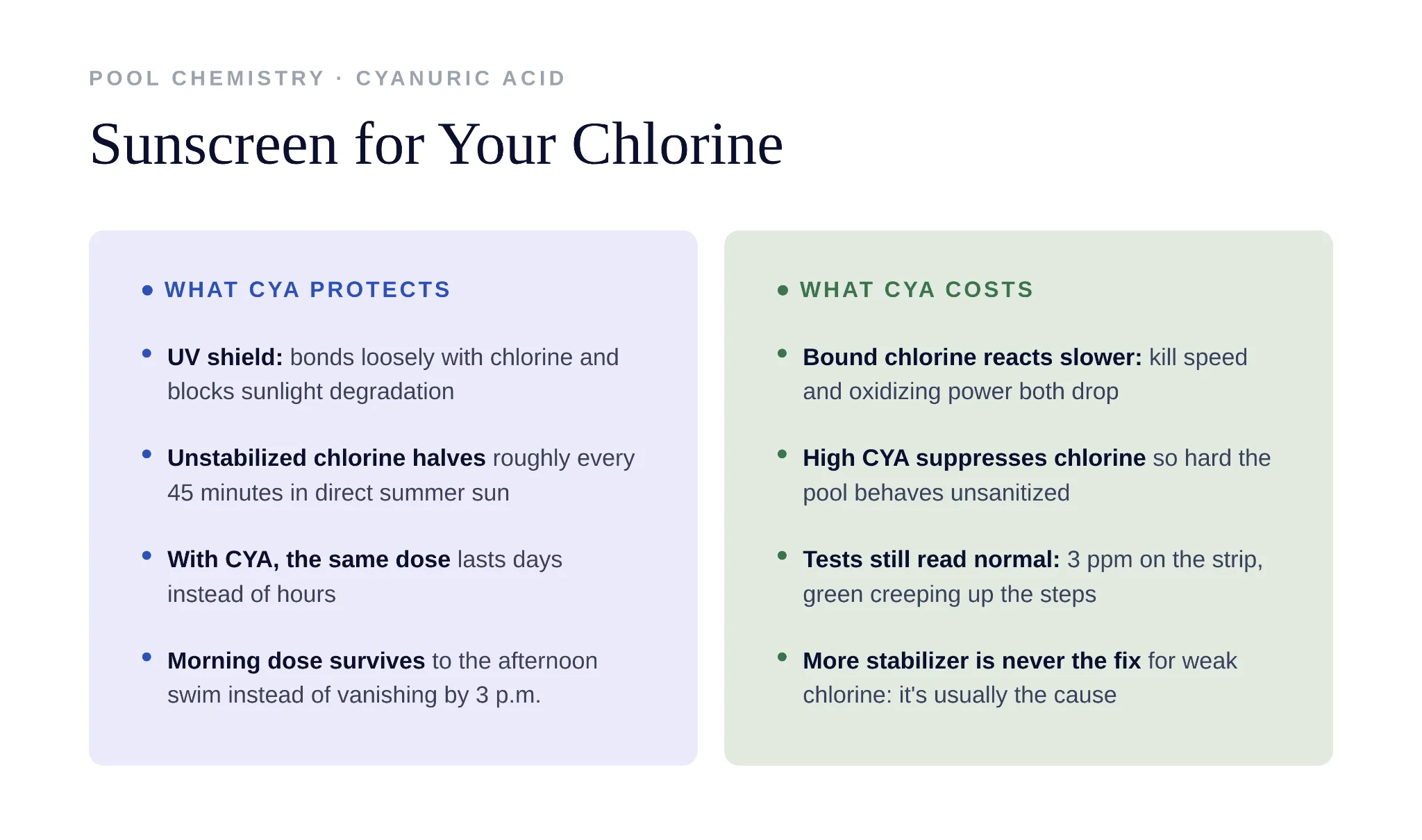
But chlorine bound to CYA is chlorine that’s slower to react, slower to kill algae, slower to oxidize contaminants, slower at everything you keep chlorine around to do.
At sensible levels, that trade is a bargain. You give up a little kill speed and gain enormous longevity.
At high levels, the trade inverts. The water can test at 3 ppm free chlorine while the chlorine that’s actually available to sanitize is a fraction of that. The test strip says you’re fine. The green tint creeping up the steps says otherwise.
People call this chlorine lock. Chemists will tell you the chlorine isn’t “locked,” just heavily suppressed, and they’re right, but the practical result is the same: a pool that reads normal and behaves like it has no sanitizer.
This is why more stabilizer is never the answer to weak chlorine performance. It’s usually the cause.
The Numbers
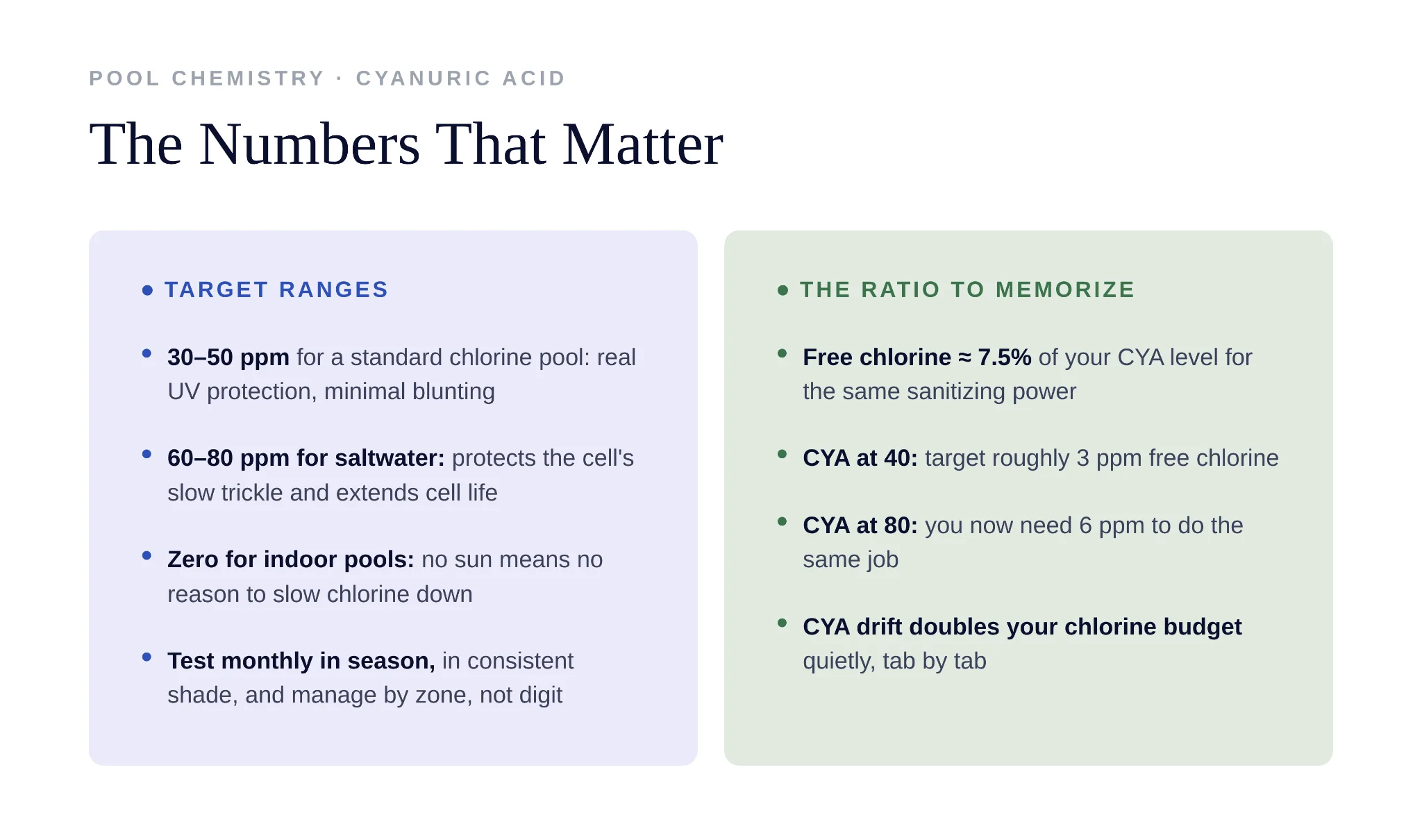
For a standard chlorine pool: 30 to 50 ppm CYA. That’s the range where you get real UV protection without meaningfully blunting the chlorine.
Saltwater pools run higher, 60 to 80 ppm, because salt cells produce chlorine slowly and steadily and the extra shielding protects that trickle from burning off as fast as it’s generated.
Most cell manufacturers specify this range; running below it makes the cell work harder and shortens its life.
Indoor pools: zero. No sun, no UV loss, no reason to slow your chlorine down at all.
And the number that ties it together, the one worth actually memorizing, is the ratio.
Free chlorine should sit around 7.5 percent of your CYA level. CYA at 40? Target roughly 3 ppm FC. CYA at 80? You now need 6 ppm FC to get the same sanitizing power, which is exactly why letting CYA drift upward quietly doubles your chlorine budget.
How CYA Sneaks Up on You
Almost nobody over-stabilizes a pool by dumping in too much stabilizer. It happens through the tabs.
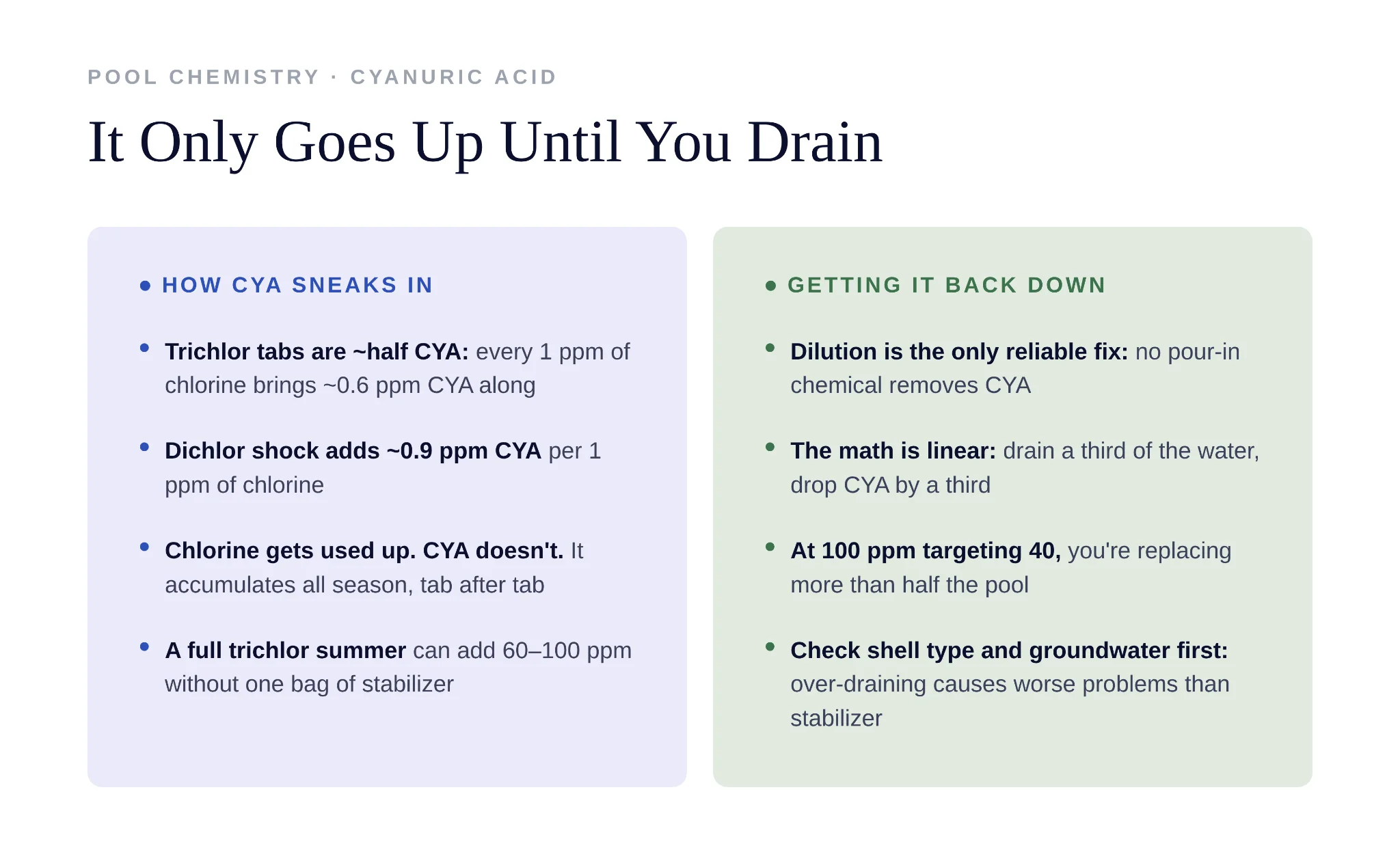
Trichlor pucks, the standard 3-inch tablets in every floater and inline chlorinator, are roughly half cyanuric acid by weight. Every 1 ppm of free chlorine they add brings about 0.6 ppm of CYA along with it. Dichlor granular shock does nearly the same thing, about 0.9 ppm CYA per 1 ppm FC.
Chlorine gets used up. CYA doesn’t. It just accumulates, week after week, tab after tab. A pool running on trichlor all season can add 60, 80, 100 ppm of CYA in a single summer without the owner touching a bag of stabilizer once.
By August, the chlorine stops working, the owner shocks harder with dichlor, adding more CYA, and the spiral tightens.
If you run tabs as your primary chlorine source, test CYA monthly during the season. Not because the tabs are bad, but because they have a rider attached, and the rider compounds.
Liquid chlorine and salt cells add no CYA at all. That’s the main reason experienced pool owners drift toward one or the other over time.
Getting CYA Down: There’s Basically One Way
Nothing removes cyanuric acid from water in any practical, reliable sense. No chemical you pour in, despite what some product labels imply. CYA reducers based on bio-remediation exist, and results are inconsistent enough that most pool professionals don’t bother.
The fix is dilution.
Drain a portion of the pool, refill with fresh water, retest. The math is linear: draining a third of the water drops CYA by roughly a third. At 100 ppm and targeting 40, you’re replacing more than half the pool.
That’s an expensive, tedious fix, which is the whole argument for watching the number before it gets there. If your fill water runs hard as well as high-CYA, that same refill is the moment to deal with it — our guide on softening pool water covers methods that don’t require draining the whole pool again.
Also worth knowing: heavy rain and splash-out dilute CYA slowly all season, and a pool that gets partially drained for winterizing resets somewhat every year. Pools in dry climates with no drainage cycle are the ones that hit 150 ppm and stay there.
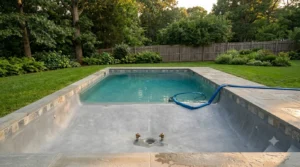
One caution on draining: check your water table and your shell type first. Draining a fiberglass or vinyl pool too far, or any pool with high groundwater, creates problems considerably worse than high stabilizer. The full safe-drain sequence, shell type by shell type, is in our guide to how to drain an inground pool without structural damage.
Testing: Trust It Loosely
The standard CYA test is the turbidity type: mix pool water with melamine reagent, pour it into a tube over a black dot, and note where the dot disappears. It’s genuinely imprecise, plus or minus 10 ppm on a good day, worse in bad light. Strips are rougher still.
That’s fine. CYA is not a chemistry value you manage to the single digit.
You’re checking which zone you’re in: too low (under 30, chlorine burning off), right (30–50), creeping (50–80, start planning), or problem (above that, dilution time). The test is plenty accurate for zone-level decisions.
Test in consistent outdoor shade, at the same time of day, and don’t chase small movements between readings.
Less Work for the Chlorine, Less Drama from the CYA
The reason CYA management matters at all is that chlorine has a workload. UV eats some of it, and CYA handles that. But organic debris eats the rest: leaves, dirt, oils, everything that lands in the water and starts consuming sanitizer.
The heavier that load, the more chlorine you burn, the more tabs you feed, and, if you’re on trichlor, the faster the CYA climbs toward the ceiling.
Cutting the debris load slows the entire cycle down. That’s what Aiper’s robotic pool cleaners are for: the Scuba series scrubs the floor, walls, and waterline on its own schedule and pulls organic material out before it dissolves into chlorine demand.
Get more pool and lawn care guides from Aiper on Google