


What does 1,800 ppm TDS mean on a pool water test? Look for the first TDS reading after you filled the pool and balanced the water. If that reading was 300 ppm, your TDS has risen by 1,500 ppm. If it was 1,200 ppm, the increase is only 600 ppm. In a saltwater pool, the International Code Council includes the salt added at startup in that first reading. Use a sample taken after the salt dissolved and the water had circulated throughout the pool.
What does TDS mean in pool water?
TDS stands for total dissolved solids. Think of a spoonful of salt dissolved in a glass of water. The water looks clear, but it still contains salt. In a pool, TDS includes minerals in the water you used to fill it, salt you added and dissolved substances from pool chemicals. When water evaporates, the salts stay in the pool. Each time you replace the evaporated water, any minerals in the fresh water enter the pool too.
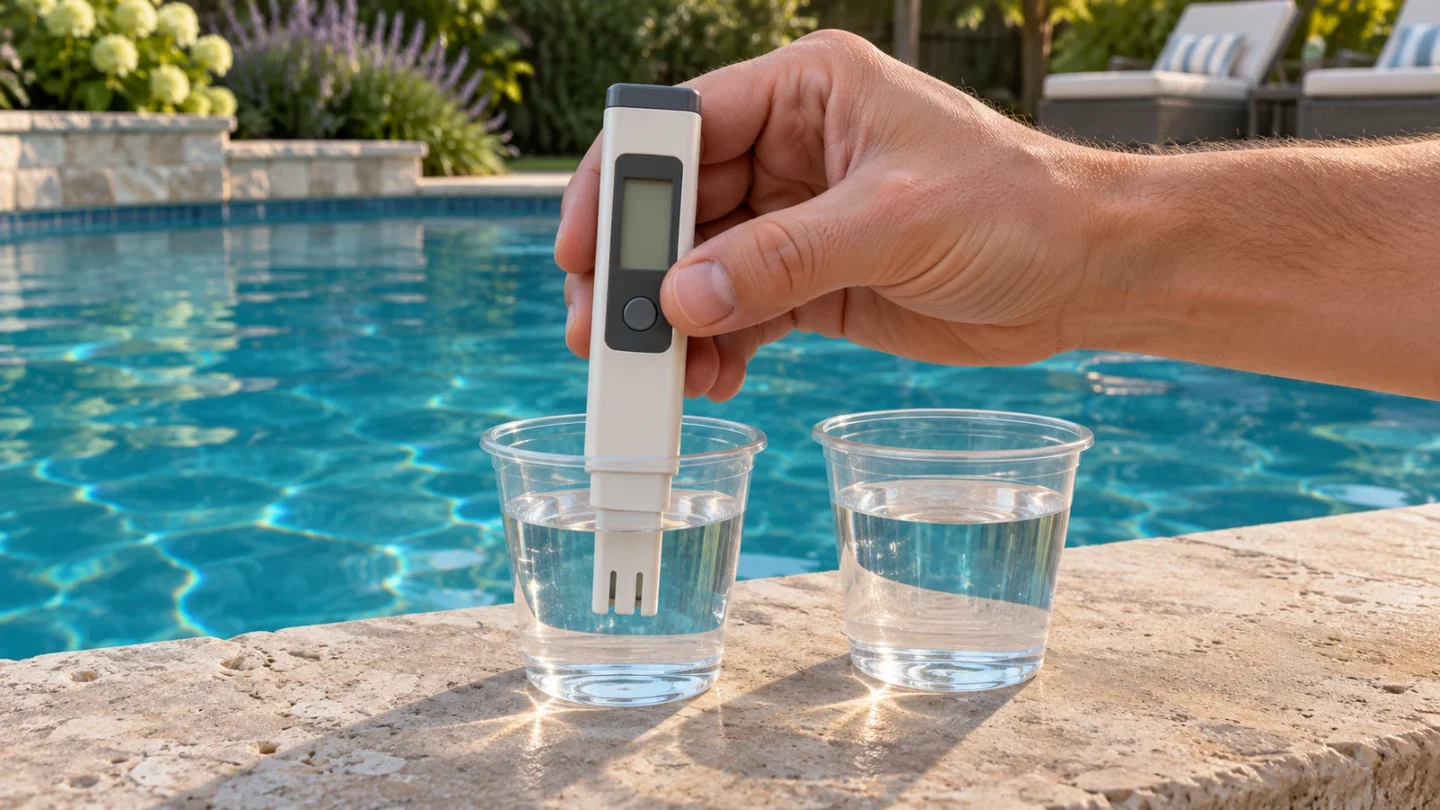
A handheld meter estimates TDS from electrical conductivity. Dissolved ions help the water conduct electricity. The meter measures conductivity and uses a conversion factor to calculate the TDS value on the screen. Two pools with different amounts of calcium and salt can give the same TDS reading. To find out whether your pool has hard water, test calcium hardness. To check the salt level for a chlorine generator, test salinity.
Is 1,800 ppm high for my pool?
The Pool & Hot Tub Alliance guidelines in Taylor’s water quality table give a recommended maximum of 1,500 ppm above the pool’s initial TDS reading. If you tested both the water from the hose and the pool water after balancing it, use the pool water result for this calculation. In a saltwater pool, using the hose water as your starting point would count all the salt you added on the first day as a later increase.
| Pool type | Initial TDS | Current TDS | Increase |
|---|---|---|---|
| Chlorine pool without a salt system | 300 after filling and balancing the pool | 1,800 | 1,800 − 300 = 1,500 |
| Saltwater pool | 3,400 after the added salt dissolved and circulated | 3,800 | 3,800 − 3,400 = 400 |
The chlorine pool in the first example has reached the recommended maximum increase. Test a fresh sample to confirm the result. The saltwater pool has the higher reading, yet its TDS has risen by only 400 ppm. If your chlorine generator displays a low-salt warning, measure salinity and compare it with the operating range in the generator manual before adding salt.
How can I get consistent TDS readings?
- Collect and label the samples. Use one clean cup for pool water and another for water from the source you use to refill the pool. If you recently added salt or pool chemicals, let the water circulate until they are evenly mixed before collecting the pool sample. Record the test date and any recent additions.
- Check the meter settings. Make sure the meter can measure the TDS level you expect, particularly in a saltwater pool. Calibrate it according to its manual. Select TDS mode and use the same conversion factor for both samples. For example, the Hanna HI983124 displays TDS in ppt and lets you adjust the conversion factor. The HI983124 instruction manual tells you to rinse the probe with distilled or deionized water between samples. On this model, the stability symbol disappears when the reading is ready to record.
- Write down the number and the unit. Multiply a reading in ppt by 1,000 to convert it to ppm. If the screen shows µS/cm or mS/cm, the meter is displaying conductivity. Switch to TDS mode before comparing the result with your pool test report. If you replace your meter and notice a sudden change, test the same sample with both meters. Check that they use the same units and conversion factor.
A short note is enough for your pool log. For example, “June 4. Pool water measured 1.80 ppt (1,800 ppm) on meter A in TDS mode. Added fresh water on June 3.” Record the result for water from the hose on a separate line.
What if I don’t have the initial TDS reading?
If you recently bought a home with a pool, ask the previous owner or the company that maintained it for the water test from the last time the pool was completely refilled and balanced. For a saltwater pool, check when the sample was taken. A sample taken before salt was added will give a different starting value from one taken after the salt dissolved and circulated.
If the only result you have is today’s 1,800 ppm, you can’t calculate how much TDS has risen since the pool was filled. You can still test the water you currently use to refill the pool and record that value separately. Use today’s pool water result as the starting point for future comparisons.
What should I check after a high reading?
If TDS rose sharply since the last test, check whether you changed meters, recorded the result in different units or recently added salt. Test a fresh sample with the same meter and settings. If the repeat test confirms that your TDS is at least 1,500 ppm above its initial value, give your pool service company the initial reading, the current reading and the TDS of your refill water. Those figures will help you discuss ways to reduce the buildup.
If you see white scale on the pool walls, measure calcium hardness, pH, alkalinity and water temperature. Enter these values and the TDS reading in the pool saturation index calculator to estimate how likely calcium carbonate is to form scale. If the hardness test shows high calcium, the guide to lowering calcium hardness explains the options.
If you want to check disinfection before a swim, the CDC recommends that home pool owners test free chlorine and pH. A TDS reading alone cannot tell you whether the pool has enough free chlorine.
Get more pool and lawn care guides from Aiper on Google