How to Soften Pool Water: 5 Methods That Actually Work

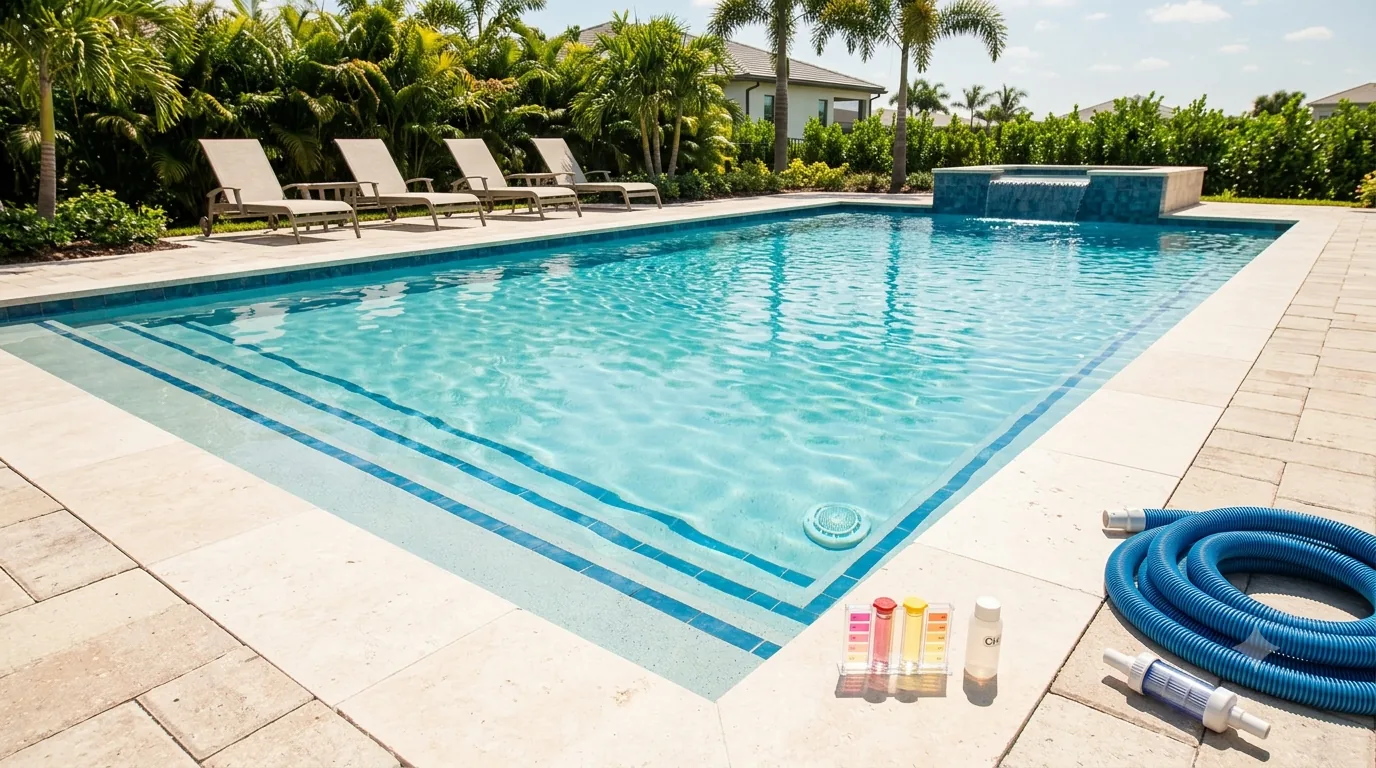
Hard water turning your pool into a rough, cloudy mess? Here are five proven ways to soften it — from a simple 30-minute fix to professional-grade solutions.
The most reliable way to soften pool water is to physically reduce the concentration of dissolved minerals — primarily calcium and magnesium. Here is the 3-step framework:
- Test your water. Use a liquid titration kit to measure calcium hardness (CH). Then test your tap/source water too — it must be softer than your pool water for dilution to work.
- Partially drain and refill. Replace 20–50% of your pool water with fresh, softer water. Never drain completely — the water weight supports your pool structure.
- Circulate and rebalance. Run the pump for 8–12 hours, then retest and adjust all chemistry levels, including pH and total alkalinity.
Need more options? Below we cover all five methods — including a no-drain chemical precipitation technique and professional RO filtration.
What Makes Pool Water “Hard”?
Hard water contains high concentrations of dissolved minerals — primarily calcium (Ca²⁺) and magnesium (Mg²⁺). These minerals enter your pool through three main pathways:
1. Source water. If your tap or well water is naturally hard, every top-off adds more minerals. Regions like the Southwest, Midwest, and Texas are especially prone.
2. Evaporation. When water evaporates, pure H₂O leaves — but the minerals stay behind. Over weeks and months, calcium becomes more and more concentrated.
3. Calcium-based chemicals. Cal-Hypo (calcium hypochlorite) shock adds a small dose of calcium with each application. Over a full season, this accumulates significantly.
Signs Your Pool Water Is Too Hard
Calcium hardness above 400 ppm typically triggers visible symptoms: Left unaddressed, that hardness can crystallize into calcium silicate scale on pool surfaces, which needs a different removal approach than a sequestrant — our guide to removing calcium silicate scale from a pool covers it.
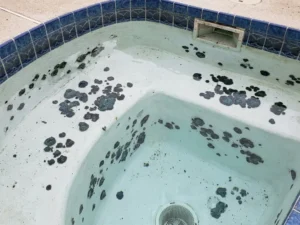
- Cloudy or milky water — suspended calcium particles scatter light, making the water look hazy even after shock treatment.
- White, crusty scale — deposits build up on tile lines, pool walls, and inside plumbing. This scale also coats heating elements, cutting heater efficiency by 15–20% within three years (even a 0.5 mm scale layer measurably reduces heat transfer).
- Rough surfaces — pool walls and floor feel like sandpaper instead of smooth plaster or vinyl.
- Skin and eye irritation — high mineral content makes the water feel “sharp” and can aggravate sensitive skin.
- Reduced chlorine effectiveness — calcium interferes with chlorine’s ability to sanitize, forcing you to use more chemicals.
Calcium hardness below 150 ppm makes water “aggressive” — it will leach calcium from plaster, grout, and metal fittings, causing permanent structural damage. The goal is always balance, not zero hardness.
Ideal Calcium Hardness Range by Pool Type
Not all pools have the same target. The ideal range depends on your pool’s surface material:
| Pool Type | Ideal CH Range (ppm) | Minimum (ppm) | Maximum (ppm) | Why It Matters |
|---|---|---|---|---|
| Plaster / Concrete | 200–400 | 200 | 400 | Plaster contains calcium; low-CH water will etch and pit the surface |
| Vinyl Liner | 175–250 | 150 | 300 | Vinyl is less sensitive but low CH can still corrode metal frames and ladders |
| Fiberglass | 200–250 | 150 | 300 | Gel coat can haze and stain with prolonged high-CH exposure |
| Spas / Hot Tubs | 150–250 | 150 | 250 | Higher temperatures accelerate scale formation; keep CH on the lower end |
Calcium hardness does not work in isolation. The Langelier Saturation Index (LSI) factors in CH, pH, total alkalinity, water temperature, and TDS to determine whether your water is balanced, scaling, or corrosive. Aim for an LSI between -0.3 and +0.3. Many pool stores offer free LSI calculations, or you can use the Aiper LSI calculator.
How to Test Calcium Hardness Accurately
Test strips are convenient for daily chlorine checks, but solving a hardness problem demands precision. Use a liquid titration drop test kit (Taylor K-2006 or TF-100). These kits let you count drops until a color change occurs, giving you an exact ppm reading — not a rough color-match estimate.
Critical step: Before draining anything, test your source water (tap or well). If your fill water already has 300 ppm CH, a partial drain-and-refill will barely move the needle. You need to know this number to calculate how much water to replace.
Method 1: Partial Drain & Refill (The Gold Standard)
This is the only method that physically removes minerals from the water. By replacing a portion of your hard pool water with softer source water, you permanently lower the calcium concentration.
Step-by-Step Process
- Test your pool water and source water. Write down both CH readings. If your source water CH is close to or higher than your pool water, this method will not work — skip to Method 2 or 3.
- Calculate how much to drain. Target the middle of your pool type’s ideal range. As a rough rule: replacing 25% of the water reduces CH by ~25%, 50% by ~50%, and so on.
- Set up your drain equipment. Use a submersible pump or your filter’s waste/backwash setting. Place the pump at the deep end. Never use your main drain for a partial drain — it can create unbalanced pressure.
- Drain with caution. Monitor continuously. Stop when you reach your target level. Mark the waterline beforehand with tape so you know exactly where to stop.
- Refill immediately. Start refilling as soon as draining stops. Use a hose filter if your source water is moderately hard. Run the hose at moderate pressure to avoid stirring up debris.
- Circulate for 8–12 hours. Run the pump continuously to thoroughly mix the old and new water.
- Retest and rebalance. Test CH, pH, and total alkalinity. Adjust pH first, then alkalinity, then recheck CH. Balance all levels before swimming — and if you swim often, it’s worth knowing how long chlorine stays in your hair.
A fully drained vinyl liner pool can shrink and tear. A fiberglass or concrete shell can float out of the ground (hydrostatic pressure). In areas with high water tables, even a partial drain below 50% can be risky. When in doubt, consult a pool professional. If a deeper drain ever becomes unavoidable, our guide to draining an inground pool without floating the shell walks through the protections that make it survivable.
Simple and inexpensive
Works for any pool type
No special chemicals needed
Not feasible in drought areas
Risky with high water tables
Requires full rebalance after
Method 2: Soda Ash Precipitation (Advanced, No-Drain)
This method, developed by the pool chemistry researchers at onBalance (Que Hales, Doug Latta, and Kim Skinner) and published in both Service Industry News (February 2025) and AQUA Magazine (November 2024), uses soda ash (sodium carbonate) to chemically force calcium out of solution — without draining a single gallon of water.
How It Works
Adding a large dose of soda ash shifts the water chemistry, causing dissolved calcium bicarbonate to react and form solid calcium carbonate (CaCO₃) — a fine white precipitate that turns the water milky and can then be physically filtered out. Unlike what you might expect, the process is roughly pH-neutral overall because the precipitation itself consumes carbonate alkalinity:
Ca(HCO₃)₂ + Na₂CO₃ → CaCO₃↓ + 2NaHCO₃
What You Need
- DE (diatomaceous earth) filter — essential. Sand and cartridge filters cannot capture the fine precipitate effectively.
- Soda ash (sodium carbonate) — available at pool supply stores. You may need 30–70 lbs depending on pool size and CH level.
- Liquid titration test kit — you will be testing frequently throughout the process.
- Patience — the process takes 2–4 days of continuous filtration.
Step-by-Step Process
- Test baseline CH and pH. Record your starting numbers.
- Calculate soda ash dosage. The general guideline: a documented onBalance case study reduced a pool from 1,200 ppm CH to ~600 ppm using 70 lbs of soda ash over three days. As a rough estimate, start with 0.5–1.5 lbs of soda ash per 1,000 gallons for every 100 ppm of CH you want to drop. Work with a pool professional to confirm your exact dosage before starting.
- Add soda ash in batches. Dissolve in a bucket of pool water first, then pour slowly around the perimeter. Do not dump all at once — add in 3–4 batches over several hours.
- Run your DE filter 24/7. The water will turn milky white — this is the calcium precipitating. This is normal. Backwash the DE filter frequently as the pressure rises.
- Monitor pH closely. While the overall process is roughly pH-neutral, pH may drift during precipitation. Keep pH between 7.0 and 8.2. Add small amounts of muriatic acid if pH rises too high. Test at least twice daily during the process.
- Retest CH after 48–72 hours. Once CH drops into your target range, stop adding soda ash. Let the filter clear the remaining cloudiness over 12–24 hours.
- Rebalance all chemistry. After the water clears, adjust pH back to 7.4–7.6 and alkalinity to 80–120 ppm. Your CH is now permanently lower — with zero water wasted.
Permanently removes calcium
No draining risk
Works for any pool type
Labor-intensive (2–4 days)
pH management is tricky
Not recommended for beginners
Sand and cartridge filters cannot capture the fine calcium carbonate precipitate. If you attempt this with a sand filter, the precipitate will simply pass through and re-dissolve when pH is later adjusted — wasting your time and chemicals. If you only have a sand or cartridge filter, use Method 1 (drain & refill) or Method 3 (RO) instead.
Method 3: Reverse Osmosis (RO) Filtration (Professional)
Reverse osmosis is a truck-mounted mobile filtration service. A professional company brings equipment to your property, runs your pool water through industrial RO membranes, and returns purified water — all without draining the pool.
How It Works
Pool water is pumped through a series of high-pressure membrane filters that strip out calcium, magnesium, TDS (total dissolved solids), cyanuric acid (CYA), and even salt. The purified water flows back into the pool while the concentrated waste is discharged. The process typically takes 8–24 hours depending on pool size.
When RO Makes Sense
- Calcium hardness above 600–1,000 ppm — when drain-and-refill would require replacing most of the water.
- High CYA levels — RO removes cyanuric acid as well, so you solve two problems at once.
- Water restrictions or high water table — when draining is illegal, impractical, or dangerous.
- Old or fragile pools — where draining risks structural damage.
Removes CH, CYA, TDS, and salt all at once
Preserves existing water
Safe for all pool types and ages
Not available in all areas
Wastes some water as concentrate
Scheduling required
Method 4: Hose Pre-Filters & Water Softeners
Rather than treating the entire pool, this approach filters minerals out of incoming water before they ever enter the pool. Think of it as a gatekeeper rather than a cleanup crew.
Option A: Inline Hose Pre-Filter
A small, disposable cartridge filter that screws onto your garden hose. As water passes through, the filter media captures a significant portion of calcium, magnesium, iron, and copper before the water reaches your pool. These filters cost $15–$40 and last for roughly 2,000–4,000 gallons of fill water. Ideal for top-offs and partial refills in areas with moderately hard water.
Option B: Whole-House Water Softener for Fill Water
If you already have a whole-house water softener, route your pool fill line through it. This uses ion-exchange resin to swap calcium and magnesium ions for sodium ions, producing genuinely soft water. Important: This only works for top-offs and partial fills. Filling an entire pool through a residential softener will exhaust the resin bed and potentially damage the unit. For new fills, consider a dedicated pool-fill service or portable softener.
No. Water softener salt (sodium chloride or potassium chloride) does not soften pool water when dumped in directly. It simply dissolves into sodium and chloride ions. In a saltwater chlorine generator (SWG) pool, the salt is converted to chlorine — it has zero effect on calcium hardness. Dumping softener salt into a non-SWG pool just makes the water salty with no benefit.
Low cost (hose filter: $15–$40)
No pool chemistry disruption
Simple to use
Hose filters are consumable
Whole-house softeners cannot handle full pool fills
Slow — only works gallon by gallon
Method 5: Chemical Sequestering Agents (Temporary Management)
Chemical sequestering agents do not remove calcium or soften water. Instead, they chemically bind to calcium ions, keeping them dissolved and preventing them from forming scale on surfaces. They are a management tool — not a permanent solution.
What to Use
- HEDP-based (1-Hydroxyethylidene-1, 1-diphosphonic acid) sequestrants: The most effective option. HEDP molecules wrap around calcium ions and prevent them from precipitating out as scale. Products labeled “stain & scale control” or “metal sequestrant” typically contain HEDP or similar phosphonates.
- Flocculants and clarifiers: These clump together suspended particles so the filter can catch them. They cannot bind to dissolved calcium and will not lower your CH reading on a test kit.
- Alum-based products: Some pool stores sell alum as a “hardness reducer,” but multiple user reports and tests show minimal or no effect on actual calcium levels.
Sequestering agents wear off after 4–6 weeks. When the bond breaks, the calcium re-enters solution and can form scale again. You must re-dose regularly. If your CH is above 500 ppm, sequestrants alone will not be enough — combine with Method 1 or 3 for a lasting fix.
No draining or equipment needed
Works immediately to prevent scale
Good stopgap while planning a permanent fix
Requires reapplication every 4–6 weeks
Ongoing cost adds up
Limited effectiveness above 500 ppm CH
Which Method Is Right for You? Quick Comparison
| Method | Best For | Cost | Time | DIY? | Permanent? |
|---|---|---|---|---|---|
| 1. Partial Drain & Refill | CH above 400 ppm, soft source water | Water bill only | 4–12 hrs | Yes | Yes |
| 2. Soda Ash Precipitation | CH above 500 ppm, DE filter, no-drain needed | $30–$80 (chemicals) | 2–4 days | Advanced | Yes |
| 3. Reverse Osmosis | CH above 600 ppm, high CYA, cannot drain | $400–$1,500+ | 8–24 hrs | No (pro service) | Yes |
| 4. Hose Pre-Filter | Moderately hard source water, prevention | $15–$40/filter | Ongoing | Yes | Preventative only |
| 5. Chemical Sequestrants | Mildly elevated CH, scale prevention | $15–$30/month | Minutes | Yes | No (4–6 weeks) |
“Natural” Ways to Soften Pool Water: What Works (and What Doesn’t)
The internet is full of home remedies. Here is what the chemistry actually says:
| Method Claimed | Does It Soften Water? | What Actually Happens |
|---|---|---|
| Baking soda | No | Raises total alkalinity. Does not bind or remove calcium. May actually make scaling worse by increasing carbonate alkalinity. |
| Borax | No | Raises pH. No effect on calcium hardness. |
| Vinegar / muriatic acid | No | Lowers pH drastically without affecting CH. The amount needed to dissolve existing scale would make the water dangerously acidic and corrosive. |
| Pool salt (NaCl) | Sort of | Softens the feel of water (saltwater pools feel silkier) but does not reduce calcium hardness. Requires a saltwater chlorine generator. |
| Rain dilution | Yes (slowly) | Rainwater has near-zero CH. Over time, heavy rainfall plus draining excess water will gradually lower hardness. Unreliable as a primary method. |
| Reverse osmosis | Yes | See Method 3 above. This is the only “natural” (chemical-free) way to remove calcium, but it requires professional equipment. |
How to Prevent Hard Water from Coming Back
Once you have softened your pool water, keep it that way with these five habits:
- Switch to non-calcium shock. Replace Cal-Hypo shock with liquid chlorine (sodium hypochlorite) or dichlor granules. They sanitize without adding calcium. Over a full season, this alone can prevent 50–100+ ppm of CH creep.
- Install a hose pre-filter for every top-off. A $20 reusable filter on your fill hose stops minerals at the gate. Make it a habit — attach it whenever you add water.
- Use a pool cover. A solar or safety cover reduces evaporation by up to 95%. Less evaporation means fewer top-offs and slower mineral concentration. Bonus: it keeps debris out and retains heat.
- Test calcium hardness monthly. Add CH to your monthly test routine. Catching a rising trend at 350 ppm is much easier than fixing 600+ ppm. Use a liquid drop kit for accuracy.
- Schedule an annual partial water change. Replace 15–25% of your pool water each season — ideally in spring before the heavy-use months. This resets the gradual mineral accumulation before it becomes a problem.
Frequently Asked Questions
The most reliable method is a partial drain and refill with softer source water (Method 1). Test both your pool and fill water first. If draining is not an option, consider soda ash precipitation (Method 2, requires a DE filter) or professional reverse osmosis (Method 3). Chemical sequestrants (Method 5) manage symptoms temporarily but do not actually lower hardness.
No. Baking soda (sodium bicarbonate) raises total alkalinity — it has zero effect on calcium hardness. In fact, raising alkalinity when calcium is already high can increase the risk of scaling by pushing the LSI further into positive territory. Baking soda is useful for balancing alkalinity, not for softening water.
The cheapest permanent method is a partial drain and refill. You only pay for the replacement water (typically 500–5,000 gallons, or a few dollars on most municipal water bills). Chemical sequestrants have a lower upfront cost ($15–$30 per bottle) but require ongoing monthly purchases, making them more expensive over time.
Calcium hardness above 400 ppm causes: (1) white scale deposits on tile, plaster, and inside plumbing; (2) cloudy water that resists clarifiers; (3) reduced heater efficiency as scale coats the heating element; (4) rough, sandpaper-like surfaces; and (5) skin and eye irritation for swimmers. Over time, unchecked scaling can clog pipes, damage pump seals, and permanently etch surfaces.
You can use a whole-house water softener for top-offs and partial fills, but you cannot fill an entire pool through one. A residential softener regenerates after treating 1,000–2,000 gallons — a 15,000-gallon pool would exhaust the resin bed and potentially damage the unit. For large-volume softening, use a portable pool-fill service or a dedicated in-line treatment system. Do not dump water softener salt directly into the pool — it dissolves into sodium and chloride but does not remove calcium.
You have two options: soda ash precipitation (Method 2 — chemically forces calcium to precipitate so your DE filter can remove it) or professional reverse osmosis (Method 3 — a truck-mounted system filters your pool water on-site). Both achieve permanent CH reduction without draining a drop. Chemical sequestrants (Method 5) are a third option, but they only prevent scale temporarily rather than removing calcium.
Calcium hardness measures the concentration of dissolved calcium (and magnesium) in the water — the minerals that cause scaling. Total alkalinity measures the water’s ability to buffer against pH changes — primarily from bicarbonate and carbonate ions. Both are critical for water balance (along with pH and temperature, they determine the LSI), but they are tested and adjusted independently. High CH causes scale; high TA causes pH drift. You can have one problem without the other.
How This Guide Was Created
This guide combines industry-standard pool chemistry (based on NSPF/CPO curriculum and Taylor Technologies reference materials), the latest 2024–2025 trade research from onBalance on soda ash precipitation, and real-world testing feedback from thousands of pool owners on forums like TroubleFreePool. Every method described has been verified against published water chemistry data and manufacturer specifications.
For hands-on help diagnosing your pool water, try our free Pool Water Troubleshooting Wizard — it walks you through symptoms like cloudy water, scaling, and irritation step by step.
Get more pool and lawn care guides from Aiper on Google