

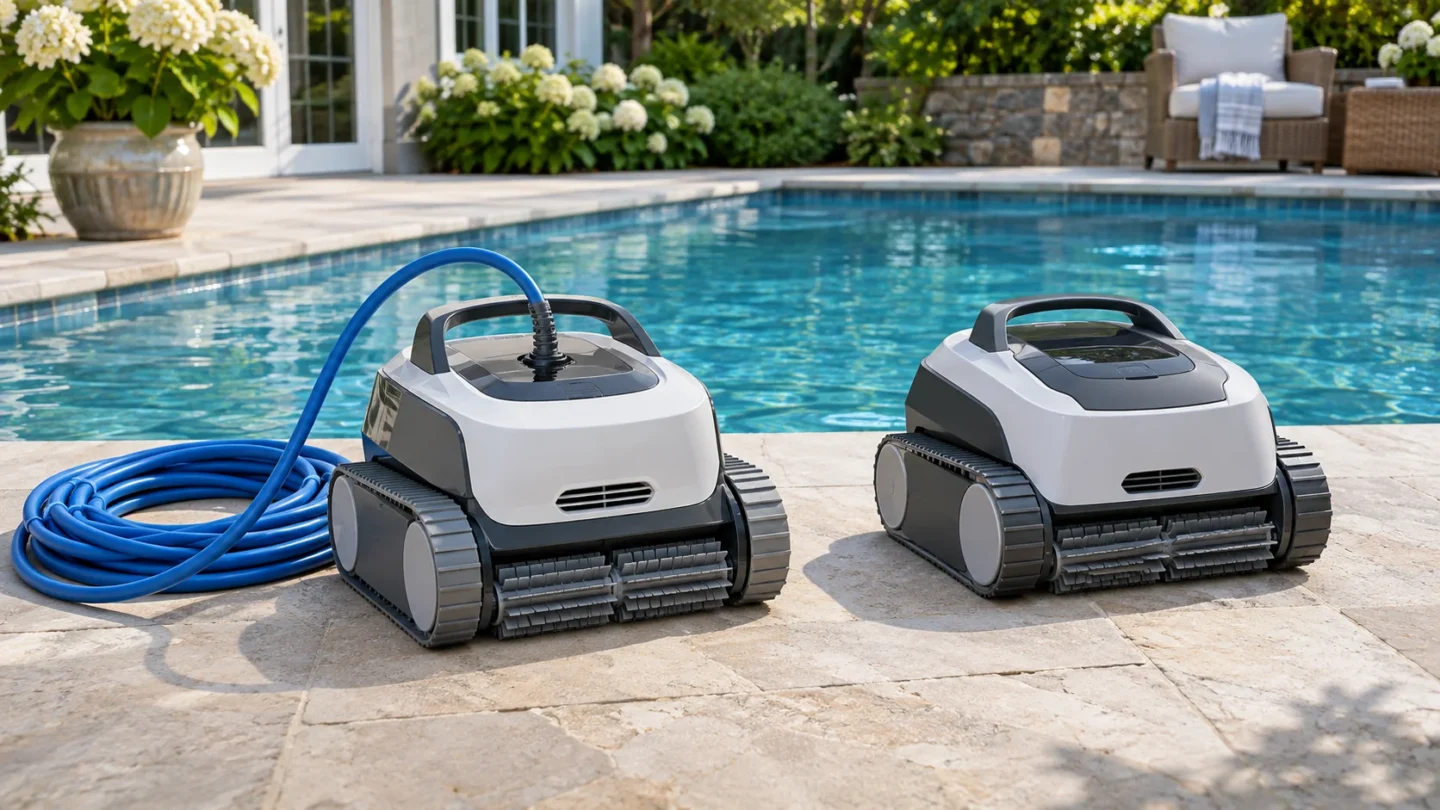
A corded pool vacuum can clean the deep end and climb the walls, but its cable can limit how freely it moves. It can snag on drains, wrap around the unit, or restrict access to parts of the pool.
A cordless vacuum removes that restriction, but introduces other trade-offs, including battery life and charging time.
The difference isn’t just the price. It’s how much of the pool each cleaner can cover without intervention and how much work it takes to keep it running.
The Cord in the Water
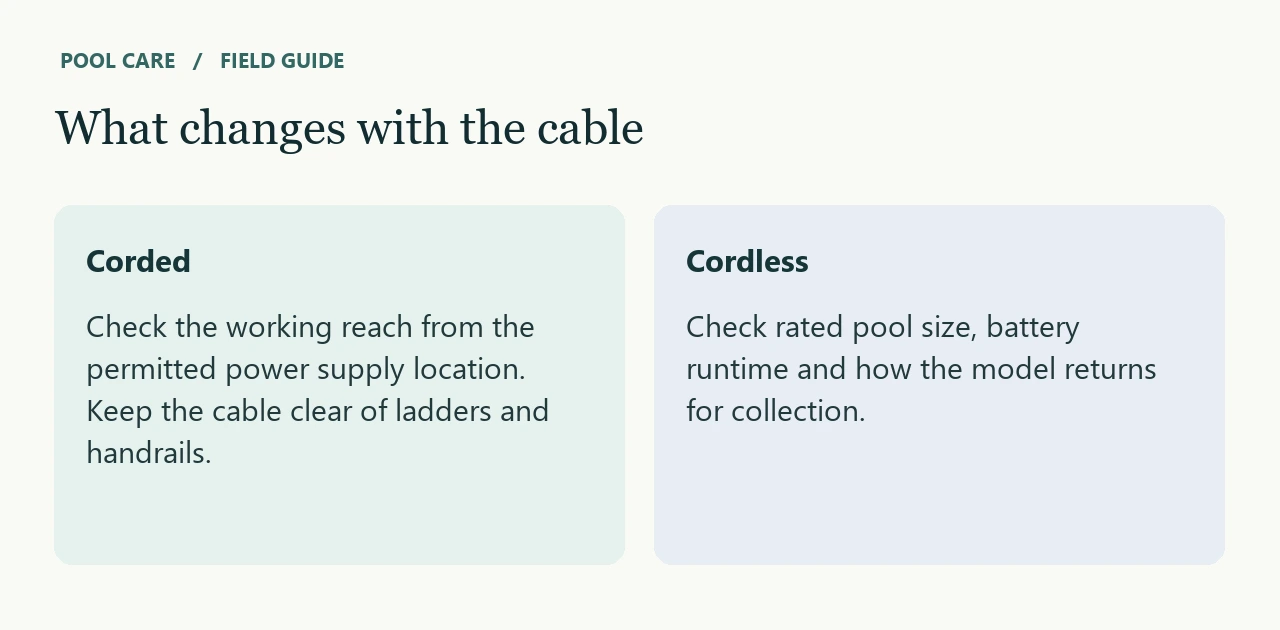
Every corded cleaner drags a power cable behind it for the full run, and that cable never sits still.
It drifts, sinks, and reacts to the same pump currents moving the cleaner around. Most of the day-to-day friction with these units traces back to that one fact.
How the cable tangles
Robotic cleaners turn, climb walls, and double back. The cable follows every move, often twisting around itself or catching on ladders, handrails, and drain covers.
Swivel connections reduce tangling by letting the cable untwist as the cleaner moves. But they don’t prevent it from wrapping around the cleaner’s body.
Where it can and can’t reach
Cable length limits how far a cleaner can travel from its power supply. Since the supply needs to stay near an outlet, parts of larger or irregularly shaped pools may fall outside its reach.
Moving the power supply can solve this, but it means stopping the cycle, relocating the unit, and restarting the cleaner. That makes an otherwise automated cleaning cycle less hands-off.
Setup and Power
Before a corded cleaner touches the water, it has to be plugged in, and that one requirement carries more weight than it looks.
The power supply needs a grounded GFCI outlet, and for safety, that outlet belongs a few feet back from the water’s edge. A pool built without one nearby forces a choice between running an extension cord or not using the cleaner there.
Extension cords around standing water are the hazard they sound like, and manufacturers put it in writing that owners shouldn’t use them.
So the outlet’s location ends up dictating where the cleaner can work.
A pool with power on only one side gets a cleaner that reaches well on that side and poorly across the rest. None of this appears on a spec sheet. It appears the first time the unit gets set up, the cord won’t stretch to the deep end.
The End of the Cycle
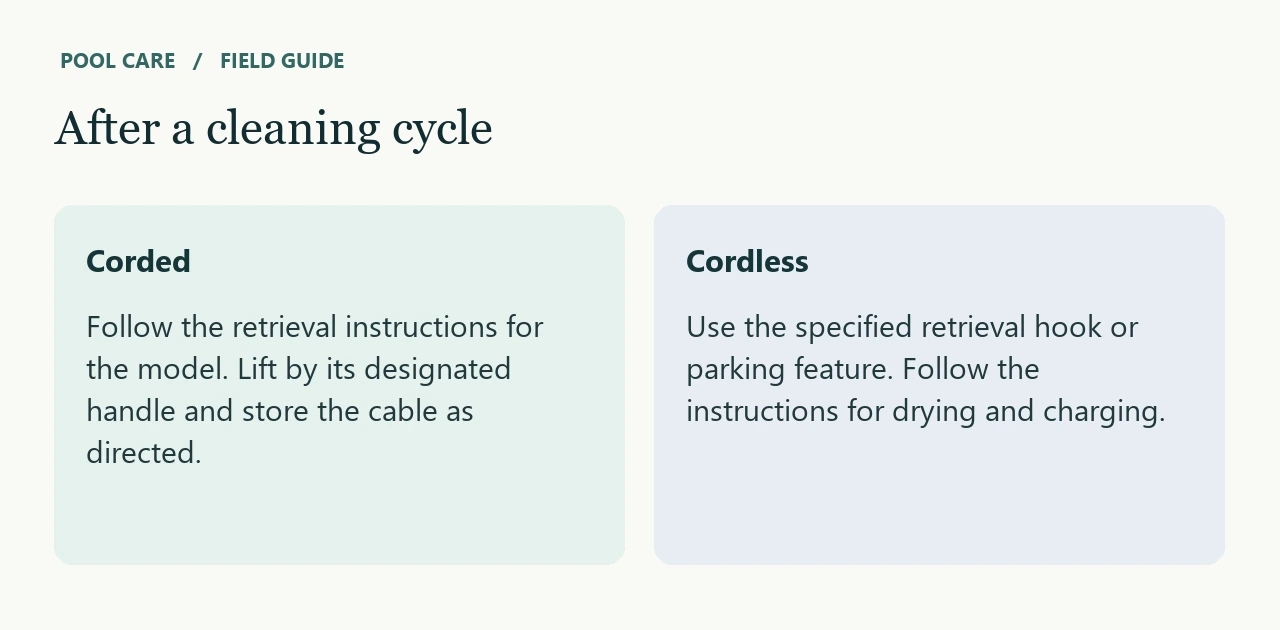
With a corded unit, the cycle finishing is the start of a second small job.
The cleaner has to come out, and it comes out on the cord, hauled in hand over hand across the pool. That is when any tangle from the run announces itself. A cable that knotted mid-cycle has to be worked loose before the unit will sit flat in storage.
Then there’s the cable itself, which has to go somewhere between uses.
Coiled wrong, it kinks, and kinked cable holds its shape and tangles faster next time, so the coil actually matters. The cleaner, its power supply, and the length of cord together need a corner of a shed or a deck box rather than a shelf.
A cordless unit ends its cycle as one sealed object.
It gets lifted out and set down to charge. On any single day, the difference in cleanup is a couple of minutes. Across a season of twice-weekly runs, it stops being nothing.
What Cordless Gives Up
Going cordless carries its own compromises, and runtime is the big one.
A charge covers a set amount of cleaning. A very large pool, or a badly fouled one, can outlast a single charge, which means pulling the unit, recharging, and running it again to finish.
Charging takes hours, so a cleaner that dies mid-job isn’t going back in that afternoon.
Retrieval has a quirk too. A cordless unit sitting at the bottom of the deep end has no cable to pull it up by. Most are built to surface on their own when the cycle ends, or they ship with a retrieval hook, and in a deep pool getting a stalled one back is clumsier than reeling in a cord.
Batteries also age. After a few seasons, a pack holds less than it did when it was new, and eventually it needs replacing, which is a cost and a maintenance step a corded unit never asks for.
Which One Still Makes Sense
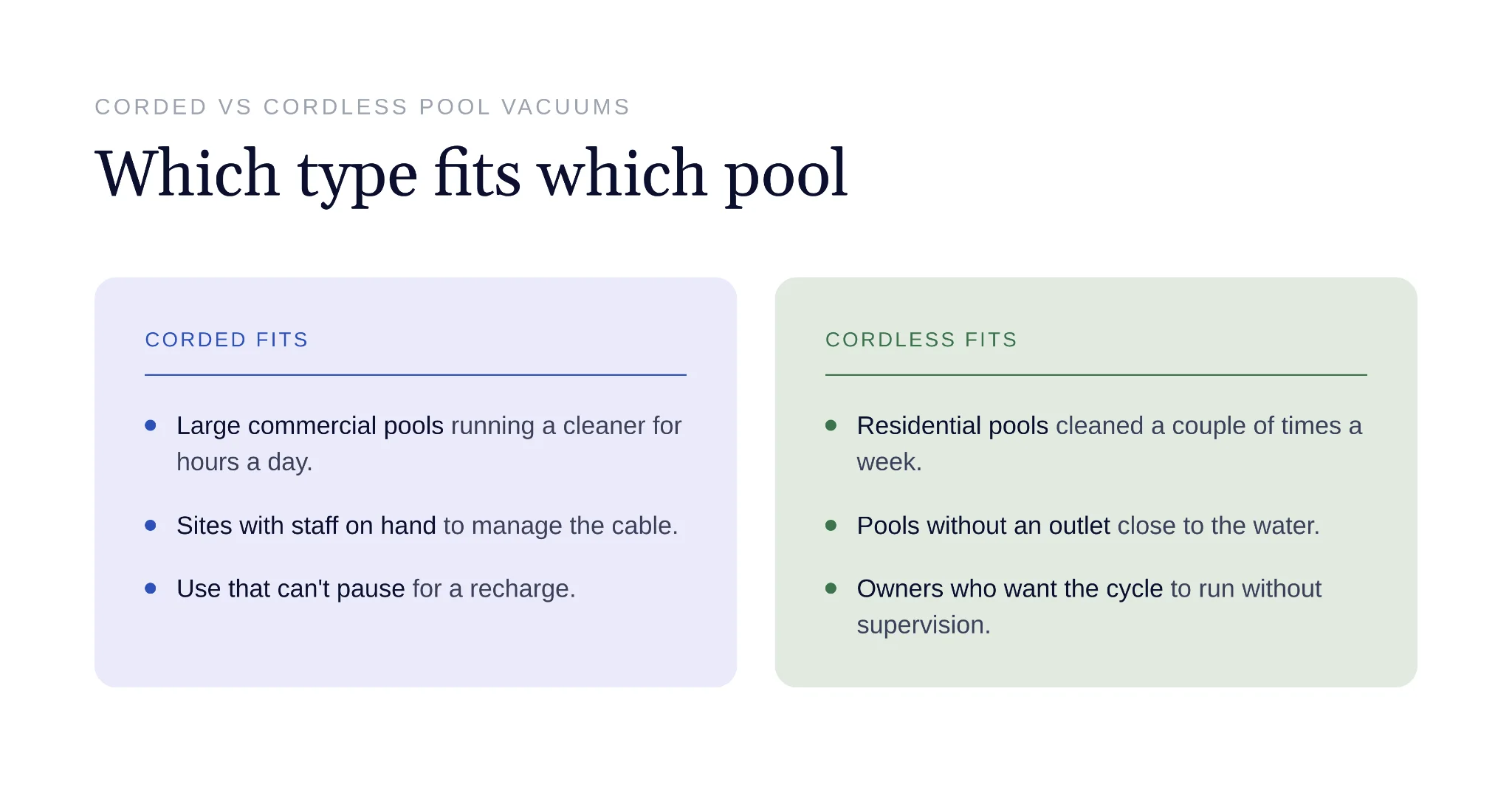
Corded still earns its place on certain pools.
A large commercial pool that runs a cleaner for hours a day benefits from never stopping to charge, and at that scale someone is usually on hand to manage the cable anyway.
For a residential pool cleaned a couple of times a week, the cord is mostly cost with little to show for it. It tangles, it chains the cleaner to wherever the outlet happens to be, and it turns both retrieval and storage into extra steps. The actual cleaning was never the part the cord made better.
A cordless robotic pool cleaner from Aiper answers that residential case directly. It drops in and runs the cycle on its own, then comes out as one piece, with no cable to untangle and no outlet to plan the layout around.
Get more pool and lawn care guides from Aiper on Google