
How to Change a Pool Light: LED Retrofit Guide


Most residential pool lights can be changed from the deck without draining the pool. The fixture is built to lift out of its wall housing and come up to the edge on a coiled cord, where you can open it and swap the bulb.
Switching to LED during the change cuts the light’s power use and means far fewer changes in the future. The work takes an hour or two once you have the right parts, and the parts depend on what kind of light you have now.
Wet-Niche and Dry-Niche Lights
Pool lights sit in a recessed housing in the pool wall called a niche. How the light is serviced depends on which of two niche types your pool has.
Wet-niche lights are the standard on residential pools. The fixture sits in a water-filled niche with extra cord coiled behind it, so it can be unscrewed and lifted to the deck. This guide covers wet-niche lights.
Dry-niche lights are sealed into the wall and serviced from behind, through a tunnel or access panel outside the pool. They are uncommon in homes. If yours is a dry niche, hire an electrician who works on pools.
Bulb Swap or Full Fixture Replacement
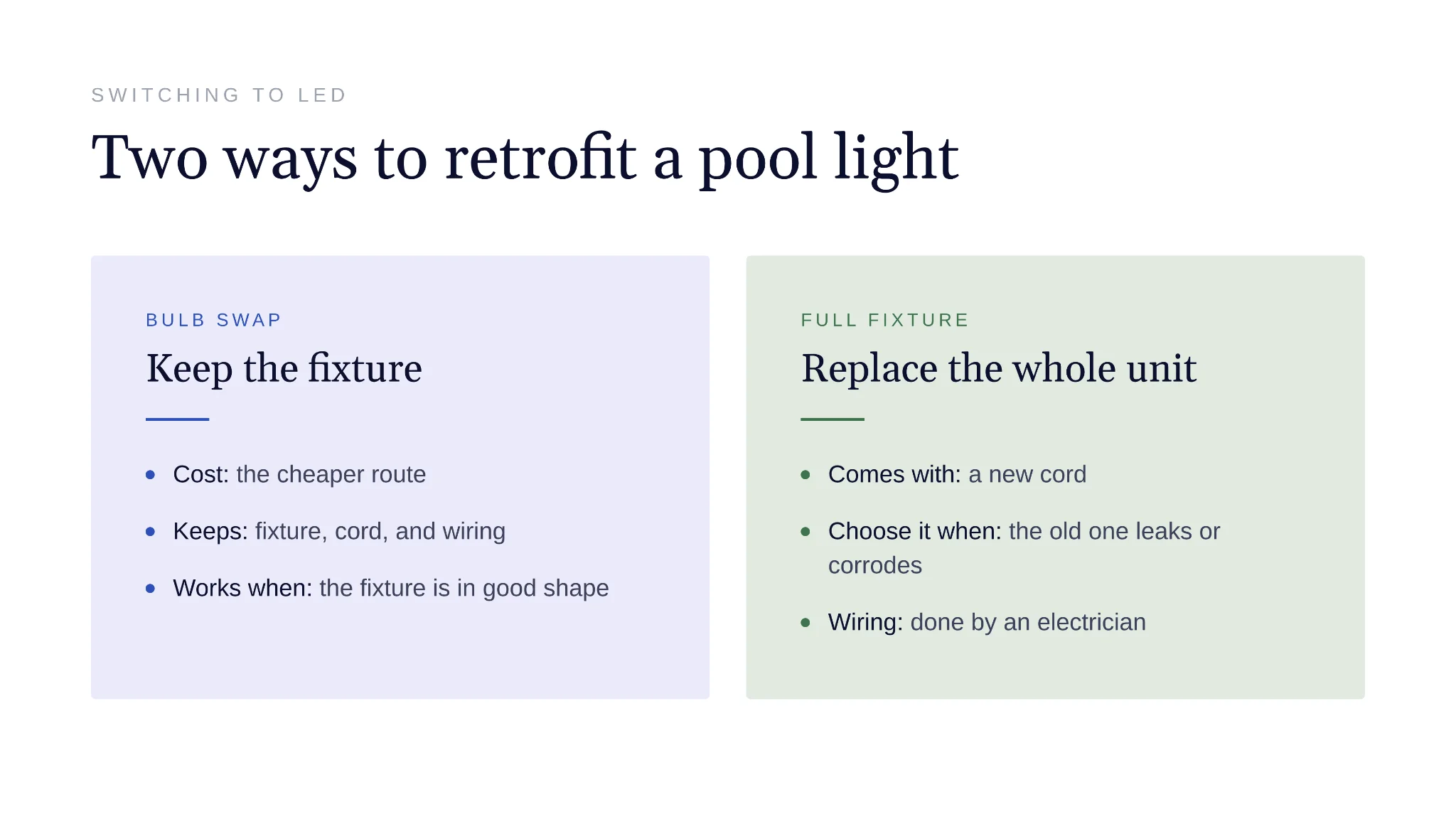
There are two ways to switch to LED. Which one you choose depends mostly on the condition and age of the fixture you have.
- Replacing only the bulb: LED replacement bulbs screw into many existing incandescent and halogen fixtures. This is the cheaper route and keeps the original fixture, cord, and niche connection.
- Replacing the whole fixture: A new LED fixture comes with its own cord, which has to be fed back through the conduit to the junction box. Choose this route when the old fixture is corroded, cracked, or leaking, or when you want a color-changing light the old fixture can’t support.
Feeding a new cord through the conduit and connecting it at the junction box is electrical work. Leave that part to a licensed electrician, even if you remove the old fixture yourself.
Matching the Replacement to Your Pool
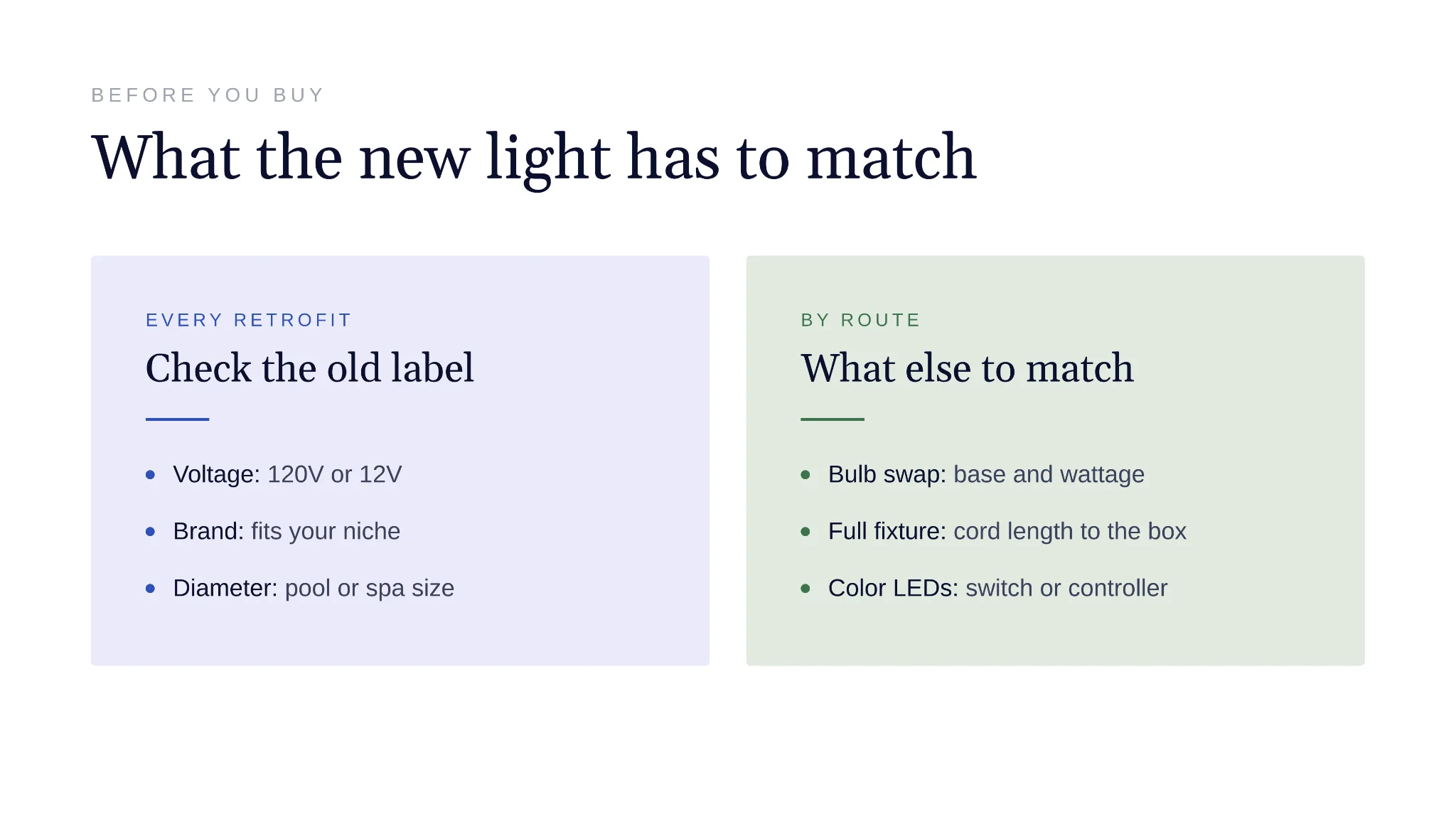
The wrong part won’t fit the niche or won’t run on your circuit. Before you buy, take the old fixture out and read the label on its back, or photograph it if the label has worn.
| What to match | Where to find it | Why it matters |
|---|---|---|
| Voltage | Fixture label: usually 120V or 12V | A 12V light on a 120V circuit fails instantly; a 12V system also needs a transformer |
| Fixture or niche brand | Fixture label or the niche ring | Fixtures are sized to fit specific niches |
| Fixture diameter | Measure the face of the fixture | Large pool lights and small spa lights are not interchangeable |
| Cord length (full fixture only) | Measure the old cord or check the label | The cord must reach the junction box without splicing |
| Bulb base and wattage (bulb only) | The old bulb | The LED bulb must fit the socket and the fixture housing |
Color-changing LEDs cycle through colors when you switch the power off and on, or through a separate controller. Check that the light works with your existing switch or plan for a compatible controller.
How to Change the Light
Pick a dry day and have a new lens gasket on hand before you start. Gaskets harden and crack with age, and a reused one is the most common reason a fixture leaks afterward.
To replace a wet-niche pool light:
- Turn off the pool light circuit at the breaker panel. Tape a note over the breaker so no one switches it back on.
- Flip the light switch on to confirm the light stays dark.
- Find the single screw at the top of the light’s faceplate and remove it.
- Pry the fixture gently out of the niche with a flat screwdriver at the bottom edge.
- Uncoil the cord from behind the fixture and lift the fixture onto the deck. Lower the water level slightly if the cord is too short to reach.
- Lay the fixture face-down on a towel and remove the lens ring, either by undoing its screws or releasing its clamp.
- Check inside for water, corrosion, or a burned smell. If you find any, stop and replace the full fixture.
- Remove the old bulb and screw in the LED bulb, or prepare the new fixture if you are replacing the whole unit.
- Fit the new gasket evenly around the lens, then reattach the lens ring and tighten its screws a little at a time in a crisscross pattern.
- Coil the cord back around the fixture, set it into the niche, and replace the top screw.
- Turn the breaker back on and switch on the light.
Watch for bubbles from the fixture for a few minutes after it goes back in. A steady stream means the seal isn’t tight, so turn off the breaker and reseat the gasket.
Electrical Safety Around the Pool
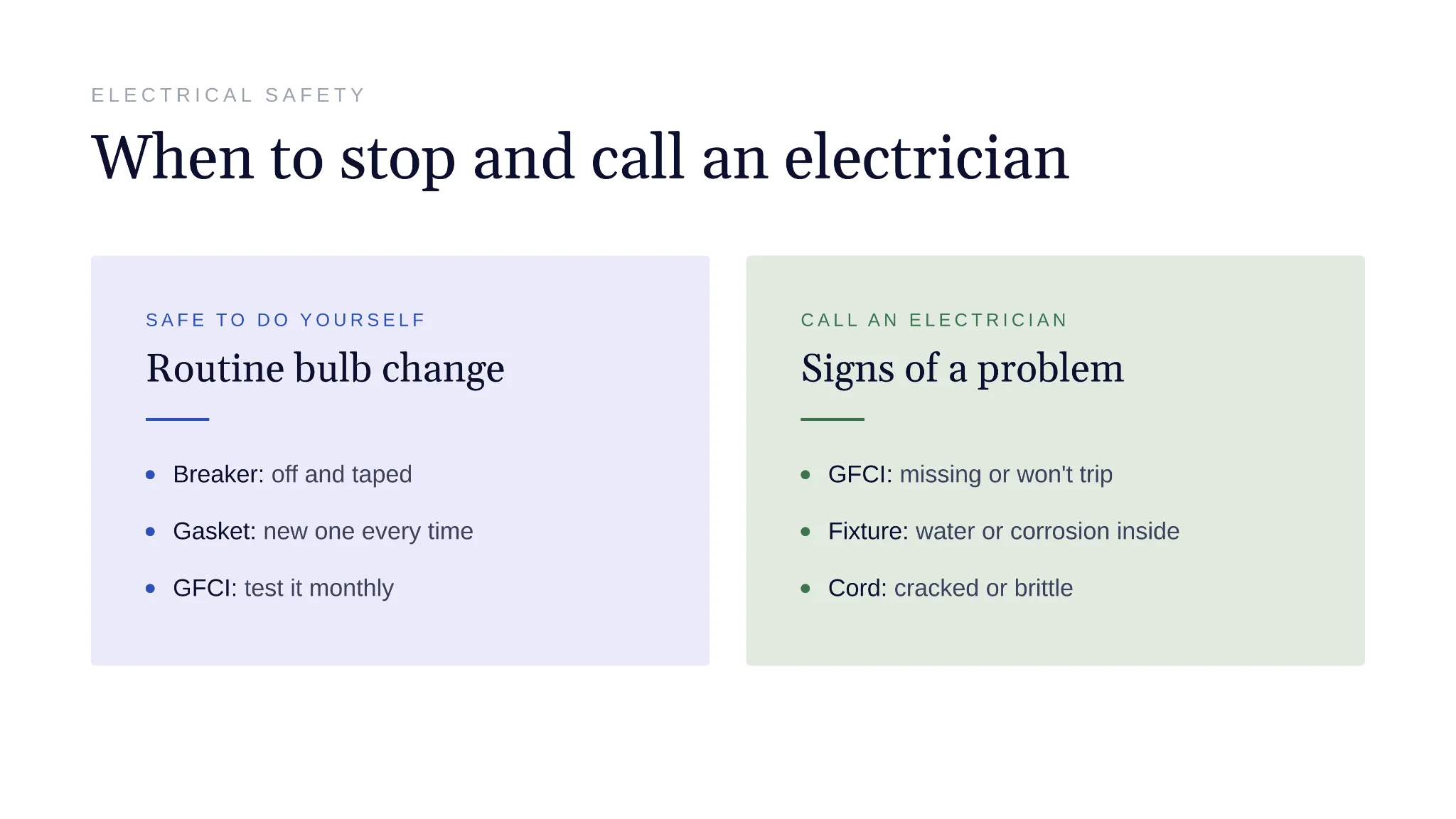
A pool light puts household current inside the water, so a small fault matters more here than anywhere else in the house. The CPSC’s warning on pool electrocutions singles out underwater lighting on older pools, where fixtures may have degraded, and the circuit may lack ground-fault (GFCI) protection.
The CPSC recommends testing the GFCI monthly. Press the test button and confirm the pool light shuts off, then press reset and confirm it comes back on.
Call an electrician experienced with pools if any of these come up:
- The pool light circuit has no GFCI protection, or the GFCI won’t trip when tested
- The GFCI trips on its own after the light goes back in
- The cord is cracked, cut, or brittle
- The new fixture needs a cord run through the conduit
- The light flickers or works only some of the time
If anyone in the pool feels a tingling sensation, get everyone out without touching the water and turn off all power. The State of Idaho’s electrical water safety guidance advises calling 911 and using a non-conductive pole for any rescue.
Why LED Is Worth the Change
LEDs use at least 75 percent less energy than incandescent bulbs and last up to 25 times longer. For a pool light, the longer life matters as much as the energy savings, since every bulb change means pulling the fixture out of the water.
LEDs also run much cooler. An incandescent pool bulb relies on the surrounding water to stay cool and can crack its lens if switched on while out of the pool, while an LED is far less likely to overheat during a quick test on the deck.
Keeping the Light Bright
Scale and algae build up on the lens over a season and dull the light. Wipe the lens with a soft cloth when you brush the walls, and check the calcium level if white crust keeps returning.
Brighter LED light also shows every leaf and patch of dirt on the floor at night. A robotic cleaner scrubs the floor and walls on a schedule, so the pool looks as clean after dark as it does in daylight. Compare models in the Aiper robotic pool cleaners collection.
Get more pool and lawn care guides from Aiper on Google