



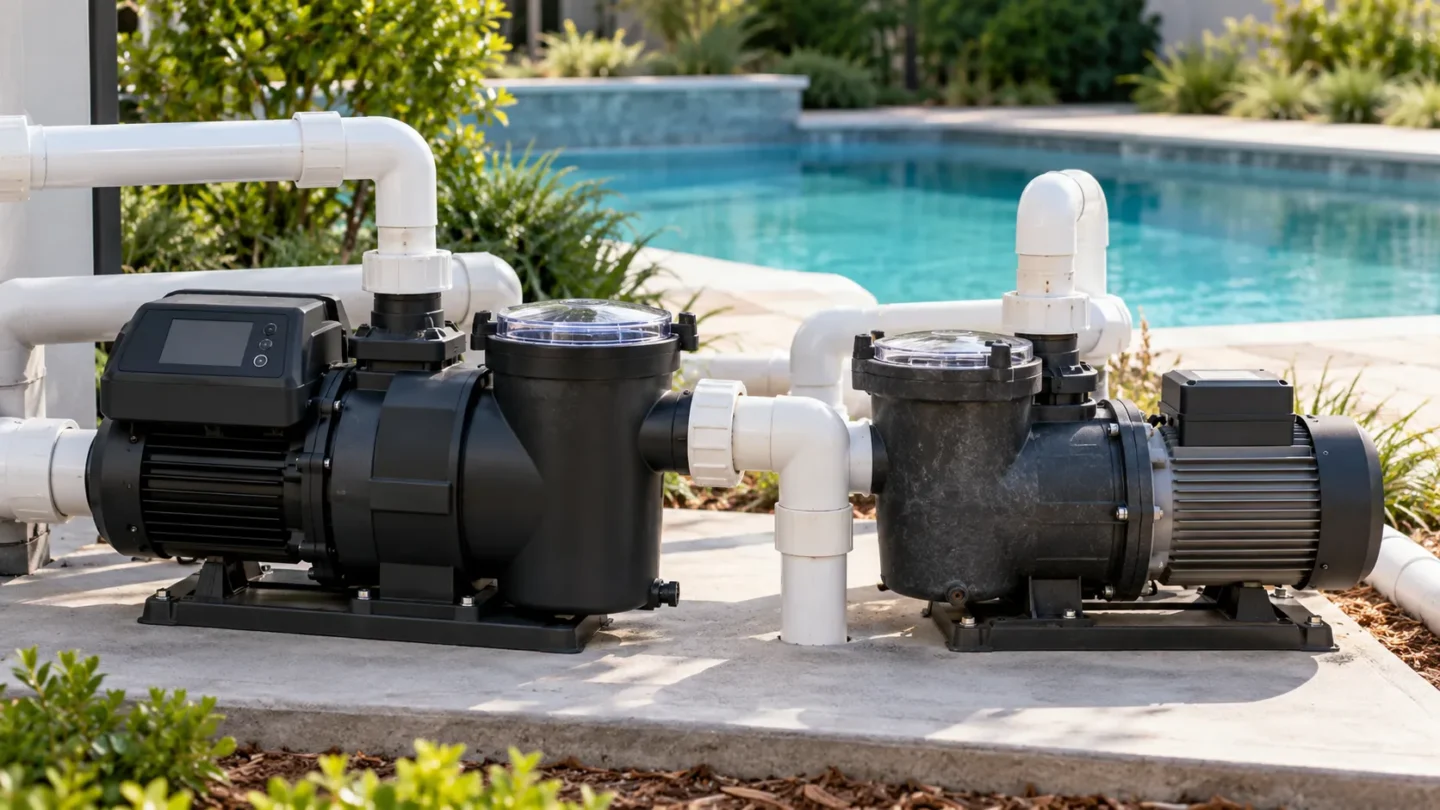
The pool pump is the biggest electricity draw most houses have that nobody thinks about. It’s not the air conditioning, which at least switches off in spring.
The pump runs eight, ten, twelve hours a day, every day, moving water through the filter so it doesn’t turn green, a motor the size of a watermelon pulling two thousand watts, humming away behind the equipment pad while the power meter spins.
In a lot of homes with a pool, it’s the single largest line on the summer bill, and the owner has no idea.
That’s the whole reason the variable speed conversation exists.
A pump that runs that many hours is a pump where small efficiency differences compound into real money, fast. And the efficiency difference here isn’t small. It’s enormous, and it comes out of one piece of physics that most people selling the pumps don’t bother to explain.
The Cube Law Is the Whole Reason This Works
A single-speed pump has one speed: full. Usually around 3,450 RPM. It’s either off or it’s flat out, drawing its full rated wattage the entire time it runs. There’s no in-between.
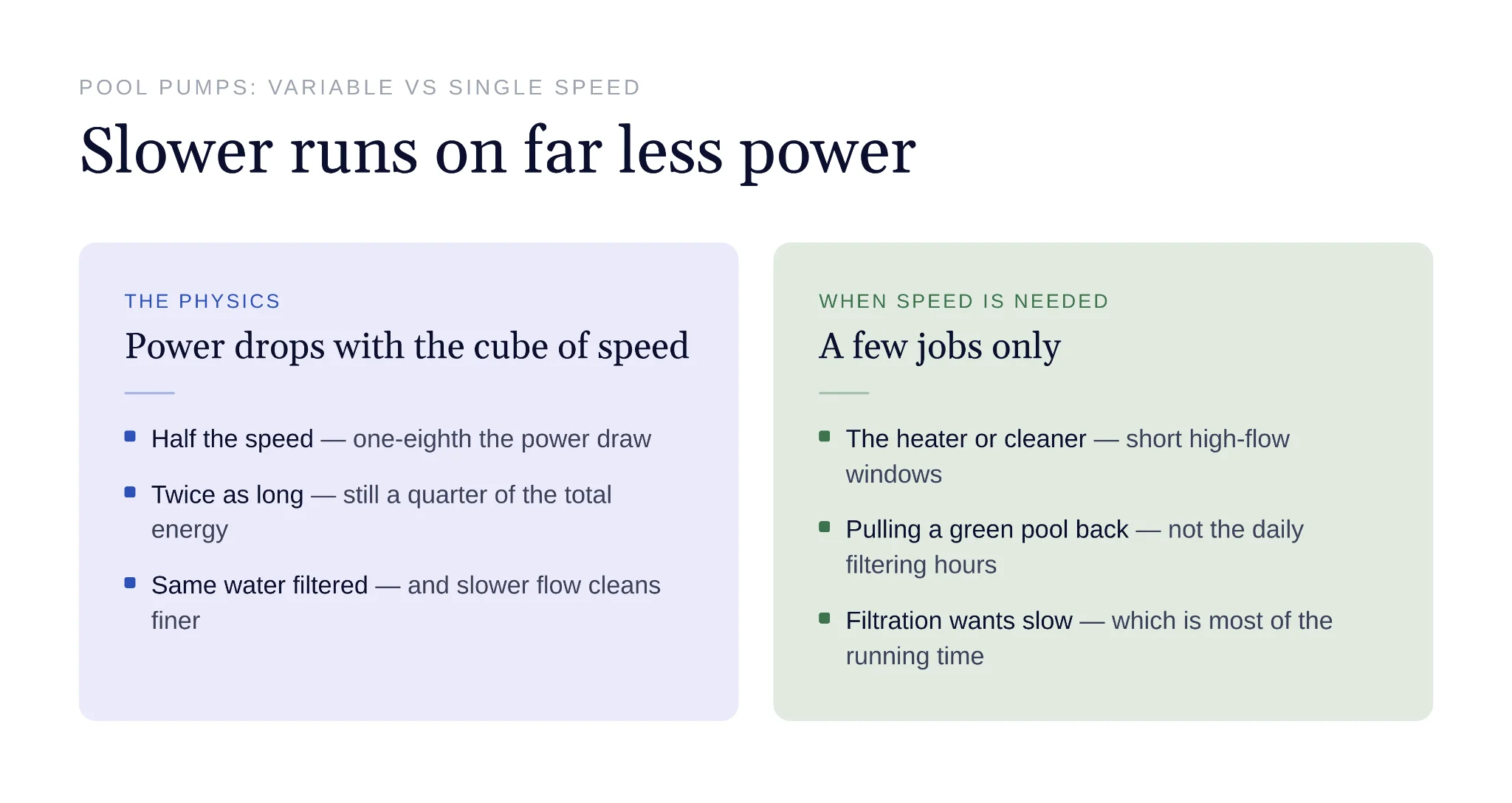
A variable speed pump can slow down. And when a pump slows down, the power it draws doesn’t drop in proportion to the speed. It drops with the cube of the speed.
Halve the RPM and the motor draws one-eighth the power. It’s how centrifugal pumps work. The relationship between how fast the impeller spins and how much electricity it eats is brutally nonlinear, and it runs entirely in your favor when you slow things down.
Here’s the catch that makes people think it cancels out, and why it doesn’t.
Running slower moves less water per minute, so you have to run longer to filter the same volume. Fine. Say you run at half speed and it takes twice as long to turn the water over. Twice as long at one-eighth the power is one-quarter the total energy, for the same water filtered.
You traded a short burst of high draw for a long stretch of tiny draw, and came out using a quarter of the electricity to do the identical job.
That’s the engine of every dollar of savings below.
Slow water through the filter is also cleaner water, as longer, gentler filtration catches finer particles than a fast blast does, so the slow run isn’t even a compromise on the filtering.
It’s better filtering for a quarter of the power. The pump only needs to spin fast for the few jobs that actually demand flow: running a heater, driving a pressure-side cleaner, pulling the pool back after it’s been let go. Filtration, which is most of the hours, wants slow.
One of those jobs comes off the list easily. The Aiper line of cordless robotic cleaners drops in and out in about a minute and needs no hoses or booster pump, which takes a chunk of high-wattage runtime off the pump on top of what the slow-filtration math already saves.
The Actual Math
Let’s see how the numbers bend.
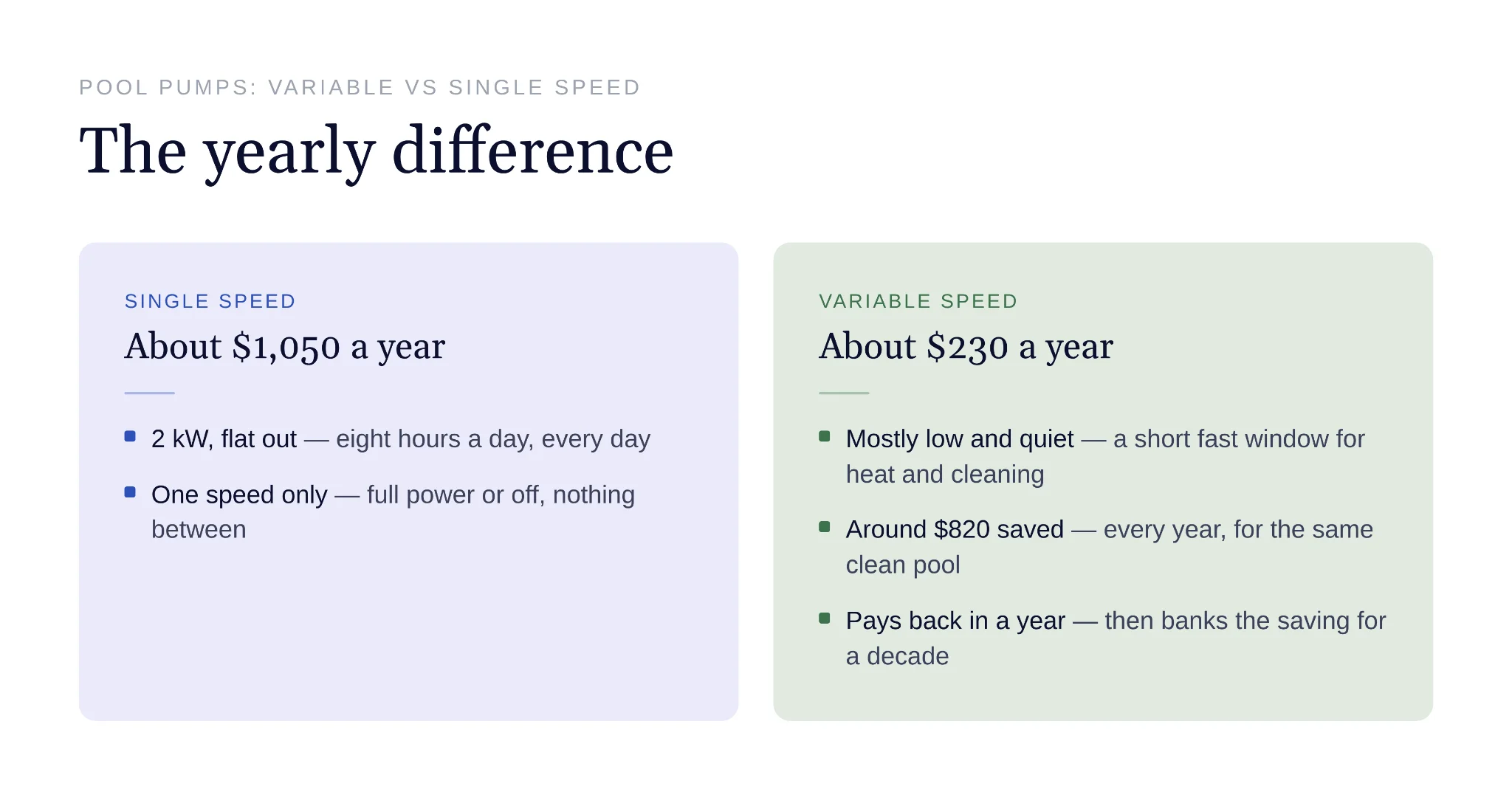
A common single-speed setup: a 2 HP pump pulling roughly 2,000 watts (2 kilowatts) running 8 hours a day.
- 2 kW × 8 hours = 16 kWh per day
- 16 kWh × 365 days = 5,840 kWh per year
- At $0.18 per kWh → about $1,050 a year, just to run the pump.
Now the variable speed pump, filtering the same pool.
It runs most of the day slowly, say 12 hours at a low speed drawing around 250 watts, and a couple of hours faster for the heater and cleaning. That lands somewhere near 3.5 kWh a day in typical use.
- 3.5 kWh × 365 → about 1,280 kWh per year
- At $0.18 per kWh → roughly $230 a year.
The difference is about $820 a year, every year, for the same clean pool.
The variable speed pump costs more up front.
Call the premium $700 to $1,000 over what you’d have paid for the single-speed. Divide the premium by the annual savings, and the payback lands around one year, maybe a year and a half.
After that, the pump is handing you eight hundred-odd dollars a year for the rest of its life, which is a decade or more.
That’s the case in a nutshell. A thing that pays itself back in a year and then prints money for ten is not a close call.
Which Way the Number Bends
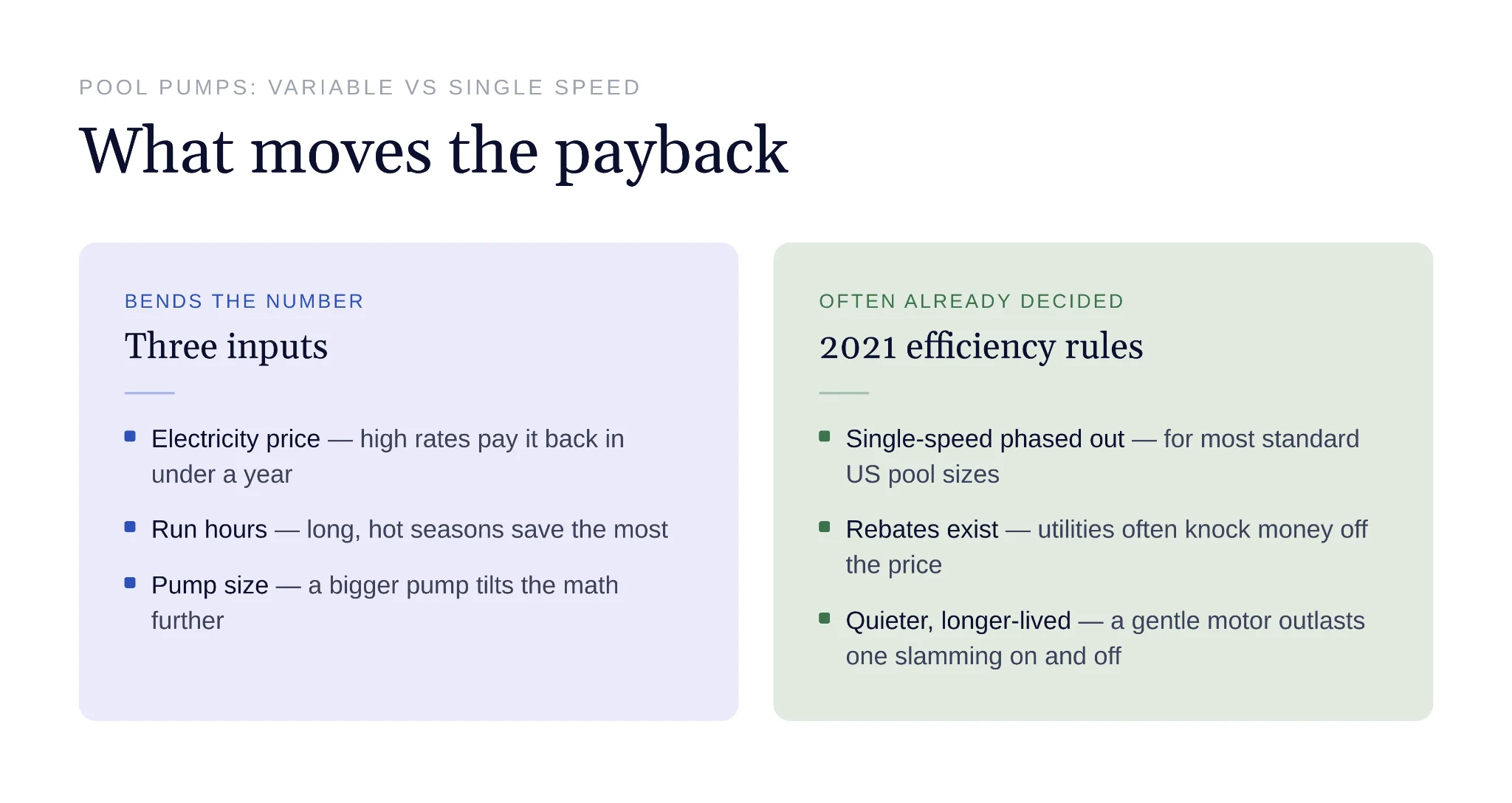
Those figures swing hard on two inputs, and your actual payback depends entirely on where you land on both.
Electricity price
The whole saving is measured in kilowatt-hours, so the value of each one scales straight with your rate.
At $0.30 a kWh, coastal California, parts of the Northeast, the annual saving is closer to $1,400, and the pump pays back in well under a year.
At $0.10 a kWh, cheap-power territory, the same savings shrink to maybe $450 and the payback stretches toward two years or more. Still worth it. Just slower.
Run hours
A pump running 12 hours a day in a hot climate with a long season saves far more in absolute dollars than one running 6 hours for four months up north.
More hours of the inefficient single-speed burning full wattage is more hours the variable speed avoids. The longer and harder your pump runs, the faster the better pump pays off.
Pump size
A big 3 HP single-speed on a large pool is pulling even more watts for even longer, so the savings are bigger and the math is even more lopsided. A tiny pump on a small plunge pool that runs a few hours a day moves the least money and has the longest payback of any case here, sometimes long enough that it’s genuinely a toss-up.
Run those two sliders to their stingy ends at once, cheap power, short season, small pump, and you reach the one scenario where the honest answer is that the single-speed might cost less over its life.
It exists. It’s rare, and it’s getting rarer, for a reason that has nothing to do with the math.
You May Not Have a Choice Anyway
In the US, federal efficiency rules that took effect in 2021 effectively ended the single-speed pump for most pool sizes.
Dedicated-purpose pool pumps above a fairly low horsepower threshold have to meet an efficiency standard that a single-speed motor simply can’t hit, which in practice means the pump you can legally buy new for a standard residential pool is a variable-speed one. The old single-speeds are gone from the shelves for those sizes.
So for a lot of people the comparison is already settled by regulation, and the only live question is whether to replace a still-working single-speed early or wait until it dies.
A few places offer their own rules on top, and plenty of utilities offer rebates, often a few hundred dollars knocked straight off the purchase, which shortens the payback further. Worth a five-minute check of your utility’s site before buying; the rebate is money sitting there for the claiming.
When Replacing Early Makes Sense, and When to Wait
A single-speed pump that’s old and about to fail is an easy call. Replace it now with a variable-speed pump, start banking the savings, and don’t throw good money at repairing the old one.
A single-speed that’s only a year or two old and running fine is the harder case.
You’d be eating the remaining value of a pump that still works.
The savings are real enough that the early swap often still pays, eight hundred a year covers a lot of premature replacement, but it’s the one situation where sitting tight and waiting for the old one to give out is a defensible choice rather than a mistake.
Run your own numbers on it. Remaining life of the current pump against the annual savings you’re forgoing by keeping it.
Get more pool and lawn care guides from Aiper on Google