How to Remove Calcium Silicate Scale From Pool Surfaces

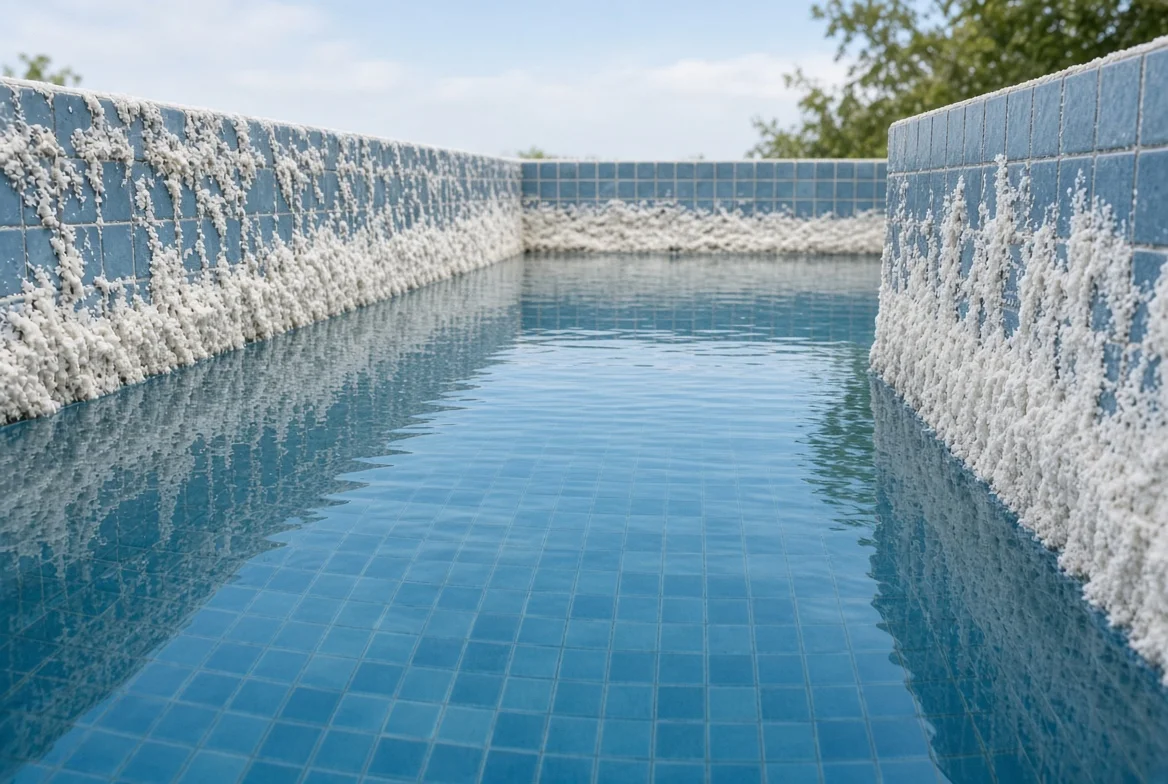
Two different mineral deposits show up as white crust on pool tile and plaster, and they call for opposite treatments. Calcium carbonate is the soft, flaky one that dissolves in acid. Calcium silicate is the gray, dense one that acid leaves untouched.
Getting silicate off takes mechanical removal, usually a professional service. Getting it to stay off takes a change in water chemistry, because the deposit took years of the same conditions to build.
Confirm It’s Silicate, Not Carbonate
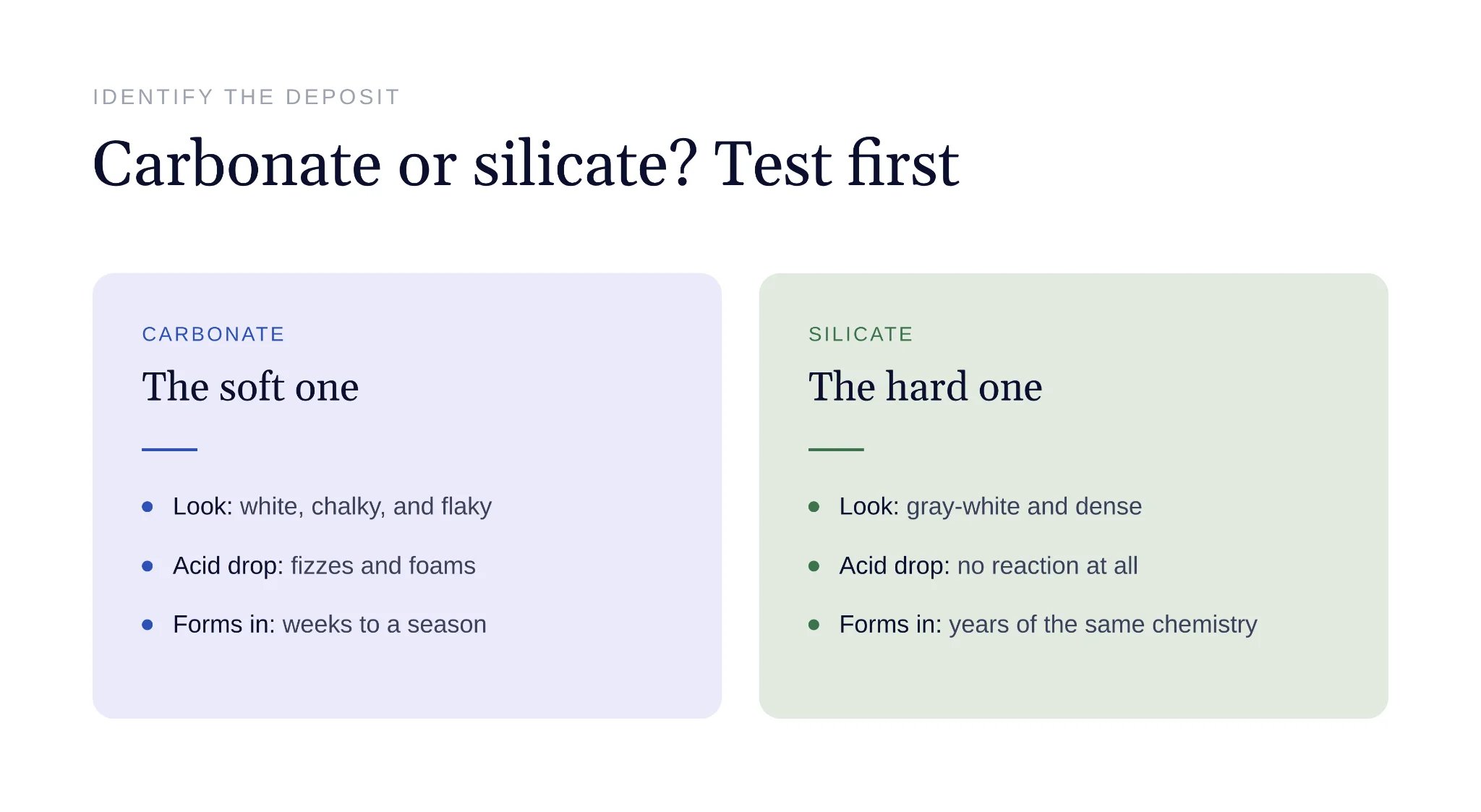
Test before buying any product. The wrong method on the wrong deposit wastes an afternoon and can scratch the surface permanently.
- Put on goggles and gloves, and work above the waterline on a dry patch of the deposit.
- Place one drop of muriatic acid on the crust. A drop is enough.
- Watch for a reaction. Fizzing and foaming means calcium carbonate. No reaction at all means calcium silicate.
| Calcium carbonate | Calcium silicate | |
|---|---|---|
| Look | White, chalky, flaky | Gray-white, dense, cloudy |
| Acid drop test | Fizzes | No reaction |
| Time to form | Weeks to a season | Years |
| Removal | Acid products, pumice on hard surfaces | Mechanical, usually bead blasting |
| Also found in | Waterline tile | Tile, plus pipes and the filter |
Silicate deposits often mean the same material has built up in the plumbing and filter, so the visible band at the waterline is one part of a larger problem.
Why Silicate Scale Forms
Scale of any kind forms when pool water holds more dissolved mineral than it can carry. The National Plasterers Council encourages using the Saturation Index to keep water balanced, with an ideal range of 0.0 to +0.3, and notes that high salt levels and elevated cyanuric acid both shift those calculations.
Hard fill water is the other half of it. The USGS classifies water above 180 mg/L as very hard, and every gallon added to replace evaporation brings that calcium with it while the water that left took none of it along.
Silica is the ingredient that makes the deposit silicate rather than carbonate. It enters through fill water and some algaecides, and it binds with calcium into a coating closer to cement than to chalk.
What Won’t Remove It
Plenty of products get sold for this job and can’t do it. Before spending money, rule these out:
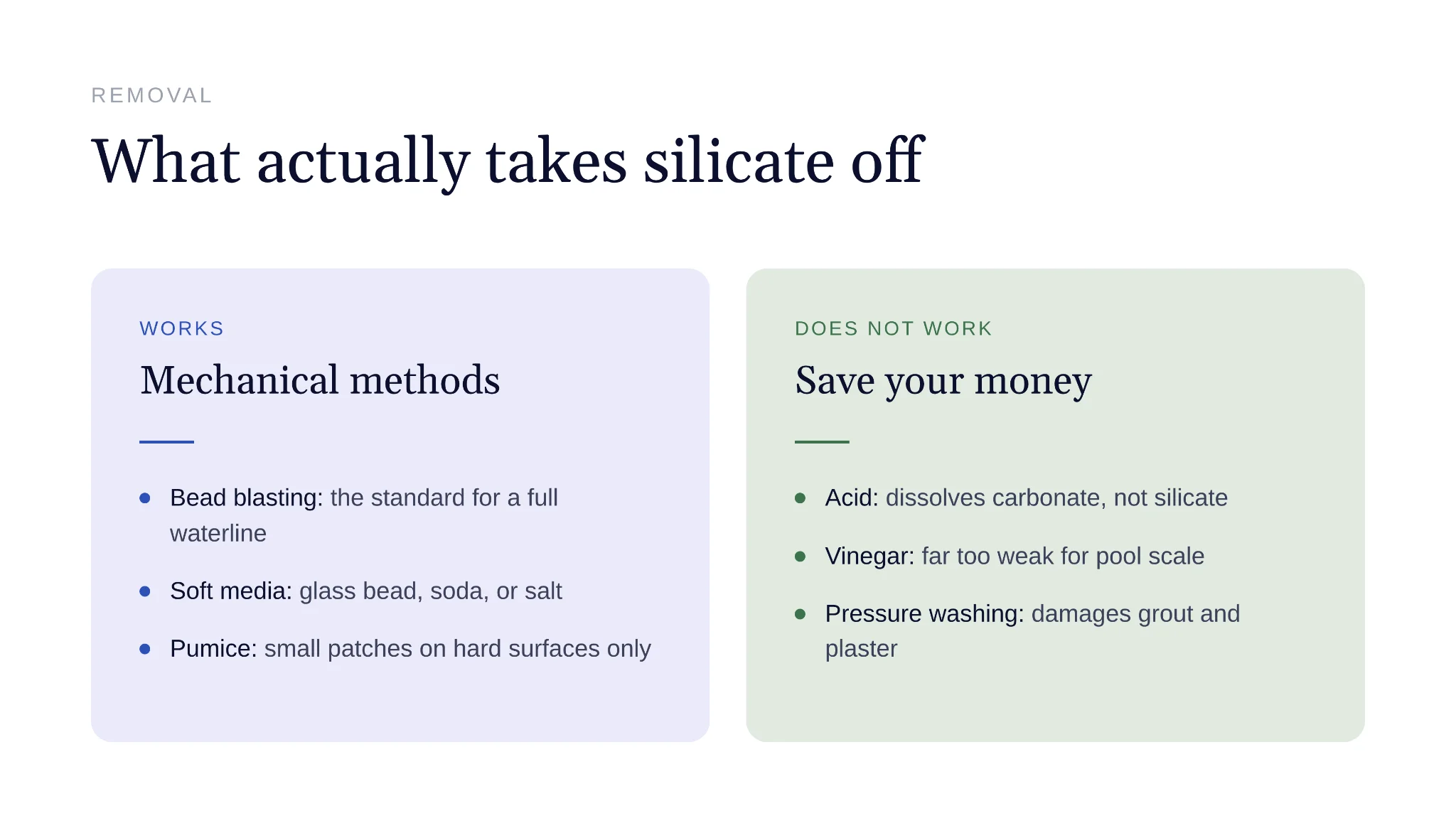
- Vinegar and lemon juice. The acid is far too weak for any pool scale.
- Muriatic acid. It dissolves carbonate and does nothing to silicate, while still damaging grout and plaster if it dwells.
- Scale removers formulated for carbonate. Read the label, and assume a product that relies on acid won’t work.
- Pressure washing. Standard pressure washers don’t shift silicate and can damage grout and plaster.
- Pumice on glass or iridescent tile. It removes some silicate and scratches the glaze permanently.
How Silicate Scale Gets Removed
Mechanical removal is the only route that works across a whole waterline. The method depends on how much surface is affected.
Bead blasting is the standard for a full waterline. A technician sprays fine media at low pressure to strip silicate without gouging the plaster or tile underneath. Softer media such as glass bead, sodium bicarbonate, or salt are gentler on glazed tile than silica sand.
Pumice works on small patches, and only on hard ceramic tile or plaster. Keep it wet, keep the surface wet, and stop if it leaves marks.
Abrasive pads handle moderate buildup on durable surfaces. They take real effort and won’t clear a heavy band.
Blasting is usually a one-visit job on a residential waterline, and the pool is typically drained below the tile line for the work. Media and loosened scale end up in the pool, so plan on vacuuming afterward.
Before and After a Blasting Service
The service removes the deposit. Everything before and after is on you, and it decides whether the tile stays clean.
- Test and record the water first. Get pH, total alkalinity, calcium hardness, cyanuric acid, and total dissolved solids on paper before anything changes.
- Check your fill water’s hardness. Your water utility publishes it, and well water can be tested with a kit. This number sets the floor for how low your pool’s calcium can go.
- Plan a partial drain. Replacing part of the water is the practical way to bring down calcium hardness and total dissolved solids, and it pairs naturally with a job that needs the level lowered anyway.
- Refill and rebalance immediately. Bring pH and alkalinity into range as the pool refills rather than days later.
- Recalculate the Saturation Index. Use the new numbers, not the ones from before the drain.
Keeping the Chemistry From Rebuilding It
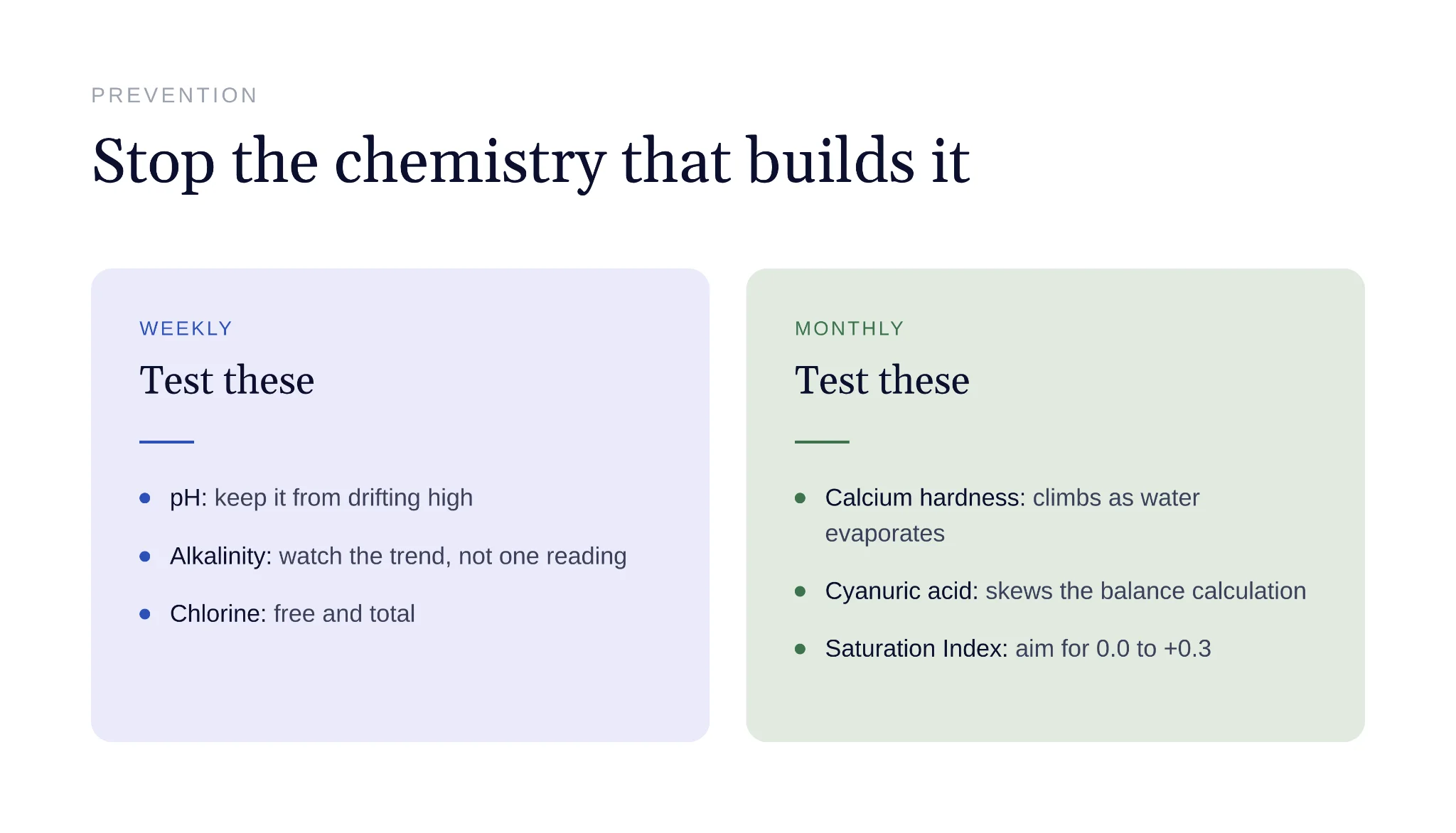
Silicate scale is a chemistry problem that shows up as a cleaning problem. The NPC recommends testing pH, total alkalinity, and chlorine one to two times a week, and calcium hardness, cyanuric acid, and total dissolved solids once a month.
Watch calcium hardness through the summer in particular. Evaporation removes water and leaves minerals behind, so hardness climbs steadily in hot weather even when nothing is added to the pool.
Cyanuric acid deserves the same attention. High stabilizer levels change the alkalinity reading used in the Saturation Index calculation, which means the water can be scaling while the numbers look acceptable.
Brushing Between Services
Fresh deposits come off far more easily than cured ones. Scale that has sat through a season becomes the hard, gray layer that needs blasting, so the waterline and walls are worth brushing on a schedule rather than when a band appears.
A robotic cleaner covers most of that work without a weekly session on the pole. The Aiper robotic pool cleaners scrub the floor, walls, and waterline on a set cycle, which keeps soft deposits from sitting long enough to harden.
Brushing won’t remove silicate that has already formed. It keeps new buildup soft enough that the next removal is a scrub rather than a service call.
Get more pool and lawn care guides from Aiper on Google