


Copper stays invisible in pool water. It can sit dissolved and colorless for weeks, then show up as a blue-green cast across the shallow-end floor the morning after a heavy shock.
If the cause of discolored or cloudy water is still unclear, start with the Pool Water Troubleshooting Wizard – Diagnose & Fix Green or Cloudy Water to compare symptoms and test readings before choosing a treatment.
By the time that cast appears, the copper has already left the water and bonded to the plaster.
While it’s dissolved, it’s removable.
Getting it back off once it’s bonded to the surface means a stain-removal program or draining the pool for an acid wash, which is slow and hard on a plaster finish.
The work is in the window between pulling the copper out before a pH swing or a dose of chlorine drives it onto the wall.
Where the Copper Is Coming From
Removal only holds if the source stops. Do everything else right, dose it, drain it, refill it, and a corroding heater still puts the copper back to staining levels within a month, so the source is worth ruling out before any treatment.
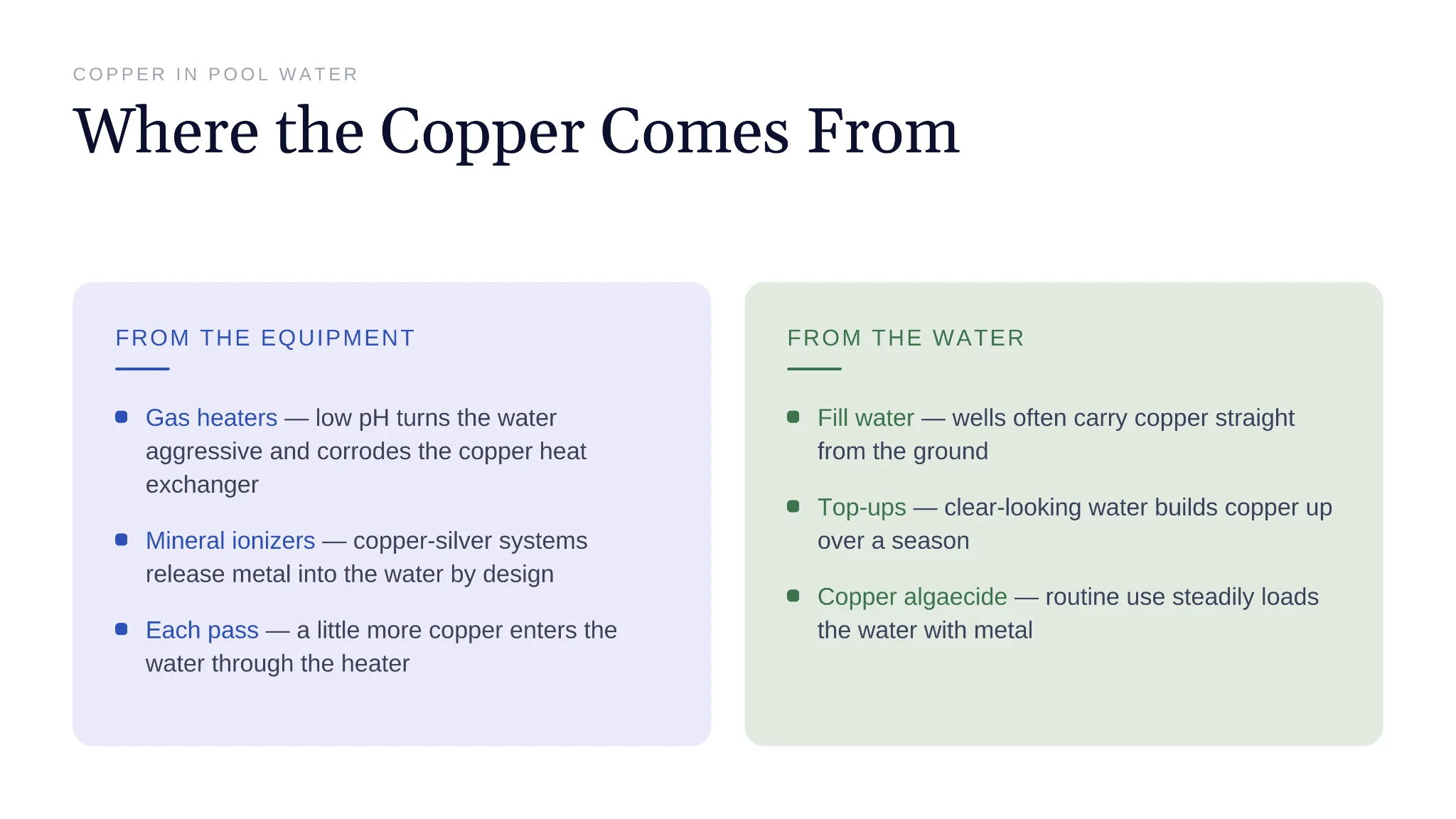
The usual culprit is a gas heater.
A copper heat exchanger sits inside it, and when pH drifts low, under 7.0, which happens faster than most owners expect when acid demand isn’t tracked, the water turns aggressive and starts eating the exchanger from the inside.
Every pass through the heater adds a little more copper to the water.
Mineral sanitizer systems are the next source.
Copper-silver ionizers put metal into the water on purpose; run one too hard, or let pH climb, and the copper it releases is the copper that stains. Then there’s the fill water. Homes on well water often pull copper straight from the ground, and a top-off that looks clear can carry enough to build up over a season.
Last is copper-based algaecide, effective and cheap, and a steady way to load the water with metal when it’s used as routine maintenance instead of a one-off.
Know the Number Before Treating
Treating blind wastes product and time. The first real step is a copper test, a drop-based metal kit, or a sample taken to a shop that runs a proper panel, to turn a vague tint into a number to work against.
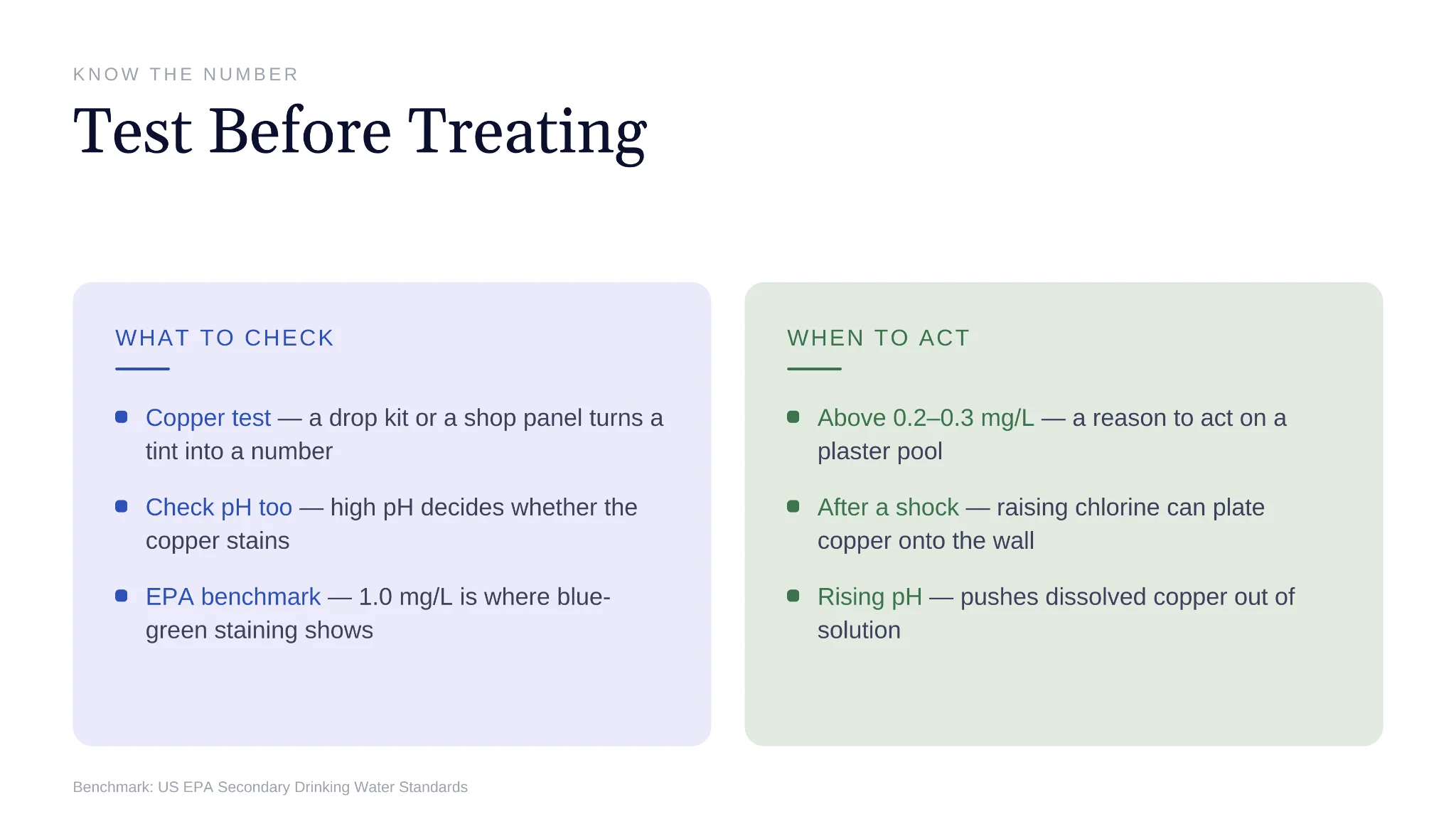
One benchmark is worth knowing. The EPA flags copper at 1.0 mg/L as the level where blue-green staining and a metallic taste become noticeable.
That figure is written for drinking water, and a pool is harsher at the margin. High pH and a shock dose can plate copper out well below it. On a plaster pool, treat anything above roughly 0.2 to 0.3 mg/L as a reason to act rather than a number to sit on.
Getting the Copper Out
No single product does the whole job.
The staining happening right now has to be stopped, the total copper in the water has to come down, and the plaster has to stay clear while both of those play out. So three jobs and three methods, run at the same time.
Hold it in suspension with a sequestrant
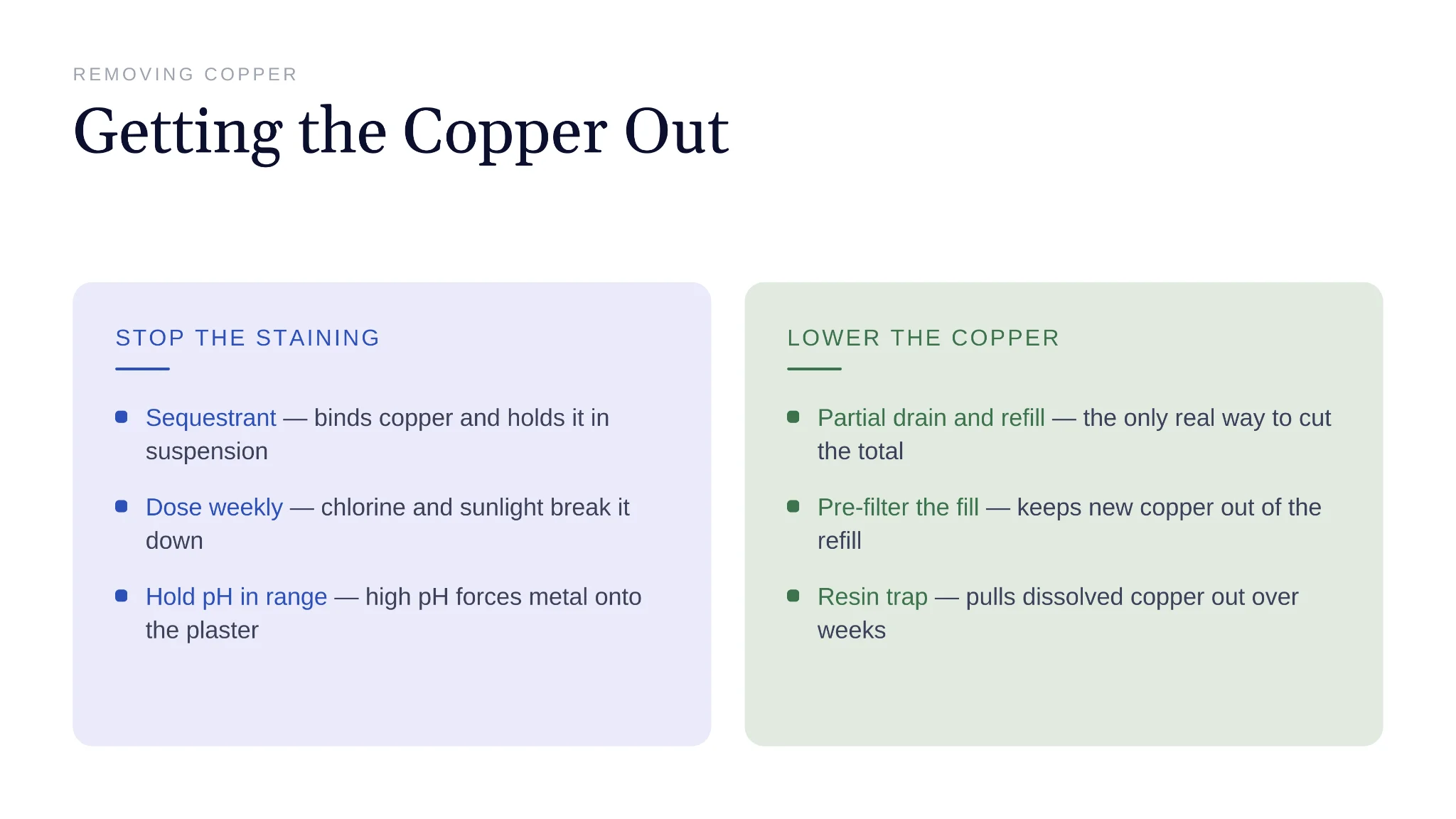
The first move, the same day a high test comes back, is a sequestrant, a metal control product, usually HEDP-based, sold as “metal out” or something close. It binds the copper and locks it in solution so it can’t drop onto the plaster.
What it doesn’t do is take any copper out of the pool; the metal is still in the water, only held. And it breaks down.
Chlorine and sunlight chew through it inside a week or two, which is why a weekly maintenance dose matters. Skip the follow-ups and the copper that was being held starts plating out again, usually right after the next shock.
Dilute it out with a partial drain
Sequestering buys time. It doesn’t lower the copper, and the only straightforward way to do that is to replace water. Draining a quarter to a third of the pool and refilling cuts the copper by roughly the same fraction, which is simple, reliable, the one method that actually reduces the total in the water.
The catch is the refill. If the fill water is where the copper came from, running it straight in through a garden hose just tops the problem back up, so a hose-end pre-filter on the fill line is what makes the swap worth doing.
Trap it on a resin
For copper that’s already dissolved, a standard sand or cartridge filter is no help. The metal is in solution as ions, not floating as particles the filter can catch.
A chelating-resin trap is what grabs it: a pouch of metal-binding resin dropped into the skimmer or pump basket, where water passes through it every cycle and leaves a little copper behind each time. It works slowly, over days and weeks, and it pulls real copper out instead of just holding it.
For a pool that can’t be drained easily, a high water table, a region on water restrictions, a resin trap paired with a sequestrant is often the only practical answer.
| Method | What it actually does | Timeline |
|---|---|---|
| Sequestrant | Holds copper in suspension so it can’t stain; removes nothing | Same day, needs weekly re-dosing |
| Partial drain and refill | Lowers total copper by the fraction of water replaced | A day, immediate drop |
| Chelating-resin trap | Pulls dissolved copper out of the water as it circulates | Weeks of continuous filtering |
Put in order, a copper problem on a plaster pool runs like this:
- Test for copper and check pH at the same time.
- Add a sequestrant immediately if copper reads high. This stops the staining clock while everything else happens.
- Bring pH back into range and hold it there, since high pH on top of high copper is what forces the metal onto the wall.
- Set up a resin trap in the skimmer or pump basket and run long filter cycles.
- Drain a quarter to a third and refill through a pre-filter if the reading is stubborn or the fill water is the source.
- Retest after a week before deciding on another round.
Stop It Coming Back
Copper removed is not copper gone for good. The same source that loaded the water once will do it again, so the last task is closing the inlet.
Keeping pH in the 7.0 to 7.8 range the CDC recommends for pool water stops the water from turning corrosive and stripping copper off the heat exchanger in the first place.
A sacrificial anode, a zinc block plumbed into the circulation line, gives aggressive water something to corrode instead of the copper in the system. And the algaecide, if that was the way in, comes off the shelf; a polyquat algaecide does the same job without the metal.
Keep the Surface Clean While the Chemistry Works
Chemistry handles the copper. The plaster still needs attention while it does, because copper plates out fastest where water goes still, and debris settles on the deep-end floor, shaded step corners, behind the ladder.
A dead spot with a layer of leaf grime on it is exactly where a stain takes hold, even with a sequestrant in the water.
Keeping the floor and walls brushed, and the water moving across them denies copper those footholds.
A robotic cleaner earns its place here: running an Aiper robotic pool cleaner over the plaster daily keeps the surface scrubbed and pushes water through the spots the returns miss, so nothing sits long enough to plate.
Get more pool and lawn care guides from Aiper on Google