How to Drain a Pool Safely (and When You Actually Need To)

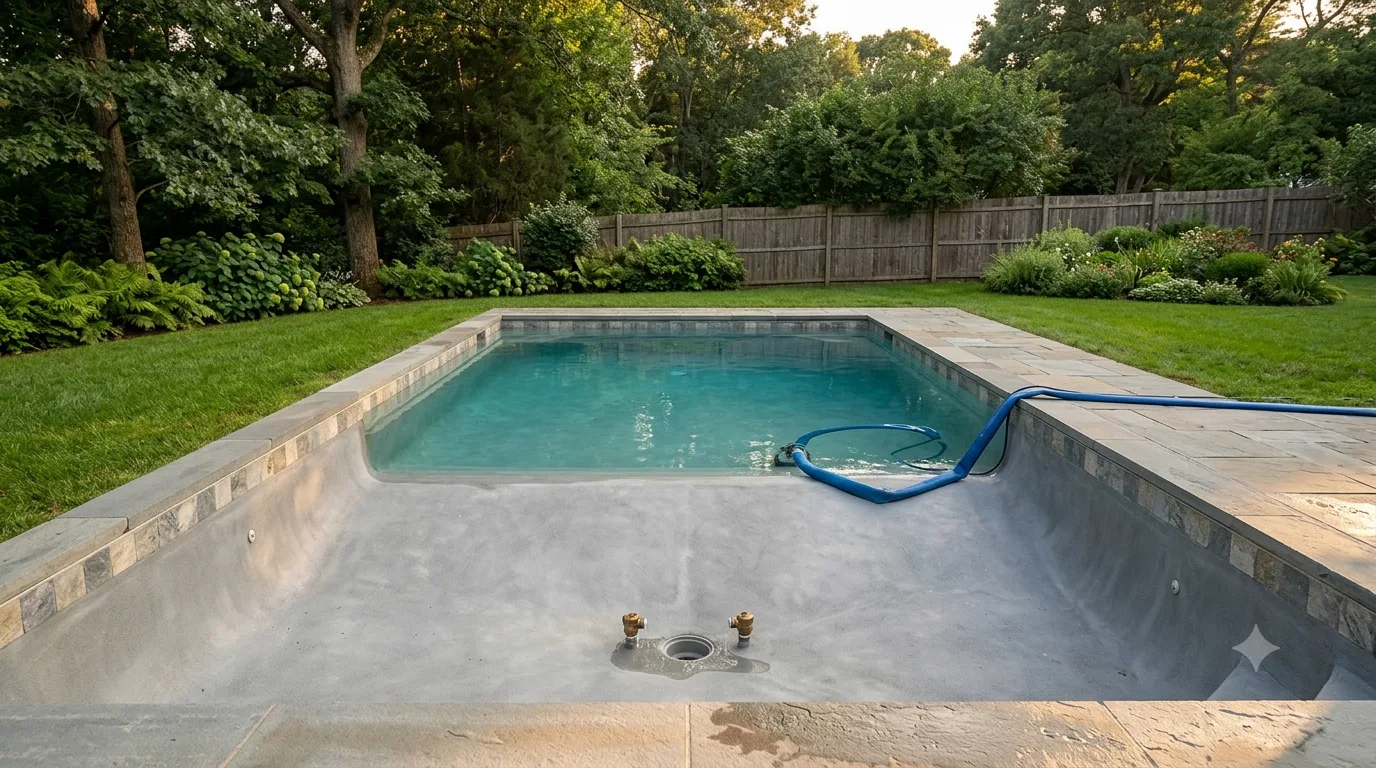
Here’s the thing nobody tells you until it’s too late: an empty pool is more dangerous to itself than a dirty one.
Pools are built to be full. The water pushes outward and downward against everything the ground is pushing in. Take it away, and you’ve changed the physics of a hole in the earth that was engineered around a very specific assumption, and the ground does not care that you had good intentions.
Every year, someone drains a pool to clean it properly, walks away for a weekend, and comes back to find the shell has lifted out of the ground like a boat. Fiberglass pools do this. Concrete pools do this. It’s called popping, which happens when groundwater pressure under the empty shell has nothing holding it down anymore, and it is not repairable in any way that resembles affordable.
Most Draining Is Unnecessary
The reasons people think they need to drain: the water’s cloudy, it’s green, it’s been a rough season, it “just needs a fresh start.”
None of those are draining problems. All of them are chemistry problems, and chemistry problems get solved with the water in the pool.
A green swamp of a pool, genuinely green, opaque, frogs-have-opinions green, can be brought back with chlorine, patience, and a filter that runs around the clock for a week. It’s tedious. It’s still cheaper and safer than draining.
A partial drain and refill handles almost everything else. Closing for winter is the one seasonal exception: after dropping the water below the skimmer, you still have to blow out the pool lines before winter so trapped water can’t freeze and split the plumbing. Drop the water a third, top it back up, and you’ve diluted whatever was accumulating. Do it twice if the numbers are bad. You never expose the shell, you never gamble against the water table, and the pool stays a pool the entire time.
The Short List of Real Reasons
There are only a few situations where a full or near-full drain is actually the right call, and every one of them shows up on a test, not in a feeling.
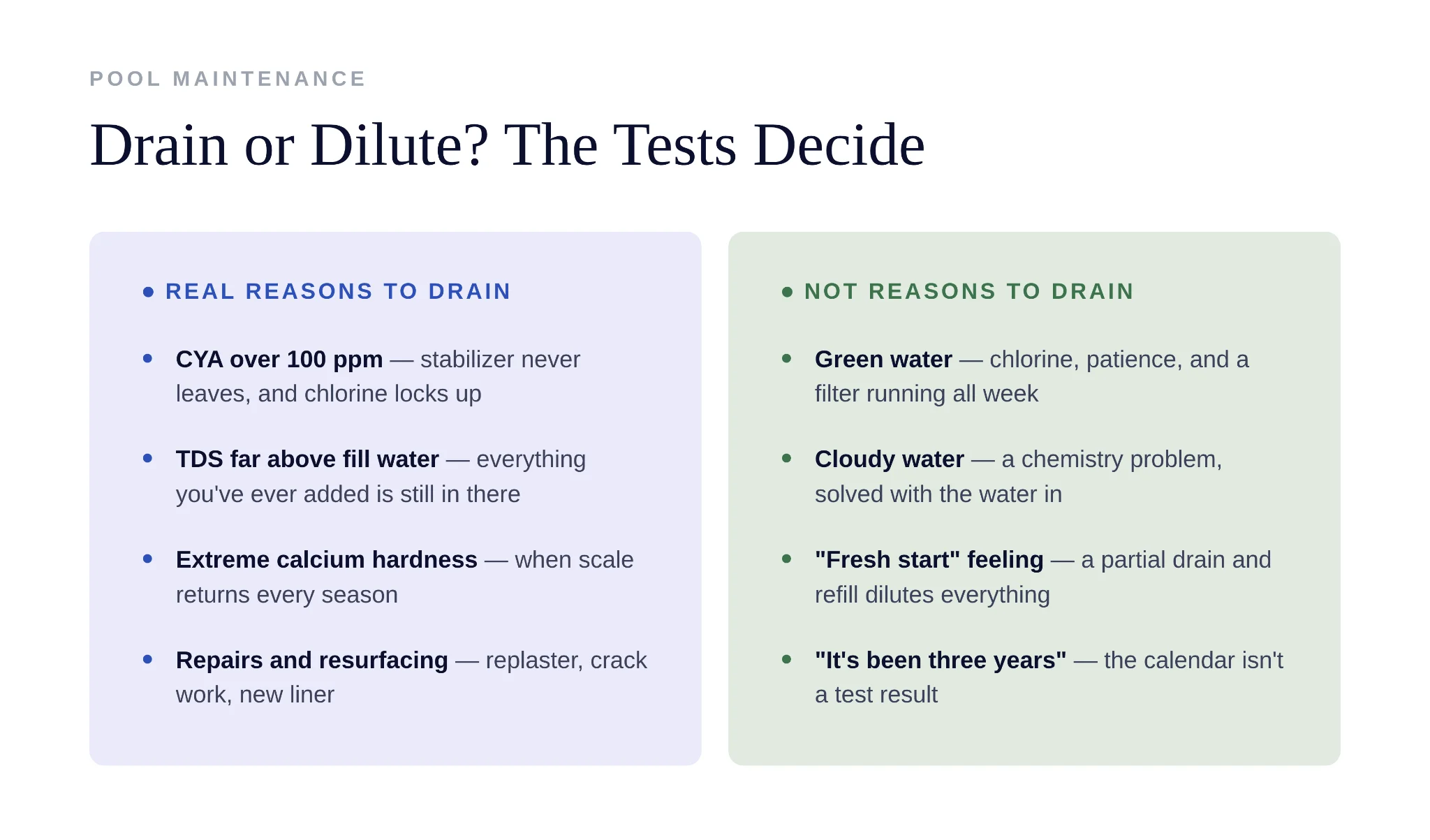
Cyanuric acid over 100 ppm: This is the most common one. Stabilized chlorine, trichlor pucks, dichlor shock, adds cyanuric acid every time you use it, and CYA never leaves. It doesn’t evaporate, it doesn’t filter out, it just builds, season after season, until there’s so much of it that your chlorine can’t do its job no matter how much you add. People call it chlorine lock. Dilution is the only fix, and at very high levels, partial drains stop being practical.
Total dissolved solids far above your fill water: Everything you’ve ever added to the pool is still in there in some form. When TDS climbs a couple thousand ppm past your tap water, the chemistry starts behaving strangely, and the water feels off no matter what the individual numbers say.
Calcium hardness through the roof: Common in hard-water regions where evaporation concentrates minerals year over year. When you’re scraping scale off the tile line every season, dilution beats chemistry.
Repairs and resurfacing: Replastering, major crack repair, liner replacement. No way around it. Before draining for any repair, confirming the leak’s exact location with our guide to finding a leak in an inground pool saves you from draining a section that was never the problem. If a quote for this work is unclear, see the difference between pool resurfacing and replastering.
That’s the list. If the tests don’t say drain, don’t drain.
Groundwater Is the Whole Game
This is the part that deserves the most attention, because it’s the part that destroys pools.
The soil around your pool holds water. After rain, after snowmelt, in low-lying yards, near creeks, sometimes a lot of it, sitting at a level higher than the bottom of your pool. A full pool doesn’t notice. Sixty or eighty thousand pounds of water inside the shell easily outweighs the pressure from below.
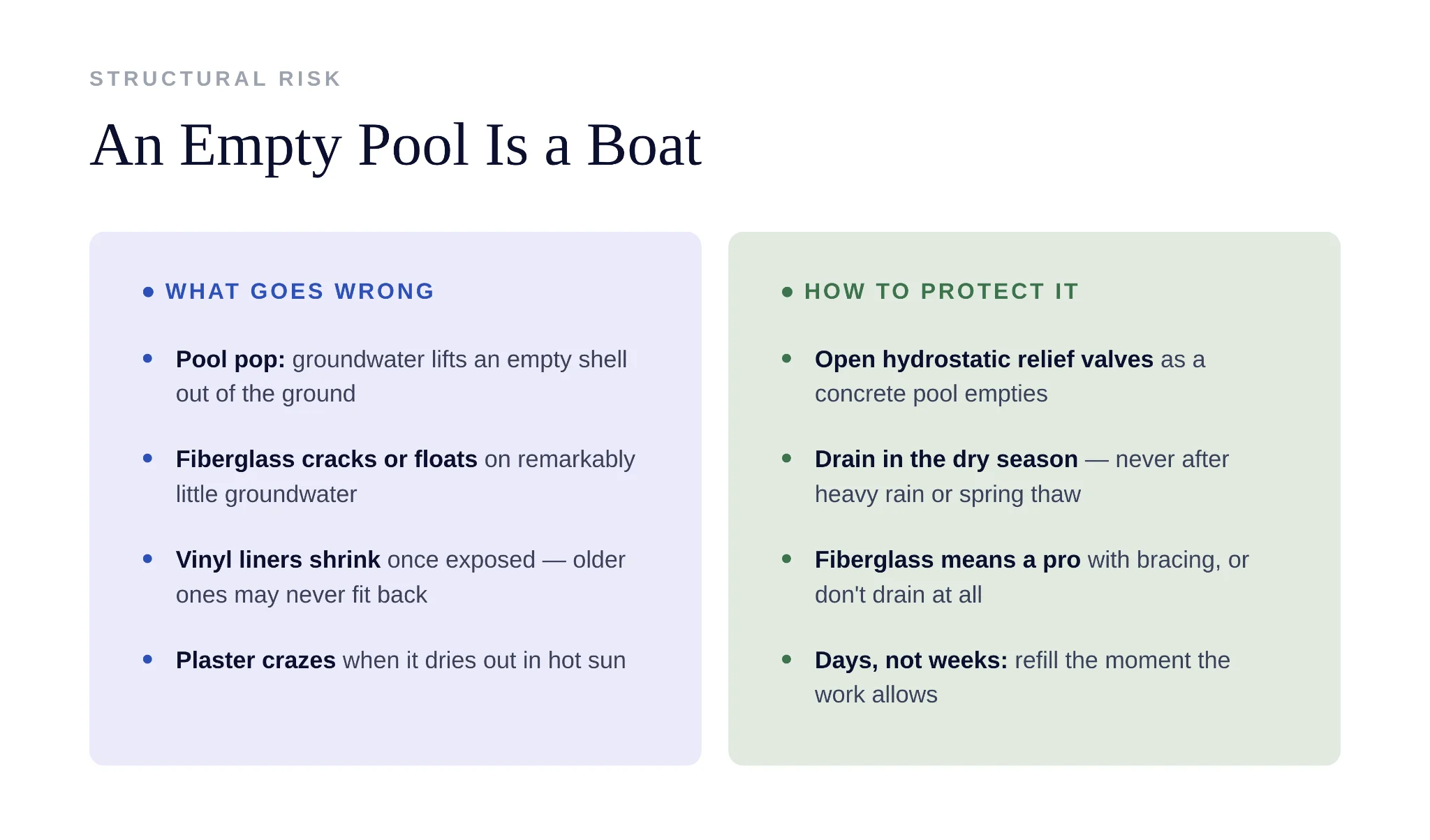
An empty shell is a hollow object in wet ground. Physics calls that a boat.
Concrete pools have a safeguard for exactly this: hydrostatic relief valves, usually plugged into the main drain sump at the deep end. Opened during a drain, they let groundwater flow up into the pool instead of pushing against the shell.
If you’re draining a concrete pool, you open them. Not optionally. If you don’t know where yours are or whether they still work, that alone is a reason to hand this job to someone who does.
Fiberglass pools mostly don’t have them, which is why fiberglass manufacturers void warranties over unsupervised drains, full stop.
A fiberglass shell can bulge, crack, or float on remarkably little groundwater. If you own fiberglass and think you need a full drain, you need a pro with bracing equipment, and you need dry conditions, and honestly you should exhaust every dilution option first.
Vinyl liner pools have a different failure mode: the liner itself. Liners are held in place partly by water pressure, and they shrink once exposed — one reason draining a liner pool risks wrinkles that need working out of a pool liner.
Drain a liner pool that’s more than a few years old, and there’s a real chance the liner never fits back into its track: new wrinkles at best, a full replacement at worst. Partial drains only, unless the liner is being replaced anyway.
And timing.
Drain in the driest stretch of the year, when the water table is at its lowest. Never right after heavy rain. Never in early spring when the ground is saturated from months of weather. A drain that’s safe in late summer can pop a pool in April in the same yard.
One more thing while we’re here: exposed plaster in hot sun dries out, shrinks, and cracks. If you drain a plaster pool in a heat wave, you can watch the surface craze in real time. Empty time should be measured in days, scheduled around weather, with the work lined up before the water leaves.
Where the Water Is Allowed to Go
Thirty thousand gallons has to go somewhere, and most of the obvious somewheres are illegal.
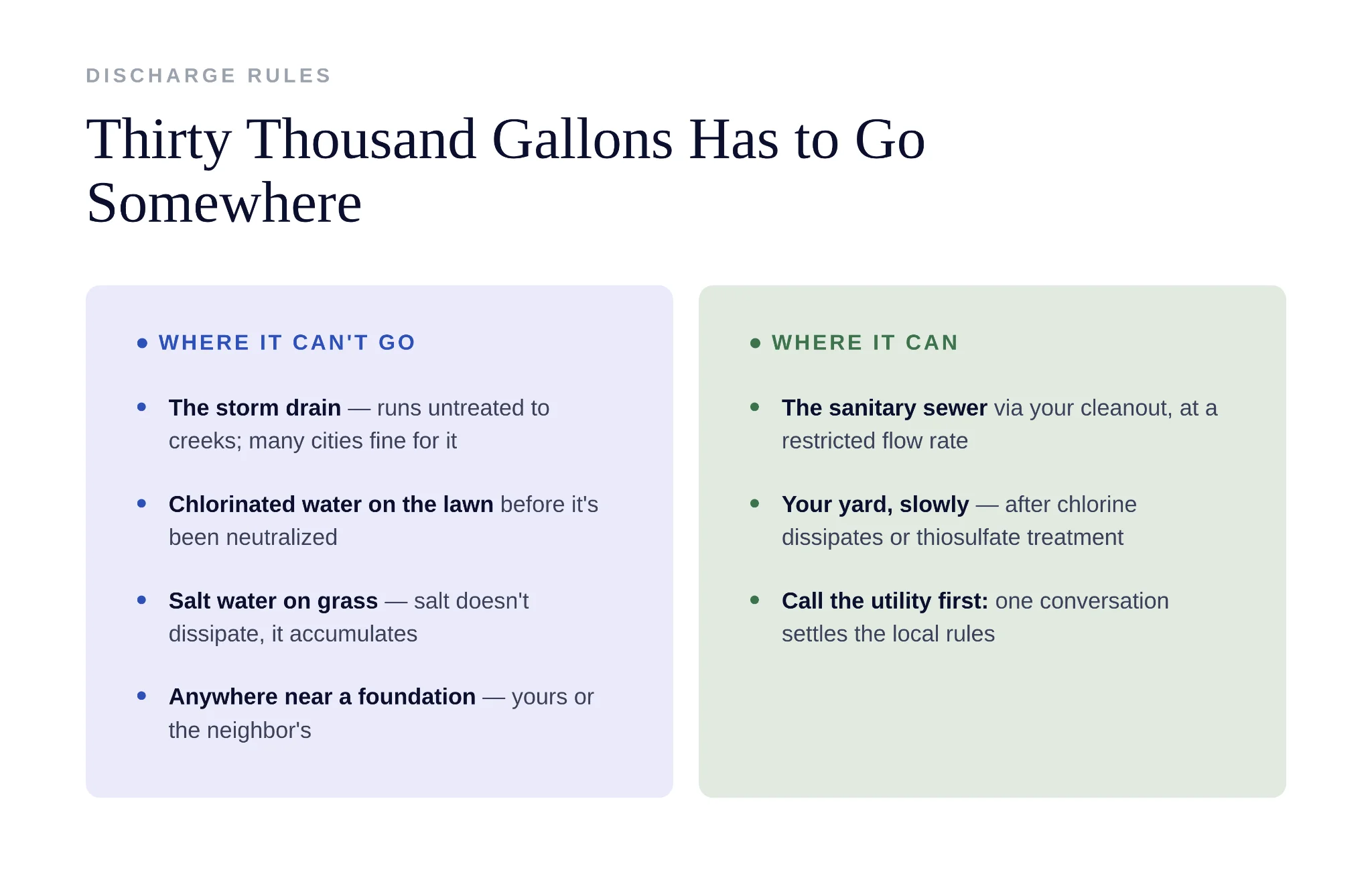
The storm drain is the one people reach for, and the one most municipalities prohibit. Storm drains run to creeks and rivers untreated, and chlorinated pool water kills things when it gets there.
Plenty of cities fine for this now, and some actively watch for it during drain season.
The usual legal route is the sanitary sewer, through the cleanout, that capped pipe near your house’s foundation, often close to a hose bib or the bathroom side of the house. Sewer water gets treated, so chlorine isn’t the problem it is in a creek. Many utilities allow this at a restricted flow rate so you don’t overwhelm the line; some want notice first. One phone call to your water utility settles what’s allowed where you live, and it’s a shorter conversation than the one that starts with a citation.
Your own yard can take some of it if the chlorine’s been neutralized, either let the pool sit without chlorination for several days so it dissipates, or dose with sodium thiosulfate and retest. Even then, slowly, moved around, and not toward the neighbor’s foundation. Saltwater pools complicate lawn discharge; salt doesn’t dissipate, and enough of it will brown whatever it soaks into.
The Drain Itself
Rent or buy a submersible pump. This is not a job for your pool’s circulation pump, it will lose prime as the water drops below the skimmer, run dry, and cook its shaft seal, and now your drain project includes a pump rebuild. For inground shells the stakes run higher at every step — how to drain an inground pool safely covers the full sequence before the pump even touches the water.
Sequence, roughly: kill power to the pool equipment at the breaker. Confirm your discharge plan and run the hose. Drop the submersible in the deep end and let it work. A decent one moves 2,000 to 3,000 gallons an hour, so plan on most of a day for an average pool. Open the hydrostatic relief valves as the deep end empties, if it’s concrete. Do whatever the drain was for: acid wash, repair, and resurface. Refill the moment the work allows.
Never leave it empty overnight if weather is coming. Never leave it empty for a week because the contractor got busy. Every day empty is a day of exposure you didn’t need.
Refilling and Starting Over
Hose in the pool, and settle in. Refilling takes as long as draining did, usually longer. Tie a clean cloth or sock over the hose end if your fill water runs through old pipes; it catches sediment and rust before they’re your problem — and while you’re at the plumbing, see our guide to unclogging pool lines that have slowed to a trickle.
Then treat the water like a brand-new pool, because it is one. Test everything: pH, alkalinity, calcium, CYA, which will now read near zero, so your chlorine is fast-acting but unprotected from sunlight until you rebuild the stabilizer to 30–50 ppm. If your area has metals in the fill water, add a sequestrant before you add chlorine, not after, unless you enjoy stain removal.
Balance it, run the filter, and you’re back, with numbers you won’t see this clean again for years. Worth writing them down. That’s your baseline for knowing when, a long time from now, the tests genuinely say drain again.
Fewer Reasons to Ever Reach for the Pump
Almost everything that makes people want to drain starts with organic load the chemistry has to burn through. Leaves, oils, dirt, whatever settles on the floor and sits there consuming chlorine while the numbers drift.
Keep that load off the water and the chemistry stays manageable, the shock treatments get smaller, and the slow accumulation of everything you’ve ever added slows down with it.
That’s the case for making cleaning automatic instead of occasional. Aiper’s robotic pool cleaners run on their own schedule, scrubbing the floor and walls and pulling debris out before it becomes something the chlorine has to deal with.
Get more pool and lawn care guides from Aiper on Google