
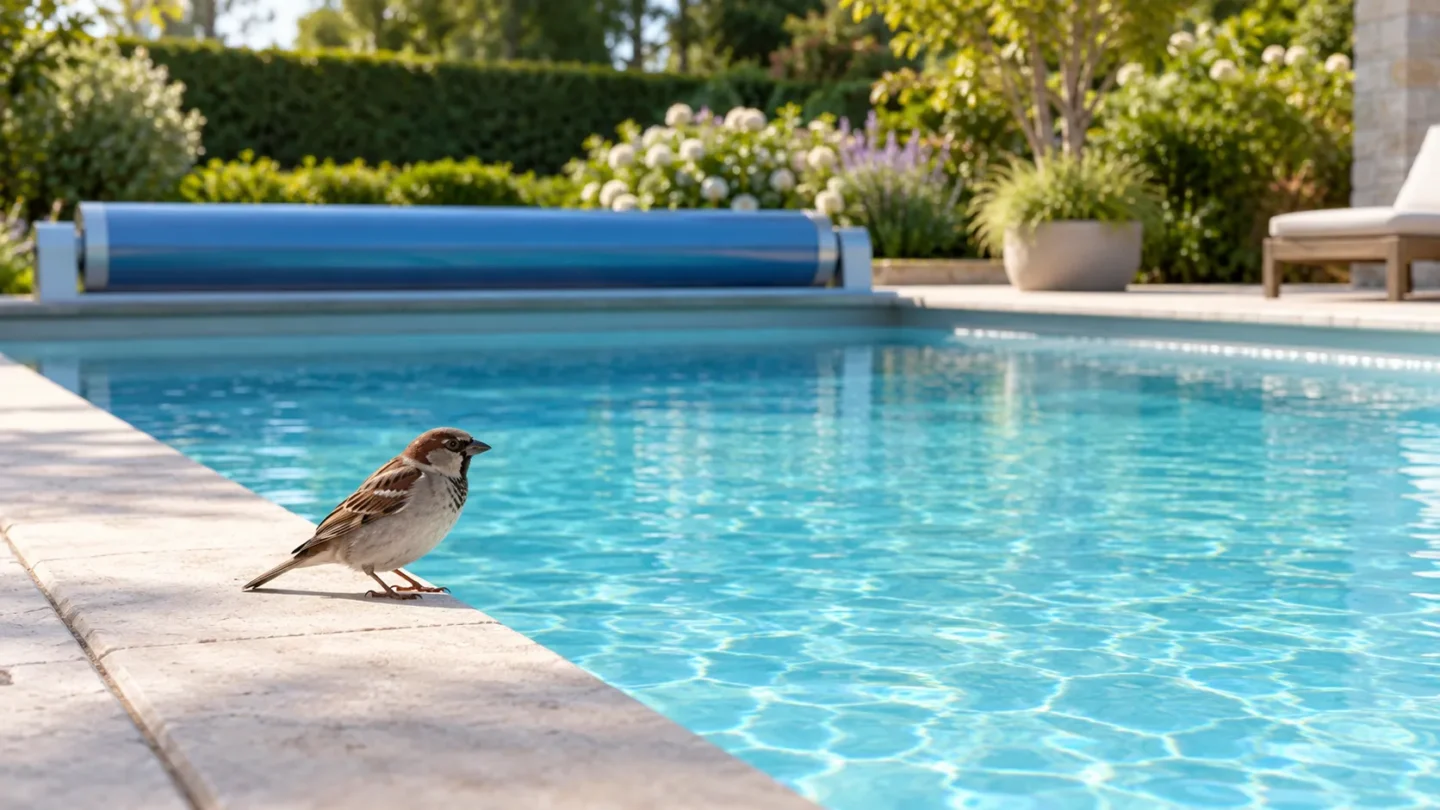
A pool is, to a bird, a large, clean water source sitting in the open. A place to drink, to bathe, and, from the edge, a place to leave droppings.
The droppings ruin a Saturday. Green-brown streaks on the steps, something floating you have to net out before anyone gets in, and if it’s been sitting, a stain on the plaster that doesn’t brush off easily.
That’s the visible problem.
The invisible one is worse, and it’s the reason this matters past aesthetics. Bird droppings carry bacteria like E. coli, Salmonella, and Campylobacter, and they carry algae spores and the nutrients algae feeds on.
A dropping in the water is a small bacterial load, and a dose of fertilizer dropped straight into water people swim in. Chlorine handles it if the chlorine’s doing its job, but a heavy enough hit, or a pool running low on sanitizer, and you’ve got a health problem and a green bloom starting at the same time.
So this is two jobs. Stop the birds from treating the pool as theirs. And handle what lands in the water fast enough that it never becomes the second problem.
Figure Out What the Birds Are Actually Doing There
Birds don’t visit a pool for one reason, and the reason decides the fix.
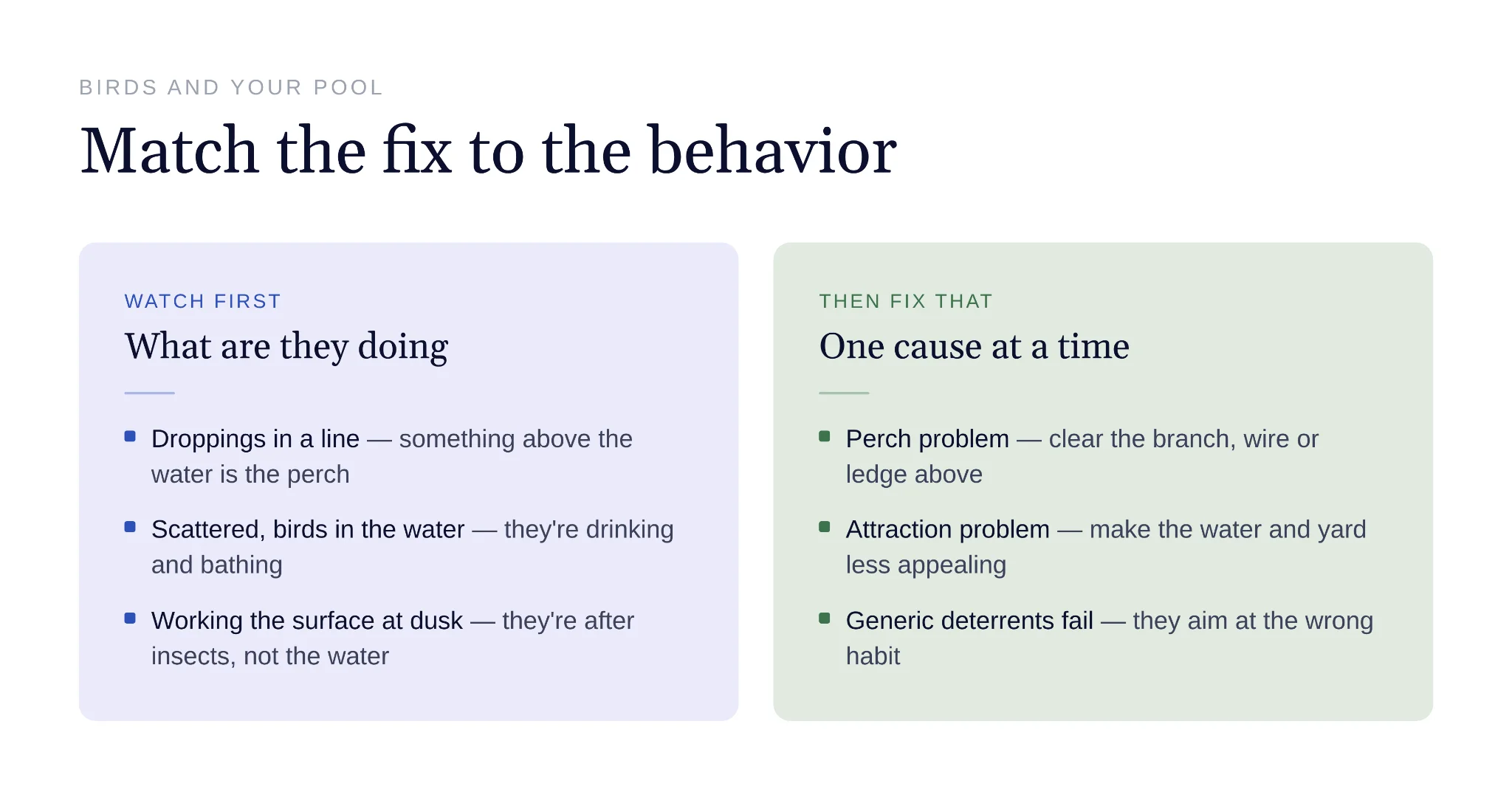
Some are drinking and bathing, as the pool is the nearest open water, so they’re using it the way they’d use a pond.
Some are perching above it, on a wire, a branch, a roofline, a patio cover, and the droppings land in the pool because that’s what’s underneath where they sit. Some are hunting, the pool draws insects, the insects draw birds, especially at dusk, and the birds work the surface for bugs.
And some pools get a specific visitor: ducks or geese that decide a pool is a pond and try to move in, which is a different and much bigger problem than a few sparrows.
Watch the pool for a day or two and see which it is.
If droppings are concentrated in a line under a wire or a branch, it is a perching problem. If droppings are scattered everywhere, birds are actually in and on the water, so make the water less appealing.
Ducks circling and landing is its own fight. The generic “bird deterrent” advice fails constantly because it’s aimed at the wrong behavior. Match the fix to what you actually see.
Take Away the Perch Above the Water
This is the highest-leverage thing on the list, and the one people skip because it’s less fun than buying a gadget.
If birds are sitting on something directly over the pool and fouling the water from above, the single most effective move is to stop them sitting there. A branch that overhangs the water, cut it back. A wire or cable crossing above the pool is harder to take care of, but it’s worth a call to whoever owns the wire about moving or sheathing it. A patio cover or pergola edge they line up on is where the physical deterrents actually earn their keep.
Bird spikes along a railing or ledge make a flat perching surface unusable without harming anything. They just can’t get a footing and go elsewhere. Anti-perch wire or a taut line strung an inch above a favorite ledge does the same job less visibly.
The point is narrow and specific: find the exact surface the droppings fall from, and make that one surface impossible to stand on. You don’t need to bird-proof the whole yard. You need to clear the few feet of perch sitting over open water.
Scare Devices Work Until They Don’t
The whole category of visual and noise deterrents, like the fake owls, the reflective tape, the floating predator decoys, the plastic snakes, the eyes-painted-on-a-balloon things, the ultrasonic boxes, shares one trait.
They work at first, and then the birds learn.
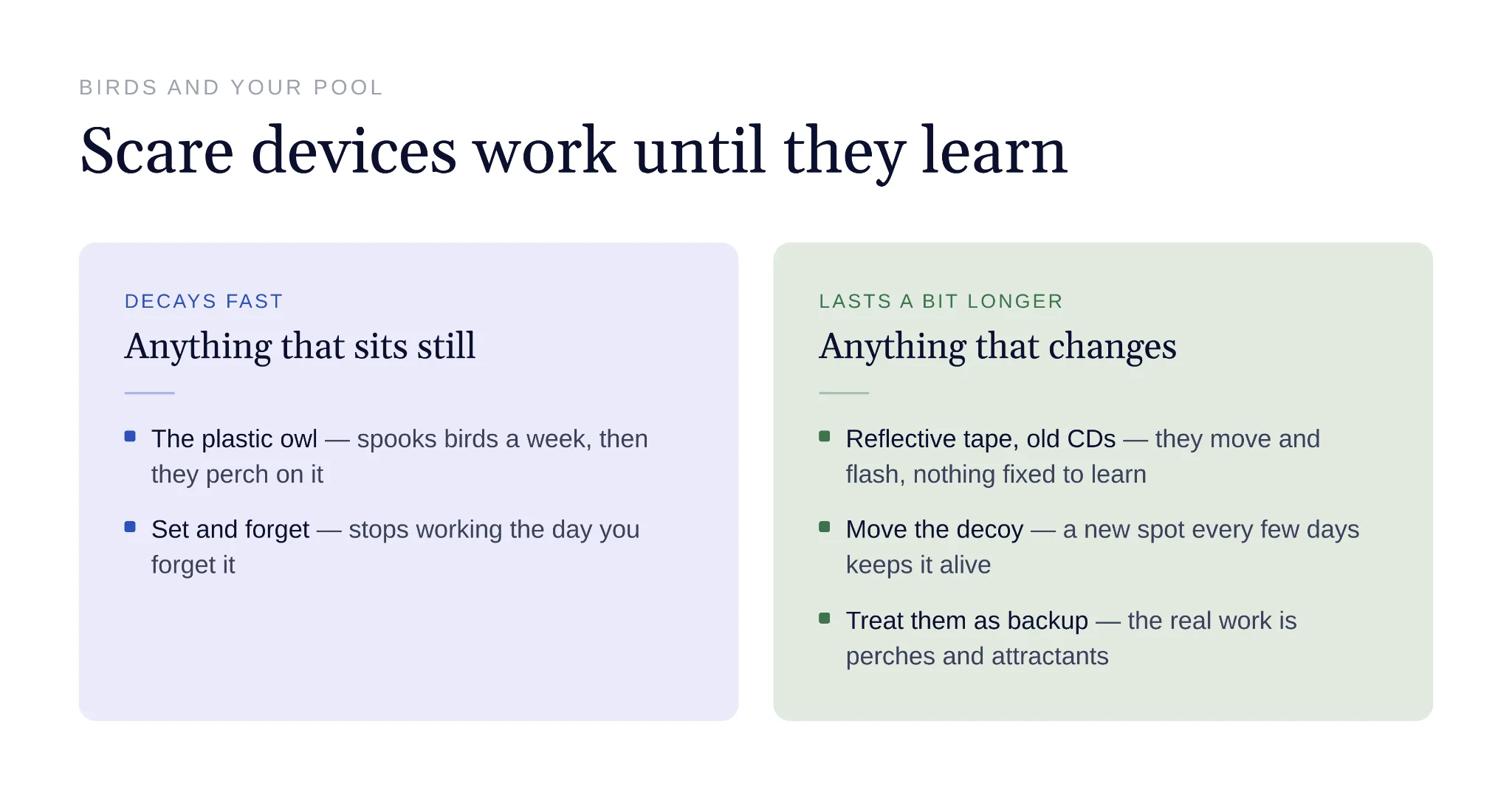
A plastic owl staring across the pool spooks birds for a week or two.
Then they notice it never moves, never hunts, never does anything an owl does, and within a month they’re perching on its head. Every stationary scare device decays the same way. The bird’s whole survival depends on telling a real threat from a fake one, and a prop that does nothing eventually reads as exactly what it is.
The ones that last a bit longer are the ones that change. Reflective tape and old CDs on a string move and flash in the wind, so there’s no fixed thing to get used to.
A decoy that you physically pick up and move to a new spot every few days keeps reading as alive because its location keeps changing. The effort is the ingredient. A deterrent you set and forget stops working on exactly the schedule you forget about it.
For most backyard pools, the honest read is that scare devices are a supplement, something to rotate through while the real fixes (the perch removal, the cover, cutting the attractants) do the lasting work. Buying a single plastic owl and expecting it to solve the problem is the most common way people waste money here.
A Cover Is the Thing That Actually Settles It
A pool covered when nobody’s swimming is a pool birds can foul all they like without a single dropping reaching the water underneath.
The tradeoff is the hassle, and it’s real.
A cover you have to drag on and off is a cover that gets used for the first week and then lives in a heap by the shed.
The ones people actually keep using are the easy ones, like an automatic cover that pulls across at the press of a switch, or a lightweight solar cover that’s quick to roll on and off and earns its keep heating the water besides. A heavy manual safety cover is excellent for a pool closing up for weeks, and far too much work for the gap between Tuesday and Saturday.
So the cover’s value depends entirely on whether you’ll use it. For a pool that sits unused most weekdays, a cover that’s genuinely easy to deploy solves the bird problem more completely than everything else on this page combined.
For a pool in use every day, the cover does less, because the hours it’d be protecting are the hours you’re in it.
Cut What’s Drawing Them In the First Place
Birds come for a reason that’s usually sitting in the yard.
A bird feeder anywhere near the pool is an open invitation. It concentrates birds in exactly the wrong spot, and birds that come to feed stay to drink and bathe and perch. Move the feeder to the far side of the property or take it down for the swimming season.
Also look for fruit trees dropping fruit, berries, or seeds that scatter near the water. This pull birds in to forage. Standing water elsewhere, like a clogged gutter, a birdbath, a low spot that holds a puddle, gives them a staging point right next door.
The insect angle is the one people miss.
A pool with a bug problem at dusk is a dinner table, and the birds working the surface at twilight are there for the insects, not the water. Keep the pool skimmed and the water balanced so it isn’t breeding midges, cut back damp vegetation at the edges where bugs congregate, and the birds that were only ever there to hunt lose the reason to come.
Give them water they’re allowed to have, too. A birdbath or a small basin set well away from the pool, at the opposite end of the yard, can pull the drinking-and-bathing crowd off the pool entirely, somewhere they’re welcome, so they stop using the place they’re not.
It won’t move a determined duck, but it quietly thins out the sparrows and finches that were only after a drink.
Ducks and Geese Are a Different War
Everything above is for small birds. Waterfowl are another matter, and a pool that’s attracted a pair of ducks or, worse, a family of geese is dealing with something that doesn’t scare off with tape and CDs.
Ducks see a pool as a pond and want to live there. The droppings from a few ducks dwarf anything a flock of sparrows produces, and the birds are large, stubborn, and inclined to come back to water they’ve claimed.
The fixes that work are physical and aimed at landing and swimming. A pool cover they can’t get through.
A temporary fence or line around the pool edge that breaks up the clear landing-and-takeoff run they need. Floating objects on the water, like pool toys, a few floating balls, anything that clutters the open surface, make the water less usable as a landing zone, because waterfowl want clear water to put down on.
Persistence is the whole game with ducks.
They test a spot, and if it’s consistently unwelcoming every time they try, they give up and find an easier pond. Give up yourself for a few days, and they resettle. The people who win against ducks are the ones who make the pool annoying every single time until the birds cross it off their list.
What to Do the Moment It Lands in the Water
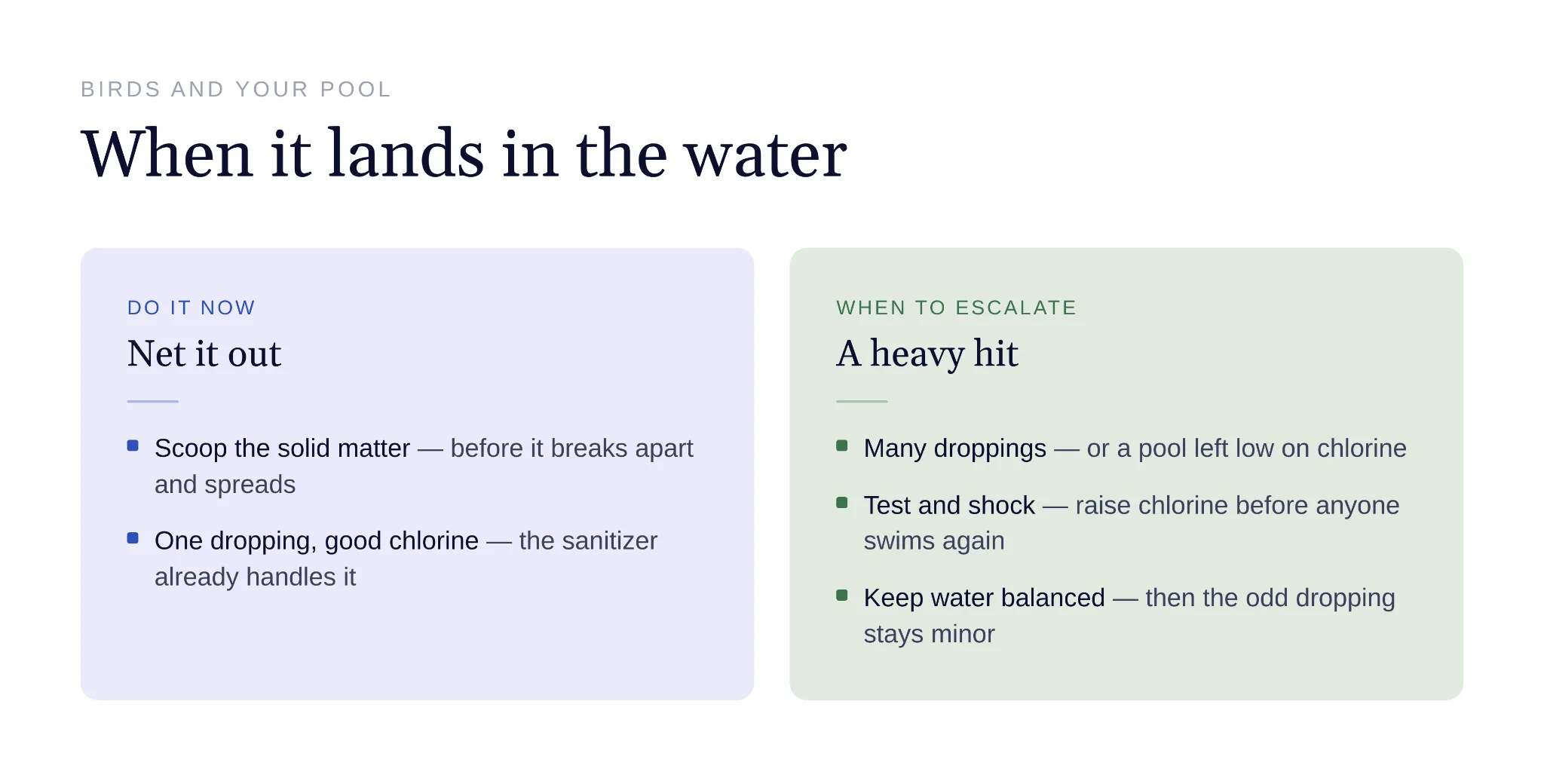
If you find a dropping in the pool, net it out now, not later. The longer it sits, the more it breaks apart, the more it spreads through the water, and the harder it is to get out cleanly. Scoop it with the net, get the solid matter out in one piece if you can.
Then think about the sanitizer, because the drop that dissolved before you saw it is the one that matters.
A single dropping in a well-chlorinated pool is handled by the chlorine already in the water is exactly the job the sanitizer exists for.
The concern is volume and timing. A lot of droppings, or droppings in a pool that’s been neglected and is low on chlorine, is a real contamination event, and the response is to test the water and shock the pool, raise the chlorine high enough to kill off the bacterial load, before anyone swims again.
Keep the water balanced as the baseline under all of this.
A pool with the right chlorine level and the right pH is a pool where the occasional dropping is a minor event the chemistry absorbs. A pool running low and cloudy is one where every dropping is both a stain and a bloom waiting to start, and no deterrent on the surface fixes a sanitizer problem underneath.
Netting takes care of the solids on the surface. What sinks and smears across the floor before anyone spots it is the part that stains, and a robotic pool cleaner working the floor and walls on a daily cycle lifts that residue off the plaster before it sets into a mark.
The Aiper line of cordless robotic cleaners runs off its own battery with no hoses or booster pump, and keeping the floor turned over every day also clears the dissolved matter a dropping leaves behind before it feeds a stain or an algae patch in a corner.
Get more pool and lawn care guides from Aiper on Google