
How to Keep Ducks Out of Your Pool Without Chemicals

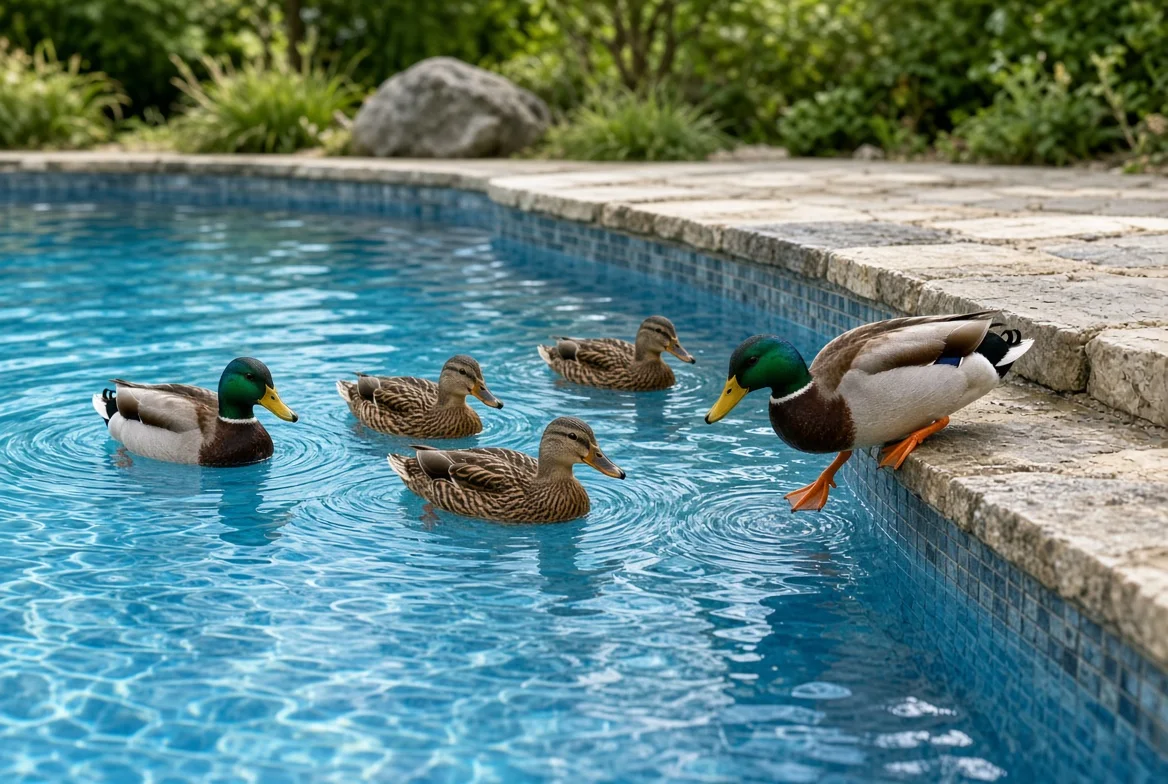
The first year it happens, it’s charming. A mallard pair drops onto the water some morning in late March, paddles two lazy laps, and leaves.
Then they come back the next morning, and the morning after that, and by mid-April there are droppings on the top step, feathers in the skimmer basket, and a hen sitting in the mulch behind the pump pad with eight eggs under her.
Now the problem runs on her timeline.
Why Ducks Choose Your Pool
A wild mallard spends its whole life doing risk math. On a natural pond, a duck on the water is watching a shoreline full of cattails and brush where a fox can get within ten feet before it breaks cover.
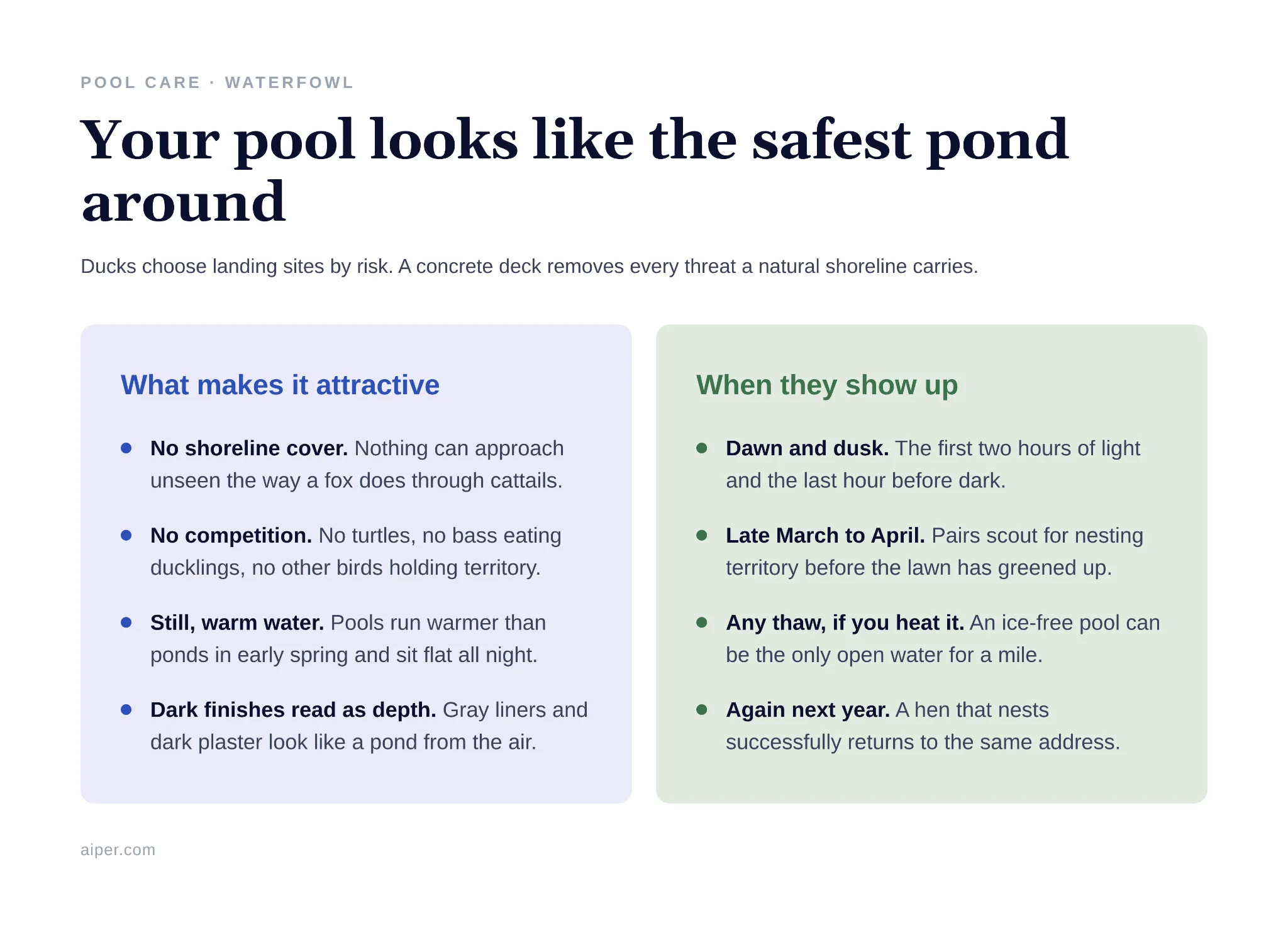
But your pool has concrete around it. Nothing sneaks up. There’s no vegetation at the waterline, no snapping turtles, no bass eating ducklings, no competition for space.
The water sits still, it runs warmer than a pond in early spring, and a dark plaster finish or gray liner reads as depth from the air, which is what a duck scanning for a landing spot wants to see.
Cover the Pool
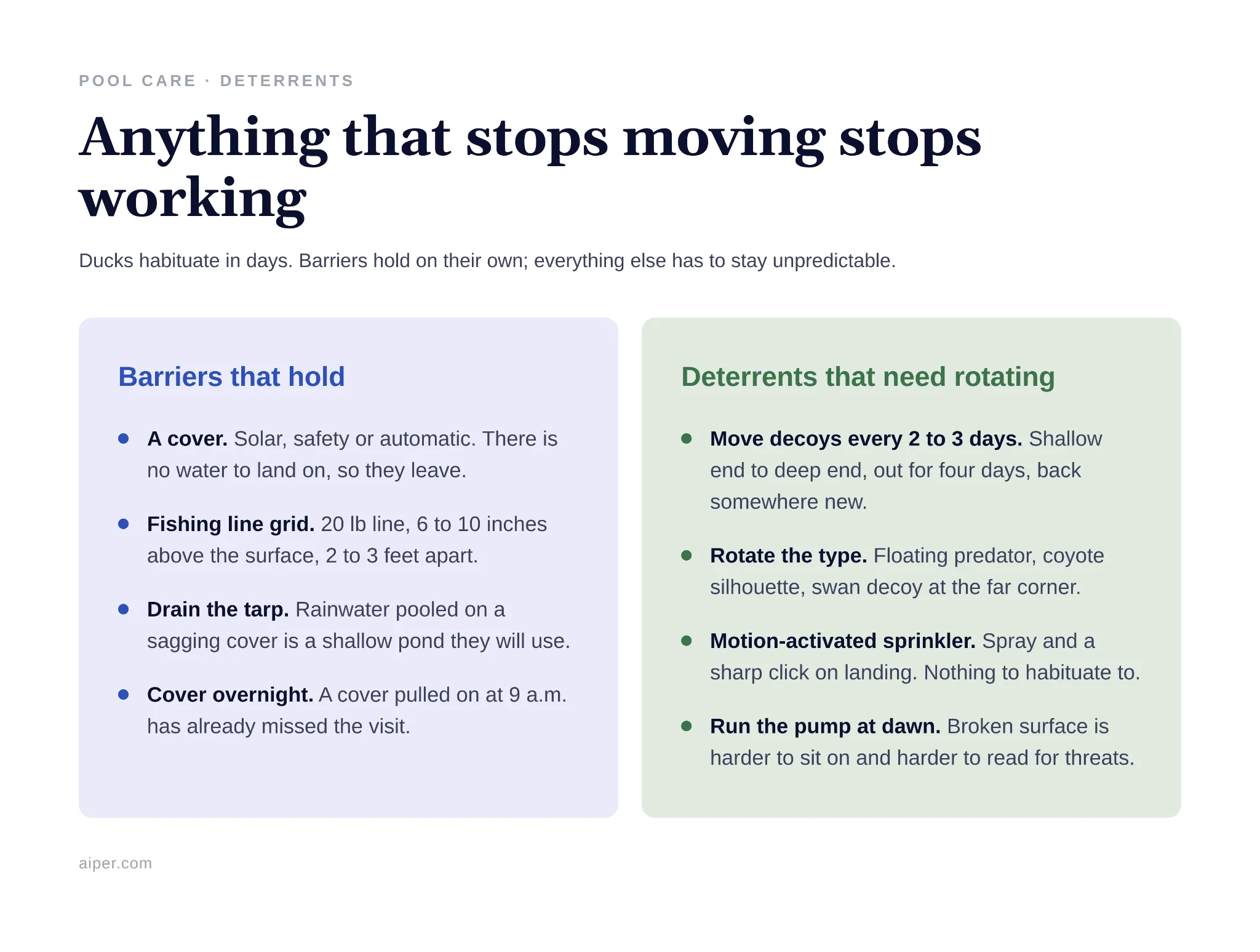
A duck lands on water. A solar cover, a safety cover, an automatic cover, none of those are water. There’s no surface to sit on, nothing to dabble in, no place to preen.
Birds that come in to scout circle once and go elsewhere, and because they never made a successful landing, they don’t come back to check.
Solar covers are the practical version in season. Roll it on at dusk and understand where the vulnerable window is: ducks are most active in the first two hours of light and the last hour before dark. A cover pulled on at 9 a.m. missed the visit.
One caution. A sagging tarp with rainwater pooled on top is worse than nothing, because that puddle is a shallow, perfectly safe pond and they will use it.
Move Your Deterrents Every Few Days
Every duck deterrent works by convincing the bird something is dangerous or unpredictable, and every one of them stops working the moment the bird figures out it isn’t.
The floating alligator head with the reflective eyes is genuinely good. Ducks avoid it for four days.
Then one bold hen lands eight feet away, watches it for a while, notices it never moves, and goes about her morning. Two weeks later she’s resting against it. Mallards will sit on top of a plastic owl.
So the rule isn’t buy a decoy. The rule is move the decoy. Every two or three days, and not on a schedule the birds can read. Shallow end to deep end. Out of the water entirely for four days, then back somewhere new.
Rotate types: a floating predator, a coyote silhouette on the deck, a swan decoy at the far corner. Swans work because real ducks know they’re territorial, but a swan that hasn’t moved in ten days is a lawn ornament.
String Fishing Line Across the Water
Ducks need a clear approach and a clear exit. They come in low, flare, and drop, and they won’t commit to a landing zone with obstacles overhead because they can’t be sure they can get back out fast.
Get a twenty-pound monofilament, strung in a grid six to ten inches above the surface, lines two to three feet apart, and anchor it to eye hooks in the deck or short stakes set around the edge.
From a lounge chair, you barely register it. From the air, it’s a hazard field.
This is the most underused method in residential pools, and it’s close to as effective as a cover. You do have to unclip it to swim, which makes it a better fit for a pool that sits unused, like a spring shoulder season, a vacation stretch, or a rental property between guests.
Keep the Surface Moving
Ducks want calm water. A rippled, churning surface is harder to sit on and harder to read for threats.
Run the pump at dawn and dusk instead of mid-afternoon, and use the waterfall or spillover in those same windows. A floating solar fountain costs very little and puts constant disturbance on the surface during exactly the hours that matter.
This won’t clear a determined pair on its own. Stacked with two other things, it tips the calculation.
Install a Motion-Activated Sprinkler
The best active deterrent available. Mounted on the deck and aimed across the water, it fires a burst of spray and a sharp mechanical click the instant a bird lands.
It stays effective for the same reason it doesn’t get stale: there’s no fixed object to habituate to, just an event that happens sometimes. Unpredictable danger is what wild animals tolerate least.
Aim it across the shallow end and the steps, where ducks congregate. Set sensitivity high enough to catch a bird and low enough that a moth doesn’t run it all night.
Skip the Ultrasonic Repellers
Birds hear in roughly the same range humans do. The frequencies these devices advertise as inaudible to you and unbearable to pests are largely inaudible to ducks too, and there’s no meaningful evidence that ultrasonic units move waterfowl off a site.
Plenty of people have mounted one and watched ducks land under it that evening.
So put the money toward a cover.
Take Food and Nesting Cover Out of the Yard
The pool is why they scout. The yard is why they stay.
Spilled seed under a bird feeder brings ducks in on foot and holds them in the neighborhood. Pet food on a patio does the same.
A neighbor who throws bread at the retention pond two streets over is the reason there’s a resident population at all, and if that conversation is available to you, have it.
Then look at the planting around the equipment pad and along the fence lines. Ducks nest on the ground, in cover, within a couple hundred feet of water.
Dense low shrubs, ornamental grass clumps, an overgrown mulch bed, these are very similar to their habitat. Thinning it in February, before pairs start prospecting, is worth more than anything done in May.
What to Do If a Duck Has Already Nested
In the United States, mallards and nearly every other wild duck are protected under the Migratory Bird Treaty Act. Once eggs are in an active nest, moving it, destroying it, or relocating the hen without a federal permit is illegal, and the penalties aren’t small.
Incubation runs about 28 days, with a week or two of laying before that. Call it five to six weeks from finding the nest to the hatch. The ducklings leave within a day of hatching, walking to water in a line.
Your pool is the water.
So the useful move in that window is preparing for the hatch rather than fighting it.
Put an Escape Ramp in the Pool
This matters more than the algae or the phosphates or any of it.
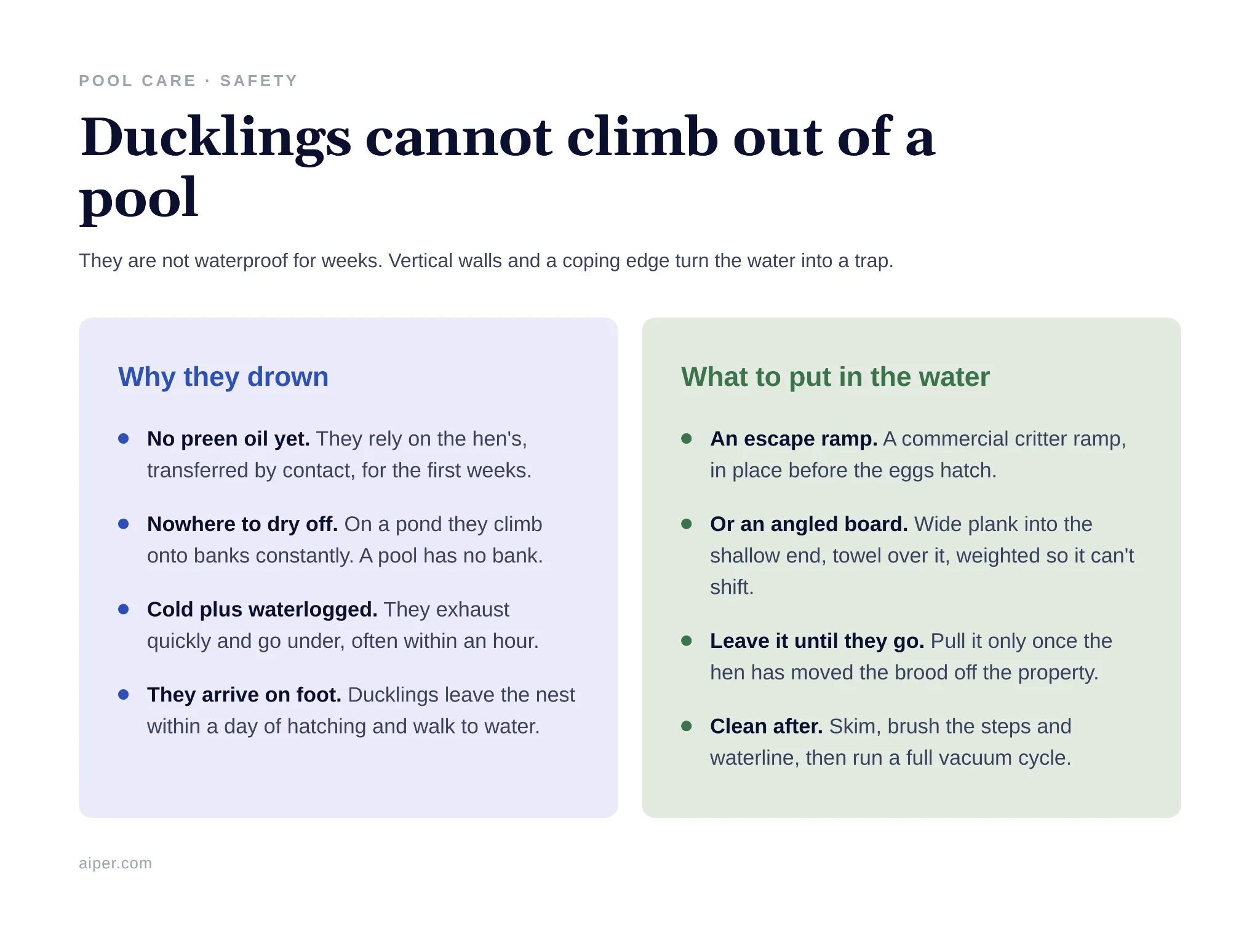
Newborn ducklings aren’t waterproof. They don’t produce preen oil for weeks and rely on the hen’s, transferred by contact. On a pond, they climb out onto banks constantly to dry and warm up. A pool gives them vertical walls and a coping edge they cannot climb, and once they’re waterlogged and cold, they exhaust and go under.
A commercial critter escape ramp works. So does a wide board angled from the deck into the shallow end, towel over it for grip, weighted so it can’t shift when they push against it. Leave it until the family moves off.
Afterward, skim, brush the steps and waterline where droppings settle, and run a vacuum cycle.
Duck waste carries E. coli, Salmonella, Campylobacter, and Giardia, and the nitrogen in it feeds algae hard in warm weather.
They Remember Where It Worked
Waterfowl show strong site fidelity. A hen that nests successfully behind your pump pad and raises a brood on your water has learned the address is good, and there’s a real chance she returns next spring. Some of her daughters will too.
That’s the case for being aggressive in year one and mildly obsessive in the six weeks between the first thaw and the first warm stretch. Cover on at night. Gator moved twice a week. Sprinkler live at dawn. Shrubs cut back, feeder down.
None of that work touches what a visiting duck leaves behind, though. A robotic pool cleaner on a regular cycle pulls droppings out of the water before the nitrogen in them feeds algae, so a single trespass never turns into a green-water fight.
Get more pool and lawn care guides from Aiper on Google