How to Repair a Damaged Pool Cover

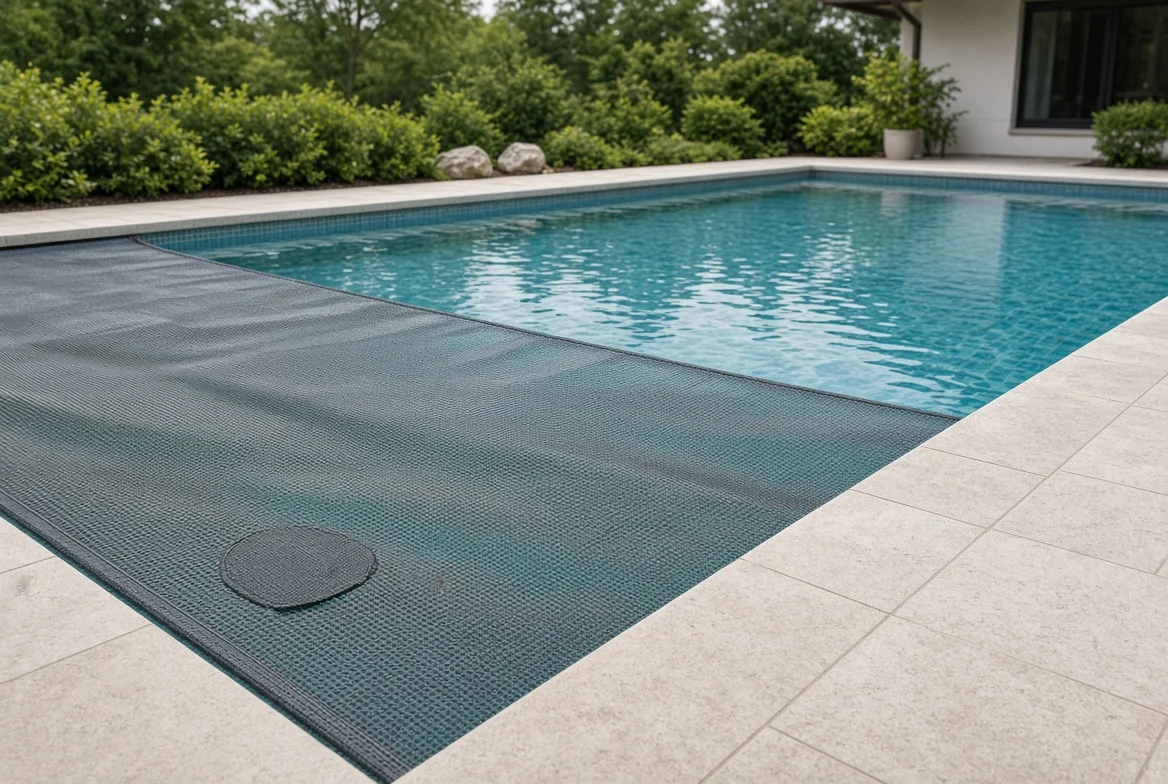
A damaged pool cover doesn’t always need replacing. Small tears, holes, and worn areas can often be repaired, but the right fix depends on the type of cover and the damage.
Solar covers, mesh safety covers, solid covers, and automatic covers all require different repair methods. Using the wrong patch or applying it to a dirty surface can make the damage worse.
Start by identifying your cover and deciding whether the damage can actually be repaired.
Assessing Whether Your Cover Is Worth Repairing
UV kills pool covers from the outside in, and it doesn’t announce itself. The cover looks fine right up until the moment you’re standing on the deck holding a patch kit over a hole that’s spreading while you watch.
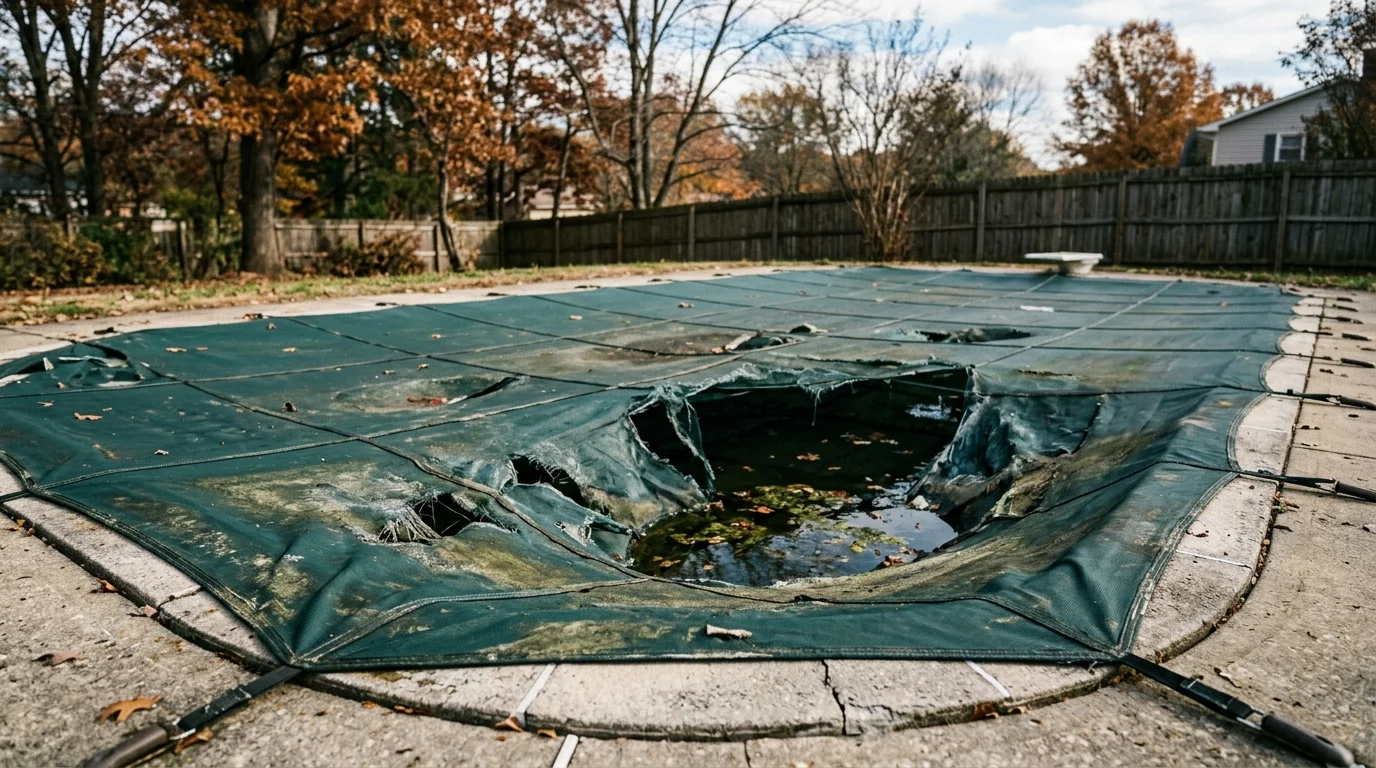
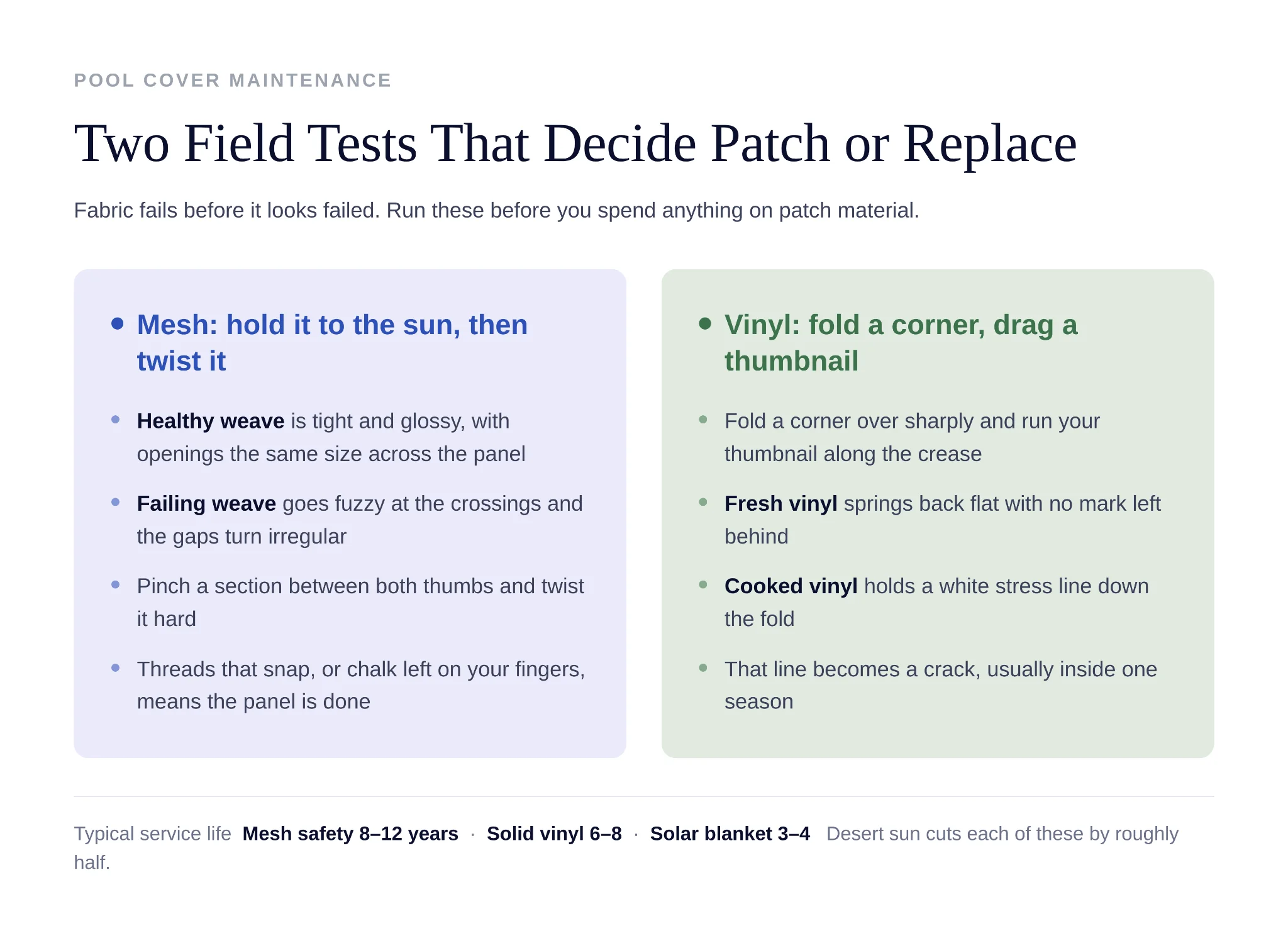
So test it.
On mesh, hold a section up against the sun and look at the weave. Healthy yarn is tight and glossy, and the openings are uniform. Dying yarn goes fuzzy at the crossings, and the openings start to look irregular because individual strands have already given up.
Then pinch a section between both thumbs and twist. If threads snap or the surface leaves chalk on your fingers, you’re not looking at a repairable cover. You’re looking at a cover that will tear next to your patch instead of through it.
On solid vinyl, fold a corner over sharply and run your thumbnail along the crease.
Fresh vinyl springs back. Cooked vinyl leaves a white stress line, and if it leaves a white stress line, it will eventually leave a crack.
Mesh safety covers generally get eight to twelve years. Solid vinyl gets six to eight, sometimes less in Phoenix or Vegas, where the sun does in four seasons what it does in ten somewhere cloudy.
Solar blankets get three, maybe four, and anyone who tells you five is counting a season the cover spent folded in the garage.
Dig out the paperwork while you’re at it.
Most safety cover warranties are prorated, which means a cover with a failed seam in year seven of a fifteen-year warranty might get you a meaningful credit toward a replacement, but only if you file before you attack it with adhesive. Manufacturers are within their rights to decline a claim on a cover you’ve already modified.
Repairing a Mesh Safety Cover
Mesh takes the most abuse and costs the most to replace, so it’s where most real repair work happens. What you can fix yourself depends entirely on where the damage is.
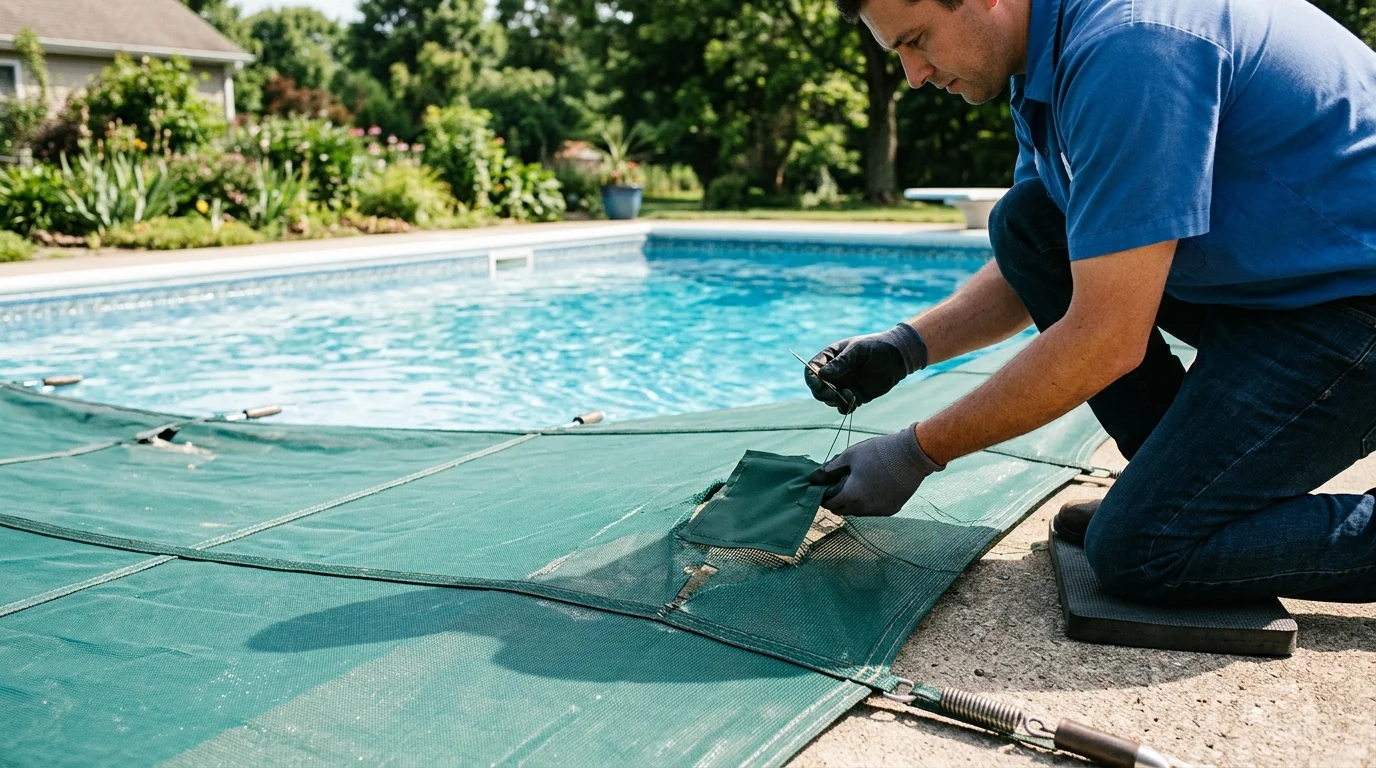
Punctures and short tears in a panel
Easy. Self-adhesive mesh patches from Loop-Loc, Latham, GLI, or any generic supplier will hold.
- Fabric must be dry and clean
- Two inches of overlap in every direction
- Round the corners
- Patch both faces
- Roll it down, don’t thumb it
Perimeter binding
Covers die at the edges, and it’s the thread that fails, not the fabric. Exposed stitching sits in full sun for a decade. Once eighteen inches of binding lets go, the edge frays and every windy day makes it worse.
Restitching is work, not magic. You need:
- Curved upholstery needle
- #69 bonded polyester thread (#92 for straps)
- Sailmaker’s palm, so you can push through four layers of webbing without shredding your hand
Overstitch two inches into sound material on both sides. Stop at the damage, and you’ve built a new weak point where the old one ended.
Panel seams
If stitching between panels is letting go across two feet, not four inches, stop. The thread has aged out across the whole cover. Fix that seam in April and three more open by October. Send it back for a warranty assessment or price a replacement.
Rodent damage
Clusters of small holes that line up in rows when you unfold the cover. The mice worked through a folded stack in the shed. Each hole patches fine. There are just a lot of them.
When to stop and call the manufacturer
A safety cover is a life-safety device certified against ASTM F1346. That certification assumes an intact perimeter, intact straps, and sound anchors working as one system.
A hole in the middle of a panel is a debris problem. These are not:
- Compromised straps
- Torn D-ring attachments
- Separated perimeter binding
- Anchors pulled loose from the deck
If the load path is damaged, the cover is out of service until it’s properly repaired. There is no version of “it’s probably fine” that belongs near a cover a toddler might walk onto.
Repairing a Solar Cover
A torn solar blanket needs one thing: clear solar cover tape, a heavy-duty transparent tape applied to both faces. The tape isn’t the hard part. Drying the blanket and cutting the patch correctly are what decide whether the repair survives the season.
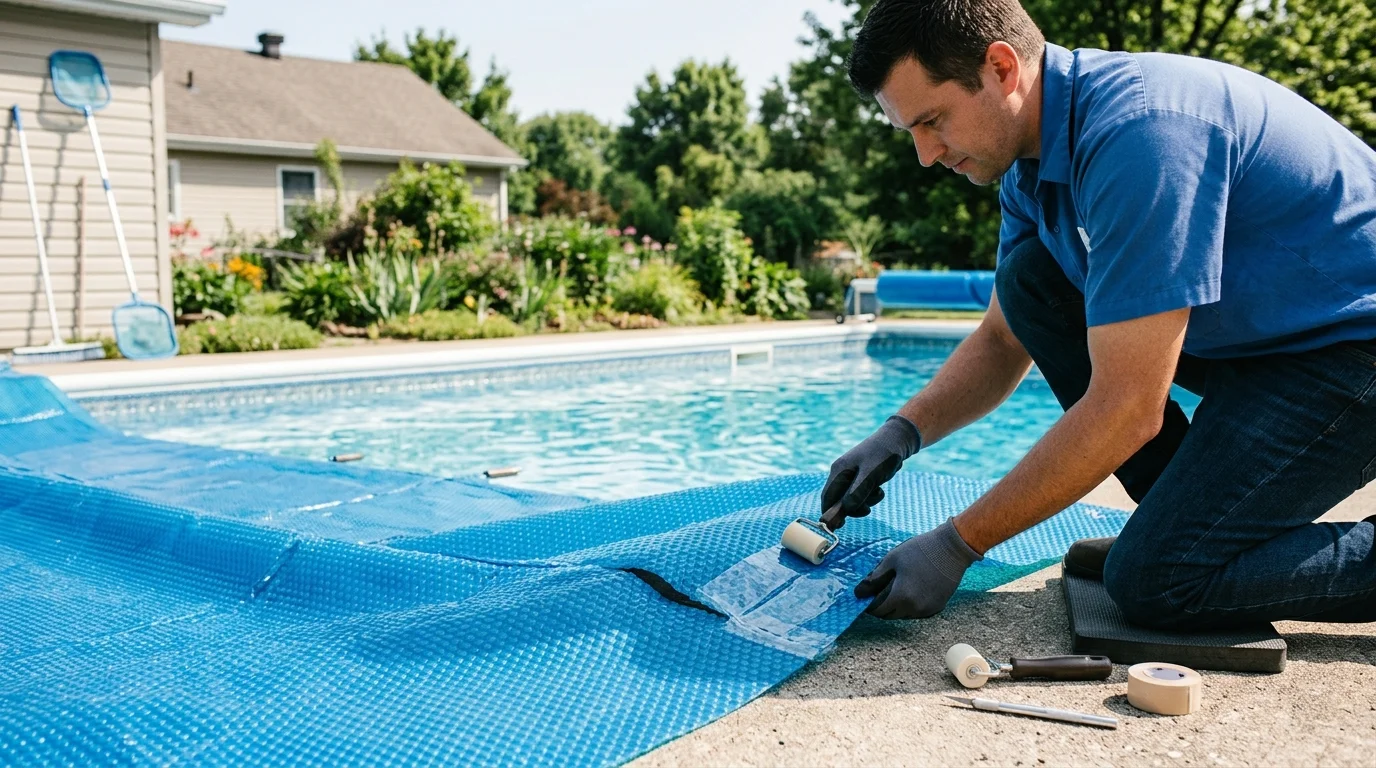
Dry it all the way through
This is the step people skip. Pull the blanket off the water, spread it bubble-side down on the deck, and give it an hour in moving air.
Not full midday sun on concrete. That cooks the bubbles, and you’ll trade a tear for a delaminated patch of dead cells. Shade, or early morning.
Cut long, round the corners
Two inches past each end of the tear, minimum. Round the corners of the patch with scissors.
Square corners lift. They just do. The corner catches on the water surface, on the reel, on your hand while you’re pulling the blanket off, and once one corner is up, the rest follows.
Press from the center out
Use the edge of a credit card so you’re pushing air out rather than trapping it. Then patch the same tear on the other side. Both faces, every time.
Know when it’s finished
Delamination has no repair. When the two layers separate and water works into the bubble layer, the blanket gets heavy, stops floating properly, and starts sinking at the edges. There is no adhesive answer.
The only question left is how many weeks you want to spend dragging a waterlogged sheet of plastic off your pool before you admit it.
Two habits shorten a blanket’s life more than weather does. Leaving it on the water through a shock treatment and leaving it out in the sun off the water.
High free chlorine eats polyethylene from below. Direct sun with no water underneath to absorb the heat cooks it from above, and a blanket left folded on a hot deck for one afternoon can come apart along the folds on its own.
Strap, Spring, and D-Ring Repairs
Straps pull out of their stitching long before the webbing wears through.
Fix it with a box-X stitch: sew the perimeter of a rectangle where the strap meets the cover, then cross corner to corner through the middle. Load spreads across the entire rectangle rather than concentrating on a single line of needle holes.
Replacement webbing sells by the foot in one-inch and one-and-a-half-inch widths. Match what came off. Wider is not better here; buckle hardware and spring hooks are sized for the original.
Springs stretch, and nobody catches it. A spring with no tension left still holds the cover down and still looks correct from the deck. The cover sags six inches into the water at that corner every time it rains.
Set tension so each spring compresses to about half its free length when the cover is tight. Fully compressed means the anchor absorbs shock load with nothing left to give, and that’s how brass anchors come out of concrete.
Repairing a Solid Vinyl Cover
Pick your adhesive before you pick your patch. Getting this wrong is the single most common reason vinyl repairs fail.
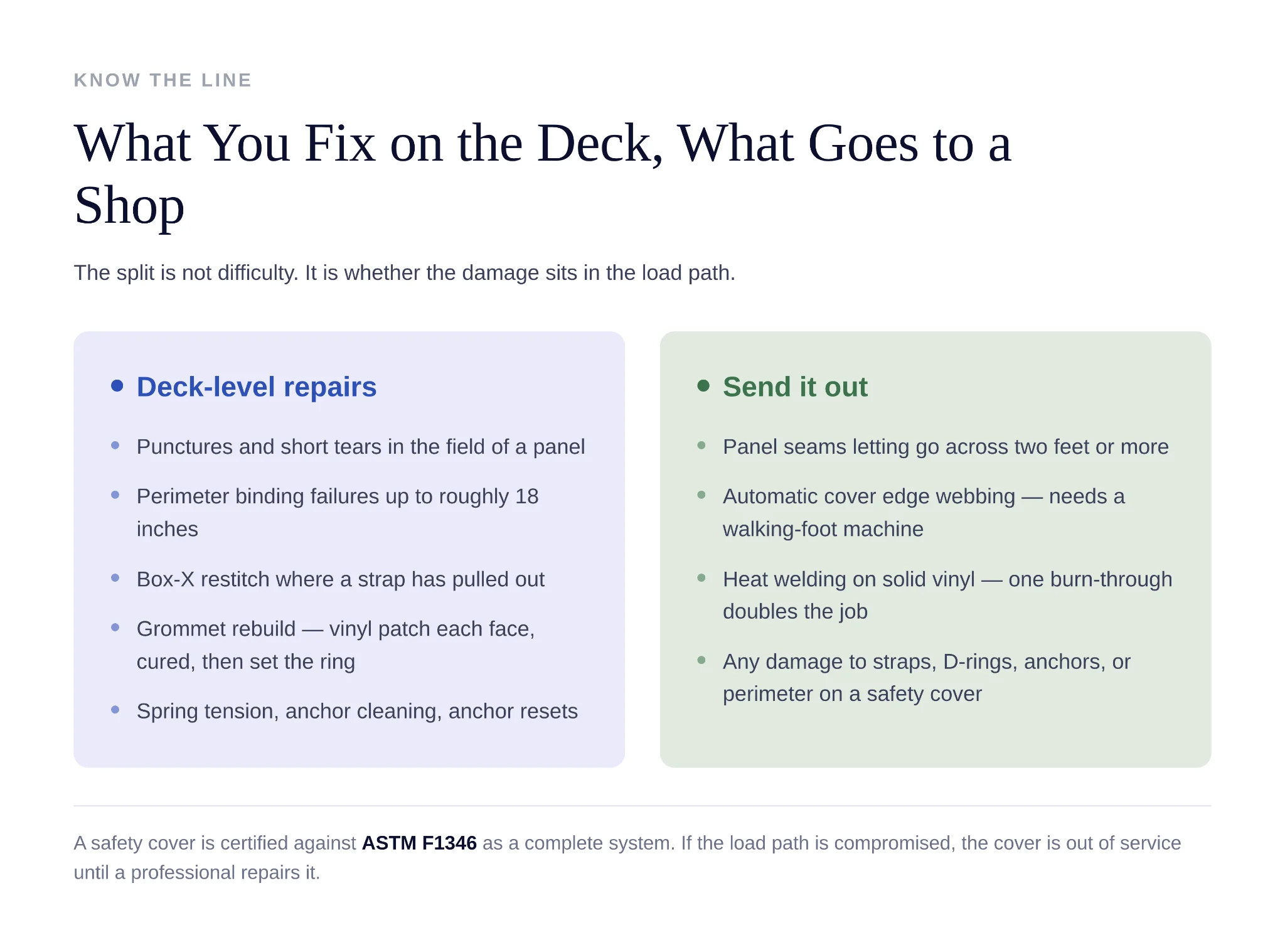
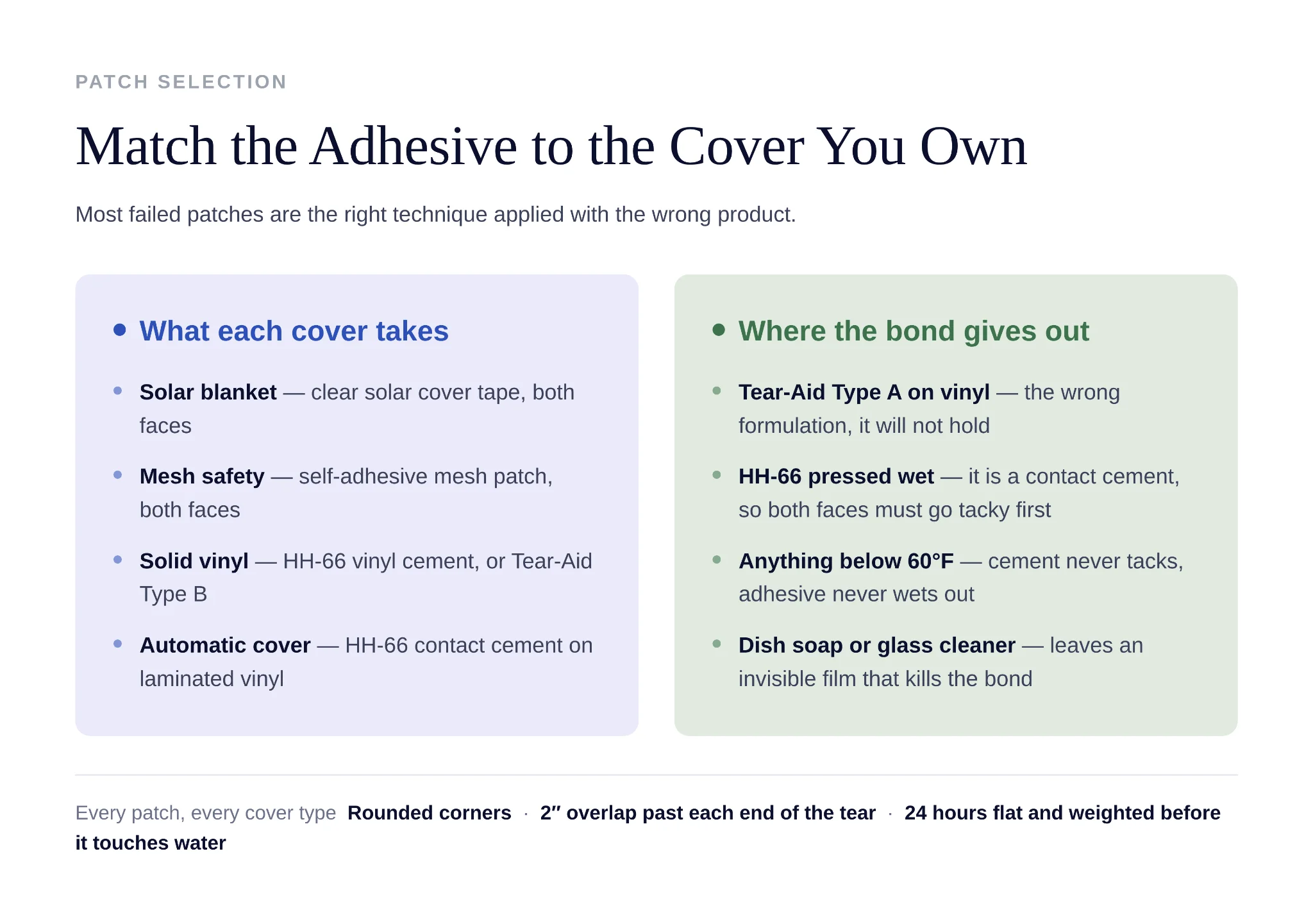
HH-66 vinyl cement
The standard, and it is not glue in the way most people use the word. It’s a contact cement, which changes the whole procedure:
- Coat both surfaces, the patch and the cover
- Wait until both go tacky
- Press together
- Roll it down
Spread it on one side and slap the patch down wet, and you get a bond that looks perfect for three days, then peels off in one piece.
Tear-Aid
The other common answer. The type matters more than the packaging suggests.
- Type B: Vinyl and PVC
- Type A: Basically everything else
Type A on a vinyl winter cover is a repair that will fail, and you won’t understand why.
Heat welding
How these covers were built, and the strongest repair possible. Also not a driveway project. It takes a hot-air welder, the right nozzle, a seam roller, and enough practice to know a fused seam from a scorched one. Burn through once and a four-inch tear becomes a repair the size of your hand.
Grommets
A blown grommet is seldom a grommet failure. The metal ring is fine. The vinyl around it stretched and tore under wind load until the ring pulled through.
Set a fresh grommet into that same tired vinyl, and the next storm does it again.
Build a sandwich instead: vinyl patch on each face, cemented, fully cured, then set the new grommet through the reinforced stack.
No sound material left at the edge? Skip the grommet. Use a ball bungee or a tarp clip that grips the fabric further in, where it’s still healthy.
Repairing an Automatic Pool Cover
Replacement fabric runs two to four thousand dollars installed. That math makes almost any legitimate repair worth doing.
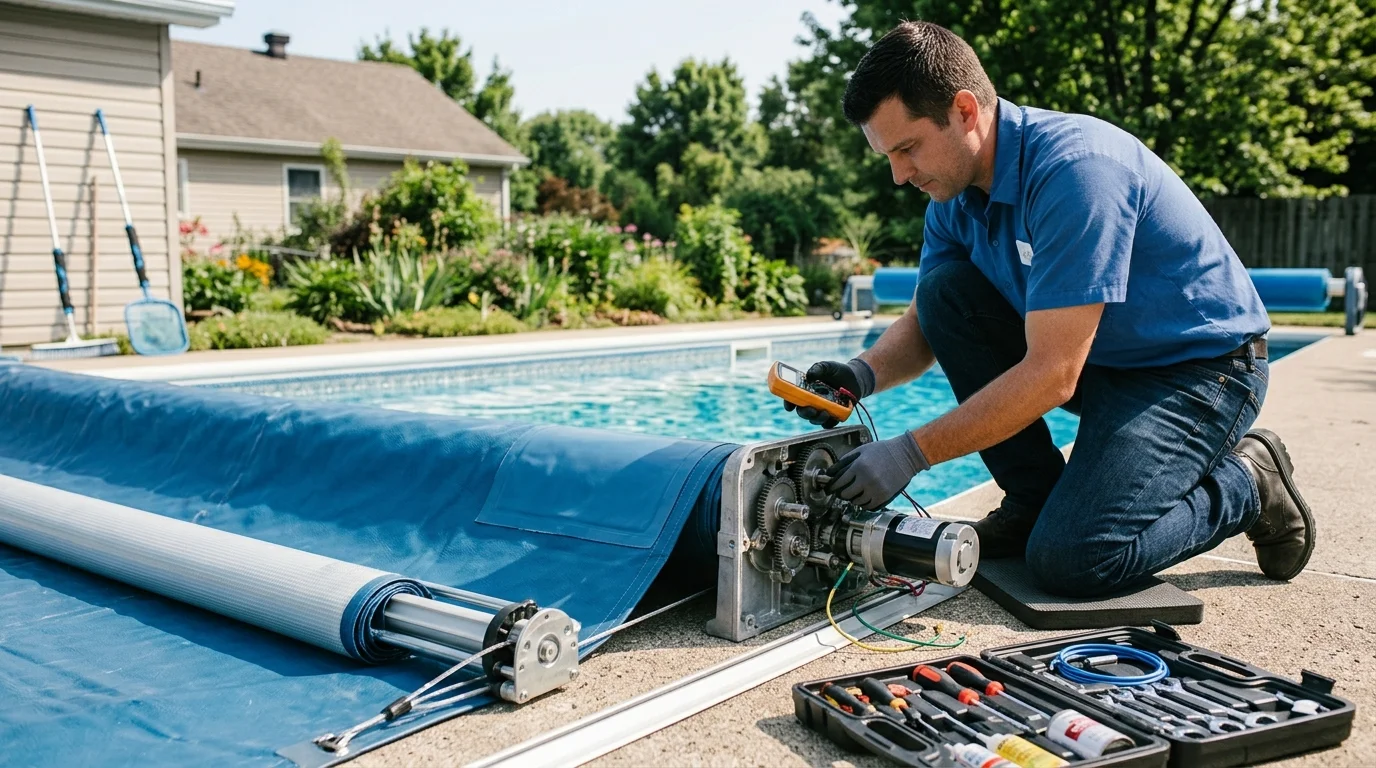
Patching the fabric
Heavy laminated vinyl, and it takes patches well. Same contact-cement approach, same prep, same rolling as a solid cover.
Pinholes
They show up scattered across the surface rather than as one tear, and the cause is chemistry: standing water on the cover concentrates chlorine and acid as it evaporates. That’s a maintenance problem wearing a repair problem’s clothes. Keep a cover pump on it.
Edge webbing
The strip that rides in the track and carries the entire pulling load. This is the failure that strands people. When it tears out, the cover stops tracking, binds, and the motor starts straining.
Restitching needs a walking-foot machine and heavy thread. A household machine will not do it and will probably die trying. Pull the fabric and send it to a shop.
Ropes
They fray where they cross the pulleys.
- Replace in pairs, always
- Replace before one lets go
A snapped rope mid-cycle drags the leading edge out of square and jams the assembly against the track.
Surface Prep Before Patching
Every repair above assumes a bonded patch. Bonding is the part that fails, and it fails on prep.
Dry means dry all the way through, not surface-dry. Mesh holds water in the weave for hours after it looks ready.
Clean means degreased. Wipe the repair zone and a few inches around it with denatured alcohol on a clean cloth, then let it flash off.
- Not dish soap — leaves an invisible residue film that kills the bond
- Not glass cleaner — same problem
- Heavily soiled cover? Wash with plain water, dry completely, then wipe with alcohol
Temperature matters more than the instructions admit. Below about 60°F, vinyl cement doesn’t tack properly and adhesive patches never fully wet out. A cool overcast morning in October is the worst possible time to do this, and it is also, inevitably, when everyone does it.
Cut every patch with rounded corners and overlap two inches past the ends of the tear in every direction. The ends are where a tear propagates, and a patch that stops at the tear fails there first. Roll it down with a seam roller or the back of a spoon, working center to edge.
Then leave it alone. Flat, weighted, twenty-four hours, before the cover goes anywhere near water. Curing under load is not curing.
Deck Anchor Repair and Maintenance
Brass deck anchors seize. The hex socket fills with grit and mineral scale, and by year six the tool spins in a rounded-out head instead of raising the anchor.
Clean them every closing: a shot of silicone lubricant, a brush, thirty seconds each. That habit is the difference between a cover that comes off in twenty minutes and an afternoon spent drilling brass out of concrete.
An anchor that spins freely in the deck has lost its expansion grip and is carrying no load at all, whatever it looks like from above. Pull it, clean out the hole, reset with a new anchor and structural epoxy.
Don’t leave it. A dead anchor pushes its share of the load onto the two beside it, and those are the ones that tear out next.
Storage and Handling Damage
Dragging a cover across concrete coping does more cumulative harm than weather. Every drag scuffs the underside, and the abrasion lands on the same few square feet every time. Lift and carry it, or lay a folded blanket over the coping.
Store it dry, folded, in a sealed container. Not stuffed in a bag. Not on the shed floor, which is where the mice are.
Label the container with the year you bought it. Four seasons from now you’ll be standing over a torn panel deciding whether to patch or replace, and that number is the only thing in the situation that gives you a straight answer.
One more thing that cuts handling wear: the less debris your cover is holding, the less often you’re hauling it off mid-season to deal with what’s underneath. An Aiper robotic pool cleaner works the floor and walls on its own schedule, so the cover stays put between openings instead of coming off every time leaves pile up.
Get more pool and lawn care guides from Aiper on Google