How To Blow Out Pool Lines Before Winter

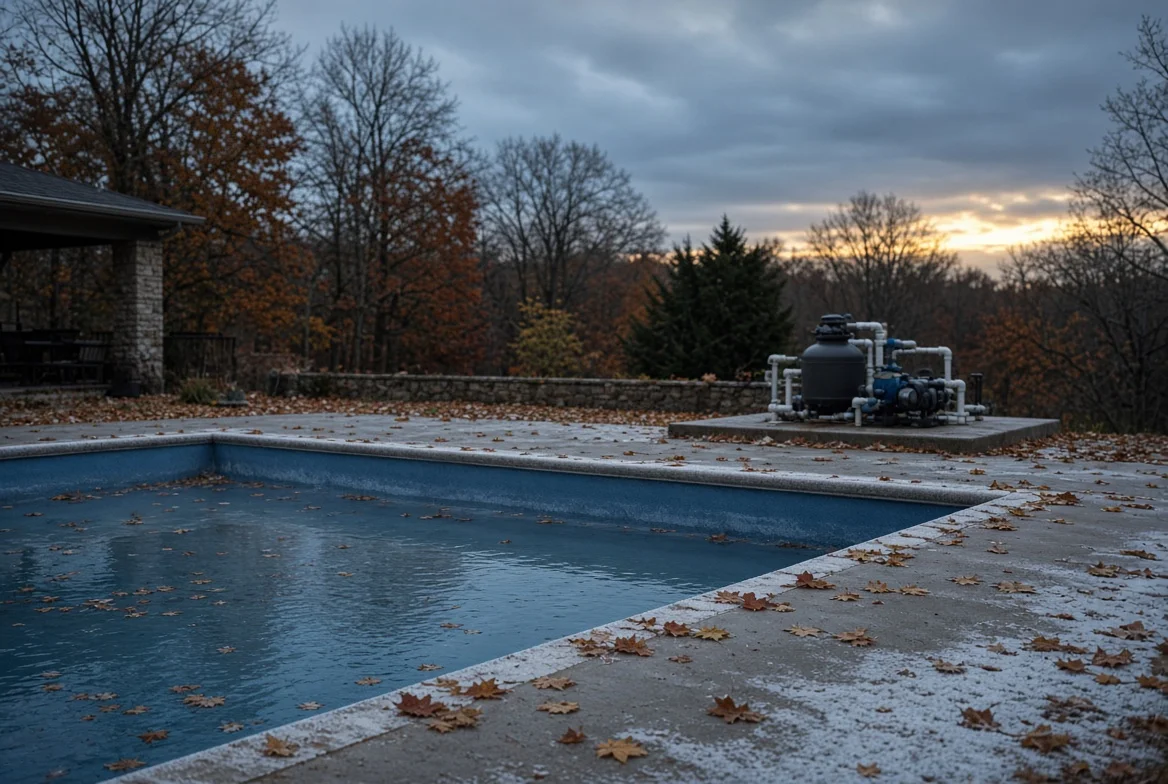
Water left inside pool plumbing can freeze during winter and crack pipes, fittings, skimmers, and equipment. The goal of blowing out pool lines is to remove trapped water and seal the plumbing to keep it empty throughout the off-season.
This guide explains how to blow out pool lines before winter, including how to clear each line, plug the plumbing, and drain the equipment that is most often damaged by freezing.
The Job In Order
If you’d rather see the whole sequence as a checklist, here it is — one line at a time, with everything else closed.
- Balance the chemistry and lower the water a few days ahead — below the skimmer mouth and the returns.
- Kill the breaker to the pad so nothing fires an empty pump.
- Pull the pump lid, strainer basket, and every drain plug on the pump housing.
- Hook the blower to the pump’s blowout port (or a threaded drain) on the suction side.
- Clear the skimmers first: blow until the water turns to steady bubbles, then plug with an expansion plug and a skimmer gizmo.
- Blow the main drain until bubbles break over the drain, and close the valve while the air is still flowing.
- Blow each return and set the threaded plug while the air is still moving. Snug, not tight.
- Blow and drain the heater — both ends of the heat exchanger — plus the heat pump, chlorinator, and salt cell.
- Drain the filter, pump, and valves; leave the multiport and diverter handles mid-position.
- Blow the forgotten lines (cleaner, spa, waterfalls, autofill, solar), then walk the deck and count the plugs.
This is the short version. For the complete close — cover, water level, chemistry dosing, and the rest — see our full guide to winterizing a pool.
Wait For The Water To Cool
Closing by calendar date is how people end up with algae in November.
The right window is after water temperatures have settled below about 60°F and stayed there, but before the first hard freeze. Close too early in warm water, and whatever chemistry gets left behind keeps reacting all fall, turning opening day into a two-week recovery project. Close too late and the first cold snap does the damage before the equipment is empty.
In most northern climates, that’s mid to late October. Watch the water, not the date.
Chemistry Comes Before Air
Handle the water a few days ahead so the pool isn’t sitting dirty under a cover for months.
Brush the walls, vacuum, balance pH and alkalinity, and get calcium hardness into range, because water that’s out of balance over a long closed winter etches plaster and corrodes metal on a schedule of its own. Shock, then let chlorine come back down before the cover goes on. Clean the filter properly rather than a quick backwash.
Then lower the water. Below the skimmer mouth and below the returns for a standard blowout, though how far depends on the pool. Vinyl liners don’t like being drained too low, since the liner can shrink and pull away from the track once it’s cold and dry.
Volume, Not Pressure
The tool matters, and the instinct people have about it is backwards.
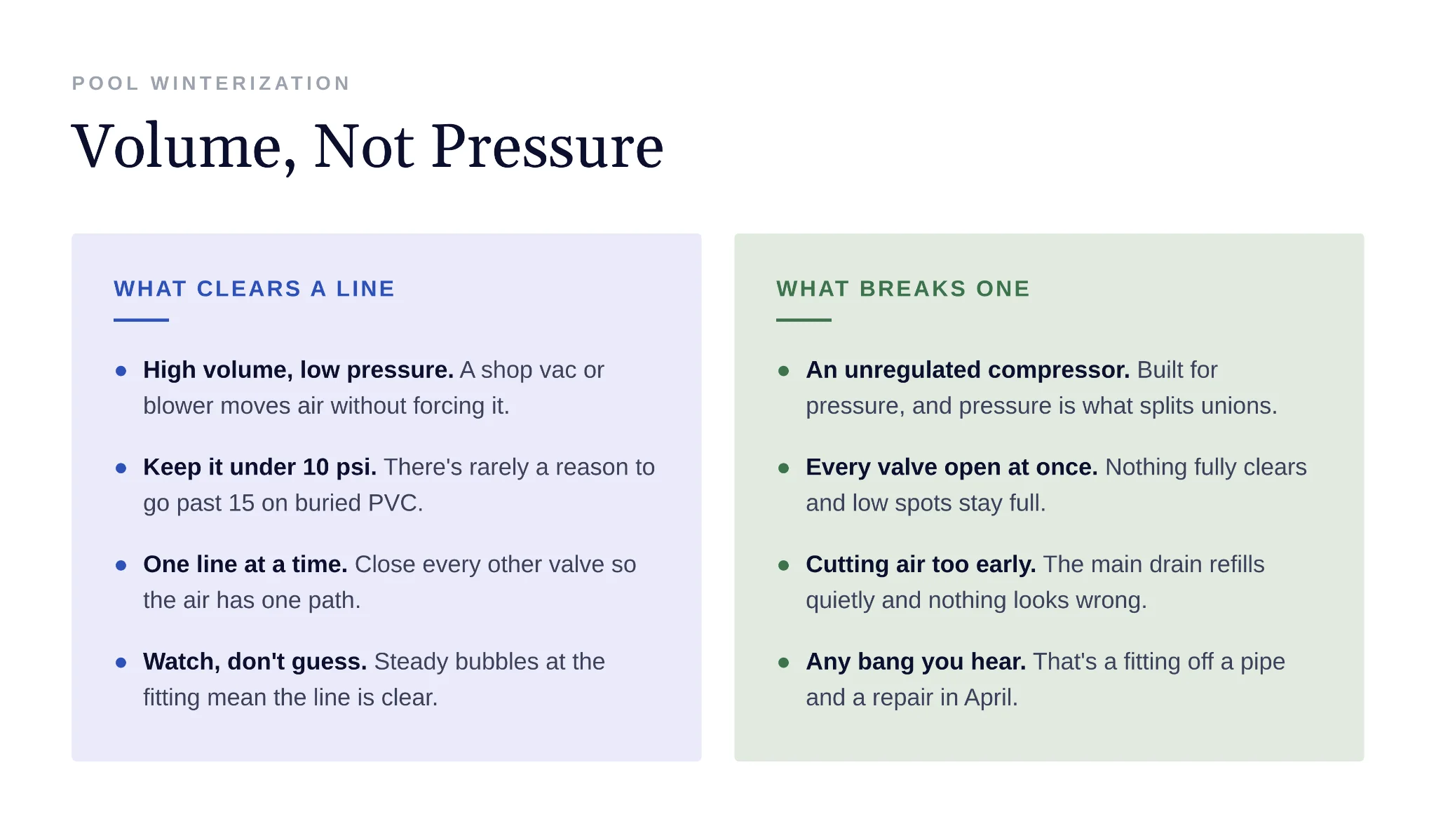
Pool lines are cleared with high volume and low pressure. A shop vac on the blow port moves a lot of air at very little pressure and will handle a short run to a skimmer or a couple of returns. A dedicated blower does it faster and better.
A big air compressor is the risky choice, because it’s built for pressure rather than volume, and pressure is what blows a fitting off a pipe or splits a plastic union.
If you use a compressor, regulate it down. Underground PVC should not see more than about 10 psi, and there’s rarely a reason to go past 15. Anything you hear as a bang is a repair you’re going to make in April.
Blowout Tools At A Glance
| Tool | What it clears | The catch |
|---|---|---|
| Shop vac (blow port) | Short skimmer runs, a couple of nearby returns | Low pressure — stalls on long, sagged, or deep runs |
| Pool blower (cyclone blower) | Most lines, including the main drain and long returns | The dedicated tool; $60–$150, worth it if you close every year |
| Air compressor | Short runs, only with a regulator | High pressure is the danger — can pop a fitting off; stay under 10–15 psi |
Where To Hook Up
The connection point is the pump, in almost every case.
Pull the pump lid and the strainer basket. Remove the drain plugs from the pump housing. Most pads have a blowout port or a threaded drain on the suction side that takes an adapter; if not, a plug with a hose barb threaded into the pump drain works. Air goes in there, and the valves at the pad decide where it goes from there.
Which is the part that makes this manageable. Do one line at a time. Close everything else. If air is going three directions at once, it isn’t fully clearing any of them, and you’ll think a line is done when it’s still holding a foot of water at a low spot.
Skimmers First
Open the skimmer line, close the others, and run air until the water at the skimmer stops surging and turns to a steady rush of bubbles. Give it another twenty or thirty seconds after that.
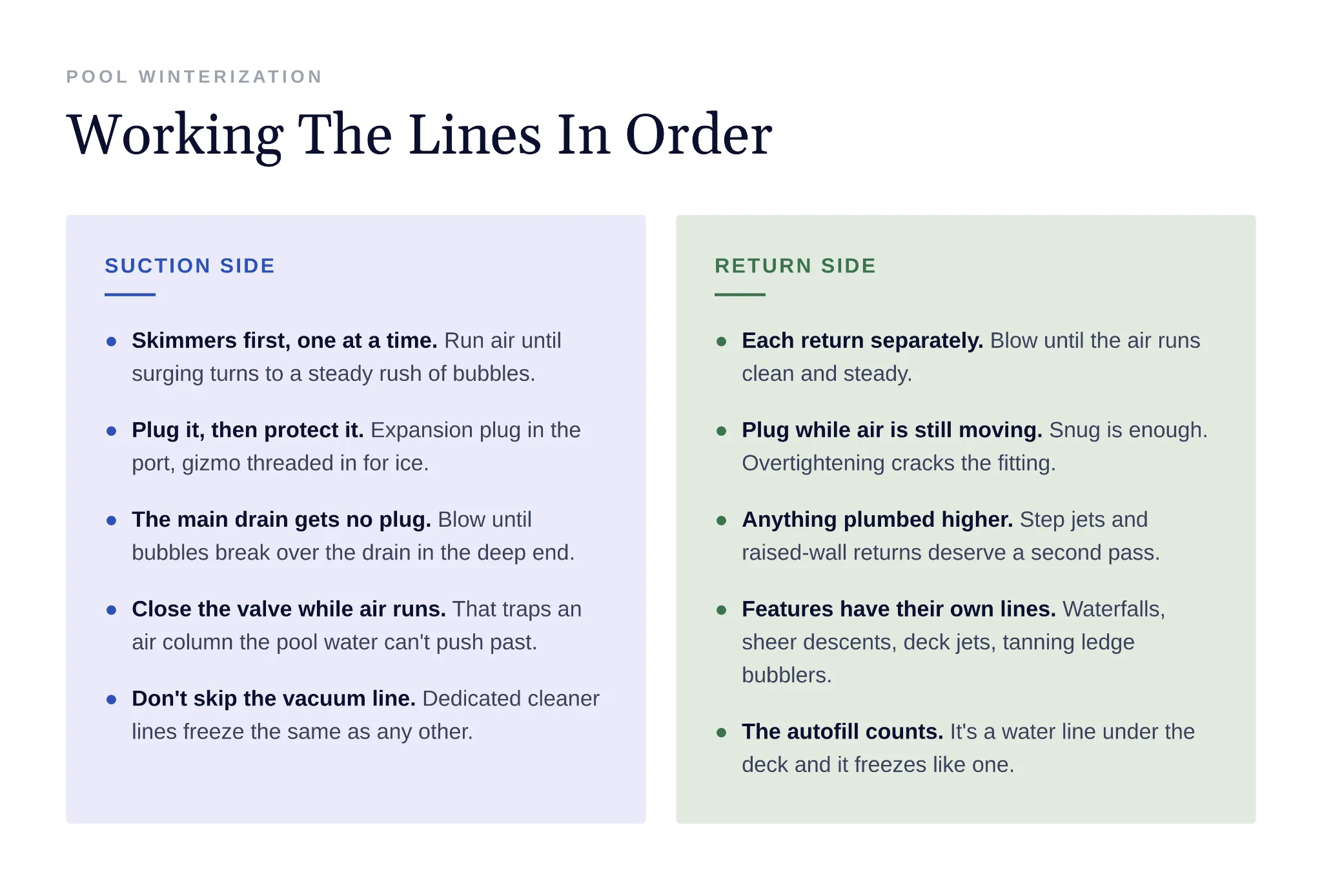
Then plug it. A rubber expansion plug in the skimmer’s suction port keeps water from getting back into the line, and a skimmer gizmo, the hollow plastic tube that threads into the same port, takes the pressure if ice does form in the skimmer body. Ice needs somewhere to expand into.
The gizmo is that somewhere, and a skimmer that cracks at the throat is a concrete repair, not a plumbing one.
Two skimmers means doing this twice, separately.
The Main Drain Air Lock
This is the one that makes people nervous, and it shouldn’t.
The main drain line runs from the deep end back to the pad and sits full of water under the weight of the pool. It doesn’t get plugged. Instead, blow air down the line until bubbles break the surface over the drain, keep the air running, and then close the main drain valve at the pad while air is still flowing.
That traps a column of air in the pipe. The water in the pool can’t push past it, so the line stays full of air all winter instead of full of water. Nothing to freeze.
Get the sequence wrong, close the valve after cutting the air, and the line refills quietly. There’s no way to tell by looking. Verify by watching the bubbles.
Plugging The Returns
Same idea as the skimmers, run by run.
Blow through each return until the air comes out clean and steady, and set a threaded expansion plug into the return fitting while the air is still moving. Snug, not gorilla tight. Overtightening a plug in a return eyeball is how the fitting cracks, and the crack won’t show up until spring.
Any return that’s plumbed higher than the rest, or a step jet, or a return that feeds a raised wall, deserves a second pass.
The Heater Is The Expensive One
Everything else on the pad is a few hundred dollars to replace. The heater isn’t.
Blow the line through it, then find every drain point on the unit itself. Gas heaters typically have plugs at both ends of the heat exchanger, and it is very easy to pull one and miss the other, leaving water sitting in the header.
Pull them both. Check the pressure switch and any low point in the internal plumbing, and if the manual for that model lists drain locations, follow it rather than guessing, because heat exchangers are not laid out the same way across brands.
Heat pumps hold a surprising amount of water and need the same treatment. Leave the drain plugs out and put them somewhere they’ll be found in spring. A sandwich bag zip-tied to the unit works.
While you’re there: empty the chlorinator and take the tabs out.
A closed feeder full of tablets all winter turns into a corrosive mess that eats the housing and the plumbing on either side of it.
And if the pool runs salt, pull the cell, rinse it, store it inside, and put the dummy cell or a length of pipe in its place.
Filter, Pump, Valves
Cartridge filters come apart. Pull the element, clean it, let it dry, and store it inside where it won’t freeze into a block of ice and split the pleats.
Sand and DE tanks get drained fully and left open. Leave the multiport handle between positions rather than locked on one, so the spider gasket isn’t compressed in one spot for five months. Backwash a DE filter first and pull the grids if the manufacturer calls for it.
The pump gets its plugs pulled and its lid left loose. In a hard climate, taking the motor inside is cheap insurance.
Diverter valves get left at a half turn, mid-position, for the same reason as the multiport. And kill the breaker to the pad. A freeze protection setting that’s still armed on a controller will happily fire a pump that has no water in it.
Antifreeze Is Not A Shortcut
Pool antifreeze has a place, but it’s a small one.
It belongs in short runs that can’t be cleared confidently, sometimes in a skimmer line below the plug, sometimes in above-ground plumbing with sags in it. It does not belong in the main drain line, and it doesn’t replace blowing lines out. Diluted with the water it was supposed to protect, it stops working.
It has to be pool-rated propylene glycol. Automotive antifreeze is toxic and doesn’t go anywhere near a pool.
When It Won’t Clear
Most of the time the air goes where you send it and the line drains. When it doesn’t, the problem is usually one of four things.
Bubbles stop at the return. A plug is set too deep or a valve is half-closed, throttling the air. Open everything on that line and blow it again before you write the run off.
No bubbles at the main drain. The valve sequence was wrong, or the air is short-circuiting somewhere else on the pad. Cut the air, reopen the line, and blow it again — closing the valve while the air is still flowing.
A shop vac isn’t clearing it. The run is too long or has a low sag holding water. Switch to a dedicated blower, or put pool antifreeze in that run only and leave it.
You heard a bang. That’s a fitting or union that let go. Stop, find the split before the line refills, and fix it now — it will not heal itself by April.
If a line is holding water because it’s partly blocked rather than just full, that’s a different job. See how to unclog pool lines before you force air through a clog.
The Ones People Forget
The pad is only where the plumbing starts.
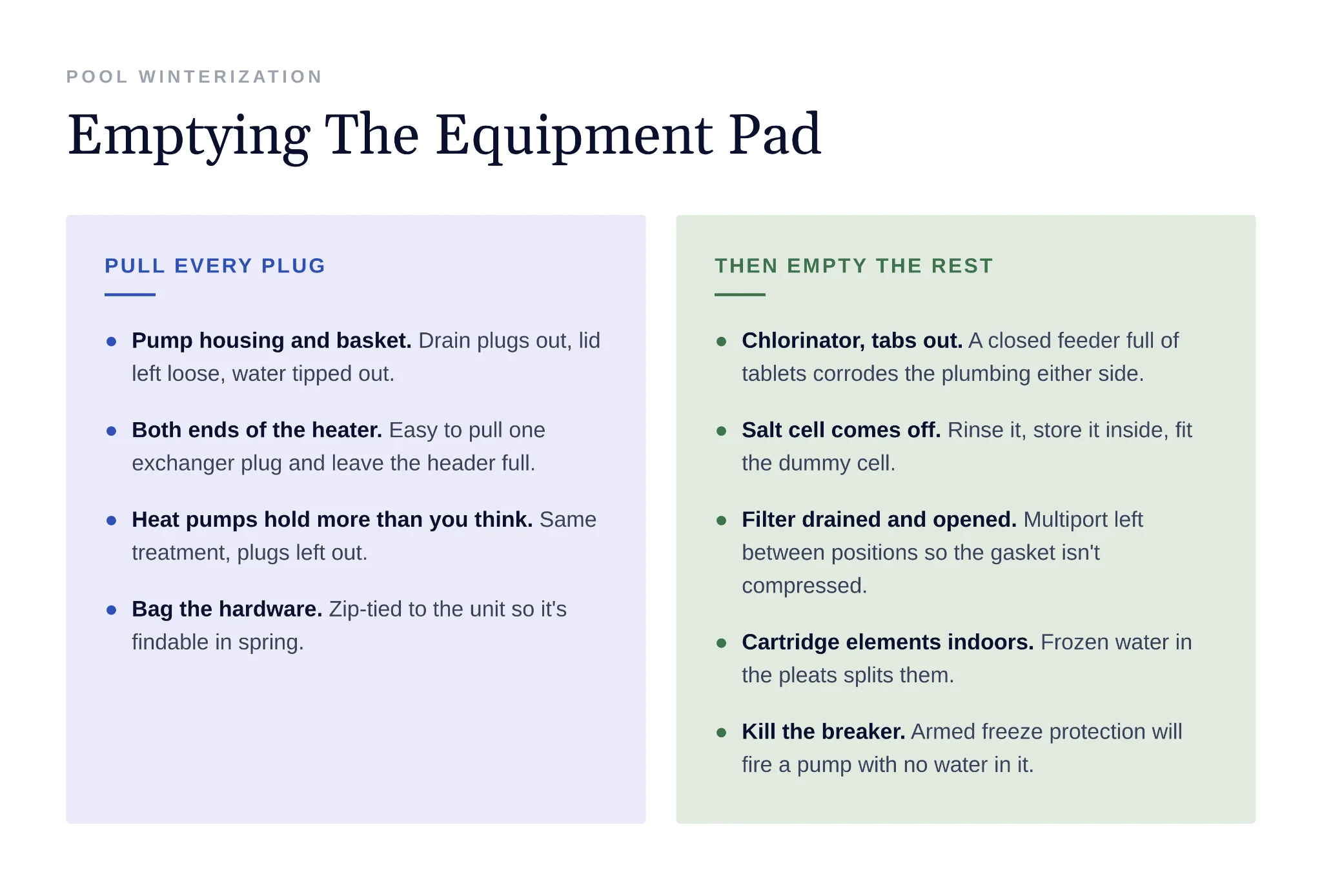
Cleaner lines and dedicated vacuum lines. Spa jets and the spa’s own suction and blower line, which holds water in a loop that never fully drains on its own. Waterfalls, sheer descents, deck jets, and the bubbler in the tanning ledge, all of which are usually fed from their own small line that gets forgotten because it’s rarely used.
In-floor cleaning systems, which have a gear valve at the pad that needs its own attention. The autofill line, which is a domestic water line running under the deck and freezes exactly like any other.
Solar panels on the roof, if there are any, and the two lines that feed them.
Once the plugs are in and the cover is on, walk the deck one more time and count the returns you plugged against the returns that exist. That count is the last chance to catch the one that got skipped, and it takes thirty seconds in October instead of a saw and a coupling in April.
The close is only as clean as the pool was on the day it happened. A cordless robot doing a full floor, wall, and waterline pass before the cover goes on saves most of the work at the other end. See Aiper’s robotic pool cleaners.
Frequently Asked Questions
The three realistic options are a shop vac with a blow port, a dedicated pool blower (also called a cyclone blower), and an air compressor with a regulator. The pool blower is the best all-around choice, a shop vac handles short runs, and a compressor is for people who already own one and know how to keep the pressure low.
On a short, shallow run, in a pinch, yes — but it’s the weakest of the options, not a proper substitute. A leaf blower moves a lot of air at no pressure, so it clears a nearby skimmer or a short return, and it stalls on anything long, underground, or sagged. The seal is the real problem: most leaf blowers don’t fit a blowout port without a cobbled-together adapter, and a leaky joint means you’re blowing air into the equipment pad, not through the line. If you’re going to make a habit of it, buy the pool blower.
Yes, for short runs. A shop vac on the blow port clears a skimmer line or a couple of nearby returns without trouble, and it’s what most first-timers already own. It stalls on long runs, deep mains, and anything with a low sag, where a dedicated blower has the volume to keep the water moving. If the line is short and the vac has a good seal on the port, it’s enough.
Regulate it down first. Set the regulator to 10 psi, never more than 15, and use a short burst with the line open rather than building pressure against a closed line. A compressor is built for pressure, not volume, and pressure is what pops a fitting off a pipe. If you don’t have a regulator, don’t use the compressor.
Skimmers first, then the main drain, then the returns, then the heater and the rest of the equipment, then the forgotten lines like the cleaner, spa jets, and the autofill. Do one line at a time with everything else closed — air going three directions at once doesn’t fully clear any of them.
Keep it around 10 psi for underground PVC, and there’s rarely any reason to go past 15. The point of blowing out a line is volume, not pressure. Anything you hear as a bang means a fitting let go — that’s a repair, not a successful blowout.
Water expands when it freezes, and trapped water doesn’t freeze gently. It cracks the pipe, splits the fitting, or breaks a skimmer at the throat — and the worst of it usually shows up in spring, when you open the pool and the water level won’t hold or the pump pulls air. The heater is the expensive casualty; a cracked heat exchanger can cost more to replace than the rest of the pad put together. In a hard-freeze climate, skipping the blowout is a gamble that the damage happens somewhere you can’t see until it’s too late.
Doing it yourself costs whatever the tool costs: a shop vac you likely already own, or a pool blower in the $60 to $150 range, plus a few plugs and a bottle of antifreeze. Paying a pool service to close the pool and blow the lines typically runs $150 to $400, depending on pool size, how much equipment is on the pad, and your market. A blowout-only call, if the rest of the close is already done, lands toward the low end of that.
Get more pool and lawn care guides from Aiper on Google