How To Winterize An Above-Ground Pool

Winterizing an above-ground pool is about protecting the liner, skimmer, cover, pump, and other equipment from months of cold weather.
Most winter damage comes from closing the pool incorrectly or failing to account for what happens after the cover goes on.
This guide walks through how to close an above-ground pool properly and protect it throughout the winter.
Leave It Up, Or Take It Down
First, decide whether the pool stays standing or comes apart, because everything after this depends on the answer.
A soft-sided pool, an Intex, Bestway, or any frame pool with a snap-in vinyl liner, isn’t built to hold a winter’s worth of ice and snow. Those come down. Scrub the liner, drain the pool completely, and let every panel dry for a day before you fold it, because a liner that goes in the box damp comes out in April smelling of mildew. Fold it loose, and store it somewhere dry and out of the sun. The water level, the skimmer plugs, and the cover that follow don’t apply to a pool that’s in a box.
A steel-wall or hard-frame pool stays up. It’s engineered to hold its shape through the winter, and the water left inside is part of what keeps the wall round. Draining one of these is the mistake. The liner shrinks off the track, and the wall loses the pressure that pushes back against ice and wind. Lower the level, seal the openings, and cover it in place.
Everything after this section is the leave-it-up path.
Wait For Sixty Degrees
Once the pool is consistently under about 60°F, algae and bacteria stop doing much, which means whatever chemistry gets sealed in stays put.
Close while the water is still warm and the chlorine burns off in weeks, leaving four months of green to open into. In most places that’s late October. In colder regions, sooner.
There’s a limit on the other end, though. All of this needs to happen before the first hard freeze, because the parts of the job that involve draining hoses and pulling plugs get much less pleasant once there’s ice in them.
Get The Water Right First
Brush the walls and floor, vacuum, and skim everything out. Then balance pH, alkalinity, and calcium hardness, since water that sits out of range all winter will corrode fittings and stain the liner, and neither problem shows itself until it’s permanent.
Shock the pool and let the chlorine drop back to normal levels before covering.
Winter algaecide and a metal sequestrant go in last, with the pump running long enough to distribute them.
One thing not to do: drop a floating chlorine dispenser in and walk away. Under a cover, with no circulation, it parks itself in one spot and bleaches a pale ring into the liner that never comes out.
What’s on the floor on closing day is what the liner sits against until spring. Leaf tannins and organic debris stain vinyl over a long winter, and a stained liner doesn’t clean up in April the way a dirty one would have in October.
Aiper’s robotic pool cleaners include cordless models sized for above-ground pools, so it runs on its own while you work through the rest of the list.
Strip The Pool
Anything attached to the pool that can come off should come off.
Ladders and steps out, rinsed, stored dry. Skimmer basket, thermometer, solar rings, floats, toys, the wall-mounted light if it’s the kind that unclips. Remove the eyeball fitting from the return so the return hole is a clean threaded opening. Take the hoses off the wall fittings.
Everything left in the water is something the cover can catch on, or something that traps water and splits.
How Far To Lower The Water
The standard approach is to pump the water down to about four to six inches below the skimmer opening, then plug the return. That puts both wall penetrations above the waterline, so there’s nothing in them to freeze. It’s simple, and it works.
The alternative is a skimmer cover plate, a solid faceplate that bolts over the skimmer opening with a gasket and seals it from the pool side.
With one of those in place, the water can stay much closer to its normal level, which is better for the liner and better for the pool’s structure under snow load.
What matters either way is not going further than necessary. A vinyl liner needs the weight of water behind it to stay in place.
Drop the level too far, and the liner cools, contracts, and pulls out of the track at the top or wrinkles across the floor, and the wall itself loses the internal pressure that helps it hold shape against ice and wind. Never drain an above-ground pool for winter.
Wait out any rain in the forecast before setting the final level, or the number changes without asking.
Take The Equipment Apart
The pump and filter are the parts of an above-ground pool that come out of the equation entirely, and taking them out is what keeps them alive.
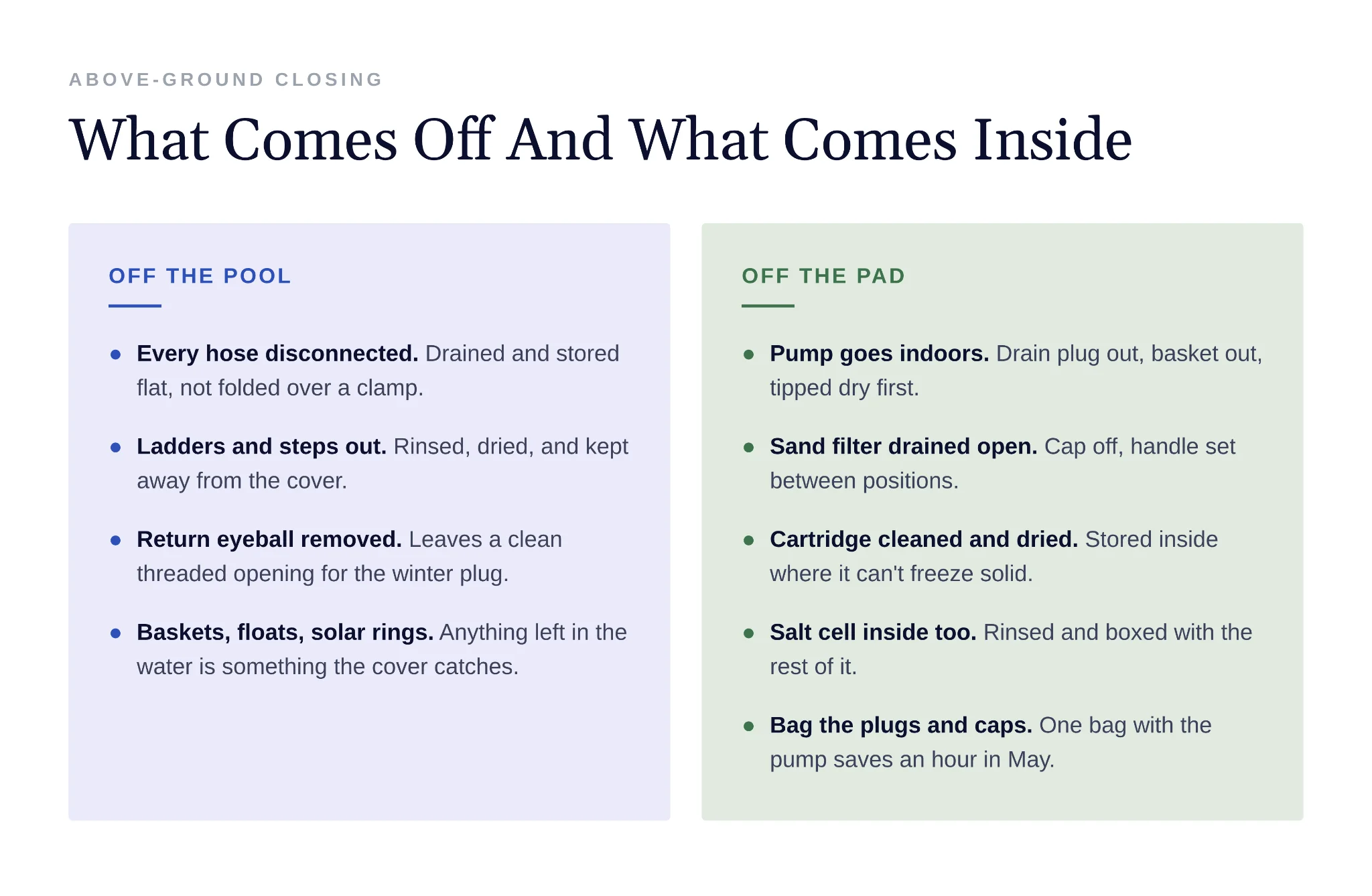
Disconnect every hose from the skimmer, the return, the pump, and the filter. Drain them completely and store them somewhere they can lie flat rather than kinked, because a hose that spends winter folded over a hose clamp cracks at the fold.
Pull the pump’s drain plug and the strainer basket, tip it to get the last of the water out, and take the whole thing indoors. A garage floor is fine. A basement shelf is better.
Sand filters get their drain cap removed and left out, and the multiport handle set between positions instead of clicked into one, so the internal gasket isn’t compressed in a single spot for five months. Cartridge filters get the element pulled, rinsed, dried, and stored inside. Any water left standing in a filter tank will freeze and crack the housing, and a cracked tank usually means a new filter.
If the pool runs salt, the cell comes off and goes inside with everything else. Solar panels get drained.
Bag the plugs, caps, and hardware together and put them with the pump. Come May, that bag saves an hour of looking.
Seal The Skimmer And Return
The return takes a threaded winter plug or a rubber expansion plug from the pool side, snugged down until it seats. Snug is enough. Torquing a plug into a return fitting cracks the fitting, and it will hold anyway until the water starts pushing on it in spring.
For the skimmer, either the water is below it, in which case there’s nothing to do beyond making sure it can’t collect rain, or the cover plate goes on with its gasket properly seated.
If the skimmer body will be holding water through the freeze, an ice compensator, a foam block, or a partly filled plastic bottle weighted down inside it gives the ice room to move instead of forcing the plastic apart.
The Air Pillow Does The Real Work
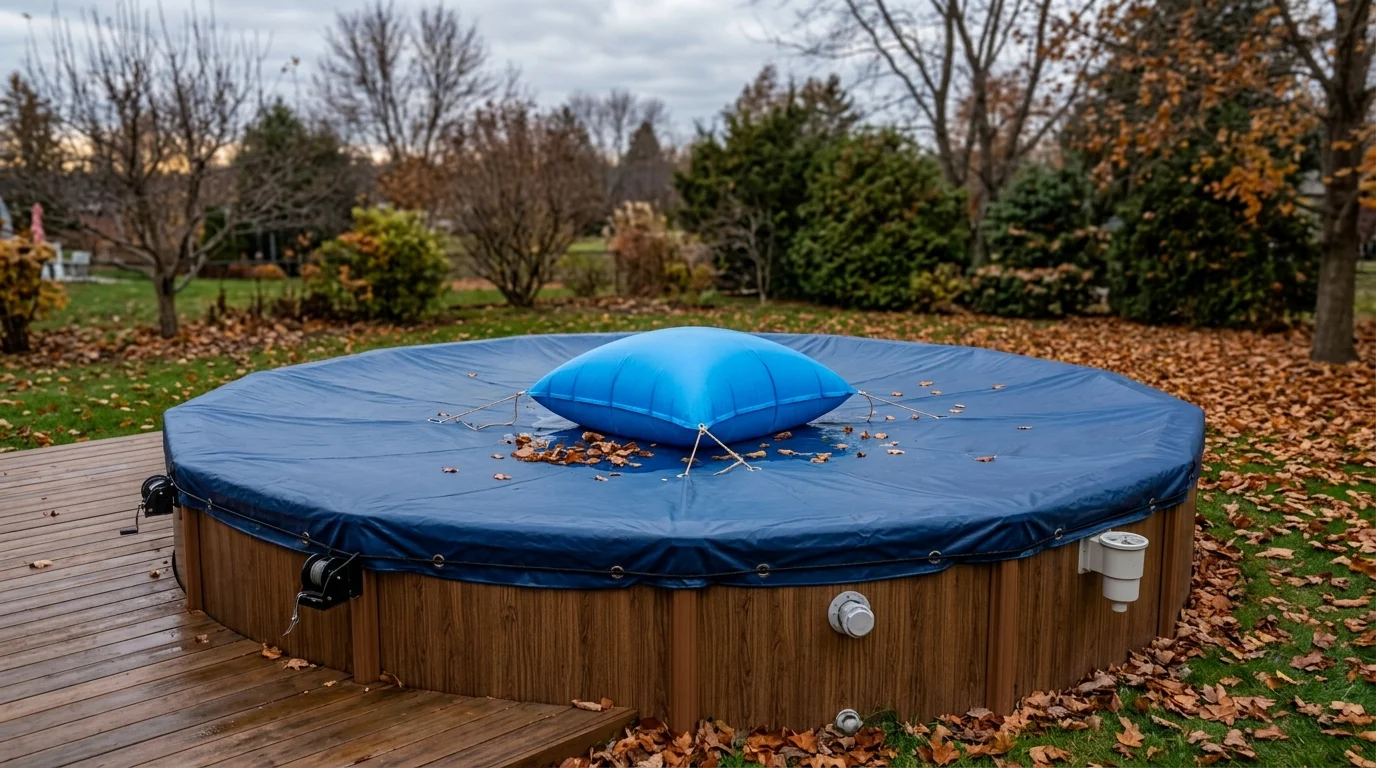
The pillow in the middle of the pool isn’t for holding the cover up. It’s there so ice has somewhere to push.
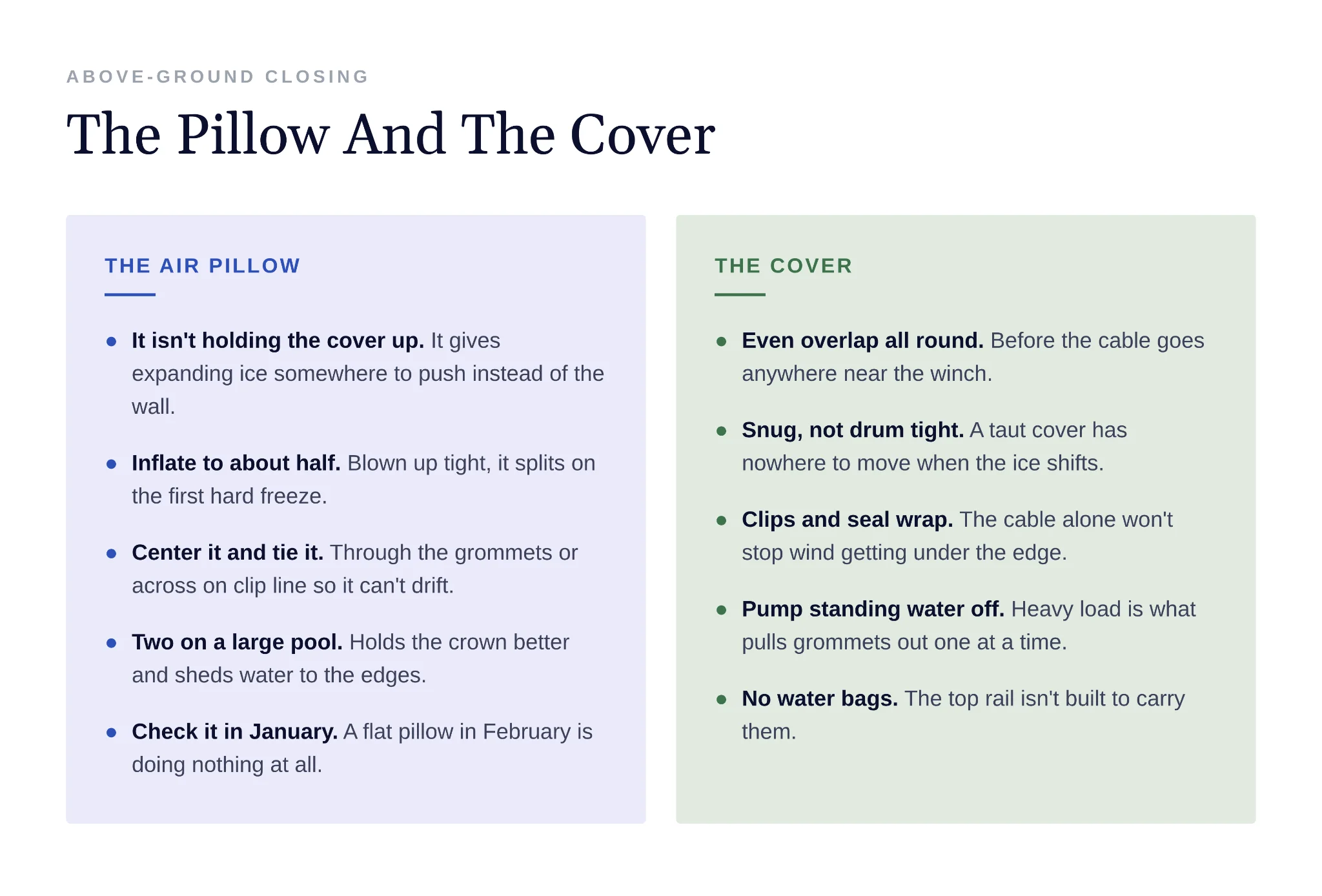
A frozen sheet of water expands outward against the walls of the pool. An inflated pillow floating in the center takes that force and compresses instead, which keeps the pressure off the wall and the top rails.
It also crowns the cover so rain and snowmelt run toward the edges rather than pooling in the middle.
Inflate it to about half. A pillow blown up tight is a pillow that splits on the first hard freeze, and a pillow with no air in it by January is doing nothing at all. Center it, tie it through the cover grommets or run a cover-clip line across it so it can’t drift to one side, and buy a second one if the pool is large. Two pillows in a big round pool hold the crown better than one.
Getting The Cover On
Above-ground covers are held by a cable and winch around the top rail, and the failure is almost always the same.
Lay the cover so the overlap is even all the way around. Feed the cable through the grommets, run it into the winch, and take up the slack until the cover is held firmly against the wall without being stretched drum tight. Then add wall clips or cover seal wrap around the perimeter, because the cable alone doesn’t stop wind from getting under the edge and lifting the whole thing like a sail.
Leave a little give. A cover that’s pulled taut in October has nowhere to move once ice forms and the water level shifts, and grommets tear out one at a time until the cover goes into the pool.
Water and light snow on top are not a problem. Heavy standing water is. A cover pump left on the cover with the float set, or a siphon run once after a big storm, keeps the load off, and the difference between a cover that survives three winters and one that lasts a season is usually whether anyone bothered.
Don’t put water bags or weights on an above-ground cover the way you would on an in-ground one. The rail isn’t built for it.
Check On It
An above-ground pool closed in October and ignored until May is a coin flip.
Two or three times over the winter, look at the pillow through the cover and see whether it’s still holding air, clear heavy snow off the middle, and check the cable for slack after any thaw. If the pillow’s gone flat and the pool is already frozen, there’s nothing to do about it that year, but knowing means opening early enough to catch a wall or rail that took a beating.
By March the cover will be filthy, and there will be an inch of black water on top of it. Pump that off before pulling the cover, not after, because the alternative is dumping all of it into water that was clear enough to open in a day.
Frequently Asked Questions
Not anywhere the water freezes. The frame and snap-in liner on a soft-sided pool aren’t rated for ice expanding against them, and snow load bends the top rails. In a warm climate that never drops below freezing, a soft pool can ride out the season standing with the chemistry balanced and a cover on. The moment ice is in the forecast, it comes down.
The pool fills with leaves and silt, the water goes green with no circulation, and ice forms straight against the wall with nothing to absorb the expansion. The air pillow only works under a cover that crowns it. By spring you’re not opening a pool, you’re draining a swamp. The cover is the cheapest step in the whole close.
Yes, anywhere the water freezes hard. One pillow is enough for a round or oval up to about 24 feet; two, tied apart, hold the crown better on anything larger. A small pool still wants one. Ice in a small pool still pushes outward, and there’s less wall there to take it.
Not to the same depth. In a mild climate you can keep the pool running through winter, or cover it with the water balanced and the equipment left connected, as long as it won’t drop below freezing. What you can’t skip is the chemistry and the cover. Warm water with no circulation and no cover grows algae just as fast as cold water does.
It’s harder, but not too late. Wait for a thaw, drain what you can, and close then. The real risk of closing late is the liner and wall that already took a few freeze-thaw cycles. Catch it before the second hard freeze and most of the damage is still avoidable.
Get more pool and lawn care guides from Aiper on Google