Landscaping vs Lawn Care: Two Different Industries, Two Different Hires

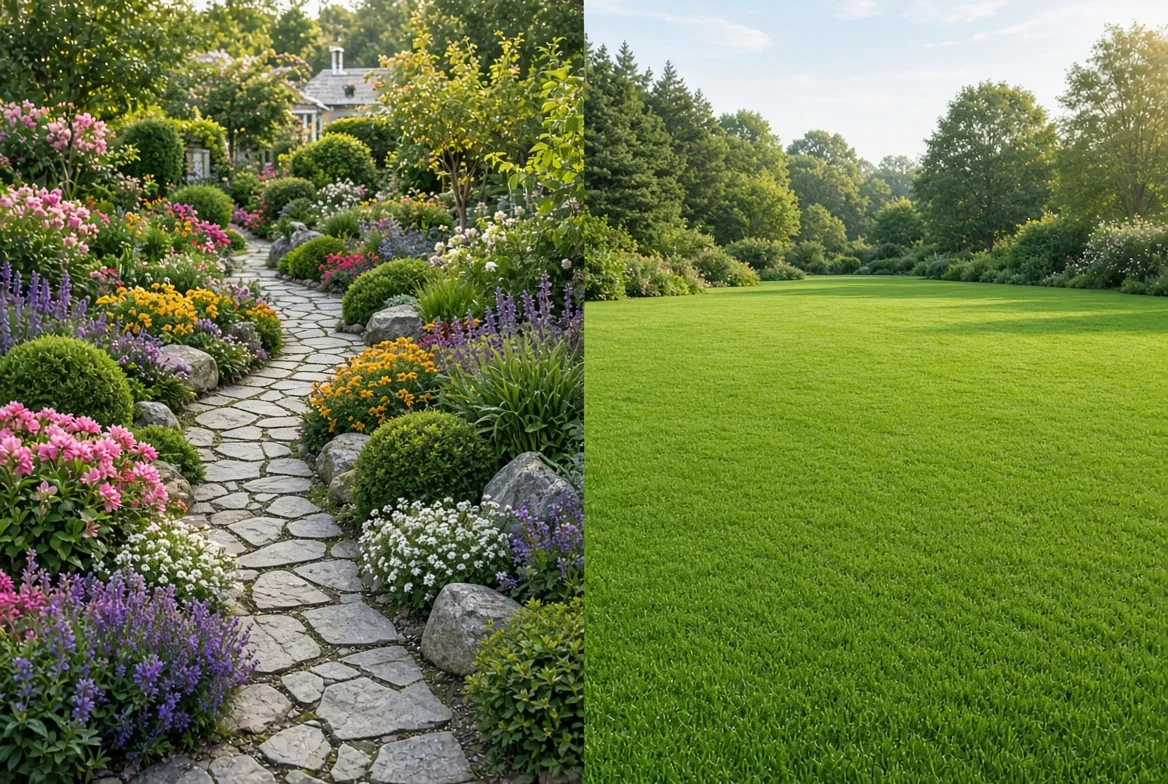
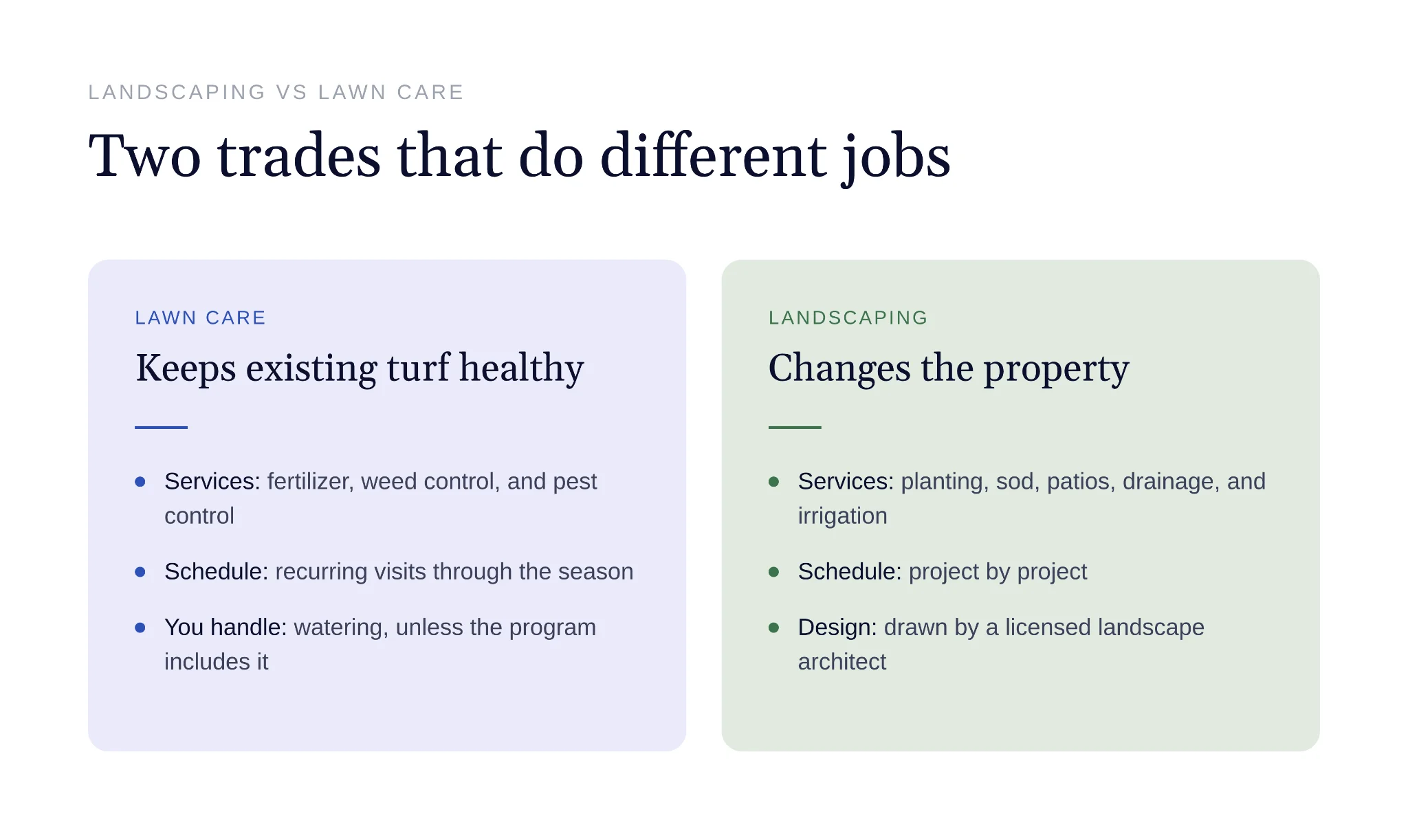
Lawn care companies keep existing turf healthy on a recurring schedule. Landscaping companies change the property itself: they plant, grade, build, and install.
The two often show up in the same yard, and plenty of homeowners call one when they need the other. The result is a crew quoting work it isn’t licensed or equipped to do, or a monthly bill for services that don’t address the actual problem.
What Lawn Care Companies Do
Lawn care is sold as a program, and the program level decides how much of the work stays with you. NC State Extension splits the industry into partial lawncare, total lawncare, and total landscape maintenance:
- Partial lawncare is the fertilizer-and-weed-control service most homeowners picture. The company applies herbicides and fertilizer, and some add insect and disease control. You still handle mowing, watering, aeration, and reseeding.
- Total lawncare covers all the turf on the property. These firms mow, trim, fertilize, and apply pesticides, and some also run and maintain the irrigation system under a written contract.
The quality of a partial program depends heavily on what happens between visits. A lawn that gets the right fertilizer and weed control will still decline if it is mowed too short or watered on the wrong schedule. For what each level of service should and should not include, see lawn care versus lawn maintenance terms on invoices.
What Landscaping Companies Do
Landscaping work changes how the property looks or functions. The U.S. Department of Labor describes landscaping crews doing sod laying, planting, sprinkler installation, and building mortarless retaining walls, alongside mowing and trimming.
California’s contractor board gives a useful list of projects that need a licensed landscaping contractor rather than a yard maintenance crew:
- Drainage systems and trenching
- Irrigation systems and landscape lighting
- Patios, walkways, and retaining walls
- Fences and decks
- Plants and sod
Some landscaping firms also sell ongoing maintenance for trees, shrubs, and flower beds. That service sits on top of the lawn, and the turf program may still be handled separately.
Design is its own profession. A landscape architect draws the plan, and a landscape contractor builds it. All states require landscape architects to be licensed, usually through a degree, supervised experience, and an exam.
How the Two Compare
The differences come down to the type of work, how often the company shows up, and which credentials matter. The table puts them side by side.
| Lawn care | Landscaping | |
|---|---|---|
| Main job | Keep existing turf healthy | Plant, build, grade, and install |
| Visit pattern | Recurring, through the growing season | Project-based, with a start and end date |
| Typical pricing | Per visit or per season | Per project, quoted on labor and materials |
| Credential to check | Pesticide applicator license | Contractor license where the state requires one |
Which One to Call
Most yard problems point clearly to one trade. Start with what you’re seeing.
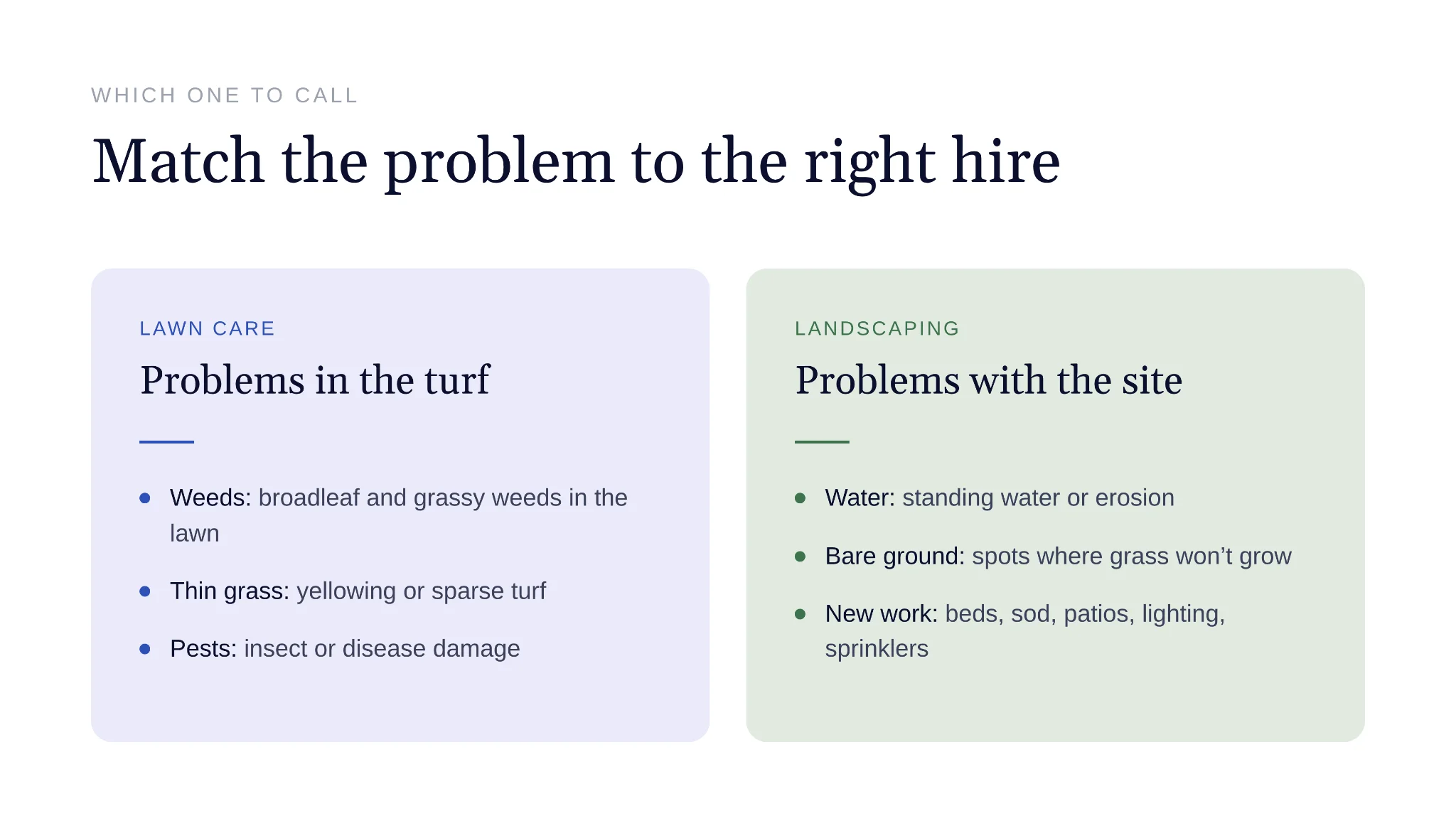
Weeds, thin grass, yellowing, or insect damage. Call a lawn care company. These are fertility, pest, and mowing problems in turf that is otherwise in the right place.
Standing water, erosion, or bare ground under trees. Call a landscaper. Fixing these usually means regrading, adding drainage, or replacing turf with plants suited to the spot.
New beds, sod, a patio, or lighting. Call a landscaper, and confirm the license before you get a quote.
Weekly mowing only. A mowing or gardening service is enough. In California, gardeners doing routine mowing, weeding, and trimming generally don’t need a state license.
A new sprinkler system. Call a landscaper or an irrigation specialist. In some states, irrigation is its own licensed trade.
Licenses to Verify Before You Hire
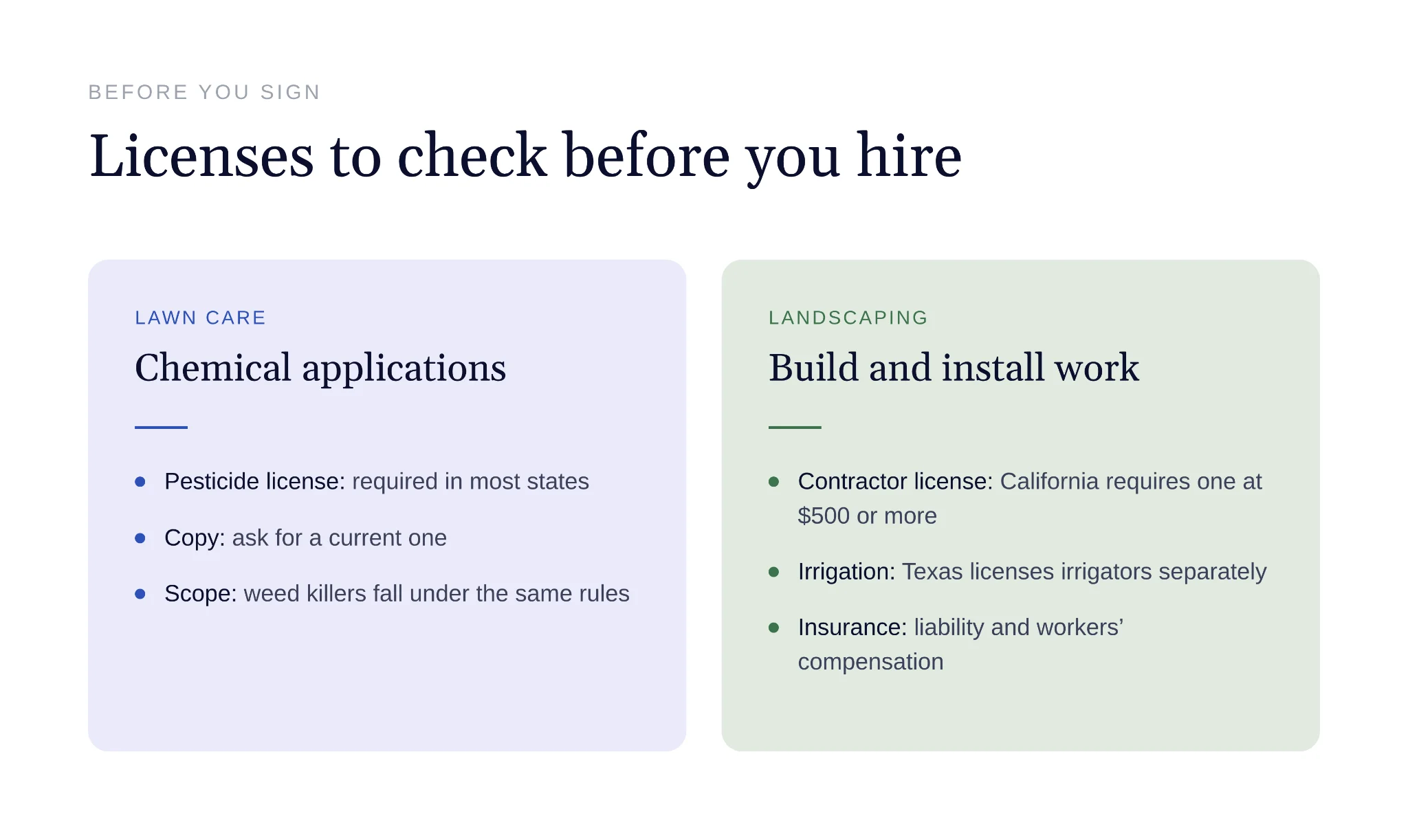
A license tells you the company has passed a state test and can be held accountable when work goes wrong. Check these before signing anything.
- Pesticide applicator license. Most states require workers who apply pesticides and fertilizers to be licensed, which usually means passing a test on handling and disposal. Ask for a current copy, and remember that common weed killers such as Roundup fall under the same rules.
- Contractor license for construction work. In California, any landscaping project of $500 or more in labor and materials requires a contractor with the C-27 Landscaping classification. Other states set their own thresholds, so check your state contractor board.
- Irrigation license where it applies. Texas requires a license for anyone who designs, installs, repairs, or connects irrigation systems, with 24 hours of continuing education every three years.
- Insurance. Ask for proof of general liability coverage and workers’ compensation. Without workers’ comp, an injury on your property can become your problem.
- Written scope of work. Get the services, visit frequency, and price in writing before the first visit.
Questions to Ask a Lawn Care Company
Most lawn care companies use similar products and timing, so the difference usually comes down to the technician and the program. NC State recommends a site consultation before any contract, including a survey of the landscape and a written description of services.
Use the consultation to ask:
- Which specific pests are you treating, and how did you identify them?
- Do you apply pesticides preventively all year, or only when a problem shows up?
- How do your fertilizer rates compare with extension recommendations for my grass?
- How quickly will someone come out if a problem appears mid-contract?
Use our lawn fertilizer calculator to gather context before your call.
Be cautious with companies that promise a weed-free lawn or sell year-round preventive treatment for every pest. NC State warns that heavy pesticide use can kill the beneficial insects that keep pests in check.
Who Manages the Watering
Watering sits between the two hires. A partial lawn care program leaves it to you, and a landscaper who installs a sprinkler system usually hands over the controller and moves on.
That gap is where many lawns go wrong. UF/IFAS notes that many homeowners leave the irrigation timer on the same schedule year-round, even though plant water needs change through the year. The result is wasted water and weaker turf.
A controller that adjusts on its own closes that gap. The Aiper IrriSense 2 sets up to 10 watering zones with separate schedules and adjusts watering based on weather, so the lawn and beds a landscaper planted get different amounts of water without manual timer changes.
When One Company Offers Both
Many firms sell lawn care and landscaping under one name. That works, but each service still needs its own credential: a pesticide license for the lawn program and a contractor license for the build work.
When a project includes new sod or plants, schedule the landscaping first. Weed control on new turf usually waits until the grass has rooted and been mowed a few times.
Get more pool and lawn care guides from Aiper on Google