Lawn Care vs. Lawn Maintenance: Terminology That Actually Matters on Invoices

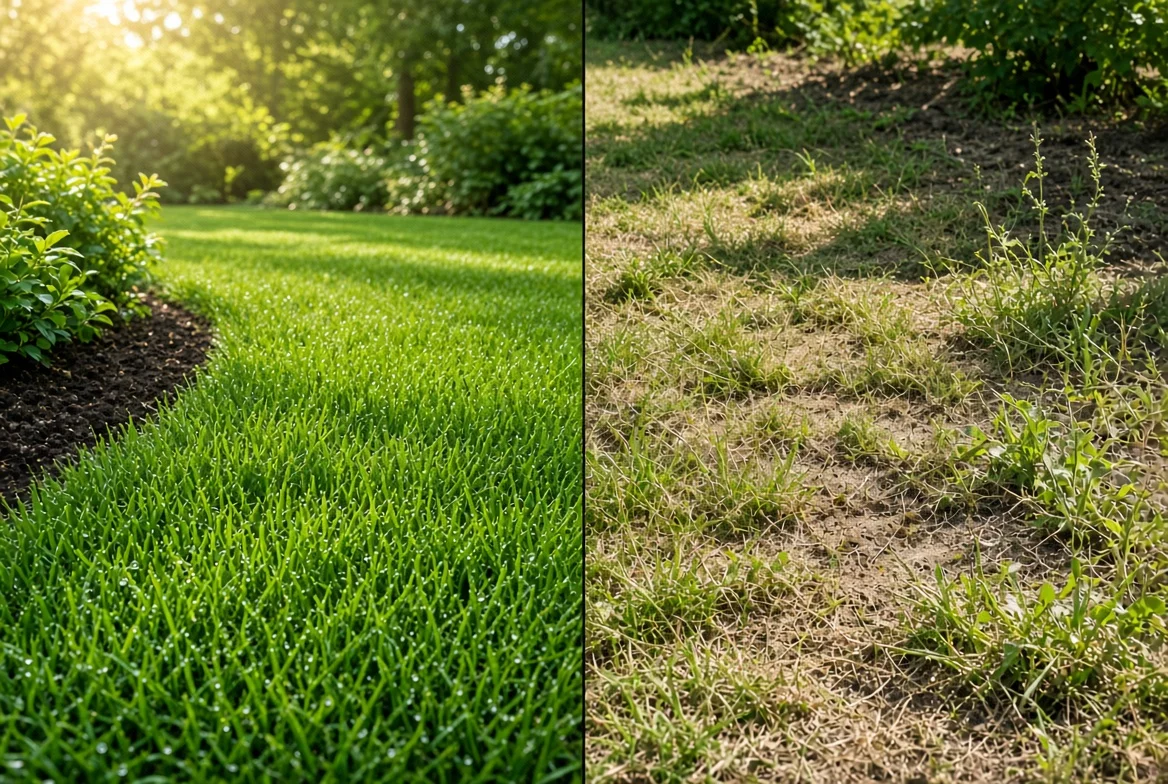
Companies use “lawn care” and “lawn maintenance” interchangeably in ads. On an invoice or service agreement, they usually describe different work with different pricing, and only one of them involves products that require a state license to apply.
Knowing which is which tells you what you are paying for, what you should receive after each visit, and what falls to you between visits.
What Each Term Covers
The simplest way to separate them: maintenance is done to the lawn’s appearance, and care is done to the grass and soil.
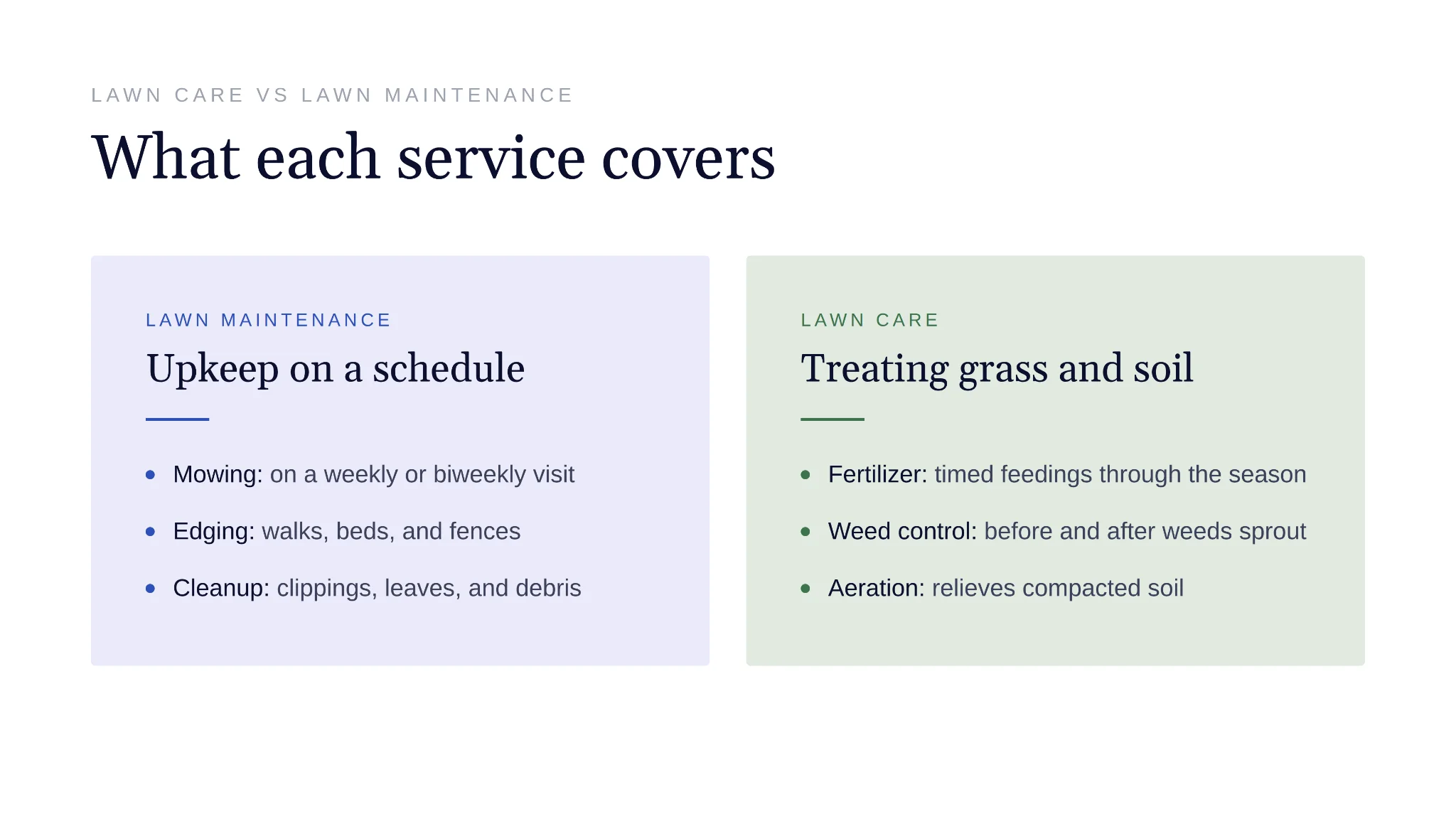
Lawn maintenance is the physical upkeep that happens on a schedule. Mowing, edging along walks and driveways, string trimming around beds and fences, blowing clippings off hard surfaces, and seasonal leaf cleanup all fall under it. A maintenance crew brings mowers and trimmers, and the visit is billed whether the grass grew an inch or three.
Lawn care is treatment. Fertilizer, pre-emergent and post-emergent weed control, grub and insect control, lime, aeration, and overseeding all count. A care company brings spreaders and sprayers, and each visit applies a product or does work meant to change how the grass grows.
Some companies offer both under one contract. Others do one and subcontract the other, which is worth knowing when something goes wrong, and you need to know whose crew did it.
Terms You Will See on an Invoice
Line items rarely explain themselves. These are the terms that cause the most confusion and what each usually means.
| Invoice term | What it usually means | What to confirm |
|---|---|---|
| Mow, edge, trim, blow | One standard maintenance visit | Whether edging is every visit or every other visit |
| Application or round | One treatment visit in a seasonal program | Which product was applied and how many rounds are in the program |
| Pre-emergent | Weed control that stops seeds from sprouting | That it went down before the soil warmed in spring, since it does nothing to weeds already growing |
| Post-emergent or spot spray | Weed control for weeds already visible | Whether it was sprayed across the lawn or only on weeds |
| Weed and feed | Fertilizer combined with herbicide | That it is listed as a pesticide application, since the herbicide makes it one |
| Core aeration | Pulling small plugs of soil to relieve compaction | That it was core aeration, since spike aeration does far less |
| Overseeding | Spreading seed into existing grass | Seed type and whether it followed aeration |
| Cleanup | Leaf, debris, or storm cleanup | Whether hauling away debris is included or billed separately |
| Landscaping | Planting, beds, mulch, or design work | Whether it is a one-time project charge or part of the recurring contract |
Why the Difference Changes Your Bill
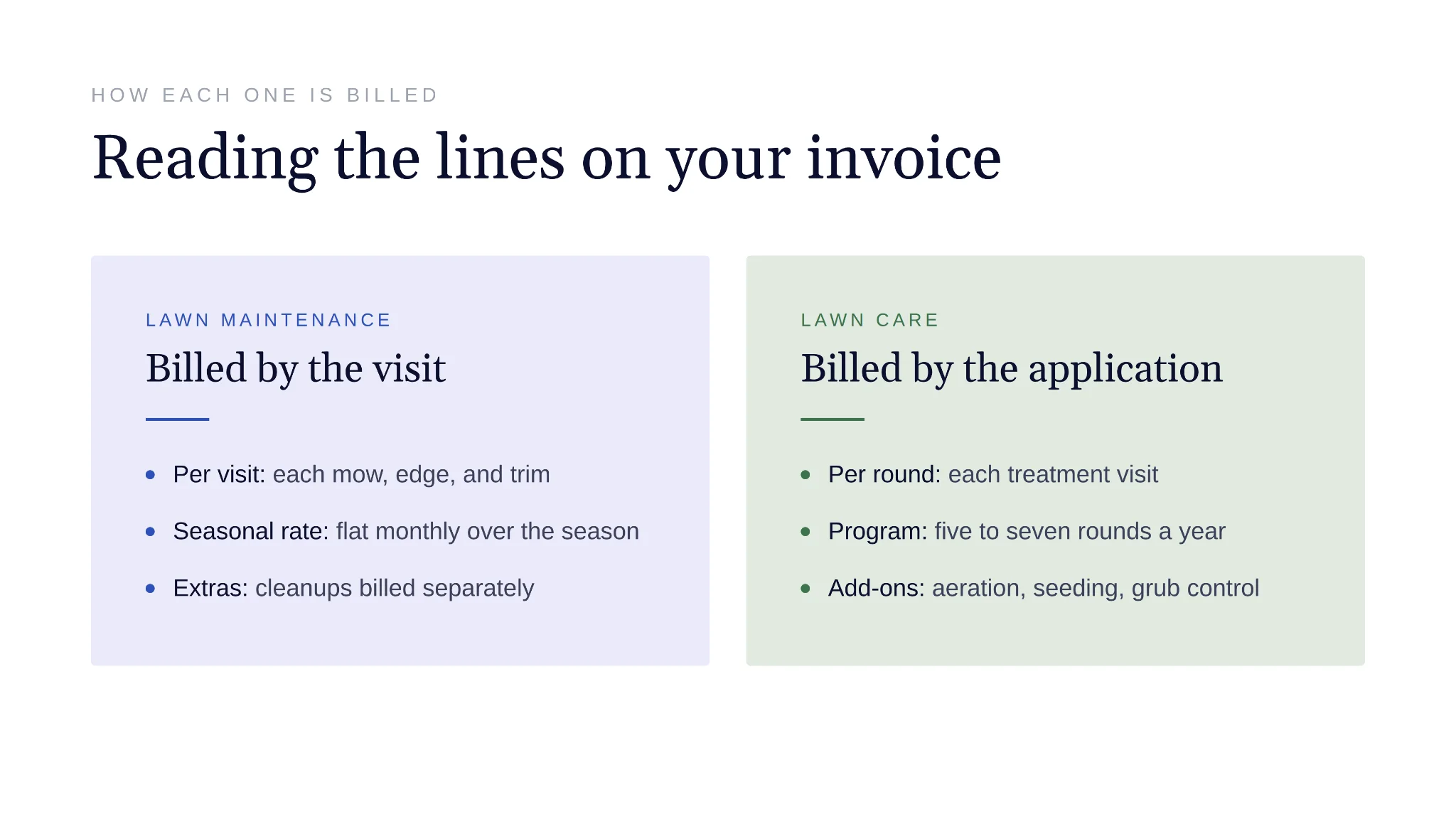
Maintenance is usually billed per visit or as a flat monthly rate over the mowing season. Care is billed per application, often as a program of five to seven rounds paid either per round or upfront.
Sales tax can also depend on the category. In Texas, lawn and yard care, including mowing, fertilizing, and planting, is a taxable service, while the professional services of a landscape designer are not, according to the Texas Comptroller’s guidance on landscaping and lawn care.
Other states draw the line differently, and some don’t tax lawn services at all. If tax shows up on one line of your invoice and not another, the category on that line is usually the reason, and your state’s revenue department can confirm it.
What a Treatment Visit Should Leave Behind
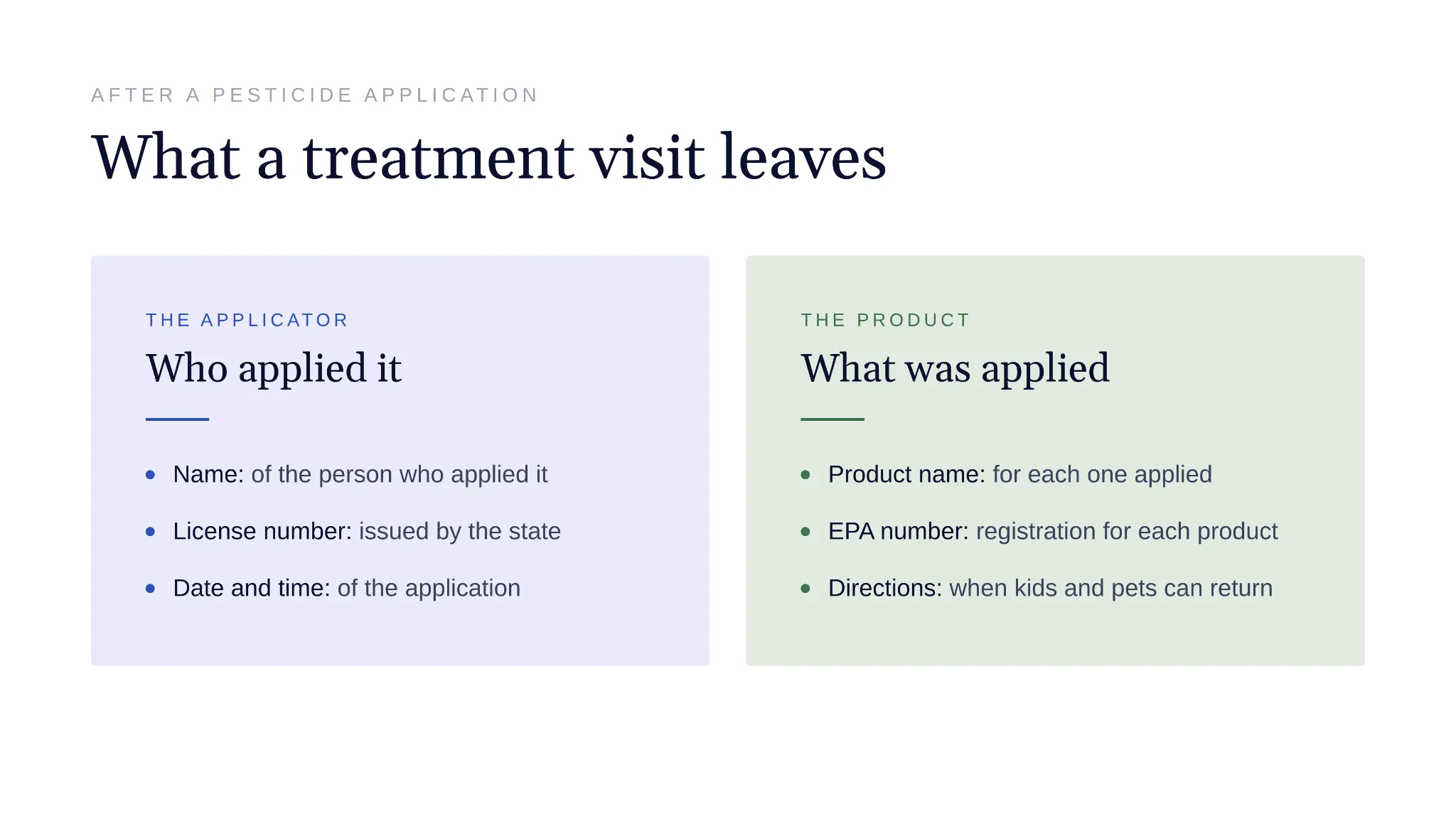
Any visit that applies weed control, insect control, or weed and feed is a pesticide application, and most states regulate it. The paperwork you get afterward is often required by law.
In Massachusetts, for example, the state’s consumer bulletin on lawn care requires the applicator to leave you:
- The applicator’s name and state pesticide license number
- The date and time of the application
- The name and EPA registration number of each product applied
- Directions on what to do after the application, such as how long to keep kids and pets off the grass
Requirements vary by state, but asking for this information is reasonable anywhere. If a company can’t tell you what it applied or who holds the license, find another company.
Many states also require warning signs on treated lawns. Ohio requires them to stay posted for 24 hours after a lawn pesticide application, per Ohio State University’s Pesticide Safety Education Program.
A fertilizer-only visit is a different case. Straight fertilizer is not a pesticide, so it usually carries no signs or license number, though the invoice should still name the product.
Reading a Service Agreement Before You Sign
The agreement decides what you are owed when the season doesn’t go to plan. Read it for the gaps between what you assume and what is written.
Before signing a lawn service agreement:
- Find the list of included services and match each one to the table above. Anything you expected that isn’t listed will be billed as an extra.
- Check how many visits or applications the price covers, and what happens to unused ones.
- Look for a drought clause. Some maintenance contracts bill every scheduled week whether the grass needed cutting or not.
- Check whether the contract renews on its own and how much notice you need to give to cancel.
- Ask whether the company re-treats for free if weeds return within a set window after an application.
- Ask who is responsible for watering.
Watering is the line most agreements leave out. Many treatments need watering in within a day or two to work, and new seed after overseeding needs daily moisture until it sprouts, but neither a maintenance crew nor a treatment company usually comes back to do it.
That job stays with the homeowner. The Aiper IrriSense 2 runs it on a schedule across up to 10 mapped zones, so a freshly seeded section can get the frequent light watering it needs while the rest of the lawn stays on its normal cycle.
One Company or Two
A single company for both simplifies scheduling and puts one name on every problem. The tradeoff is that full-service companies are often stronger at one side of the work than the other.
Splitting the work between a mowing crew and a separate treatment company tends to make sense when the lawn has a specific problem, such as grubs or heavy weed pressure, that calls for a specialist. In that case, tell each company the other’s schedule so a crew doesn’t mow the day after an application that needed time to settle.
Get more pool and lawn care guides from Aiper on Google