Lawn Service vs DIY: When Outsourcing Actually Pays Off

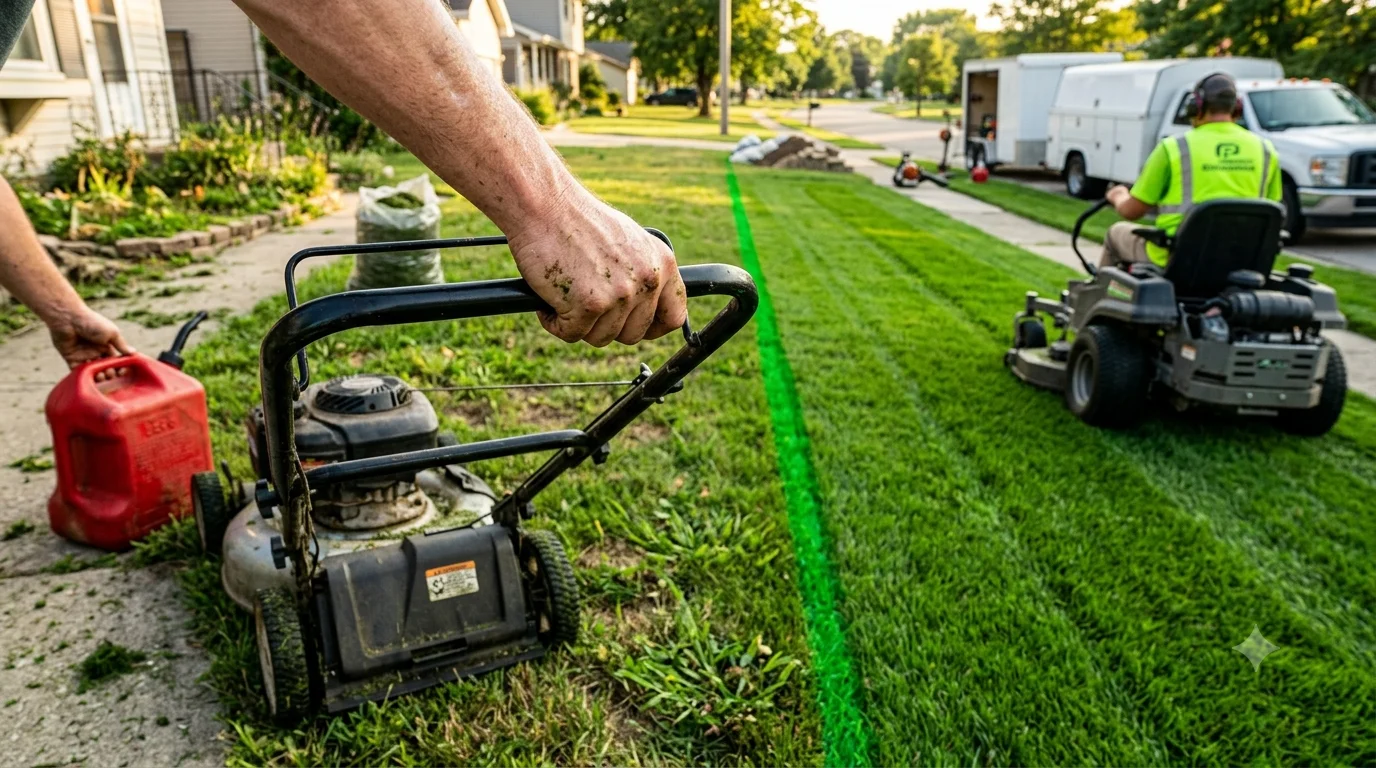
Everyone runs this math wrong the first time. They compare the mowing bill against the cost of gas and conclude the service is robbery.
Forty-five dollars a week for something I can do myself in an hour? That’s over two thousand a year. Absurd.
Then the mower needs a new blade. Then a carburetor rebuild.
Then it’s July, it’s 96 degrees, the grass grew four inches in six days because of back-to-back storms, and the “one hour” job is now two hours of pushing through wet, heavy growth that clogs the deck every third pass.
The math starts looking different around week eight.
Full DIY, full service, and the hybrid version win under specific conditions, and most people are running the wrong setup for their actual conditions.
The real cost of DIY, itemized honestly
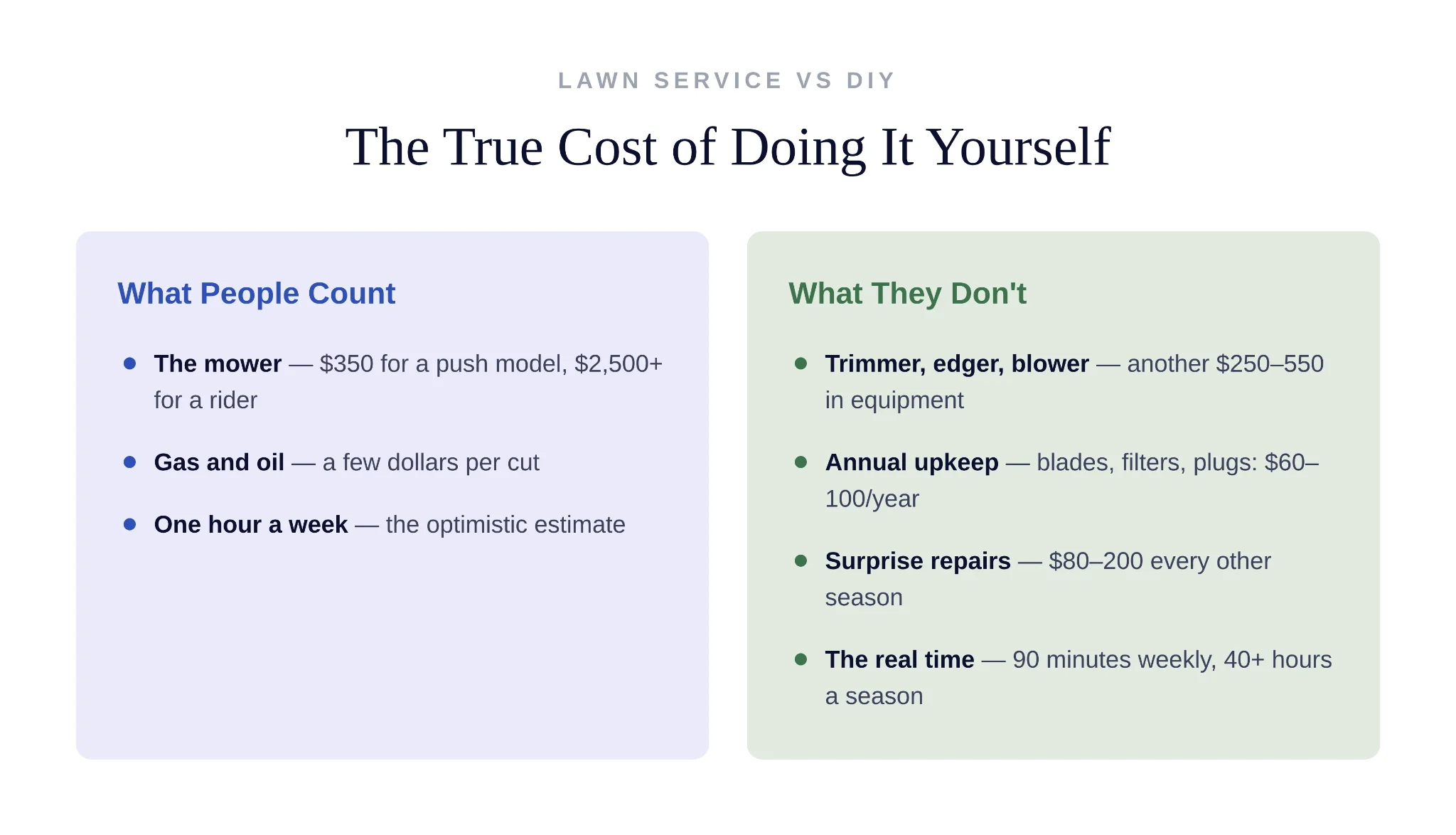
People count the mower. They don’t count everything the mower drags in behind it.
A functional DIY setup for a typical suburban lot means:
Mower: $350 for a decent push model, $2,500+ if the lot justifies a rider. Lifespan of 8–10 years if you maintain it, 4–5 if you don’t.
String trimmer and edger: Another $150–300, and the trimmer line will run out at the worst possible moment, always.
Blower: $100–250 unless you enjoy sweeping clippings off the driveway with a broom, which nobody does more than twice.
Annual maintenance: Blade sharpening, oil, air filter, spark plug, fuel stabilizer. Call it $60–100 a year if you do it yourself, more if you drop it at a shop.
The repair you didn’t budget for: A pull cord, a dead battery, a carb gummed up from ethanol fuel sitting over winter. This happens roughly every other season and costs $80–200 each time.
Spread across ten years, equipment alone runs $150-400 a year depending on how lucky you get. That’s before your time.
And the time is the part people lie to themselves about. Mowing isn’t the job. Mowing plus trimming plus edging plus blowing plus emptying the bag plus wiping down the deck is the job, and on a quarter-acre lot that’s 90 minutes, not 45. Weekly, April through October. Twenty-six weeks. Call it 40 hours a season, minimum.
If your Saturday hours are worth nothing to you, DIY wins on cost. Full stop. But most people’s Saturday hours are not worth nothing.
What a Service Actually Charges
Weekly mowing for a standard suburban lot runs $35–60 in most markets. Larger lots, gated backyards, slopes, or lots of trimming edges push it higher. Annual total for mowing alone: $900–1,600.
That number sounds bad next to a $350 mower. It sounds a lot better next to the full DIY ledger above, and it sounds completely different once you understand what you’re actually purchasing.
You’re not buying labor. You’re buying consistency.
A crew shows up every Thursday whether you’re traveling, sick, buried at work, or it rained Tuesday and Wednesday. Grass that gets cut on schedule at the right height stays denser and chokes out weeds better than grass that gets scalped every ten days because the homeowner fell behind and then overcorrected.
The crew also cuts with sharp blades. Yours are probably dull right now. Dull blades tear grass instead of slicing it, the torn tips brown out, and the whole lawn takes on that grayish haze people blame on drought.
Where DIY Genuinely Wins
Not everything favors the truck.
Small, simple lots
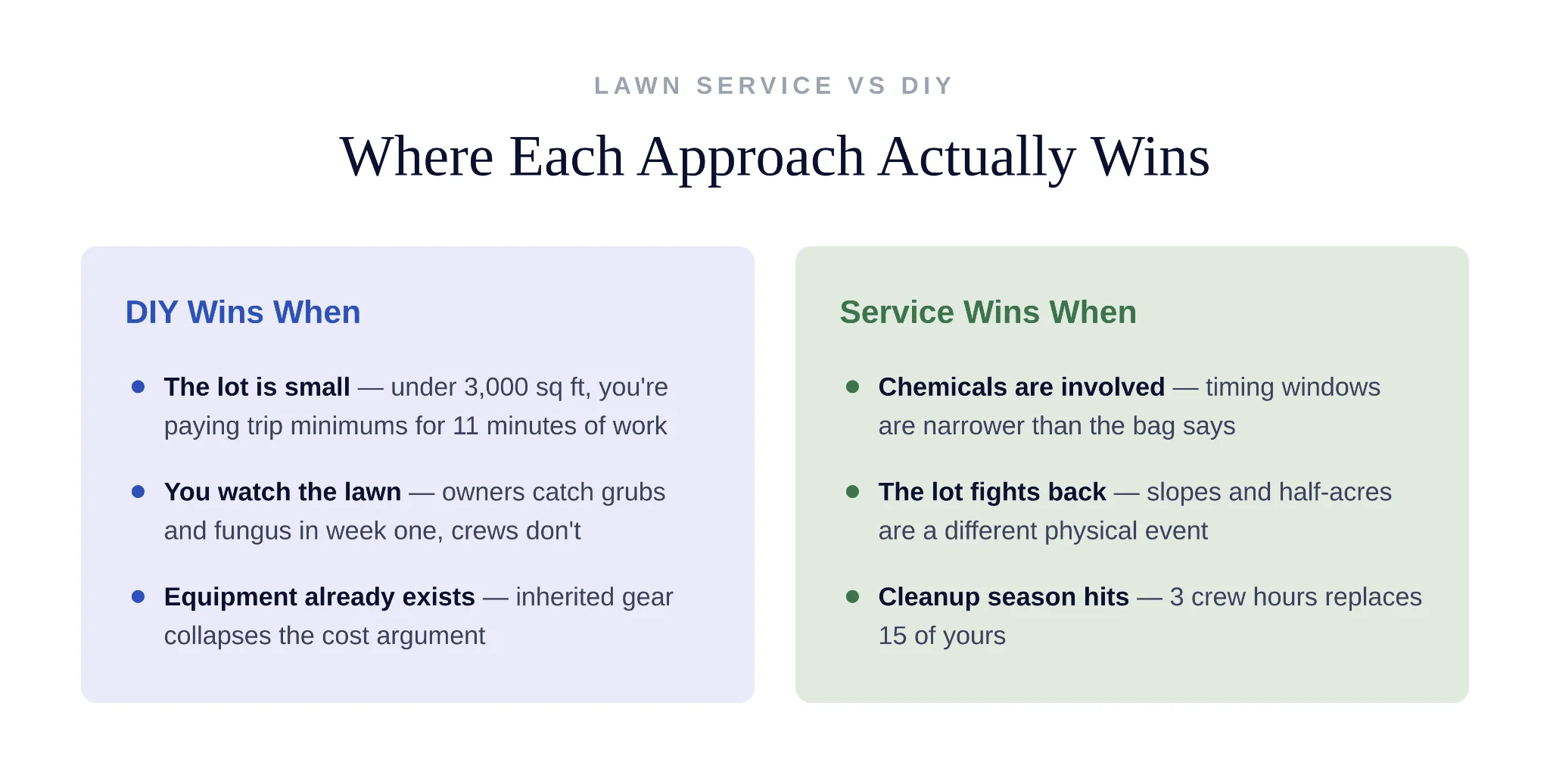
Under about 3,000 square feet of actual turf, a service is charging you a trip minimum, not a labor rate. The crew is on your property for eleven minutes. You’re paying $40 for eleven minutes. A small electric mower handles this in twenty minutes of your own time, the equipment cost is trivial, and there’s no gas engine to maintain. This is the clearest DIY case there is.
When you actually care about the lawn
This sounds backwards. It isn’t.
A mowing crew cuts grass. That’s the contract. They will not notice the grub damage starting in the back corner, the fungus ring near the downspout, or the fact that their mower is spreading crabgrass seed from the last four properties onto yours.
If you’re the person walking the lawn, you catch problems in week one instead of week six. Enthusiast lawns are almost always DIY lawns, because the owner’s attention is worth more than the crew’s blade.
If the equipment already exists
Inherited your dad’s rider? Neighbor moving and selling a two-year-old mower for $80? The capital cost argument collapses.
Marginal DIY cost drops to gas and time, and the break-even against a service gets very hard to beat.
Where the Service Wins
Here’s when it makes sense to pay for a service.
Anything involving chemicals
Think fertilization, pre-emergent, weed control, grub treatment.
Homeowners routinely get this wrong in ways that cost real money, like pre-emergent applied three weeks late does nothing, and now you’re hand-pulling crabgrass all summer.
Nitrogen dumped in July on cool-season grass burns it. The products at the big-box store are weaker formulations at retail markup, and the timing windows are narrower than the bag suggests.
A treatment program runs $300–600 a year for a typical lot. The applicator is licensed, the products are commercial-grade, and the timing is their whole job. This is the single service most worth paying for, ahead of mowing itself.
Slopes, big lots, and bodies that have opinions
A half-acre on a grade is a different physical event than a flat quarter-acre. If mowing leaves your back wrecked for two days, the service isn’t a luxury purchase. It’s cheaper than the chiropractor. People push through this for years out of stubbornness and then convert to a service in one afternoon after one bad step on a wet slope.
Seasonal cleanups and putting the house on sale
Spring and fall cleanup is where DIY estimates fall apart hardest. What looks like a weekend of raking is genuinely 12–20 hours of raking, bagging, hauling, gutter-adjacent misery. A crew with commercial blowers and a leaf vac does it in three hours for $200–400.
Curb appeal during a listing period is not the moment to experiment. Pay for it, keep it perfect, done.
The Hybrid Setup
Almost nobody’s optimal answer is 100% one or the other. The split that holds up:
Outsource: Chemical program, aeration, spring and fall cleanups
DIY: Weekly mowing, if the lot is manageable and you’re home anyway
Decide by season: Some people mow themselves in spring and fall, hand off July and August when growth peaks and heat makes the job miserable
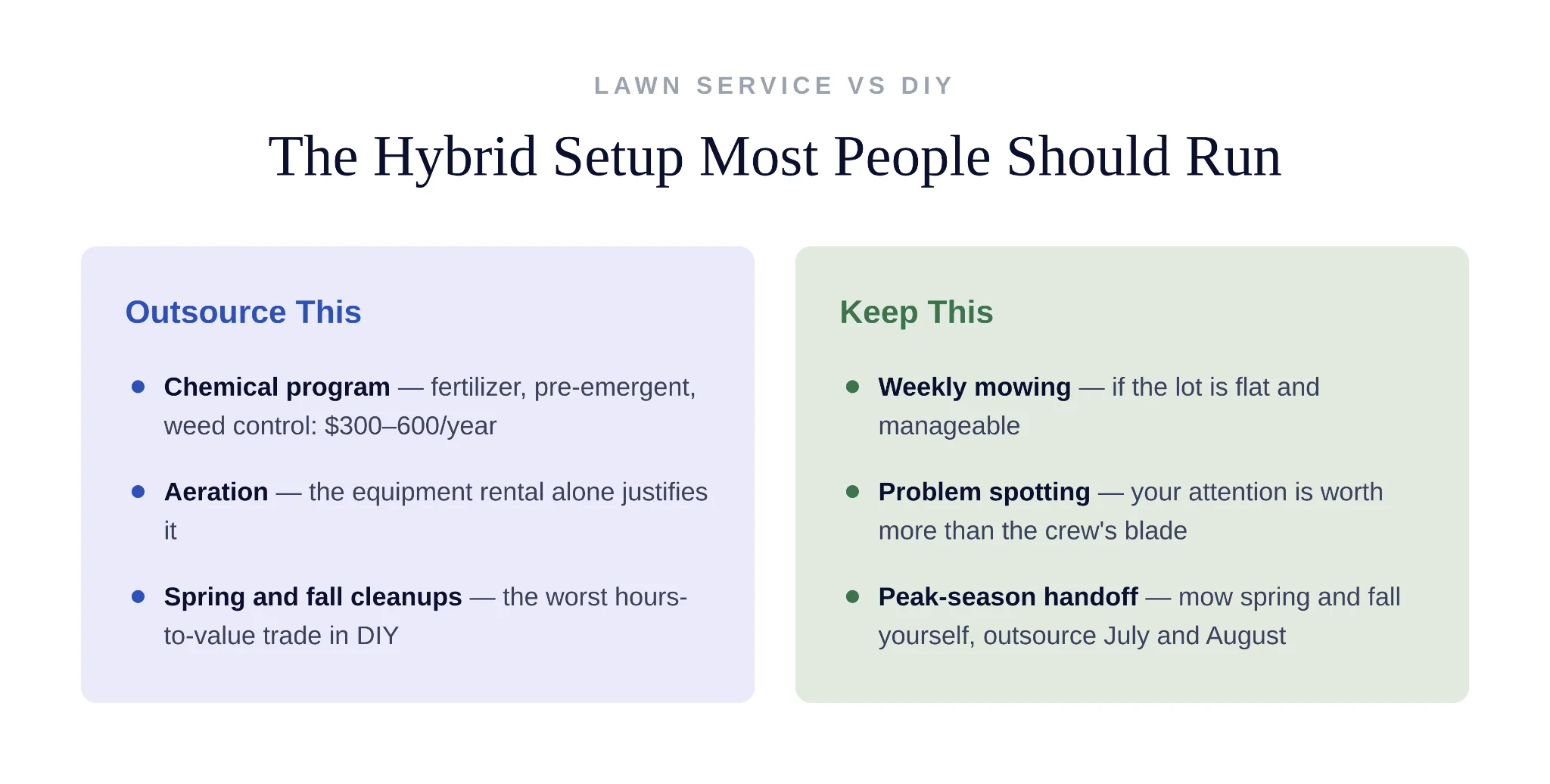
This gets you the expertise where expertise matters and keeps the recurring labor bill down where the labor is easy. Total outsourced cost lands around $600–1,000 a year instead of $2,000+, and the lawn usually looks better than either pure approach because the technical work is done right and the mowing is done attentively.
The Break-even Question
Skip the spreadsheet. Three questions settle it:
Do you make more than about $30/hour, and would you genuinely use the freed time for something? Not hypothetically. Actually. If yes, mowing service pays for itself.
Is the lot over a third of an acre, sloped, or heavily edged? Physical difficulty scales the value of outsourcing faster than lot size alone.
Are you trying to fix a lawn or just maintain one? Fixing favors a treatment service doing the chemistry while you handle the mowing. Maintaining a lawn that’s already healthy is the easiest DIY there is.
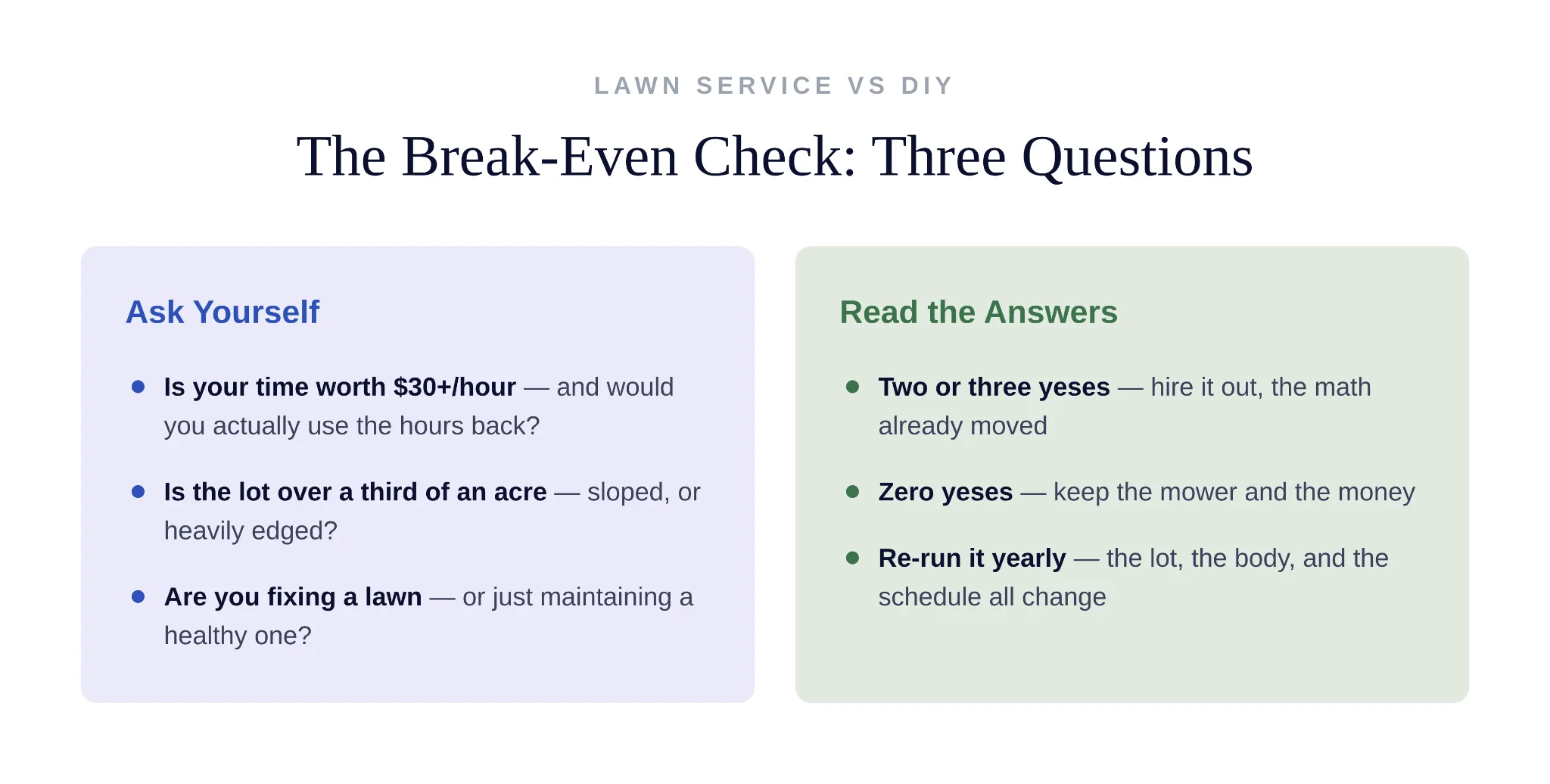
Two or three yeses, hire it out. Zero, keep the mower.
The Decision Isn’t Permanent
Whichever way it lands, notice that the biggest thing you’re buying from a service, consistency, is now something you can automate for part of the job.
The Aiper IrriSense 2 4-in-1 Smart Sprinkler & Irrigation System puts watering on the same reliable rhythm a crew brings to mowing: up to 4,800 sq ft across ten independent zones, with Weather-Sense scheduling that adjusts for rain and heat on its own.
Consistent water is half of what keeps turf dense enough to crowd out weeds, and it’s the half nobody should be doing by hand with a hose timer and good intentions.
Get more pool and lawn care guides from Aiper on Google