What Speed Should You Run Your Pool Pump?

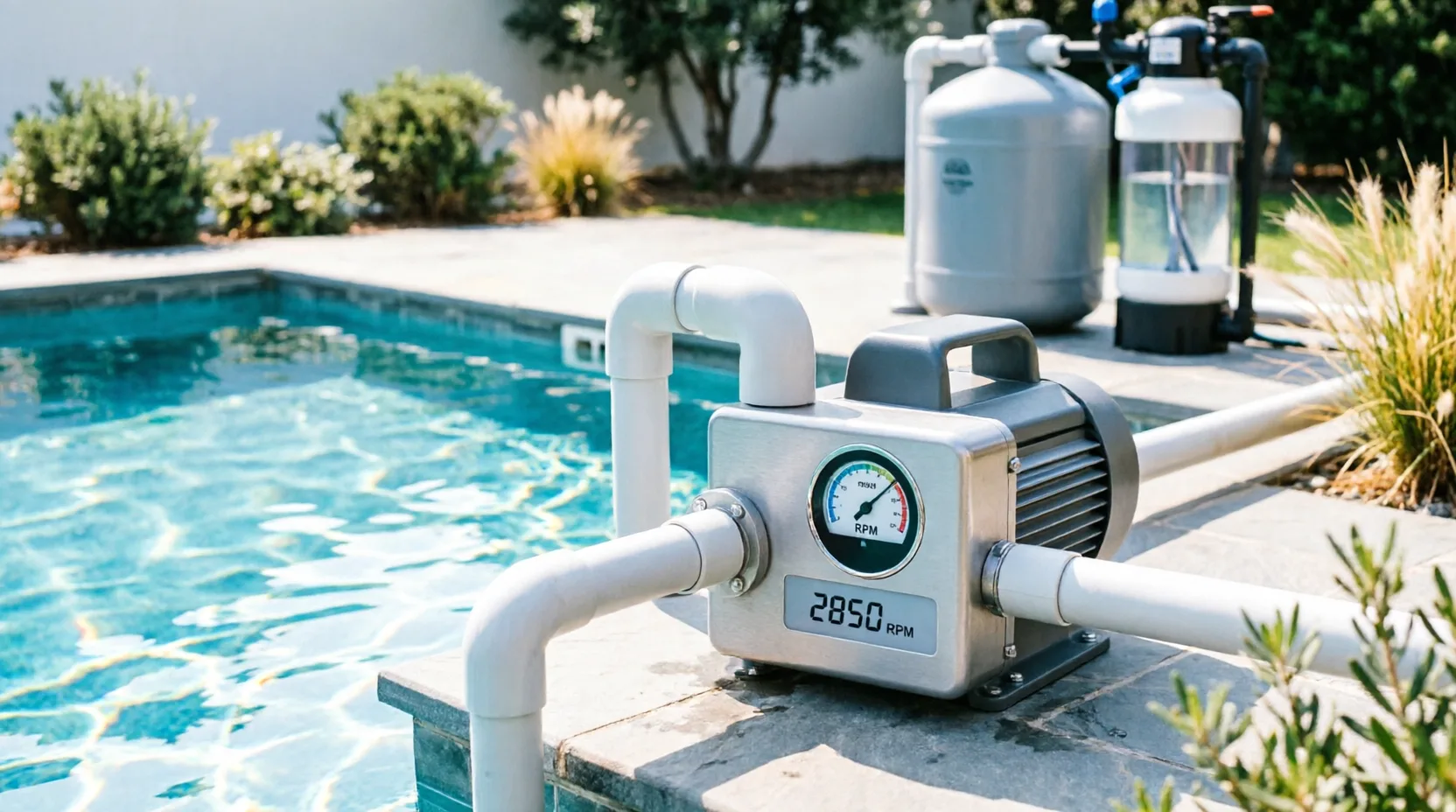
Low-to-medium speed, run for a longer daily cycle, is the efficient standard for routine pool filtration — pump energy use scales roughly with the cube of speed, so cutting speed in half can cut power use by around 75% while still moving enough water over a longer run time. Reserve full speed for shock treatments, backwashing, or anything that needs the pump’s maximum flow, similar to the flow demands covered in our guide to backwashing a pool filter. The full breakdown by task follows below.
Is There a Benefit to Running a Pool Pump at Lower Speed?
Yes, substantially. Pump power draw scales roughly with the cube of the speed, so a modest reduction in RPM produces a disproportionately large drop in energy use. Lower speed also runs quieter and puts less wear on seals and bearings over time compared to constant high-speed operation. Keep that same speed setting unchanged during a 24-hour bucket test if you suspect a leak, since changing speed mid-test skews the comparison — see our guide to finding a leak in an inground pool.
What Speed Should You Run Your Pool Pump Day to Day?
Low-to-medium speed, commonly in the range of 1,000 to 2,000 RPM depending on the pump model, run for a longer daily cycle, is the standard efficient setting for routine filtration and circulation. This achieves adequate turnover without the energy cost of running at full speed continuously — the other half of circulation is pointing pool return jets the right way for circulation.
What Is the Best Schedule to Run a Pool Pump?
Aim for at least one full turnover of the pool’s total water volume every day, calculated from your pump’s actual flow rate at the speed you’re running and your pool’s volume — which starts with getting an accurate pool depth measurement yourself. If your utility bills on time-of-use rates, splitting or shifting that run time to off-peak hours reduces cost further without changing how much filtration the pool actually gets.
Is a Pool Pump Supposed to Run 24/7?
Not necessarily at full speed. A variable-speed pump running continuously at very low RPM can be efficient in some setups, but check your specific pump manufacturer’s guidance and local code, since requirements vary. Older single-speed pumps are generally more efficient run on a scheduled cycle rather than left on continuously, since they don’t have a low-power mode to fall back on.
How Long Should You Run a Two-Speed Pool Pump?
Run low speed for the bulk of daily filtration, typically 6 to 8 hours depending on pool size and bather load, and reserve high speed for shorter periods — shock treatment, heavy bather load, or backwashing — rather than running high speed as the default.
When Should You Switch to High Speed?
Shock treatments, backwashing the filter, running a heater that needs higher flow to operate efficiently — the same higher-flow requirement covered in our guide to heating a pool — and manual vacuuming, which needs more suction than routine filtration, are the situations that call for full speed. Restricted flow near the main drain is also easier to diagnose at higher speed, since a partial blockage shows up more clearly when the pump is pulling harder.
Pool Pump Speed by Task
| Task | Recommended Speed | Why |
|---|---|---|
| Daily filtration and circulation | Low-to-medium (roughly 1,000-2,000 RPM) | Efficient turnover; energy use scales with the cube of speed |
| Shock treatment | High | Needs maximum flow to distribute chlorine |
| Backwashing | High | Needs maximum flow to properly clean filter media |
| Running a heater | High | Heaters need higher flow to operate efficiently |
| Manual vacuuming | High | Needs more suction than routine filtration |
How Do You Know If Low Speed Is Actually Circulating Enough?
Check that water is still visibly moving at the return jets and that the pool completes a full turnover within 24 hours at your chosen speed — if flow looks weak even at a speed that should be adequate, that points to a separate problem like a pump that’s lost its prime rather than the speed setting itself being wrong.
Frequently Asked Questions
How much can switching to lower pump speed actually save on electricity?
Estimates commonly run several hundred dollars a year for a variable-speed pump run at low RPM versus a single-speed pump run at full speed continuously, since power draw drops disproportionately as speed decreases. Actual savings depend on local electricity rates and how many hours the pump runs daily.
Can a single-speed pump save energy the same way a variable-speed pump does?
Not through speed reduction, since single-speed pumps only run at one RPM. The equivalent savings come from shortening daily run time or shifting it to off-peak hours instead, which is a less efficient tradeoff than actually lowering RPM.
Does a salt chlorinator require a minimum pump speed to work?
Yes. Salt cells need a minimum flow rate to generate chlorine and will often throw an error or reduce output if the pump runs too slow, so check your chlorinator’s minimum GPM specification before dropping speed lower than that threshold.
Whatever speed the pump runs, keeping debris off the floor and walls reduces how hard the filtration system has to work overall. An Aiper robotic pool cleaner handles that debris removal independently of the pump’s speed setting.
Get more pool and lawn care guides from Aiper on Google