How to Prime a Pool Pump (and Why It Keeps Losing Prime)

Priming is a two-minute job when the system is healthy. When it isn’t, priming becomes a diagnostic exercise, because a pump that keeps losing prime is never the pump’s fault.
It’s telling you there’s air getting into the suction line somewhere, and it will keep telling you until you find the leak.
What Prime Actually Means
A pool pump is a centrifugal pump. They move water by flinging it. The impeller spins, water gets thrown outward, and the vacuum left behind pulls more water in.
That trick only works on water. Air is too thin. An impeller spinning in air just spins, moving nothing, creating almost no suction.
Prime is simply the state of the pump housing being full of water instead of air. Lose the water, lose the prime, lose everything downstream, no flow through the filter, no chlorine circulating, no heater firing.
Priming the Pump
Here’s how to go about this.
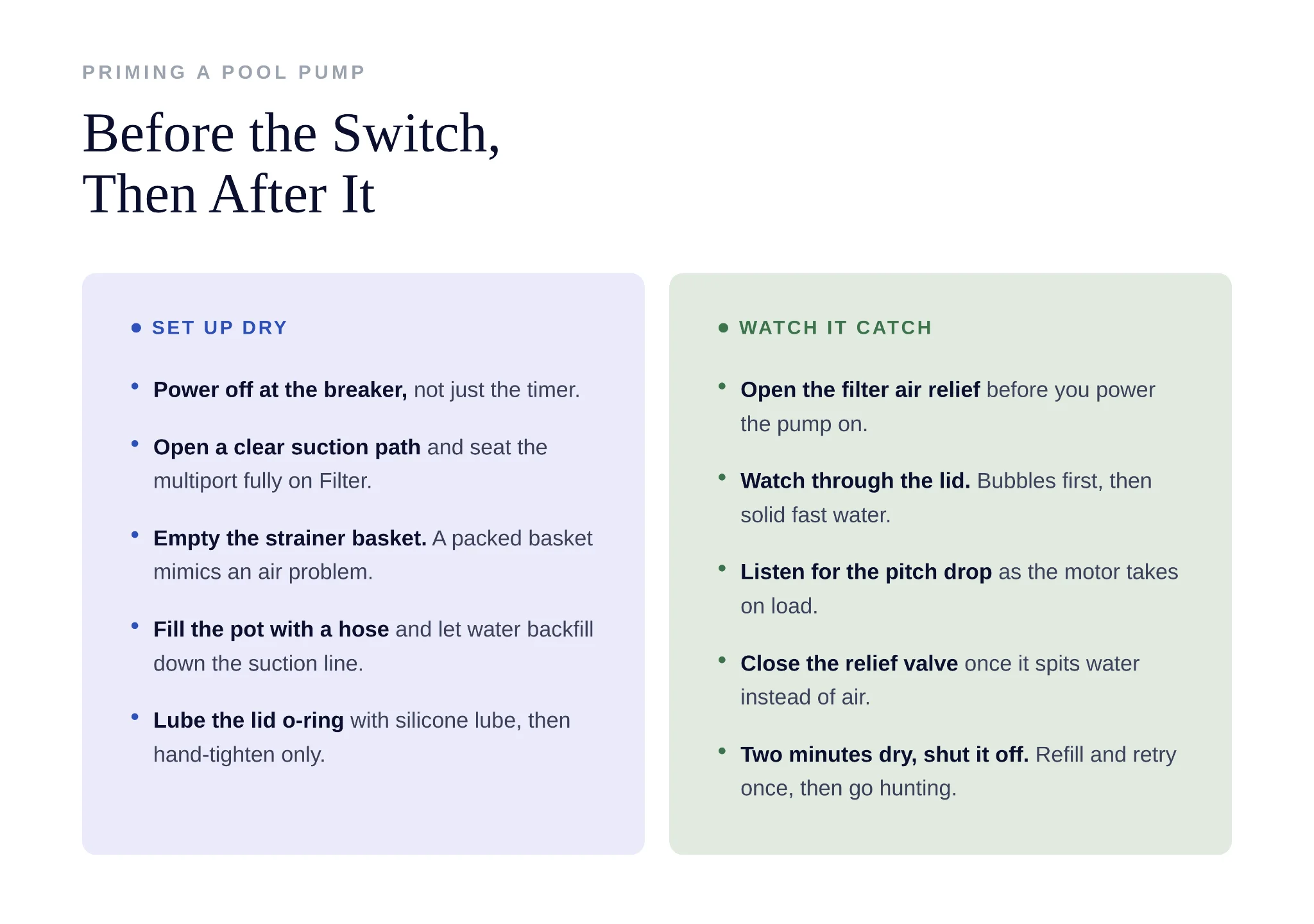
Set the system up first
Kill power at the breaker, not just the timer.
Then set your valves: skimmer and main drain lines open, or at minimum one clear suction path. If you have a multiport valve on the filter, make sure it’s on Filter and the handle is fully seated, a multiport handle resting between positions will fight you the entire time.
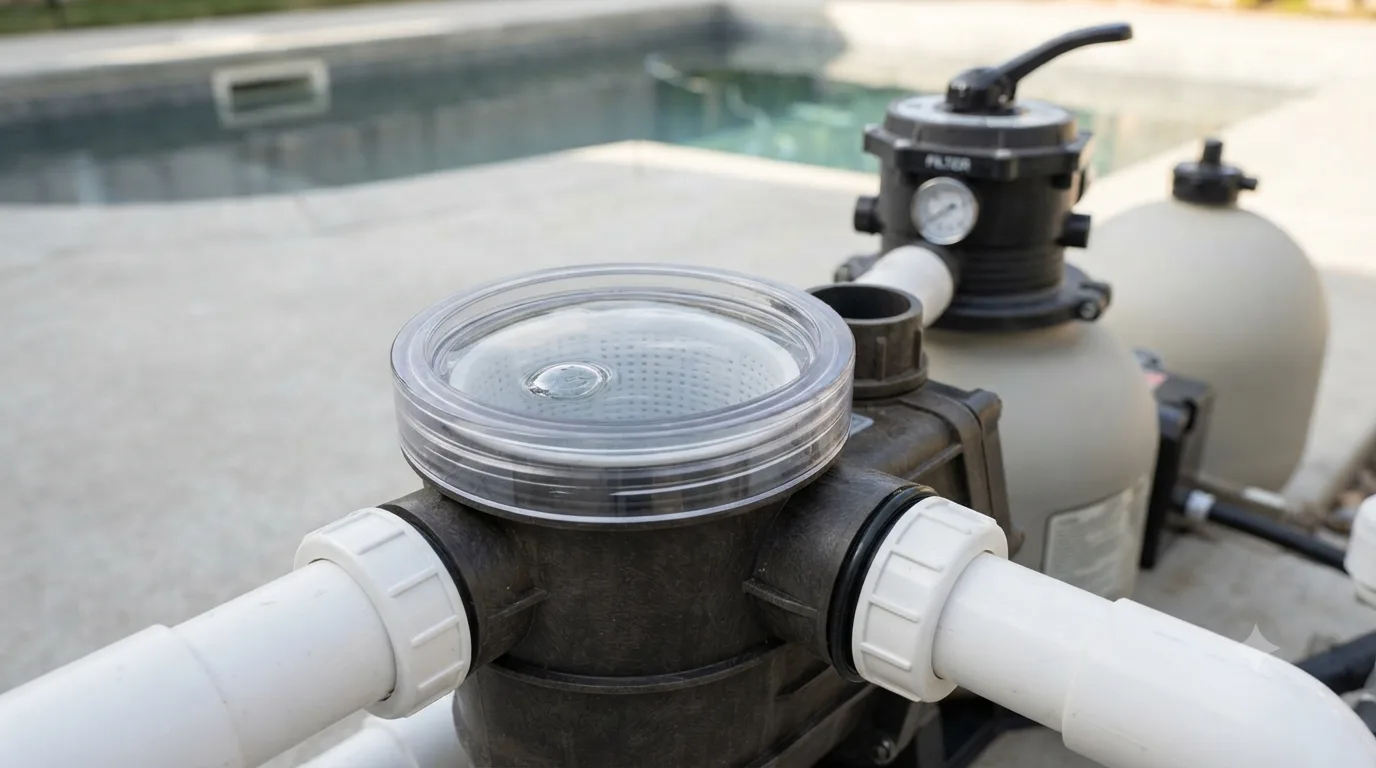
Take the pump lid off and look at what’s in the basket. Clean it out. A basket packed with leaves restricts flow enough to make priming slow or impossible, and people mistake that for an air problem constantly.
Fill the pot, not splash it
Fill the strainer pot with a garden hose and let it keep running for thirty seconds or a minute so water backfills down the suction pipe toward the pool.
This matters more if your equipment pad sits above water level. The pump has to lift water uphill on startup, and every bit of water already in the line is work it doesn’t have to do.
Deal with the lid o-ring before the lid goes back on:
Pull it out and wipe the groove clean.
Check the ring for flat spots and cracks.
Lube it with a thin coat of silicone-based pool lube. Not petroleum jelly. Petroleum products swell rubber.
Hand-tighten the lid. Cranking it down with a wrench doesn’t seal better; it distorts the o-ring and often seals worse.
Power on and watch
Open the air relief valve on top of the filter. Power on. Now watch through the lid.
You’ll see turbulence, then bubbles streaming through, then, usually within thirty to ninety seconds, the basket goes solid with fast-moving water, and the motor’s pitch drops into a lower, loaded sound. Air will hiss out of the filter’s relief valve until water spits from it.
If it doesn’t catch
Two minutes with nothing, shut it off. Running longer doesn’t help, and heat builds fast in a dry pump — and a dry pump is a loud pump, one of the causes in our guide to why a pool pump gets loud and the fixes. Refill the pot and try once more. If the second attempt fails too, stop priming and start hunting, because the problem isn’t technique.
Why It Keeps Losing Prime
Here’s the logic that solves almost every recurring prime problem: the suction side of your system runs at lower-than-atmospheric pressure while the pump is on.
A leak on the pressure side sprays water where you can see it. A leak on the suction side does the opposite, it pulls air in, invisibly, silently, right into the line the pump depends on.
So a pump that primes and then slowly fills with bubbles, or won’t hold prime day after day, has a suction-side air leak. Somewhere between the water in the pool and the impeller, air is getting in — and if the pump still misbehaves after the air is gone, cleaning a clogged pool pump impeller yourself is the next suspect.
Your job is to find where.
Start at the pump, because that’s where most of these leaks live. The lid o-ring is suspect number one, it dries out, flattens, and hairline-cracks with age, and one grain of sand across the sealing surface is enough.
Suspect two: the drain plugs on the pump body, which get removed for winterizing and reinstalled without their little o-rings seated right.
Suspect three: the union fitting or threaded adapter going into the front of the pump. Thread sealant degrades. Pumps vibrate. A joint that sealed fine three seasons ago can weep air now.
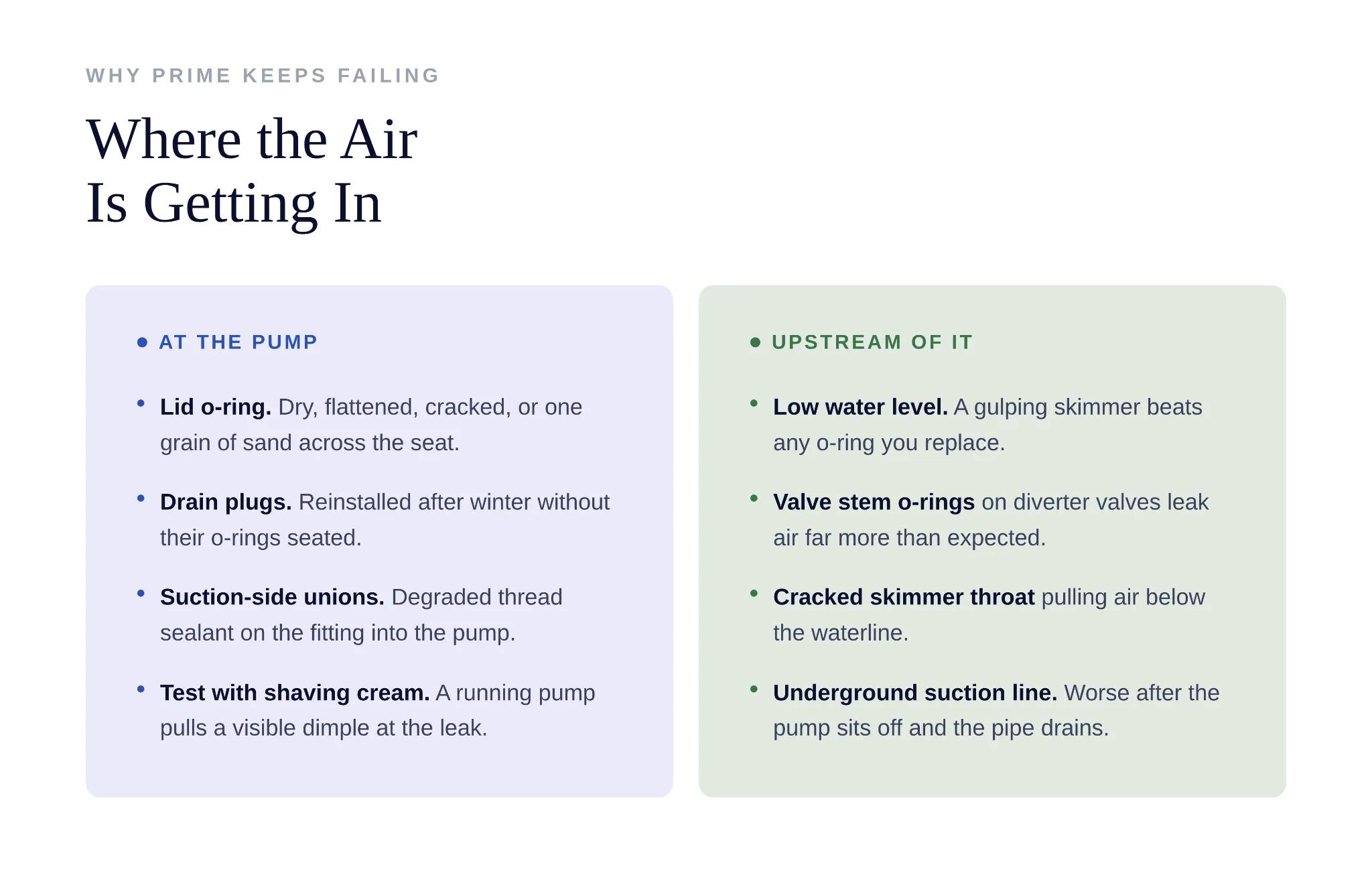
There’s an old field test that still works: with the pump running, smear shaving cream around the lid seam, the drain plugs, and the suction-side fittings.
A leak will pull the foam inward and leave a visible dimple. Water from a hose works too, trickle it slowly over each joint and listen for the pump’s tone to change or watch the bubbles in the basket momentarily clear as water gets sucked in instead of air.
If the pump checks clean, move upstream. Valve stem o-rings on diverter valves leak air more often than anyone expects.
So do cracked skimmer throats. And the one nobody wants to hear: an underground suction line with a crack in it, which usually shows up as a prime problem that gets worse when the pump has been off for a while, and the line has had time to drain.
One more, and it’s embarrassingly common in late summer: low water level.
If the pool has evaporated down to where the skimmer is gulping, sucking a mix of water and air every time a ripple passes, no o-ring on earth will hold your prime. Water needs to sit at least halfway up the skimmer opening.
Check that before you touch a single fitting.
When the Pump Primes Fine but Loses Prime Overnight
This happens most on pads that sit above pool level. The moment the pump shuts off, water in the suction line wants to fall back to the pool.
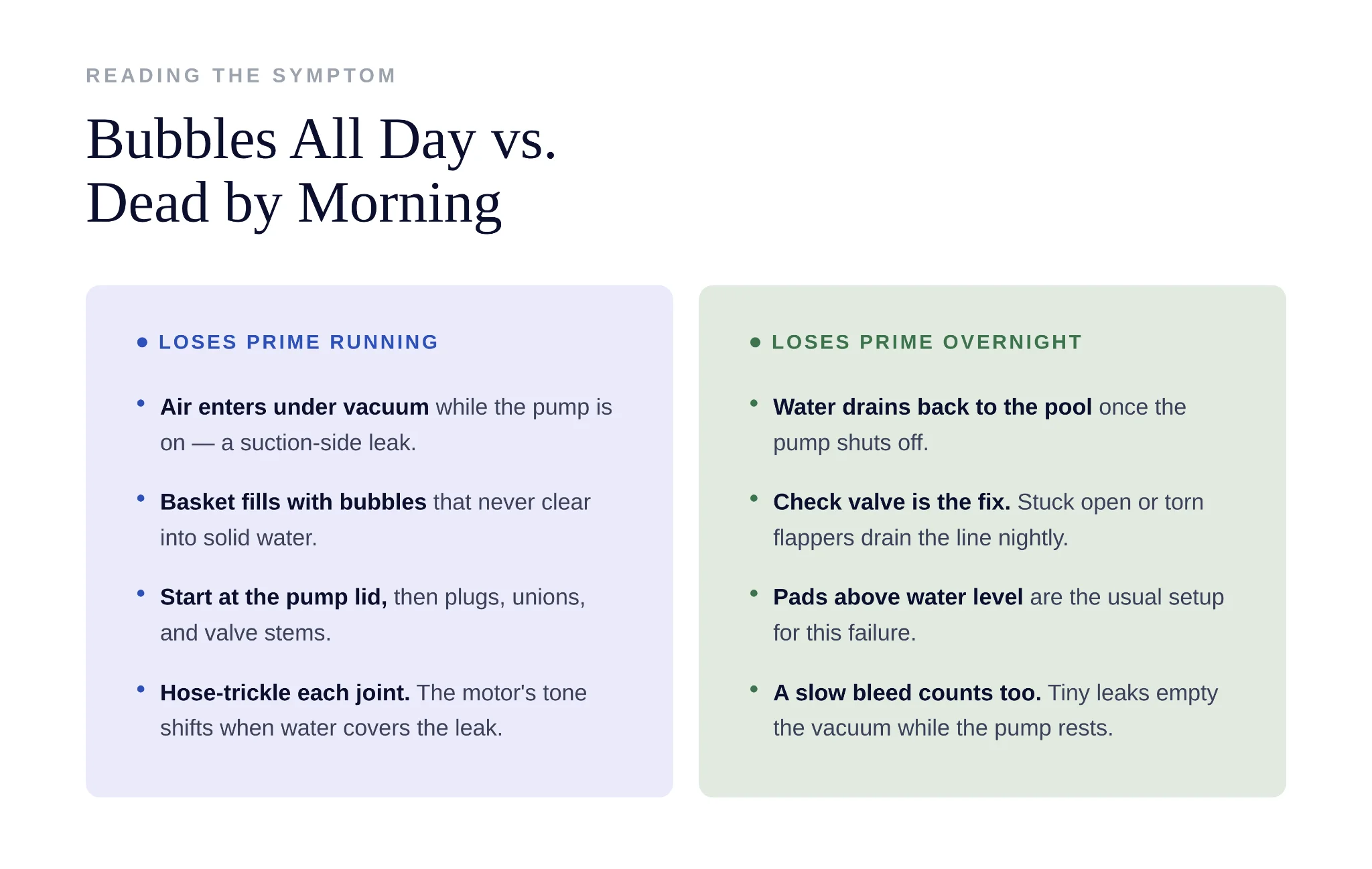
A check valve on that line is supposed to stop it. If yours is stuck open, has a torn flapper, or was never installed, the line drains overnight. Every morning becomes a fresh priming job.
The fix is cheap. A check valve is a twenty-dollar part and an hour of work. It ends the daily ritual completely.
One other cause shows the same symptom: a slow suction-side leak. Too small to matter while the pump runs. Big enough to bleed the vacuum off once it stops. Same shaving-cream hunt, just with more patience.
Take the Load Off the Suction Line
Everything that clogs a skimmer basket or a pump basket makes priming harder and the prime more fragile.
If you’re running a suction-side cleaner off the skimmer, you’ve added an entire hose full of connection points where air can sneak in, all of it hanging off the exact line you’re trying to keep sealed. That’s one of the structural tradeoffs between cleaner types — see our comparison of how robotic, suction, and pressure cleaners actually work for the rest of them.
A cordless robotic cleaner sidesteps all of it.
A cordless robotic pool cleaner runs completely independent of your pump and plumbing, no hoses, no skimmer connection, nothing added to the suction side.
It collects debris in its own basket instead of sending it toward your pump, and its AI vision navigation maps the pool and covers floors, walls, and waterline on its own, and your pump gets to do the one job it was built for: moving clean water.
Get more pool and lawn care guides from Aiper on Google