Fiberglass vs Vinyl Liner Pool: Which Lasts Longer

A fiberglass pool lasts longer, but one correction is needed before the numbers make sense. A vinyl liner pool has a replaceable part built into its design, and a fiberglass pool does not.
The vinyl liner is the only piece of a vinyl pool that wears out on a regular schedule, and the walls underneath usually outlast several liners. With fiberglass, the shell and its finished surface are one piece, so the pool’s lifespan and the surface’s lifespan run closely together.
That difference changes how you should compare cost, maintenance, and risk. Below are the expected lifespans for each part, what shortens them, and the water chemistry numbers that apply to both surfaces.
What Wears Out in Each Pool
The two pools are built differently, so they fail in different places. Knowing which layer takes the wear tells you what you will eventually pay to replace.
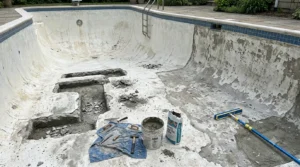
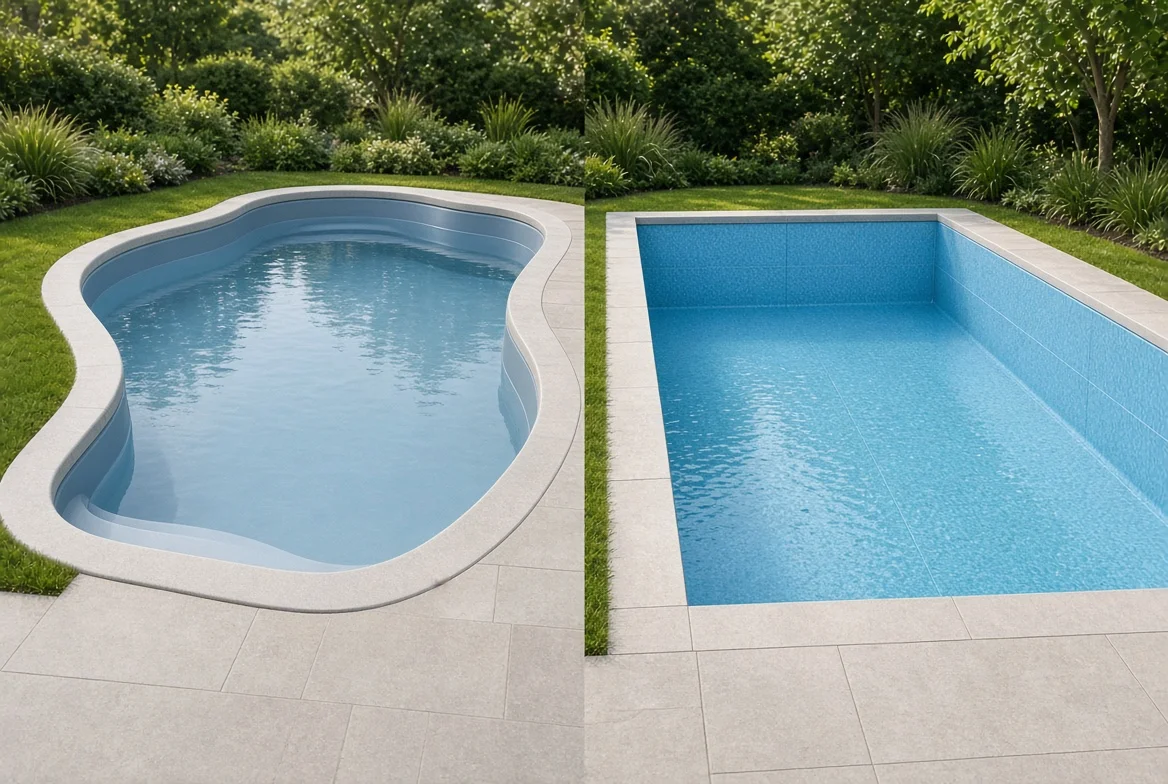
Vinyl liner pools start with wall panels made of plastic, aluminum, or steel, with a vinyl liner fitted over the walls and floor. When the liner is replaced, the installer pumps out the water, removes the old liner, re-trowels the sand floor, and checks the walls for stability and corrosion before fitting the new one.
Fiberglass pools ship as single-piece shells that are set into the excavated hole. The inner surface is a gelcoat, a hard resin finish that takes the contact with water, chemicals, and sun.
When a vinyl liner fails, it gets replaced, and the pool keeps going. When a fiberglass surface wears, it gets refinished in place, which happens far less often.
How Long Each Part Lasts
HUD publishes an official useful-life figure for pool liners and pool equipment, but not for fiberglass shells. The table pairs HUD’s figures with the estimates pool builders publish:
| Part | Official figure (HUD) | Industry estimate |
|---|---|---|
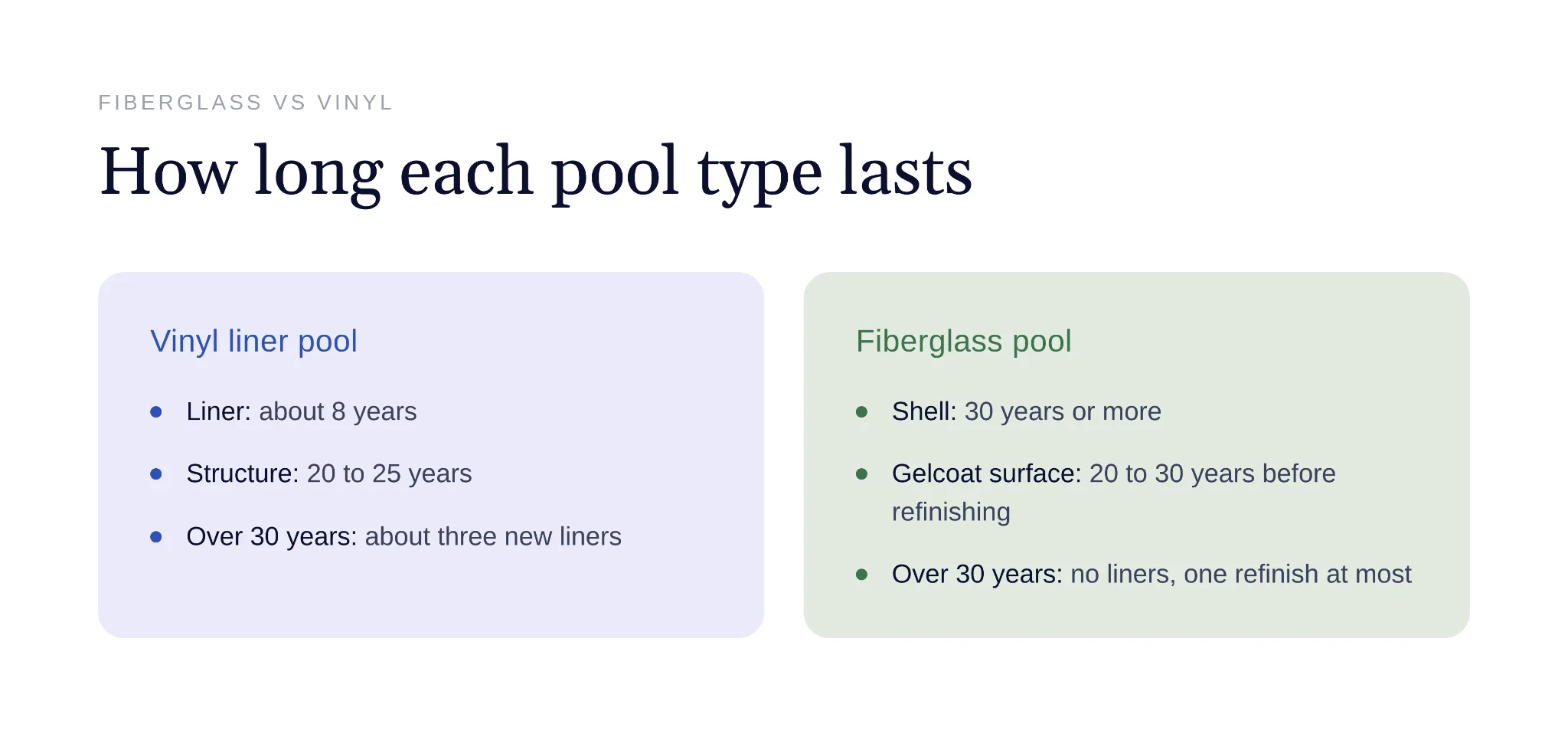
| Vinyl liner | 8 years | 6 to 12 years |
| Vinyl pool structure | None published | 20 to 25 years |
| Fiberglass shell | None published | 30 years or longer |
| Fiberglass gelcoat | None published | 20 to 30 years before refinishing |
| Pump and equipment (either pool) | 10 years | Not compared |
Over 30 years, an 8-year liner means three replacements, around years 8, 16, and 24. A fiberglass pool over the same stretch needs at most one refinish near the end.
Equipment does not change the comparison. The pump, filter, and heater serve either shell and wear out on the same schedule.
Calculate which filter you should get based on the size of your pool.
What Shortens a Vinyl Liner
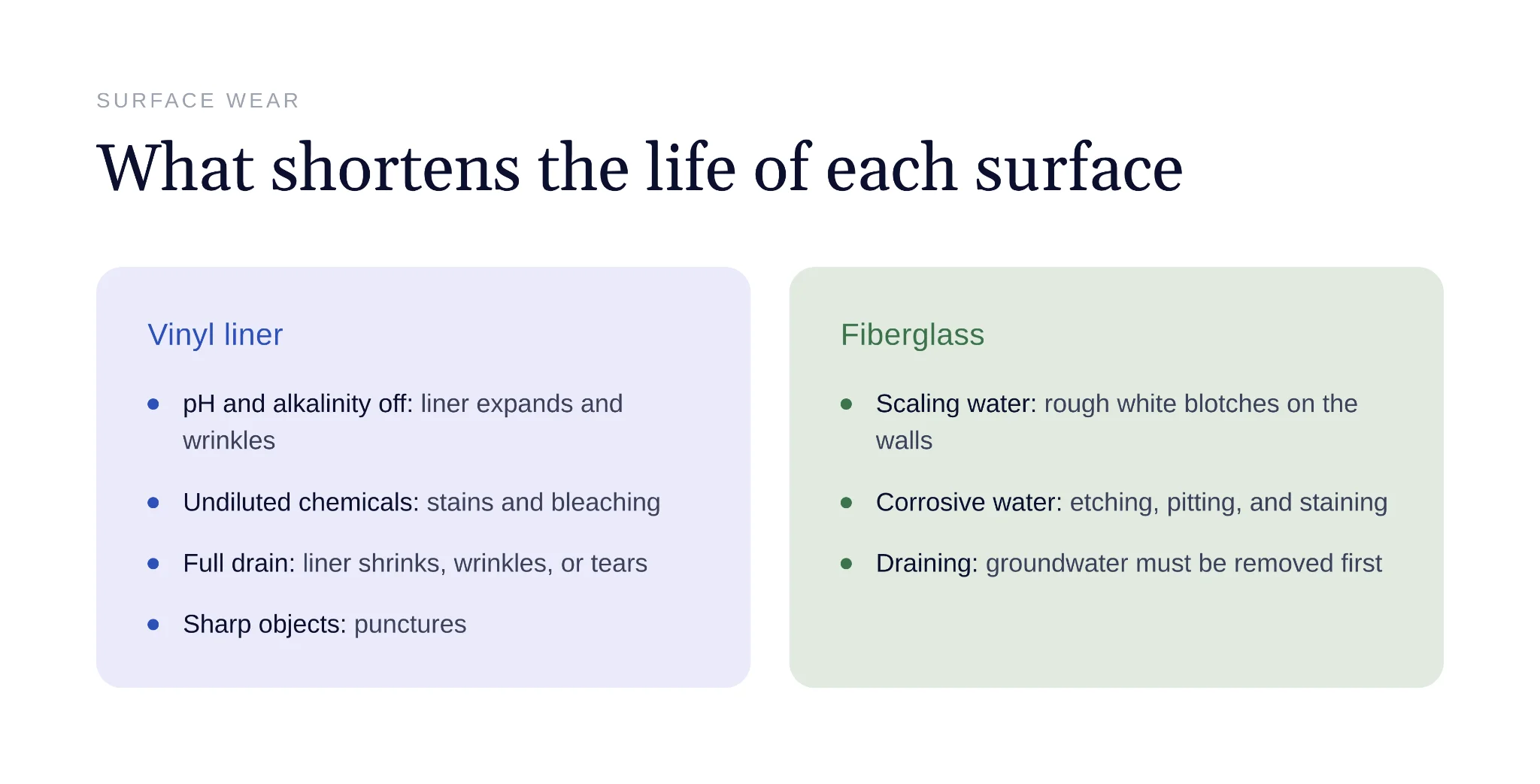
The spread in liner life comes mostly from care. Latham, a liner manufacturer, puts the range at 8 to 12 years, and past 15 years in ideal settings with proper care. These are the habits that pull a liner toward the short end:
- Letting pH and alkalinity drift. Levels that run too low or too high can make a liner expand and wrinkle. The target ranges are in the water balance section below.
- Letting chemicals touch the liner in concentrated form. Splashing undiluted chemicals onto the liner and running chlorine too high both shorten its life. Chlorine tablets are a common culprit, since a tablet left in the skimmer basket builds a high chlorine concentration around the skimmer and main drain.
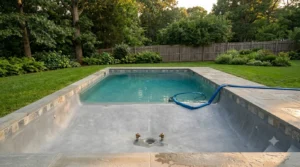
- Draining the pool completely. An empty pool lets the liner shrink, which leads to wrinkles or tears. For winter closing, lower the water to about 1 inch below the skimmer and no further.
- Allowing sharp objects in the water. Pool toys are designed without corners or sharp edges, so keep anything that is not built for pool use out of the water.
What Damages a Fiberglass Surface
A fiberglass shell has no liner to replace, so its weak points are its surface and its position in the ground. Both problems build slowly.
Scale. When the water leans toward scaling, minerals deposit on the walls as white or light-colored rough blotches, and the same scale builds up in the piping and filter.
Etching. When the water leans the other way, it becomes corrosive and can etch, pit, and stain pool walls.
Draining the pool. A full pool holds the shell down against groundwater. The groundwater around a fiberglass pool has to be removed before the shell is emptied or its water level is lowered significantly, so leave any draining to the installer.
Water Balance for Both Surfaces
Vinyl and fiberglass share the same chemistry targets, and those targets differ from what plaster pools need. The difference is calcium: the CDC’s Model Aquatic Health Code sets a lower calcium range for vinyl or fiberglass than for masonry pools.
These are the code’s targets for balanced water, along with the CDC’s chlorine minimums:
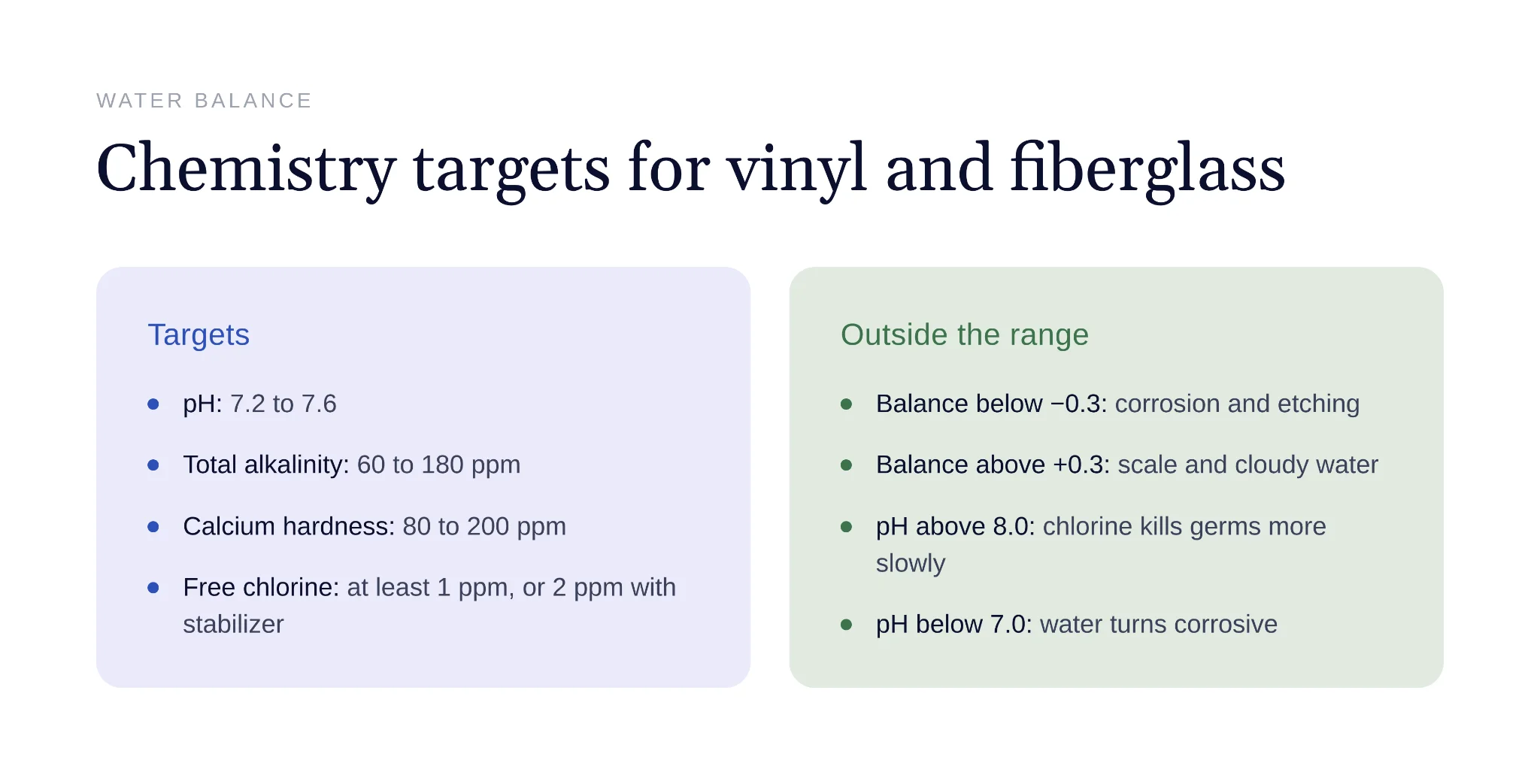
- pH: 7.2 to 7.6
- Total alkalinity: 60 to 180 ppm
- Calcium hardness: 80 to 200 ppm for vinyl or fiberglass, compared with 200 to 400 ppm for masonry pools
- Free chlorine: at least 1 ppm, or at least 2 ppm if you use cyanuric acid or stabilized chlorine
The code judges overall balance with the Langelier Saturation Index, and the target range is −0.3 to +0.3. It also notes that a small positive reading is safer than a negative one, since light scale does less permanent damage than corrosion.
pH carries the most weight of the four. Above pH 8.0, chlorine loses much of its ability to kill germs, and below pH 7.0, the water becomes more likely to corrode pool pipes.
A Testing Routine From the CDC
Chlorine and pH change fastest, so they need the most frequent checks. The CDC’s guidance for home pool owners comes down to four steps:
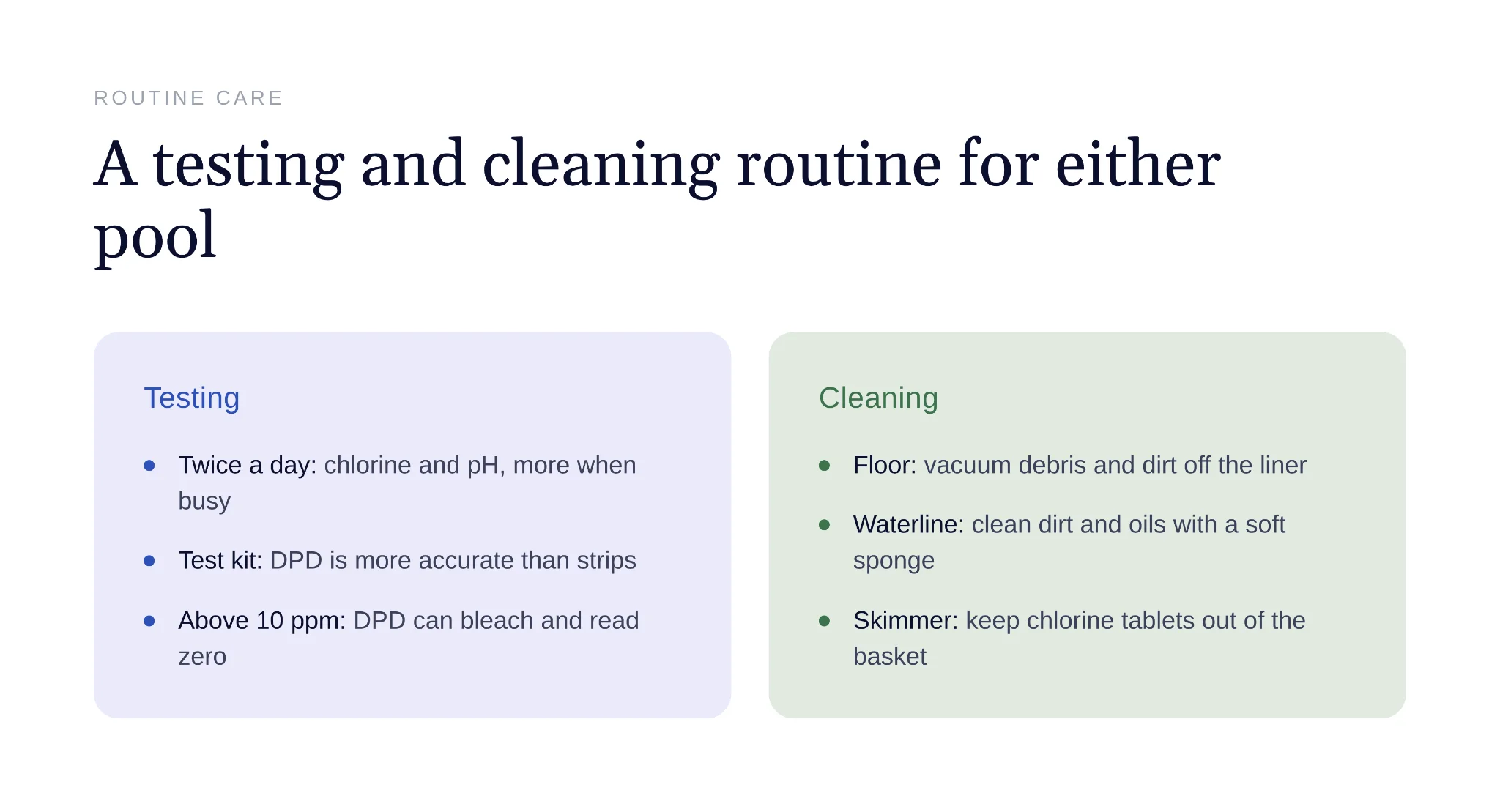
- Test chlorine and pH at least twice a day, and more often when the pool is busy.
- Use a DPD test kit for the most accurate readings. Test strips work but are less accurate.
- Treat a chlorine reading of zero with suspicion after a heavy dose. Above 10 ppm, the DPD test can bleach out and show a false low or 0 ppm.
- Follow the test manufacturer’s directions, whichever test you use.
Cleaning Without Wearing the Surface
Debris and grime shorten surface life in two places: on the floor and at the waterline. Keeping both clear is routine work, and it pays off on either pool type.
On the floor, vacuuming keeps debris and dirt from damaging a vinyl liner. At the waterline, dirt and oils build up and cause stains and fading, so clean that band regularly with a soft sponge.
Floor and wall cleaning is also the easiest job to hand off. Aiper’s robotic pool cleaners run floor, wall, and waterline cycles on a schedule, so debris gets picked up before it has time to sit on the surface.
Choosing on Lifespan Alone
If the only question is which pool lasts longer with the least replacement work, fiberglass wins. A vinyl pool still makes sense in three situations.
The budget is fixed now. Vinyl liner pools are the least expensive in-ground option, and fiberglass is the most expensive, with the liner costs spread out over decades.
The pool needs to be wider than 16 feet. Most states cap oversize road loads at 16 feet, which limits the width of every fiberglass shell. A vinyl liner pool is built on site, so its width has no shipping limit.
You plan to move within 8 years. A vinyl pool may never need a new liner in that time, so the longer life of fiberglass pays off mainly for owners who stay past the first liner.
Get more pool and lawn care guides from Aiper on Google