How to Clean a Pool Pump Impeller (Step by Step)

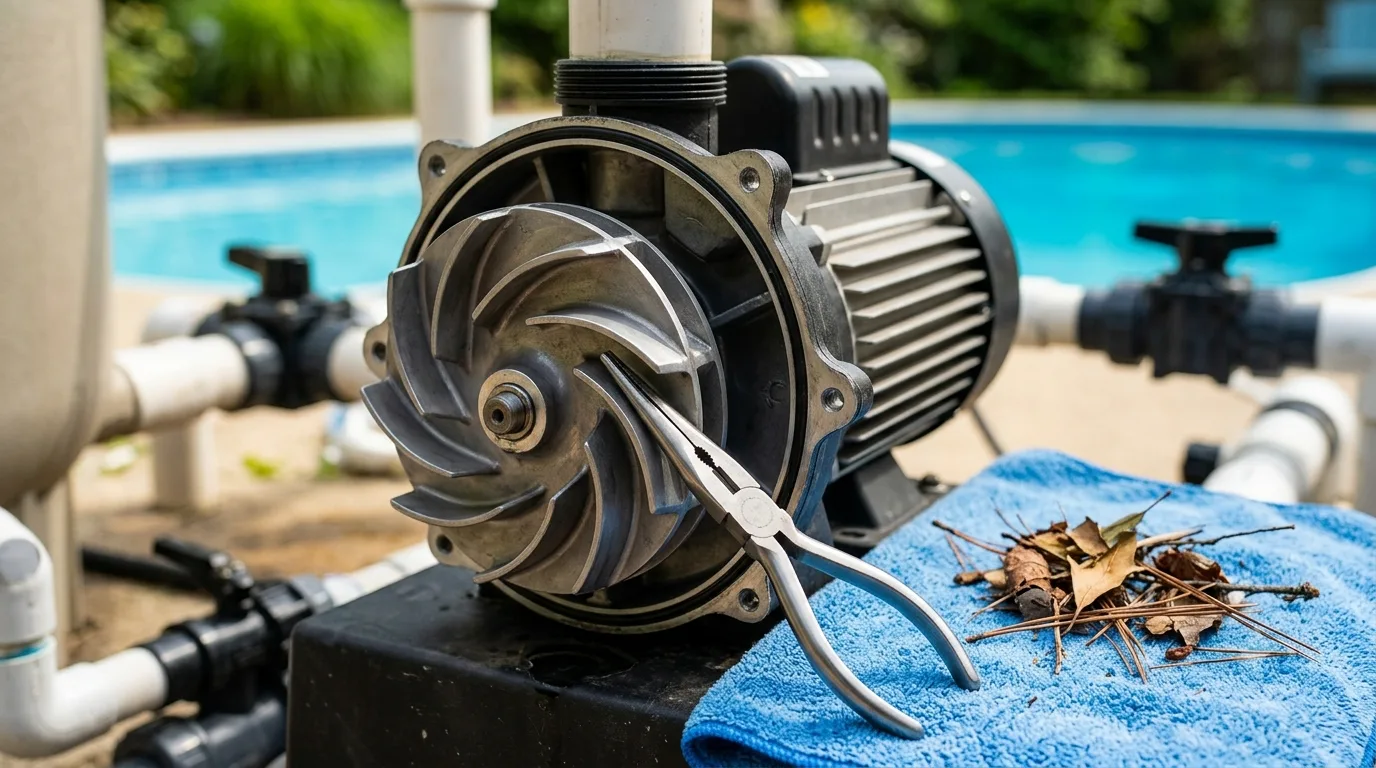
A pressure drop is usually the first thing owners notice, and it leaves most of them unsure whether pulling the pump apart is really necessary or if there’s a simpler fix. Often it is the impeller, and cleaning it doesn’t require replacing anything: turn off the pump at the breaker, access the impeller behind the seal plate, clear the vanes of debris, and confirm it spins freely by hand before reassembling. The full steps, and how to tell a clog from a worn-out impeller, follow below. A struggling pump is also usually the first thing to check if a pool heater underperforms, covered in our guide to heating a pool.
How Do You Know If a Pool Pump Impeller Is Clogged?
A pressure gauge reading lower than the pump’s normal operating range, noticeably reduced flow at the return jets, and a pump motor that sounds like it’s straining or humming without moving much water are the three most common signs. Debris visibly pulled partway into the pump basket area, without fully clearing, also points to an impeller obstruction rather than a filter problem.
How Do You Clean a Pool Pump Impeller?
Turn off the pump at the breaker, not just the switch, before opening anything — and if what drove you to open it was a new racket, start with our guide to quieting a noisy pool pump step by step. Close the valves on both sides of the pump to stop backflow, then open the pump lid and remove the strainer basket. The impeller sits behind the seal plate on most residential pumps — removing the motor housing bolts, or in some models the diffuser cover, exposes it directly.
Clear debris from the impeller vanes with needle-nose pliers or stiff wire, working carefully to avoid cracking the vanes. Spin the impeller by hand once it’s clear to confirm it rotates freely with no grinding or resistance, then reassemble in reverse order and prime the pump before restarting.
How Do You Tell If a Pump Impeller Is Bad, Not Just Clogged?
A clogged impeller usually restores full flow once debris is cleared and it spins freely by hand. A bad impeller keeps underperforming even when clean: cracked or broken vanes, a hub that spins but doesn’t grab water effectively, or visible wear grooves where debris has eroded the material over time. If the motor runs normally but output stays weak after a thorough cleaning, the impeller itself, not the motor, is the more likely point of failure.
Do Pool Pump Impellers Wear Out?
Yes. Impellers wear from ordinary sand and fine debris passing through over years of operation, and from cavitation damage caused by running the pump with insufficient water supply, such as a low pool level or a clogged skimmer restricting intake. Wear is gradual, so a pump that’s been losing a little pressure over several seasons, rather than suddenly, is often showing impeller wear rather than a single clog.
What Causes a Pool Pump Impeller to Clog in the First Place?
Leaves and debris that get past the skimmer basket, whether from an overfull basket or a basket left out entirely, are the most common cause. Root intrusion or debris breakdown inside older suction lines can also feed material to the impeller gradually — the same restricted suction that sometimes leaves a robotic cleaner stuck near the main drain. Keeping the skimmer basket empty and running the pump only with a basket in place prevents most impeller clogs before they start.
Frequently Asked Questions
How much does it cost to replace a pool pump impeller?
The impeller itself is usually an inexpensive part, often between 20 and 80 dollars for common residential pump models, though labor adds to that if you’re not doing it yourself. If the shaft or seal was damaged by a worn impeller, the repair bill climbs well beyond the part cost alone.
How often should you check the impeller as routine maintenance?
Once per season is typically enough if the skimmer basket is kept clear and the pump isn’t showing pressure or flow problems. A pump losing pressure sooner than that warrants an off-schedule check rather than waiting for the next season. How often you’re doing that kind of equipment check also depends on whether your filter is sand or cartridge — see our comparison of sand and cartridge pool filters for the maintenance differences.
Is it safe to run a pool pump with the housing open to test the impeller?
No. Running the motor with the seal plate or housing removed, even briefly, risks water spraying into the motor and damaging it. Test the impeller by spinning it with your hand while the pump is off and unplugged, never by powering the motor with the housing open.
Keeping leaves and debris out of the skimmer basket in the first place is the simplest way to prevent impeller clogs. An Aiper robotic pool cleaner removes floor and surface debris before it ever reaches the pump intake.
Get more pool and lawn care guides from Aiper on Google