How to Get Rid of Pollen in Your Pool (and Why It Keeps Coming Back)

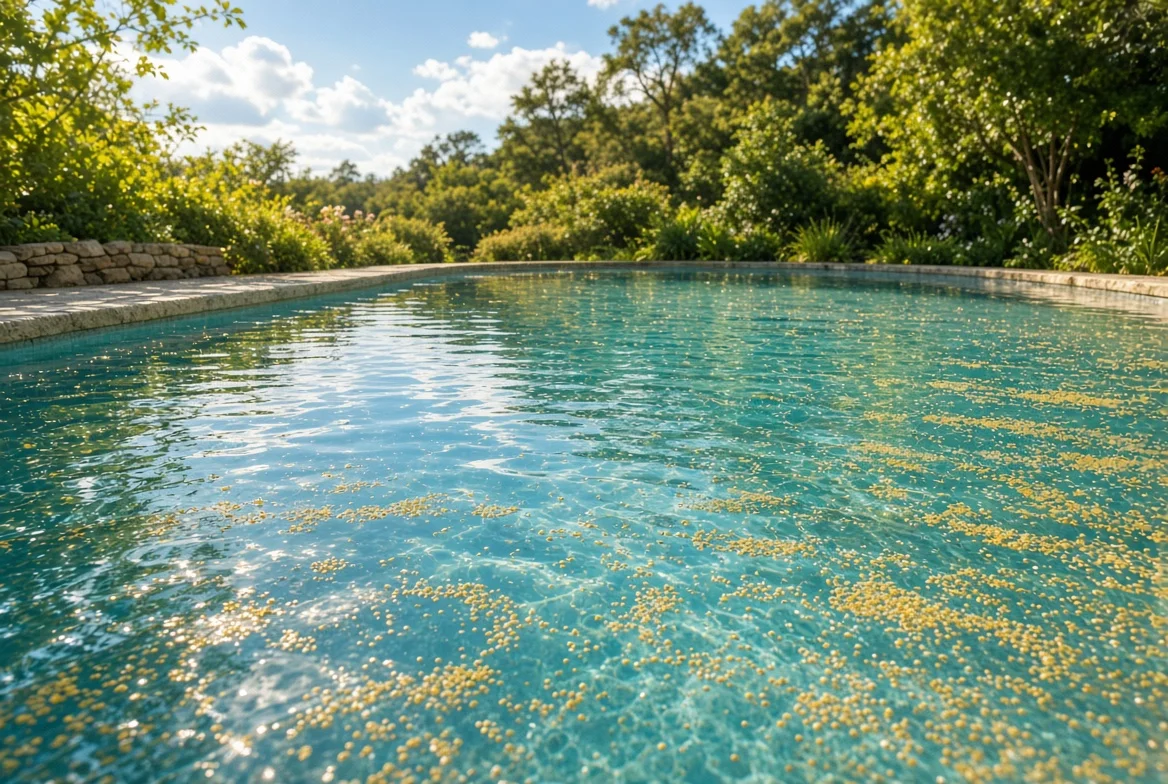
During pollen season, a pool that was clean the night before can have a yellow film across the surface by morning. The film collects in corners, sticks to the waterline, and returns every day for weeks.
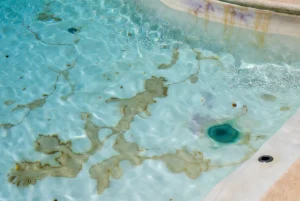
Pollen is harmless to the pool on its own. The trouble is what it leads to: clogged filters, a yellow ring at the waterline, chlorine that disappears faster than usual, and, if it’s left alone long enough, algae.
Getting rid of it takes daily skimming and a few changes to how the pool runs. Keeping it under control during peak season takes a routine.
Pollen or Mustard Algae?
Both are yellow, and many homeowners treat one when they actually have the other. A quick check sorts it out:
- Pollen floats on the surface or sits loosely on steps and the floor. It moves with the wind, gathers wherever the water is still, and smears away easily when rubbed.
- Mustard algae sticks to the walls, usually in shaded areas. It brushes off in a cloud, then returns to the same spot within a day or two.
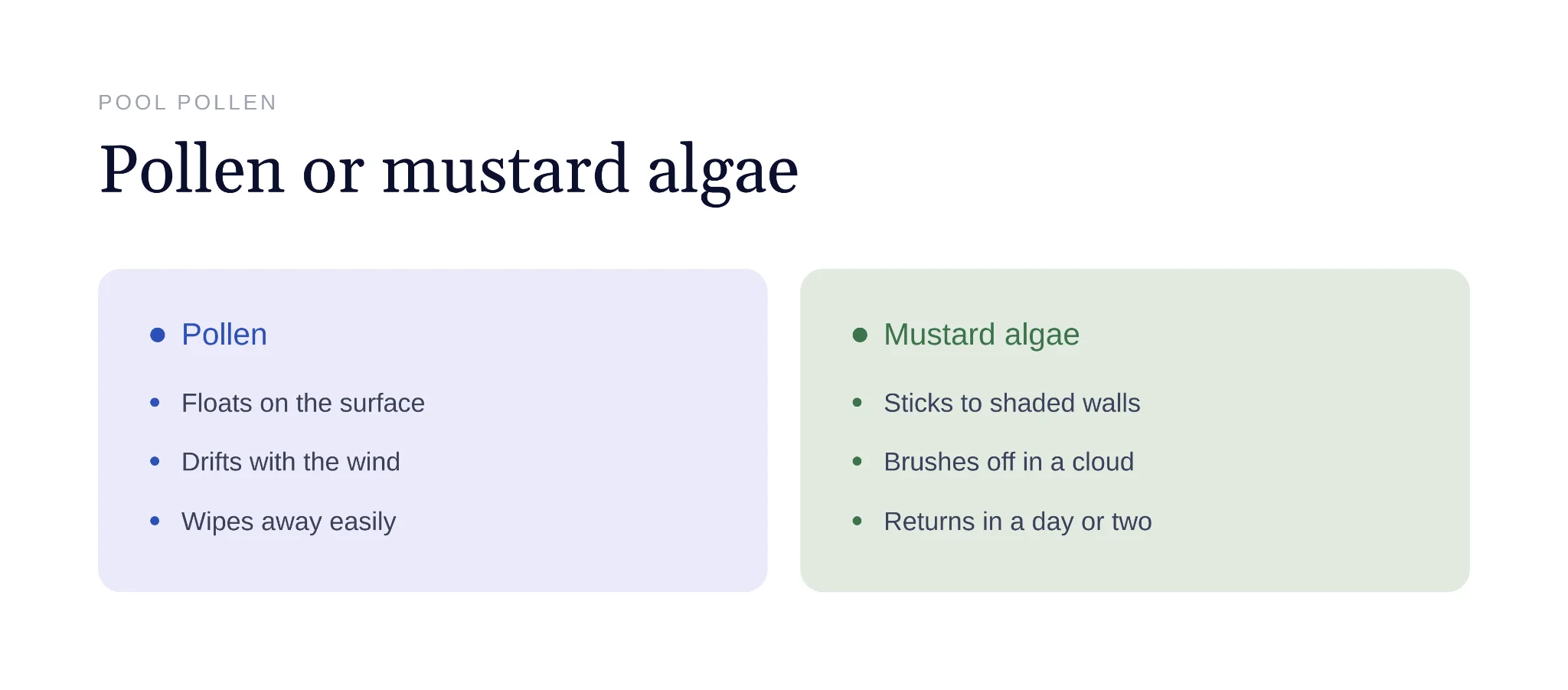
If the yellow is on the surface and drifts toward one end of the pool on a breezy day, it’s pollen. If it’s on a shaded wall and comes back after brushing, treat it as algae.
Heavy pollen can also give the water itself a faint yellow-green tint. The walls stay smooth, which is what separates it from green algae.
Why Pollen Keeps Coming Back
Pollen doesn’t come from the pool, so no treatment inside the pool stops it from arriving. Trees, grasses, and weeds release it in huge amounts, and wind carries it for miles. A pool with no trees nearby still collects it.
The season is also longer than most people expect, because different plants release pollen at different times:
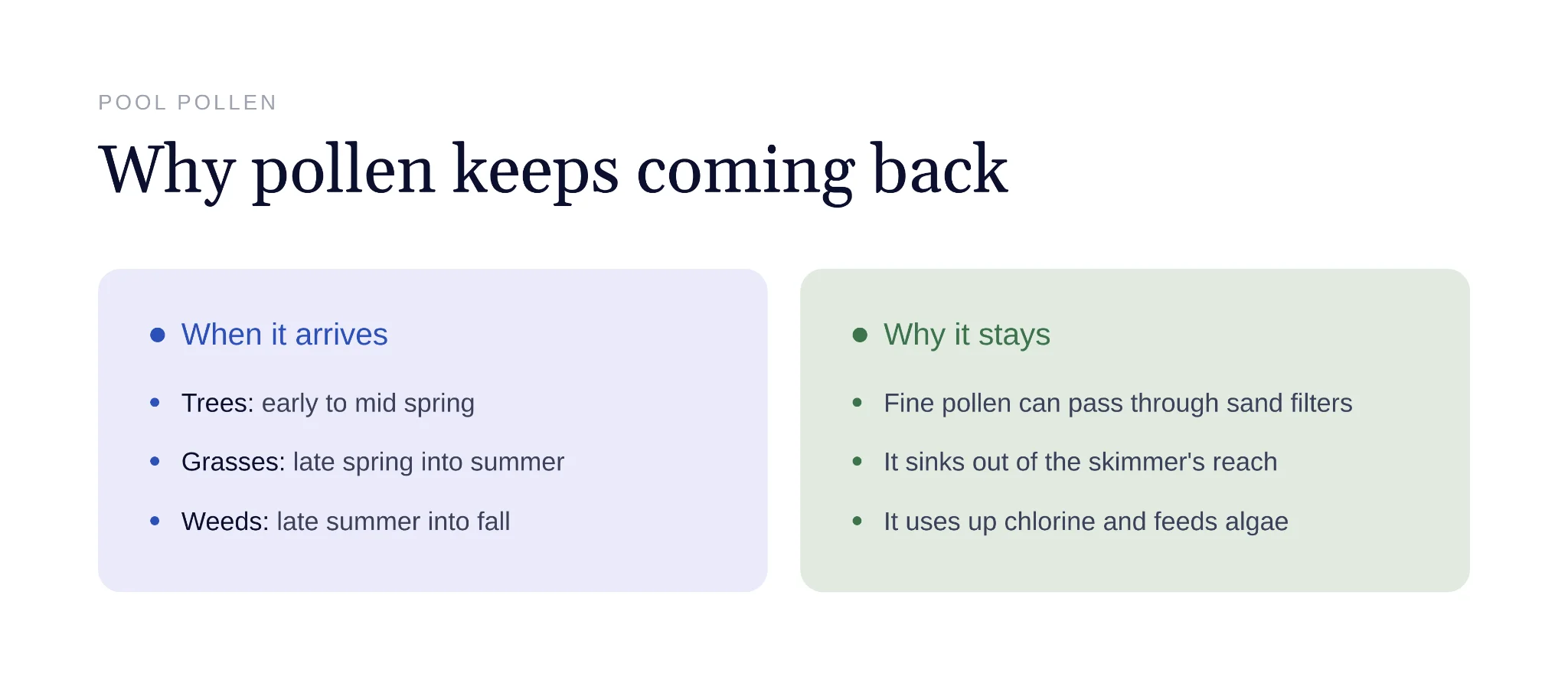
- Trees: early to mid-spring, often the heaviest yellow film of the year
- Grasses: late spring into summer
- Weeds such as ragweed: late summer into fall
In many areas, that means pollen lands in the pool from March through October, with only a short break between waves.
Three things inside the pool make the problem worse.
The filter lets some of it through. Pollen grains range widely in size, and many are small enough to pass through a sand filter. That fine pollen goes straight back into the pool through the return jets and settles again. Cartridge filters catch more of it, and DE filters catch the most.
It sinks. Pollen floats at first, then absorbs water and drops to the floor. The skimmer can no longer reach it there, and every swimmer or return jet stirs it back up.
It feeds algae. Pollen is organic material. It uses up chlorine as it breaks down and adds nutrients to the water. A week of heavy pollen with low chlorine is a common way for a clean pool to turn green in late spring.
Skim It Off the Surface
Skimming is the most effective step, and it needs to happen daily during peak weeks.
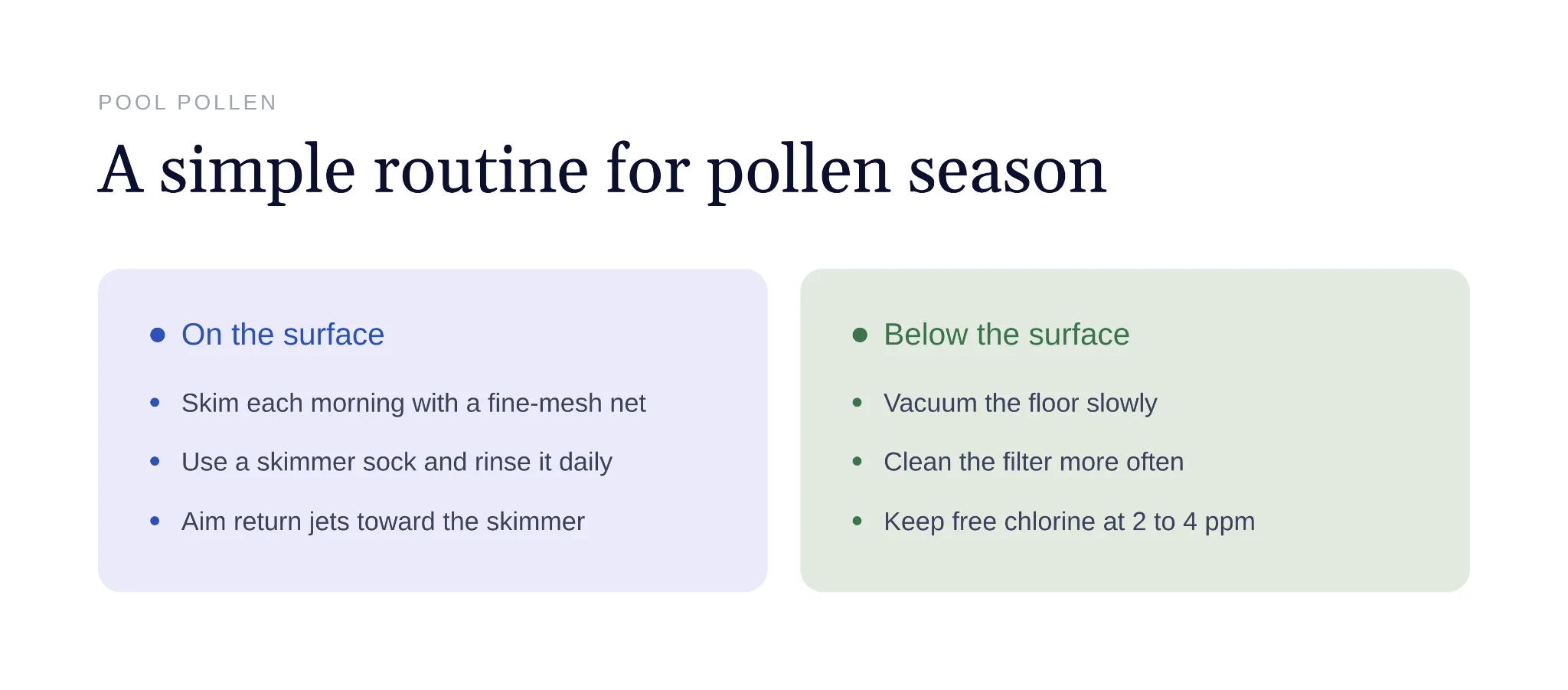
Skim first thing in the morning. Pollen that landed overnight is still floating, and it starts sinking once it’s been in the water for a while. Use a fine-mesh skimmer net, since a standard leaf net lets most pollen pass through.
The pool’s own skimmer can do much of the work with a few adjustments:
- Run the pump during the day, when pollen is landing, instead of only overnight.
- Aim the return jets slightly upward and all in the same direction around the pool. This creates a circular current that pushes floating pollen toward the skimmer.
- Put a skimmer sock over the skimmer basket. These fine nylon mesh covers catch pollen before it reaches the filter. Rinse or replace the sock daily. It fills fast.
- Keep the water level at the middle of the skimmer opening. If it’s too low, the skimmer pulls in air. If it’s too high, surface water flows past without being drawn in.
Empty the pump basket at the same time as the skimmer basket.
Help the Filter Catch It
Pollen clogs a filter faster than normal debris. Watch the pressure gauge and clean the filter when it reads 8–10 psi above its clean reading. During heavy weeks, that can mean cleaning twice as often as usual.
- Sand filters: Backwash at the pressure limit. Adding pool clarifier helps a sand filter trap fine pollen by clumping the particles together. A small dose of DE powder added through the skimmer also improves how finely the sand filters. Follow the product directions for the amount.
- Cartridge filters: Remove the cartridge and hose it off, working between the pleats. A spare cartridge makes this easier during peak season.
- DE filters: Backwash and add fresh DE powder.
Clean the Waterline Ring
Pollen mixes with sunscreen and body oils and leaves a yellow ring along the tile or liner.
Scrub it with a soft sponge and a cleaner made for pool surfaces. On vinyl liners, avoid abrasive pads and household cleaners, which can scratch or discolor the liner.
An enzyme-based pool product slows the ring from forming again. Enzymes break down oils and organic film in the water before they coat the waterline. Add it on the schedule listed on the label through the whole season.
Clear What Sank to the Floor
Pollen on the floor looks like a fine yellow or greenish dust, often thickest in corners and on the steps.
Vacuum it slowly. Fast strokes kick the pollen back into the water, where it floats around for hours before settling again. If the pool has a sand or DE filter with a “waste” setting, vacuuming to waste keeps the fine pollen out of the filter entirely.
A robotic pool cleaner handles this well because it collects debris in its own filter basket instead of sending it through the main pool filter. Running it daily during pollen season picks up the pollen that sank overnight, before it breaks down in the water.
Several models in the Aiper robotic pool cleaner lineup also include fine filtration and waterline cleaning, which helps with both the floor dust and the yellow ring. Check each model’s specs to match it to your pool type and size.
Keep Chlorine Up During Pollen Season
Pollen uses up chlorine steadily, so a pool that holds its level easily in summer can run low in April.
- Test free chlorine every day or two during heavy pollen weeks
- Keep it between 2 and 4 ppm
- Keep pH between 7.2 and 7.6 so the chlorine works at full strength
- Shock the pool once a week at dusk during peak season, and again after any day with a visibly heavy film
If chlorine keeps dropping overnight even after shocking, test for algae growth on the walls and steps before assuming the pollen alone is the cause.
Cut Down How Much Gets In
Pollen will still reach the pool, but a few habits reduce how much:
- Use a cover on the worst days. When removing a solar cover, hose the pollen off the top first, or roll the cover slowly from one end. Pulling it off quickly dumps everything on top straight into the water.
- Hose the deck away from the pool. Pollen collects on the deck, and rinsing it toward the water sends it right in.
- Trim branches that hang over the water. Pine, oak, and birch trees near the pool are some of the heaviest pollen producers.
- Choose low-pollen plants for new landscaping around the pool. A local nursery can suggest options for your region.
For swimmers with pollen allergies, skimming right before swimming and rinsing off afterward reduces irritation.
Stay Ahead of Pollen Season
Pollen is easiest to remove in the first few hours, before it sinks or reaches the filter. A short daily routine during peak weeks keeps the water clear and the chlorine steady.
An Aiper robotic pool cleaner can take care of the floor and waterline on a daily schedule, so the only job left each morning is a quick skim.
Get more pool and lawn care guides from Aiper on Google