How to Get Rid of Wild Violets in Your Lawn

Wild violets are the weed that makes people question whether they know how to take care of a lawn.
Everything else on the property responds to normal effort. Crabgrass gets pre-emergent. Dandelions yellow and curl within a week of a broadleaf spray.
Violets are built differently from almost everything else in the yard, and the standard broadleaf program is aimed at the wrong part of the plant at the wrong time of year.
Getting them out is possible. It takes a specific active ingredient, a season most people don’t associate with weed control, and an honest expectation of how long it runs.
How to Identify Wild Violets
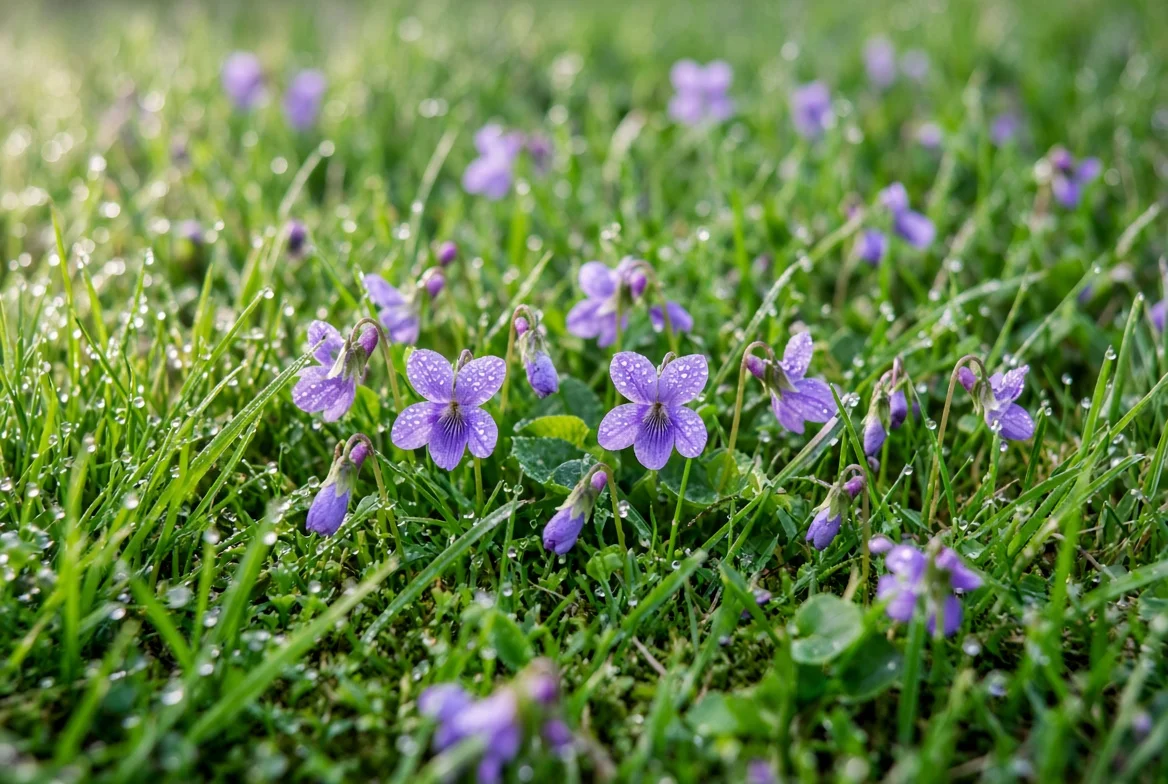
Look for heart-shaped to kidney-shaped leaves, glossy, with scalloped edges, each on its own stalk rising directly from the ground. No central stem. The clumps sit low and spread outward, and the foliage stays dense enough to shade out the grass underneath.
Flowers appear in April and May, purple, blue, or white, with five petals, held just above the leaves. They’re genuinely attractive, which is part of why people tolerate the first year.
The common mix-up is ground ivy, also called creeping charlie. Ground ivy runs along the surface on square stems, has opposite scalloped leaves, and smells sharply minty when crushed.
Violets have no runners above ground and no smell. If a plant creeps sideways in visible strands, it isn’t a violet.
Why They Survive Everything You’ve Tried
There are three reasons, and each one defeats a different common approach.
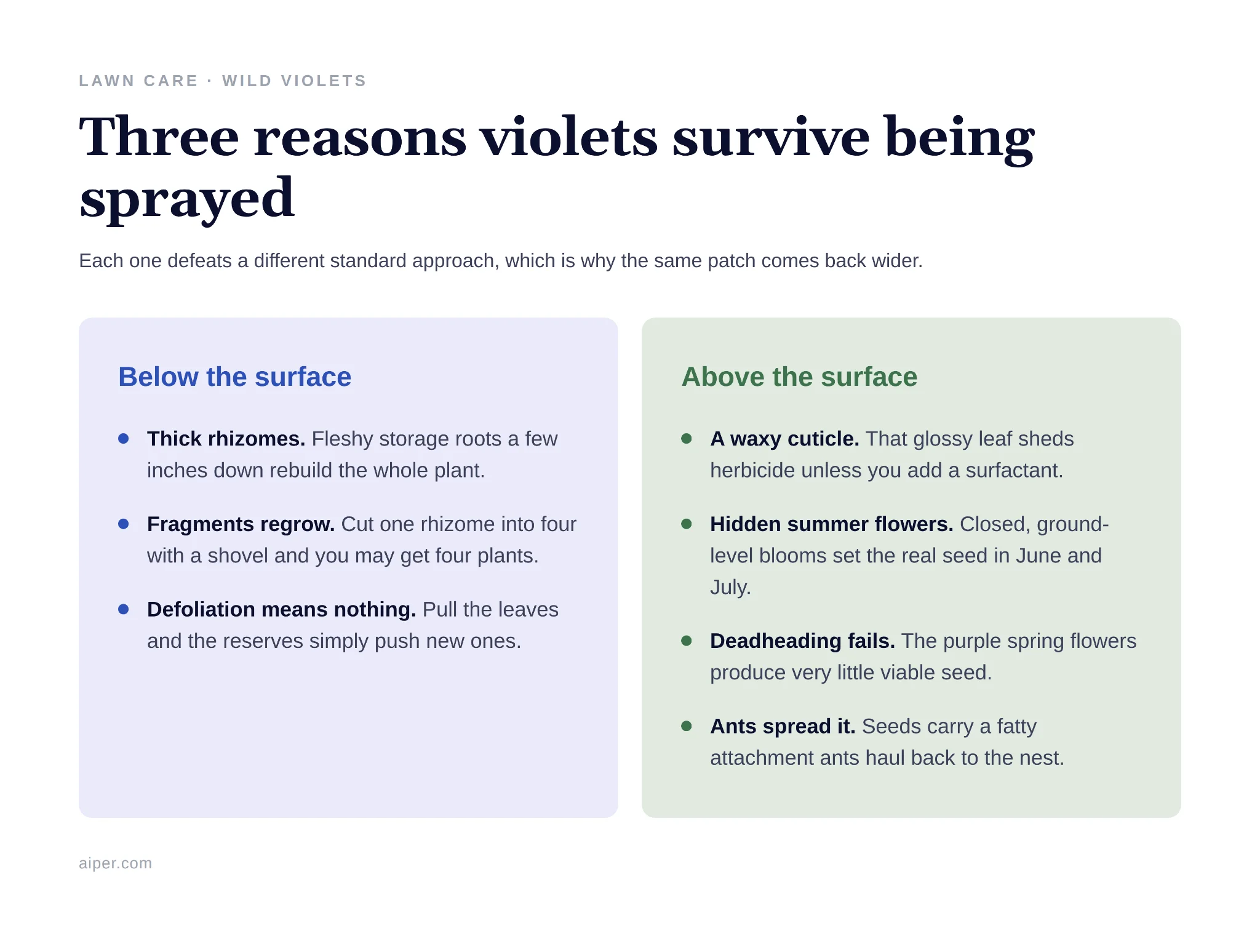
The first is underground.
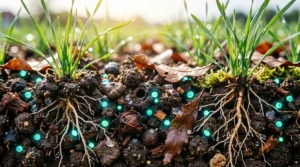
Violets grow from thick, fleshy rhizomes sitting a few inches down, and those rhizomes store enough energy to rebuild the entire plant after the foliage is destroyed. Pull the leaves, burn them off, mow them to the crown, it doesn’t care. Break a rhizome into four pieces with a shovel, and there’s a fair chance of four plants.
The second is the leaf surface.
That glossy look is a heavy waxy cuticle, and it sheds herbicide. Spray without a surfactant, and most of what leaves the nozzle beads up and rolls off before anything is absorbed.
The third is the one almost nobody knows about.
The purple spring flowers everyone recognizes produce very little viable seed. The real reproduction happens in summer, from a second kind of flower the plant makes down at ground level, these are closed, greenish, self-pollinating, hidden under the leaf canopy, never opening.
Those are where the seed comes from, and they’re producing it in June and July while the plant looks like it’s just sitting there.
So deadheading accomplishes nothing. And when those hidden capsules ripen, they eject seed several feet, after which ants carry it further, because the seeds have a fatty attachment ants collect and haul back to their nests.
That’s why a new colony shows up twenty feet from the old one in ground that was clean last year.
Spray in Fall, Not Spring
Spring is when violets are most visible and most annoying, so spring is when they get sprayed. It’s the least effective window of the year.
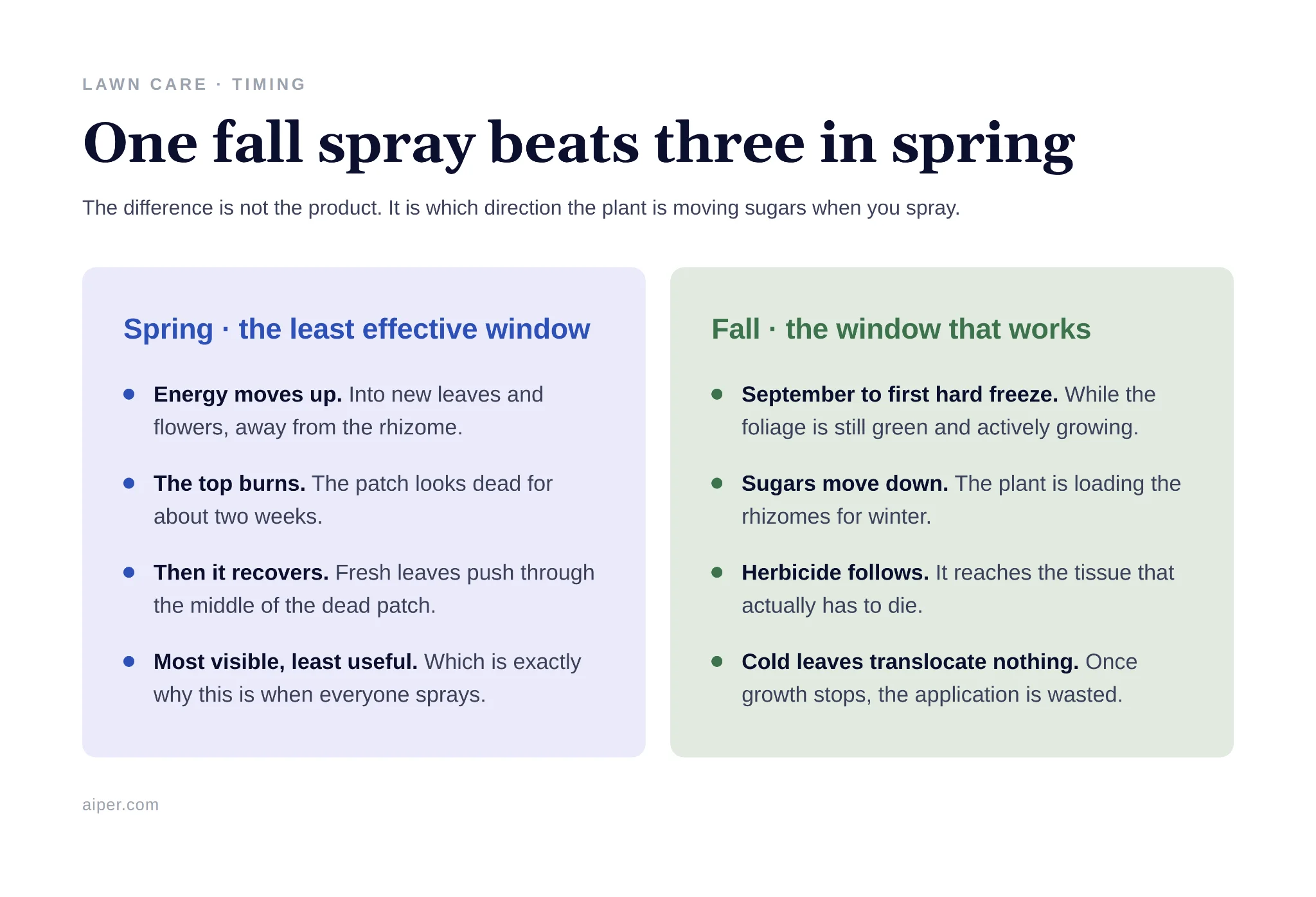
In spring, the plant is pushing energy upward into new leaves and flowers. Herbicide applied then moves poorly into the rhizome, which is why the top burns off, the patch looks dead for two weeks, and fresh leaves appear in the middle of it.
From September into November, the flow reverses. The plant pulls sugars down into the rhizomes to store for winter, and a systemic herbicide applied during that movement gets carried down with them to the tissue that actually needs to die.
The target window runs from early fall until the first hard freeze, while the foliage is still green and actively growing. Cold, dormant leaves don’t translocate anything.
An application made in October will do more than three made in April.
Use a Product With Triclopyr
Standard three-way lawn herbicides built on 2,4-D, dicamba, and mecoprop will damage violets and will not kill them. That combination is the reason so many people believe the plant is chemically immune.
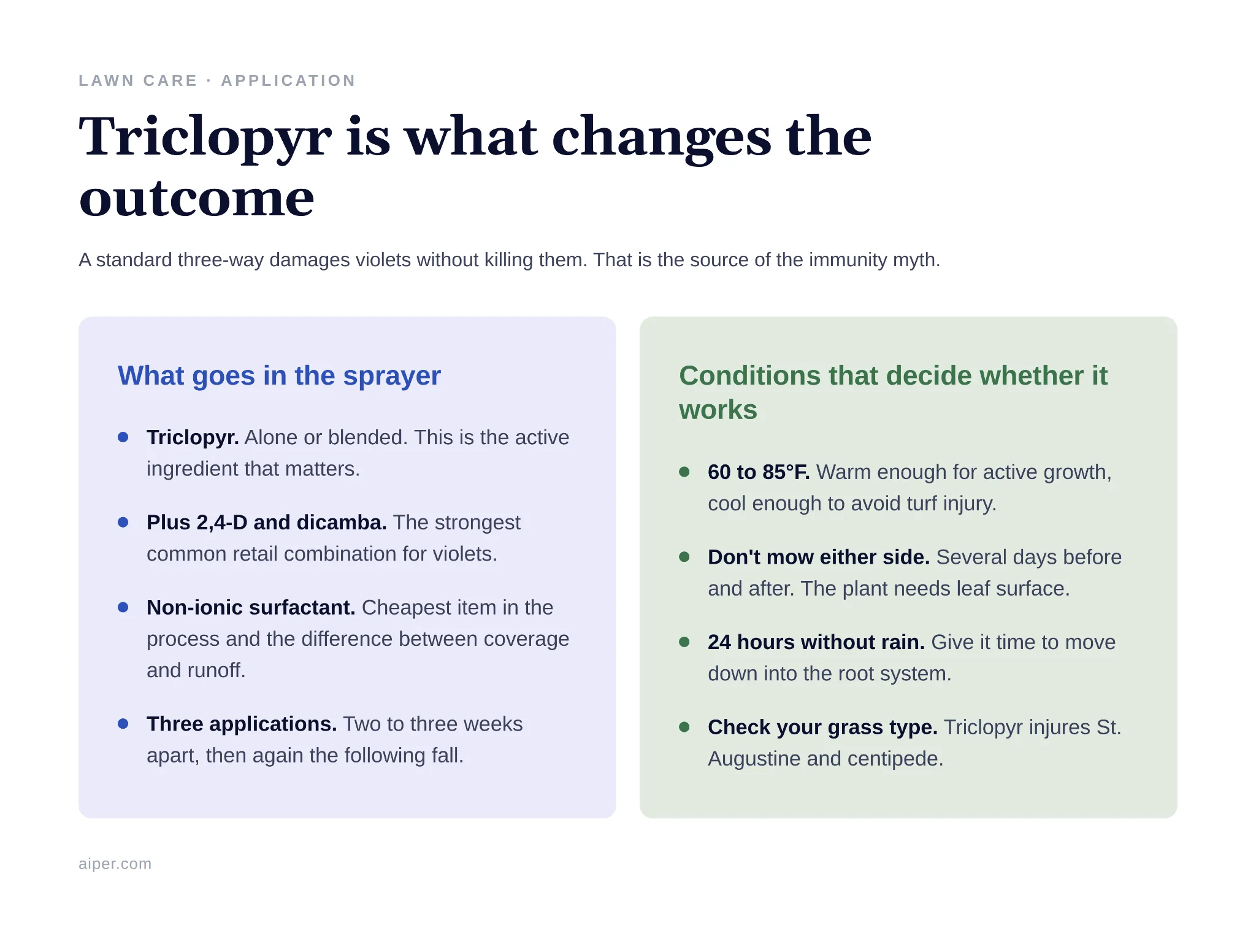
Triclopyr is the active ingredient that changes the outcome. Look for it on the label either on its own or blended into a three- or four-way product. Triclopyr with 2,4-D and dicamba is the strongest common combination available at retail.
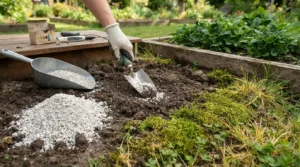
Add a non-ionic surfactant unless the product already includes one, because of that waxy cuticle. It’s the cheapest thing in this entire process, and it’s the difference between coverage and runoff.
A few practical constraints that show up as failures when ignored:
Spray when daytime temperatures sit between roughly 60 and 85°F. Don’t mow for several days before or after, since the plant needs leaf surface to absorb through and time to move the chemical down. Give it 24 hours without rain.
And check the label against your grass type. Triclopyr injures St. Augustine and centipede, so warm-season lawns need a product cleared for them specifically.
Keep it away from tree roots, shrub beds, and anything you like. Triclopyr is hard on woody plants, and violets grow under trees, which is exactly where that conflict lives.
Plan on Three Applications and Two Seasons
This is the expectation that keeps people from giving up halfway.
One fall application will kill a meaningful share of a colony and set the rest back hard. It will not clear the patch. Follow with a second application two to three weeks later while the survivors are still translocating, and a third if the weather holds and green tissue is still there.
The following spring, look at what came up. There will be some. Spot-treat it, then go again the next fall with full coverage on whatever is left.
Two seasons is normal for an established stand. Three isn’t unusual under mature shade.
Anyone selling a one-application answer to a rhizomatous perennial with a seed bank is selling something.
Dig Out Small Patches
A colony under a few square feet is worth removing by hand, and it’s the only method that produces an immediate clean result.
Work in moist soil. Cut a spade in four to six inches deep, well outside the visible edge of the clump, and lift the whole block rather than tugging at leaves. Then break the soil apart in your hands and pick out every pale rhizome fragment you find. Anything left regrows.
Refill with clean soil and seed it, because bare ground under a tree is an invitation to the next thing.
Beyond a few square feet, this stops being realistic. The rhizome network runs together, the odds of missing fragments climb, and digging simply chops the colony into starts.
Smother or Renovate a Heavy Infestation
When violets have taken more than about a third of an area, selective treatment stops being the efficient path.
Cardboard or black plastic held down over the area for eight to ten weeks through summer will kill violets along with everything else under it. Cardboard alone often isn’t enough (rhizomes have the reserves to push a long way toward light), so overlap sheets heavily and weight them properly.
The faster version is a non-selective herbicide, two applications a few weeks apart to catch regrowth, then a full reseed in early fall. That timing works out well, since fall is the right season to establish cool-season turf anyway.
Address the Shade, Drainage, and Compaction
Violets prefer damp, rich, shaded, compacted ground. Every colony in a typical yard sits somewhere that fits at least two of those.
Thin the canopy overhead to let more light through. Core aerate compacted strips. Correct the low spot that stays soggy after every rain. Mow at three to three and a half inches and overseed thin areas in fall so there’s a competitive stand of grass in the ground.
Be clear-eyed about what this does, though. Dense turf slows violets down. It does not stop them the way it stops an annual weed, because they arrive from rhizomes and from ant-carried seed rather than from bare soil, and a healthy lawn under a maple is still a good place for them to live.
Drainage is only half of that problem. The other half is a controller running a fixed schedule into a shaded zone that never dries out on its own, which keeps the ground damp for months whether or not it rained. Watering those zones by soil moisture instead, what a system like the Aiper IrriSense 2 is built to do, takes away one of the two conditions the colony is sitting on, and it’s the one you can change this season.
Skip the Approaches That Don’t Reach the Rhizome
Mowing does nothing. The growing points sit below any deck height, and cutting only removes the foliage the plant was going to shed anyway.
Hand-pulling leaves is worse than useless, because it looks like progress. The rhizome is still there, and it responds to defoliation by pushing new growth.
Vinegar, salt solutions, and horticultural acetic acid burn the top and leave the underground structure intact, and the salt-based versions damage soil in a way that outlasts the weed.
Corn gluten meal is a pre-emergent. Violets spread mainly by rhizome. The premise doesn’t apply.
Consider Keeping Them Where the Lawn Isn’t
Worth saying before the sprayer comes out.
Wild violets are native across most of North America. They’re one of the earliest nectar sources of the season, and they’re the only host plant fritillary caterpillars will eat. In a shaded bed where turf never succeeded anyway, they’re a reasonable groundcover that asks for nothing.
The decision that usually makes sense is a line rather than a war: violets stay in the beds and along the fence, turf areas get treated, and the edge between them gets watched.
Keeping them anywhere on the property does mean seed keeps arriving in the lawn, carried by ants that don’t recognize the line. Fall treatment handles it. It just means fall treatment becomes a standing item rather than a project with an end date.
Get more pool and lawn care guides from Aiper on Google