How to Get Rid of Creeping Charlie in Your Lawn

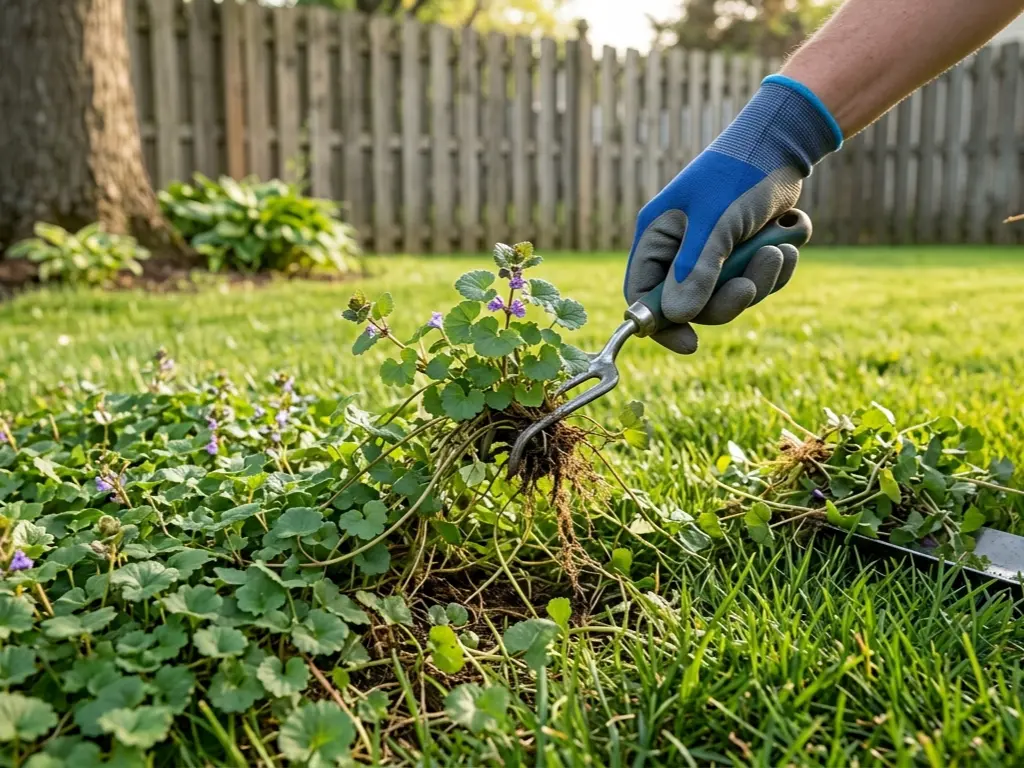
Creeping charlie doesn’t announce itself.
One spring, you notice a few low-growing rosettes with scalloped leaves tucked along the fence line, and by the time you’re mowing regularly, it’s already threaded itself through a 200-square-foot patch of turf.
The problem is that most people treat it wrong, too lightly, too late, or with the wrong thing entirely, and creeping charlie is extraordinarily patient. Unlike creeping Charlie’s low, trailing habit, quackgrass grows upright with sharp blades, so removing quackgrass from a thick, established lawn calls for a different approach entirely.
What You’re Actually Dealing With
Creeping charlie is a perennial broadleaf weed in the mint family, and it behaves like one: persistent, rhizomatous, spreading horizontally with aggressive efficiency. For a lookalike invader with triangular stems, how to get rid of nutsedge completely covers the tubers that keep it returning. Wild violets share the same shade-loving persistence, and getting rid of violets in your lawn means playing the long game.
The leaves are round to kidney-shaped, opposite, with bluntly toothed margins.
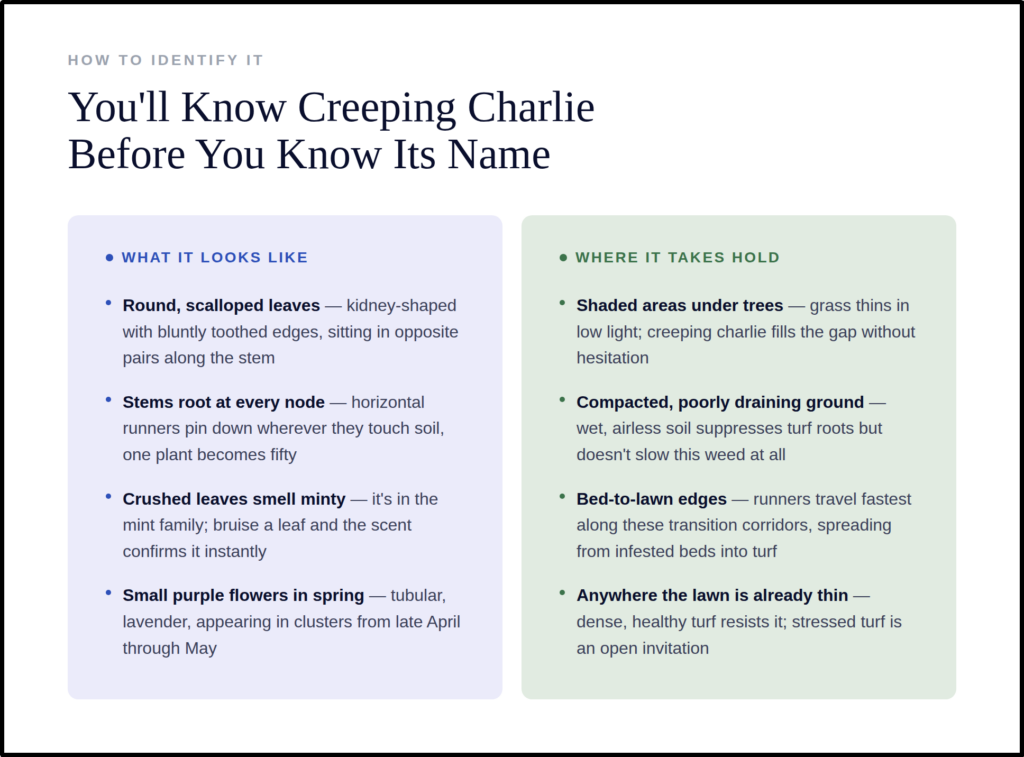
When you crush them, they smell faintly of mint. Flowers are small, purple, tubular, and appear in late spring.
It loves shade, moisture, and neglected soil. Compacted, poorly draining ground is where it thrives most aggressively. The same neglect opens the door for other opportunistic grasses like bahiagrass — our guide to getting rid of bahiagrass in a lawn covers that diagnosis and fix.
You’ll often find it worst under trees, along shaded fence lines, and in the low spots of a lawn that holds water after rain. That pattern is telling you something about why the grass isn’t competing.
Healthy, dense turf is genuinely difficult for creeping charlie to colonize. Thin, stressed turf is an invitation.
This doesn’t mean you can just fertilize and reseed your way out of an established infestation.
Once it’s there in force, you need to address it directly. But skipping the underlying conditions means it comes back. Spurge answers to the same playbook — how to get rid of spurge before it seeds walks through the removal timing that actually sticks.
The Most Effective Chemical Control
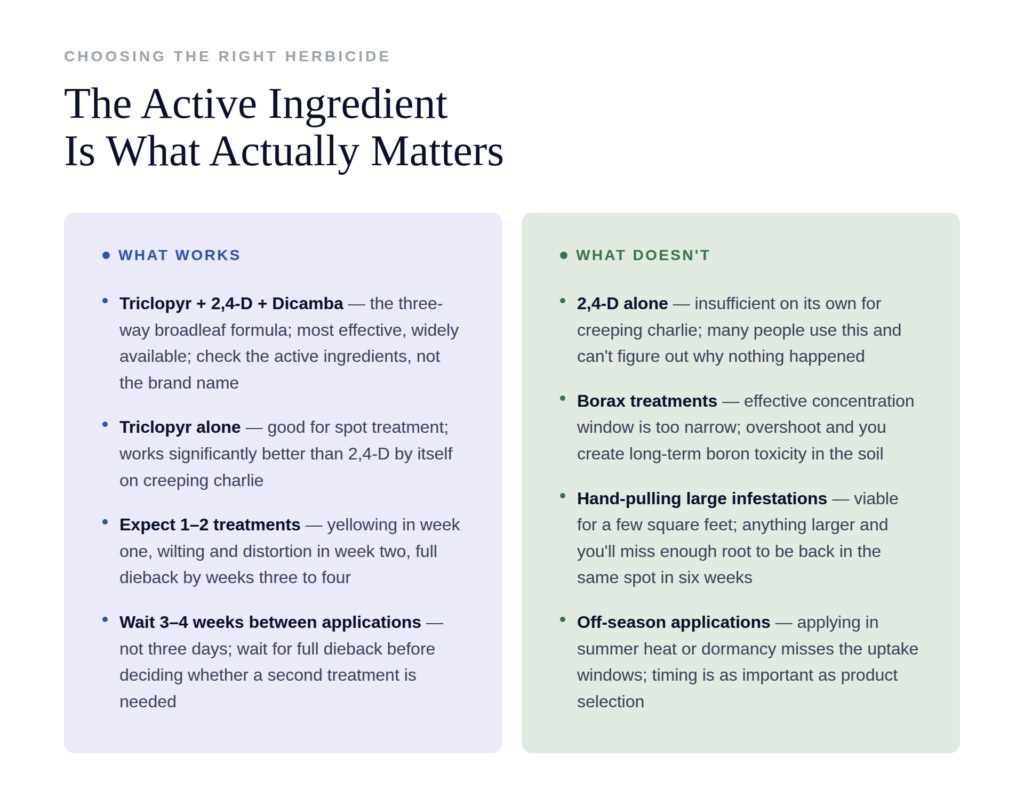
Broadleaf herbicides containing triclopyr are the standard for creeping charlie, and they work significantly better than products containing only 2,4-D.
Products with a combination of triclopyr, 2,4-D, and dicamba, the standard “three-way” broadleaf herbicides, are effective and widely available. Look for active ingredients on the label rather than going by brand name.
Timing is everything.
The best application windows are fall (mid-September through October, before hard frost) and spring (when creeping charlie is actively flowering, roughly late April to mid-May depending on your region).
Fall is the more effective window. The plant is moving carbohydrates into its root system for winter, and a systemic herbicide moves with them. Applications in the fall reach the roots more efficiently than spring treatments.
Apply to dry foliage. No rain for at least 24 hours before and after — the same dry-weather rule at the heart of whether you can spray weed killer on wet grass. Temperatures between 60-85°F.
Don’t mow for three days before or three days after, you want maximum leaf surface exposed, and you want the plant to have time to absorb and translocate the herbicide.
These details aren’t fine print. They’re why two people can apply the same product and get completely different results.
Expect yellowing within a week, wilting and distortion within two. Full dieback can take three to four weeks. Heavily established patches may require a second application. Wait three to four weeks between treatments, not three to four days.
Manual Removal: When It Makes Sense and When It Doesn’t
On small infestations, we’re talking a few square feet, maybe along a walkway or in a contained planting bed, hand removal is viable.
You need to get the root system, not just the surface runners. A hand cultivator or a weeder with a good, narrow head works better than fingers alone.
Moist soil after a rain makes this considerably easier.
Pull slowly to extract the root. Bag everything you pull rather than composting it, because plant fragments can root in your compost pile.
For anything larger than a few square feet, manual removal alone is a losing battle. You’ll spend two hours pulling, miss half the root system, and be back in the same spot in six weeks.
The Borax Method: Honest Assessment
You’ll find a lot of recommendations for borax dissolved in water as a natural creeping charlie treatment.
The theory is that creeping charlie is relatively sensitive to boron, while lawn grasses are more tolerant at certain concentrations.
This is partially true, and almost entirely impractical.
The effective concentration window is narrow enough that you’ll either undershoot and accomplish nothing. Or overshoot and damage the surrounding soil and grass.
Application rate matters enormously and varies by lawn size in ways most people don’t calculate accurately. Boron persists in soil. Overapplied, it creates long-term toxicity issues that affect everything you try to grow there afterward.
If you want to avoid synthetic herbicides, the smarter approach is targeted spot treatment with triclopyr-based products certified for organic use, or accepting that small areas need mechanical management.
Shade and Soil Are Not Footnotes
This deserves its own section because it’s where most long-term lawn care fails.
If you have a dense creeping charlie problem under a tree canopy or along the north side of a structure, you’ve probably also got thin, struggling turf. Turfgrass needs light.
Most lawn varieties need at least four to six hours of direct sun. Under heavy shade, even after you eliminate the creeping charlie, you will not successfully establish a grass lawn without changing something.
What you actually need to figure out is: what can grow here?
- Fine fescues tolerate shade reasonably well.
- Ground covers like pachysandra, sweet woodruff, or ajuga are genuinely better choices than fighting the same weed battle every two years in a spot where grass was never thriving.
- In shaded areas, a properly planted, well-mulched ground cover does what grass can’t.
For compacted soil, another root cause, core aeration in fall, followed by overseeding, helps grass compete more aggressively. Fertilizing without aerating in compacted soil gets you top growth with shallow roots. The lawn looks okay until it doesn’t.
Preventing Recolonization After Treatment
Dead creeping charlie leaves gaps.
If you don’t fill them deliberately, you’re inviting whatever seeds happen to land there, which may include more creeping charlie, crabgrass, or other opportunists. The same gap-filling instinct applies to winter annuals — see how to get rid of hairy bittercress before its seed pods fire.
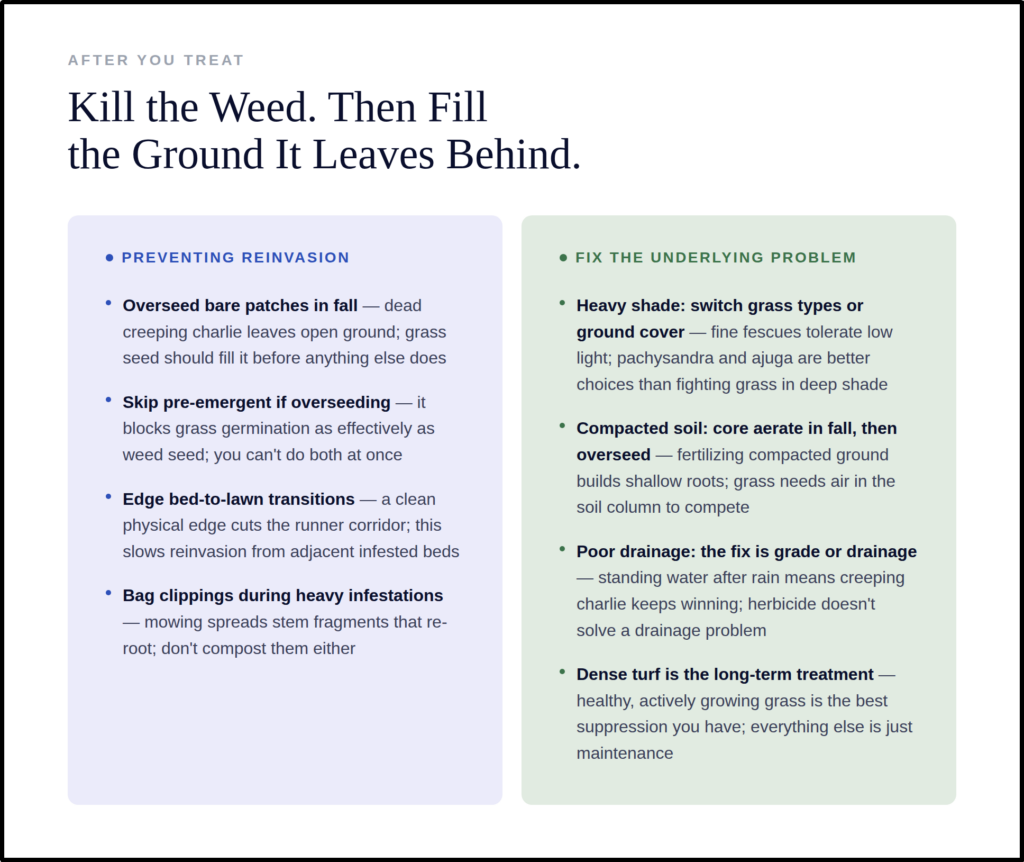
Overseed bare patches in fall with an appropriate turf mix for your light conditions. Keep the seed moist until germination. Don’t apply pre-emergent herbicide if you’re overseeding, as it will prevent the grass seed from germinating along with the weeds.
This is the step people skip. Kill the weed, do nothing with the bare ground, and complain six months later that the weed is back. Dense, actively growing turf is the best long-term suppression tool you have.
Getting the Edges Right
Creeping charlie spreads along edges first, where lawn meets garden beds, fence lines, tree bases, and hard surfaces. These transition zones are where it re-establishes after you’ve treated the main lawn area.
Maintaining a clean physical edge between beds and turf slows reinvasion.
An edging tool or half-moon edger along garden beds removes the corridor where runners travel. Some people use plastic or steel landscape edging buried a few inches deep.
It won’t stop creeping charlie from seeding in. Nothing will.
But runners are how established colonies spread the fastest, and breaking that connection between an infested bed and the lawn does meaningfully slow the process.
What a Realistic Timeline Looks Like
A serious infestation treated correctly in the fall will look like this:
- Visible dieback within two to three weeks
- Significant reduction in coverage by early spring
- Follow-up treatment in May for survivors
- verseeding of bare patches
- Evaluation in the fall to determine if a third treatment is needed
Two seasons. Sometimes three for heavily established colonies with deep root mats.
Anyone who tells you there’s a faster fix either isn’t dealing with what you’re dealing with or is selling something. The biology of the plant doesn’t bend to impatience.
The lawn where creeping charlie thrives is usually a lawn that needs attention beyond weed control — the same holds for removing bindi weeds without wrecking your grass, which starts with a thick, healthy turf. Fix the soil. Address the shade. Get the grass dense and healthy. That’s how you stop having this problem, rather than just treating the symptom every other year.
The Aiper IrriSense 2 covers up to 4,800 square feet across 10 zones, so shaded areas, open patches, and high-traffic sections each get watered on their own terms. Weather-Sense adjusts the schedule automatically, no overwatering after rain, no dry spells because the timer didn’t account for a heat stretch. The same logic as treating the underlying lawn conditions instead of just the weeds applies to irrigation.
Get more pool and lawn care guides from Aiper on Google