Pool Spa vs Hot Tub: Integration, Maintenance, And Cost

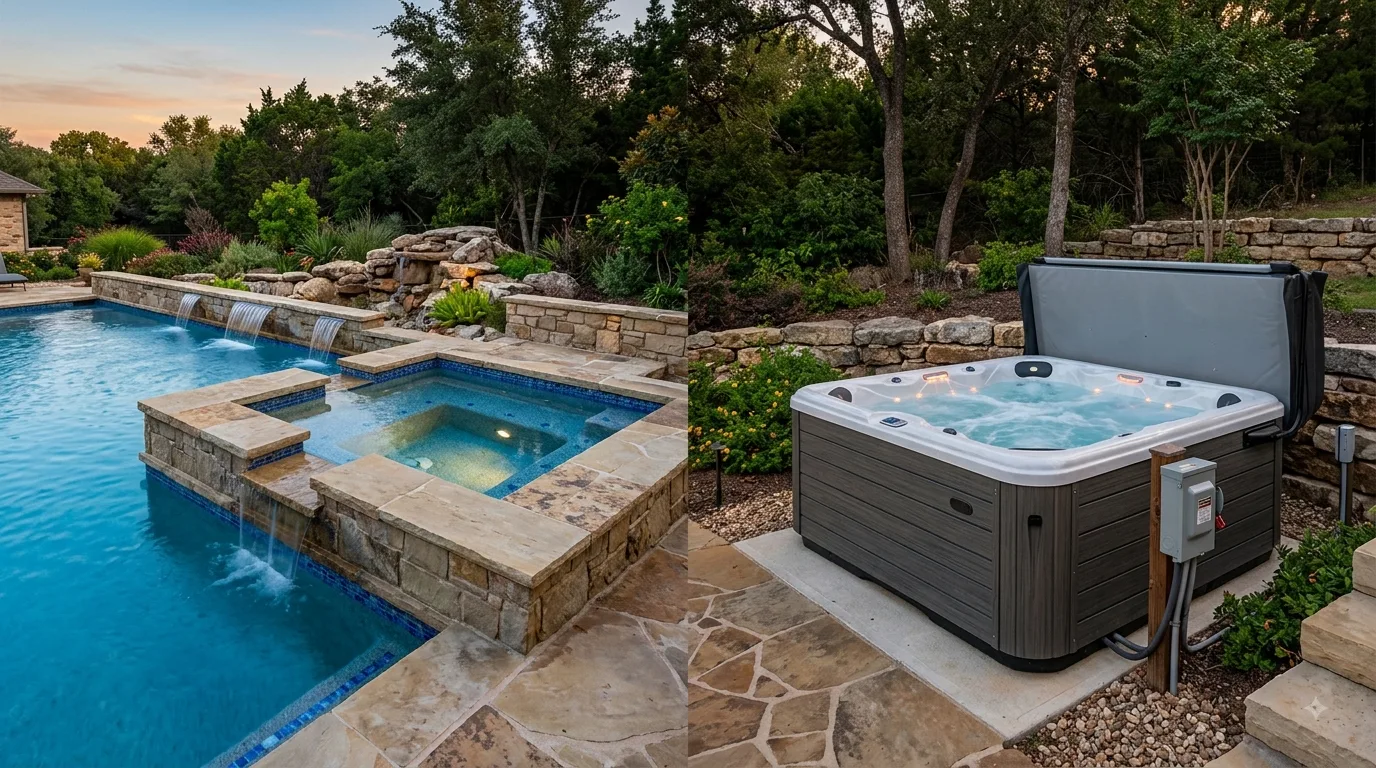
An attached pool spa and a standalone hot tub offer similar places to soak, but they operate very differently.
A pool spa is built into the pool and usually shares its plumbing, heating, and filtration equipment. A hot tub is a separate, self-contained system with its own heater, pump, controls, and insulation.
Those differences change what each one costs to run, how much maintenance it adds, and how many months of the year you can actually use it.
How An Attached Spa Shares Pool Equipment
An attached spa runs on the pool’s equipment. Same pump, same filter, same heater, same plumbing. Motorized valves called actuators redirect the water between pool mode and spa mode, and most systems switch modes from a wall panel or a phone app.
Sharing is the appeal. One filter to clean, one sanitizer program, one body of water to test. Spa water is pool water.
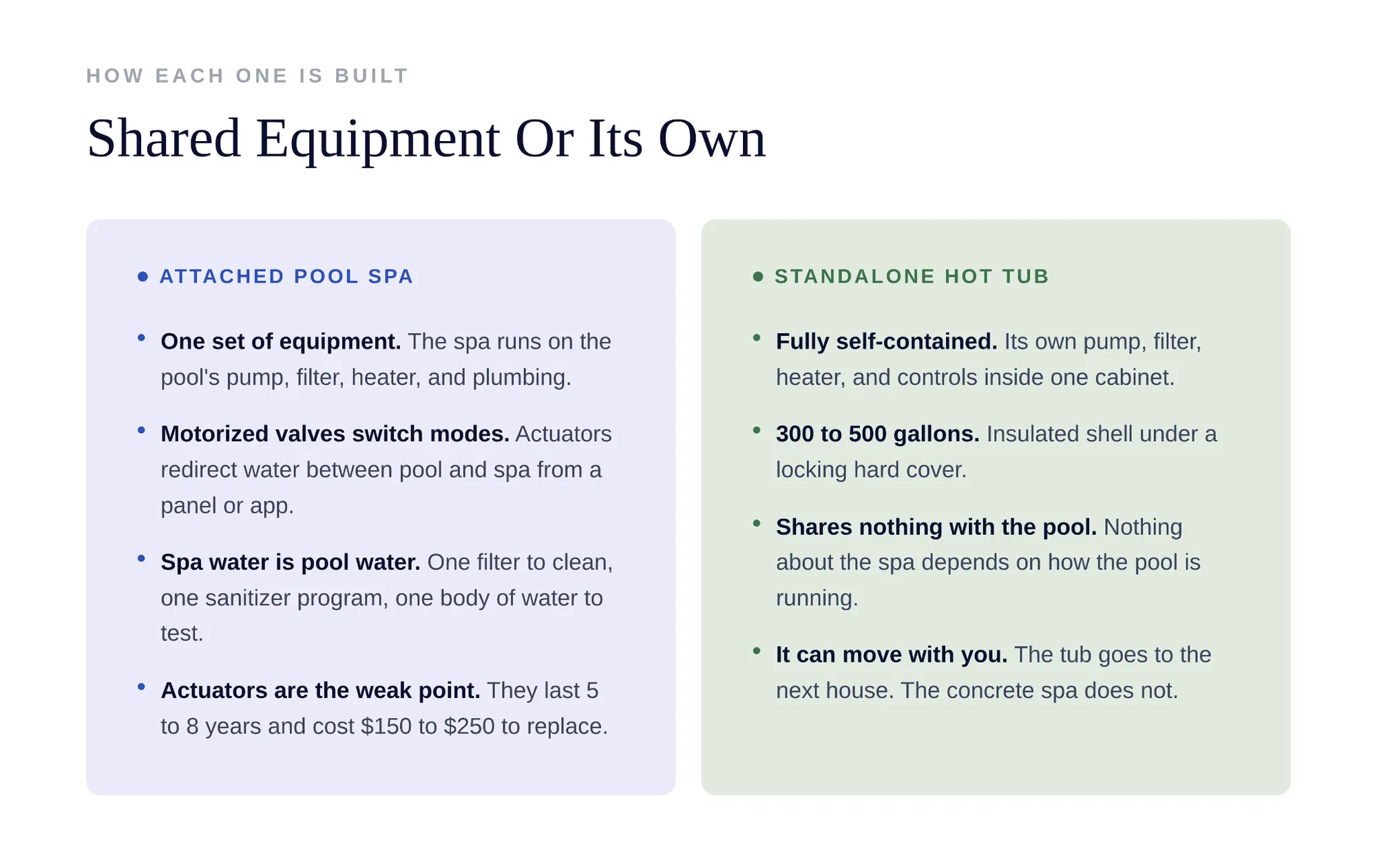
It is also where things break. Actuators last 5 to 8 years and run $150 to $250 to replace. When one fails, the spa either refuses to fill or the pool starts draining into it, and most owners notice it as a strange water level before they suspect the equipment.
A standalone hot tub shares nothing. Its own pump, filter, and heater sit inside an insulated cabinet holding 300 to 500 gallons, under a locking hard cover. It can also be moved to a new house.
What It Costs To Heat Each One
A pool heater is sized for a pool. Aim a 400,000 BTU heater at an 800-gallon spa, and it reaches 102°F from cold in around 30 minutes.
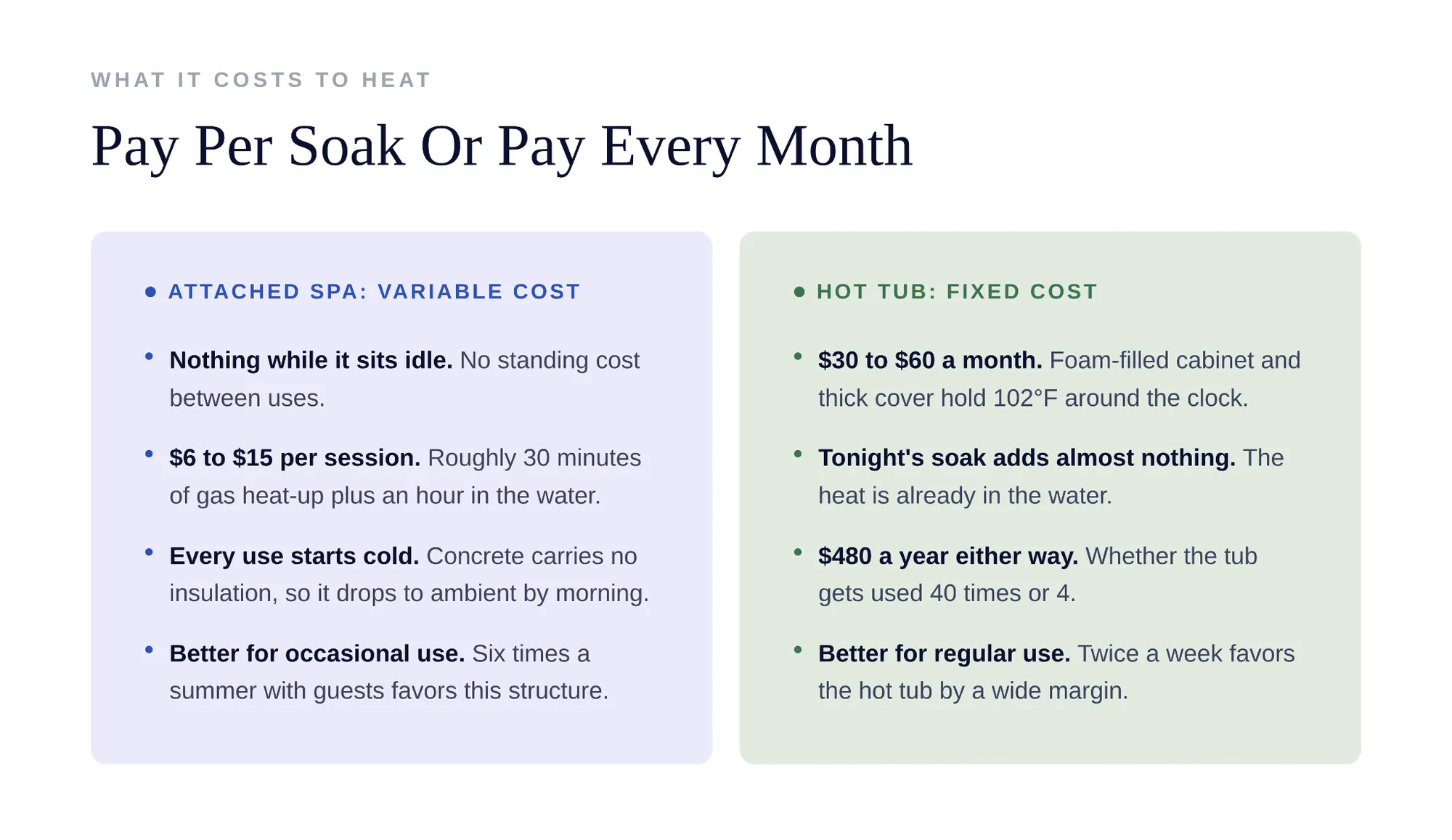
It burns roughly 4 therms an hour doing it. Depending on gas rates, a session with 30 minutes of heat-up and an hour in the water costs $6 to $15 in fuel, and the spa is back to ambient temperature by morning. Concrete spas carry no insulation, so holding one at temperature is not practical. Every use starts cold.
A hot tub reverses the structure. A 4 to 5.5 kW electric element heats 400 gallons slowly, but foam fills the cabinet around the plumbing and the cover is several inches thick, so the water stays at 102°F around the clock. Holding it there costs $30 to $60 a month in most climates. Tonight’s soak adds almost nothing on top of that.
Fixed cost against variable cost, in other words. Forty dollars a month is $480 a year whether the tub gets used 40 times or 4. The attached spa costs nothing while it sits idle and a real amount every time it runs.
So compare them per soak, against how often the household will realistically use it. Twice a week favors the hot tub by a wide margin. Six times a summer when guests visit favors the attached spa, because the standing cost never applies.
Insulation quality decides whether that monthly figure is $30 or $70. Cheaper tubs line the cabinet walls instead of filling the cavity around the pipes, and the cover soaks up water over a few winters until it stops sealing properly.
How Many Months You Can Use Each One
In a freezing climate, the pool closes in October. The spa closes with it.
That is 5 to 7 months a year when an attached spa cannot be used, covering exactly the stretch when hot water sounds best. Owners in Minneapolis or Buffalo tend to work this out the first winter after the build.
Warm climates remove the problem. A pool that stays open year-round gives the attached spa full availability, and the gas heat-up is the only friction left.
A standalone tub runs through snow, and through every month the pool sits under a cover. For a lot of buyers, that availability is the whole purchase.
One risk runs the other direction. A hard freeze during a power outage can damage a hot tub within 24 to 48 hours, because the water stops circulating and the plumbing inside the cabinet freezes. Fixing that means cutting into the foam to reach the split pipe.
Water Chemistry And Maintenance
Shared water means the spa is sanitized at pool levels, which is thin for 102°F. Heat burns off chlorine faster, and four people in a spa add far more sweat and body oil per gallon than the same four in a pool. An evening of spa use leaves a chlorine shortfall that the pool’s volume absorbs over the next day.
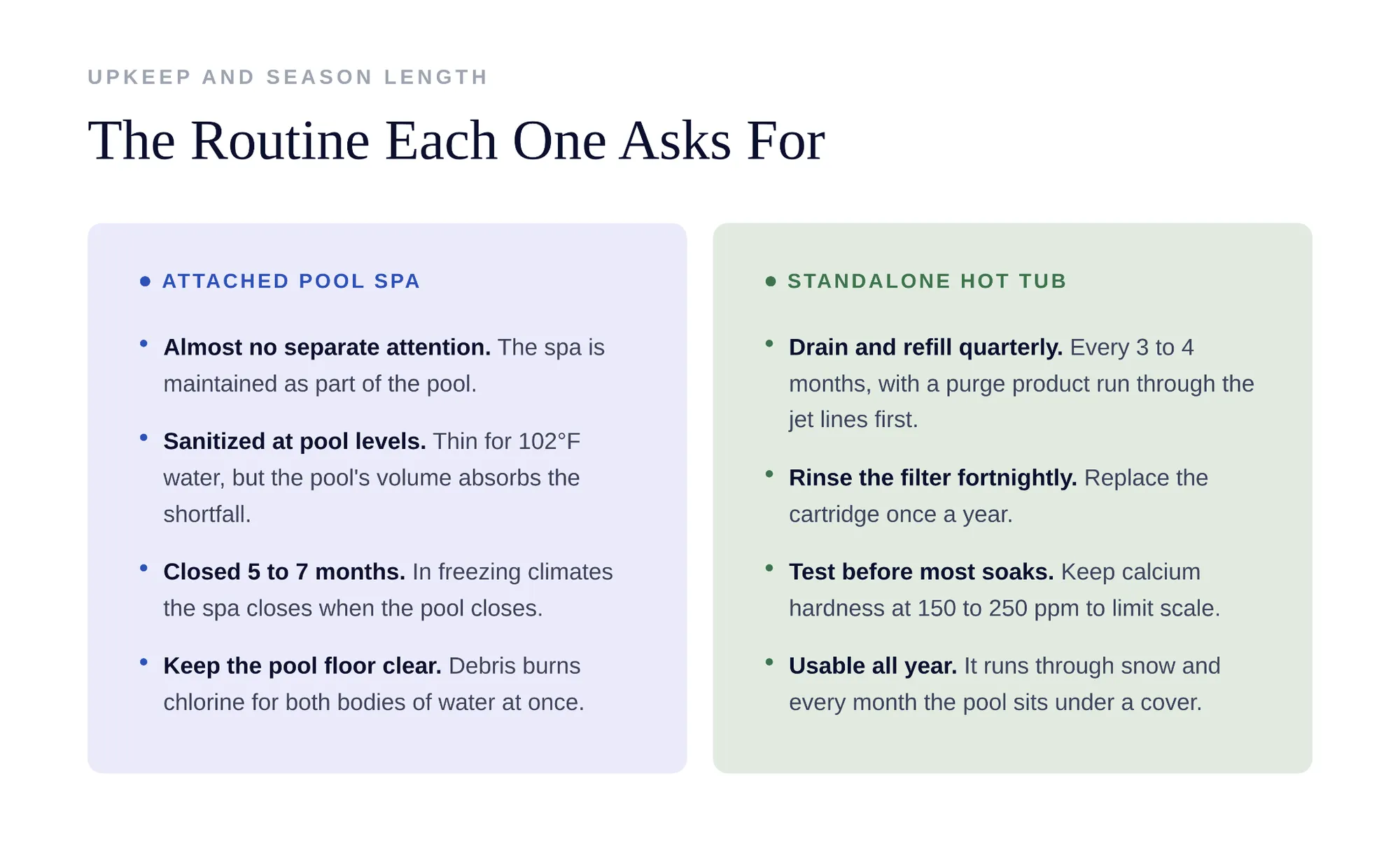
A hot tub has no volume to absorb anything, so four hundred gallons, four people, 102°F, and water that never gets diluted by rain.
That creates a routine the attached spa never asks for. The cartridge filter gets rinsed every two weeks and replaced yearly. Sanitizer gets tested before most soaks. Calcium hardness sits around 150 to 250 ppm, lower than a pool, because hot water pushes calcium out of the water and onto the heater element as scale. And the tub gets fully drained and refilled every 3 to 4 months.
Run a purge product through the plumbing before each drain. Bacteria and body oils build into a slime layer inside the jet lines where no brush reaches, and refilling without that step puts clean water into dirty pipes. Foam on the surface within a week of a refill is the usual sign it was skipped.
The spa side of an integrated system needs almost no separate attention, which puts the real question back on how the pool itself gets maintained.
Debris on the pool floor consumes chlorine for both bodies of water at once. Pulling it out mechanically keeps that demand down, something robotic pool cleaners can help with.
What Each One Costs To Buy And Install
Here’s what purchase and installation costs, before any running expenses:
- Concrete spa built as part of a new pool: $15,000 to $25,000
- Spa added to an existing pool: considerably more, since it means breaking deck and re-plumbing
- Quality standalone hot tub: $5,000 to $12,000
- Dedicated 240V, 50A circuit and disconnect: $1,000 to $2,500
- Pad, delivery, and a crane where access is tight: $500 to $2,000
Service life comes out similar. A concrete spa lasts as long as the pool shell and gets resurfaced on the same schedule. A good acrylic tub runs 15 to 20 years, with a control board at $400 to $800 and at least one pump replacement likely somewhere in there.
The 120V plug-in models deserve a specific warning. They heat at 2 to 3°F per hour and cannot run the heater and the jets at full power simultaneously, so the water cools while people are sitting in it. Skipping the electrical install is their only real advantage.
Why Many Households End Up With Both
The attached spa gets built with the pool because it adds relatively little at that stage and it completes the design. It sees use in July, often with guests, usually when the pool is already warm.
Three or four winters later, the same household buys a tub and puts it near the back door, close enough to reach at 11 pm in January without crossing the yard. The two were never serving the same purpose.
Get more pool and lawn care guides from Aiper on Google