Why Is One Zone Underperforming? An Irrigation Diagnostic Walkthrough

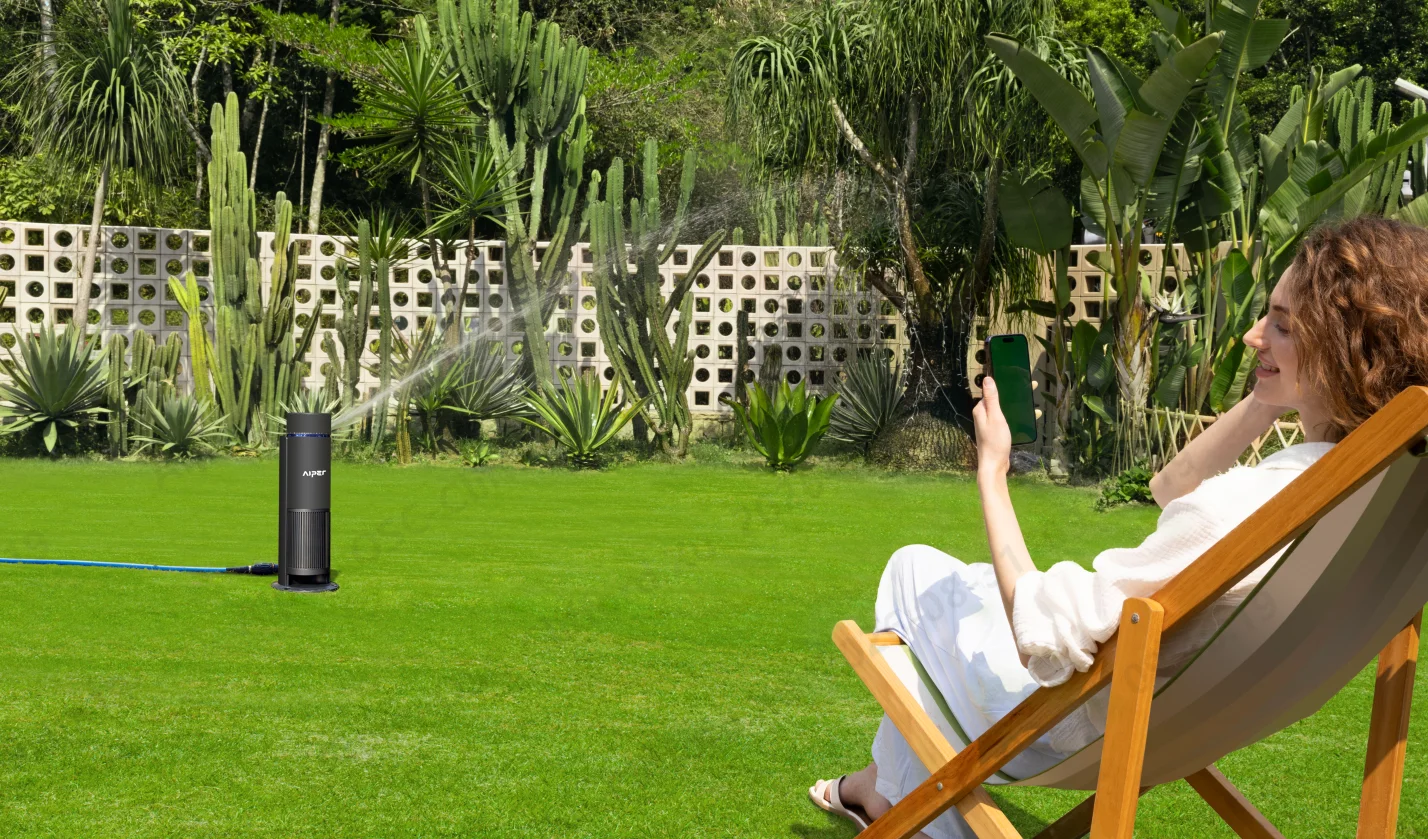
Uneven watering can leave one part of your lawn dry, pale, or thinning while the rest stays healthy. Running the zone longer often makes the problem worse by overwatering areas that are already getting enough.
The cause is usually one of a few things: low pressure, clogged or damaged nozzles, a valve problem, an obstruction, or an issue with the soil.
This guide walks through how to check each one and identify what is actually causing the uneven coverage.
Turn It On And Watch
Run the zone manually from the controller and go stand in it. Not a glance from the driveway. Walk the whole zone for at least one full cycle and look at every head, because brown grass tells you something failed a while ago and a running zone tells you what’s failing right now.
Worth noticing:
- Heads that pop up slowly, partway, or not until the others have been running thirty seconds
- Water coming out as fog instead of droplets
- A head near the end of the run dribbling while the ones near the valve throw hard
- Rotors that spray but don’t turn, or stall halfway back
- Anything spraying into a fence, a shrub, a downspout, or the street
Note which heads and where. The temptation is to fix the first thing you see. A tilted head and a pressure problem look similar from ten feet away, and the fix for one does nothing for the other.
Read The Pattern
The shape of the damage is a diagnosis on its own, and it’s free.
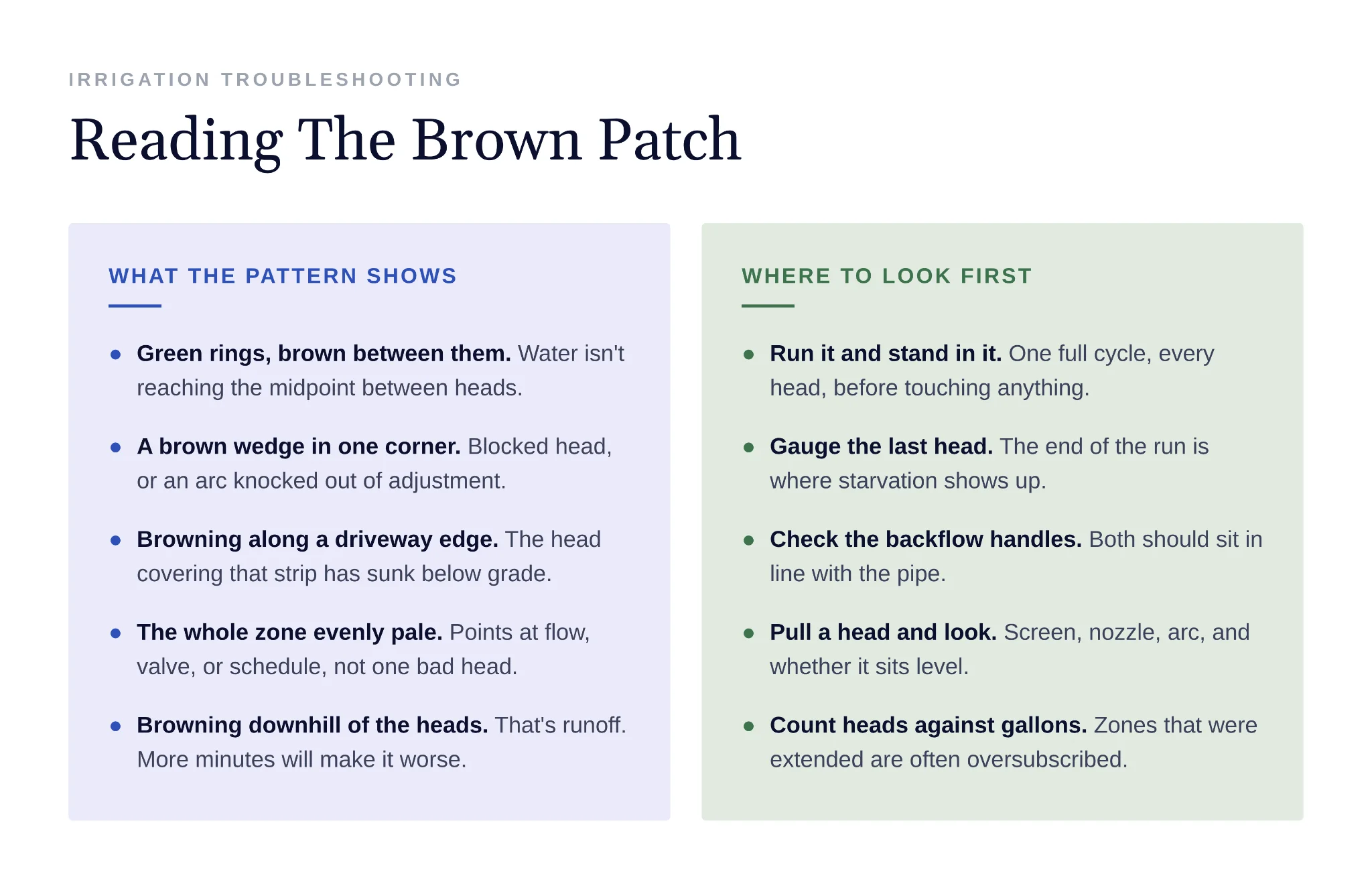
Green rings around each head with browning between them means water isn’t reaching the middle ground. That’s a throw problem, which is usually a pressure problem.
A brown wedge in one corner points to a blocked or misaimed head, or an arc knocked out of adjustment by a mower. Browning along a long straight edge, like a driveway or bed line, often means the head covering that strip has sunk below grade and is watering the grass six inches in front of it.
Then there’s the whole-zone version, where nothing is patchy, and everything is just slightly worse than the neighboring zones. Uniform decline points at flow, valve, or schedule rather than any single head.
If it’s browning downhill of where the water lands, that’s runoff. More minutes will make it worse.
Pressure First
Pressure explains more failing zones than everything else on this list combined, and it fails in both directions.
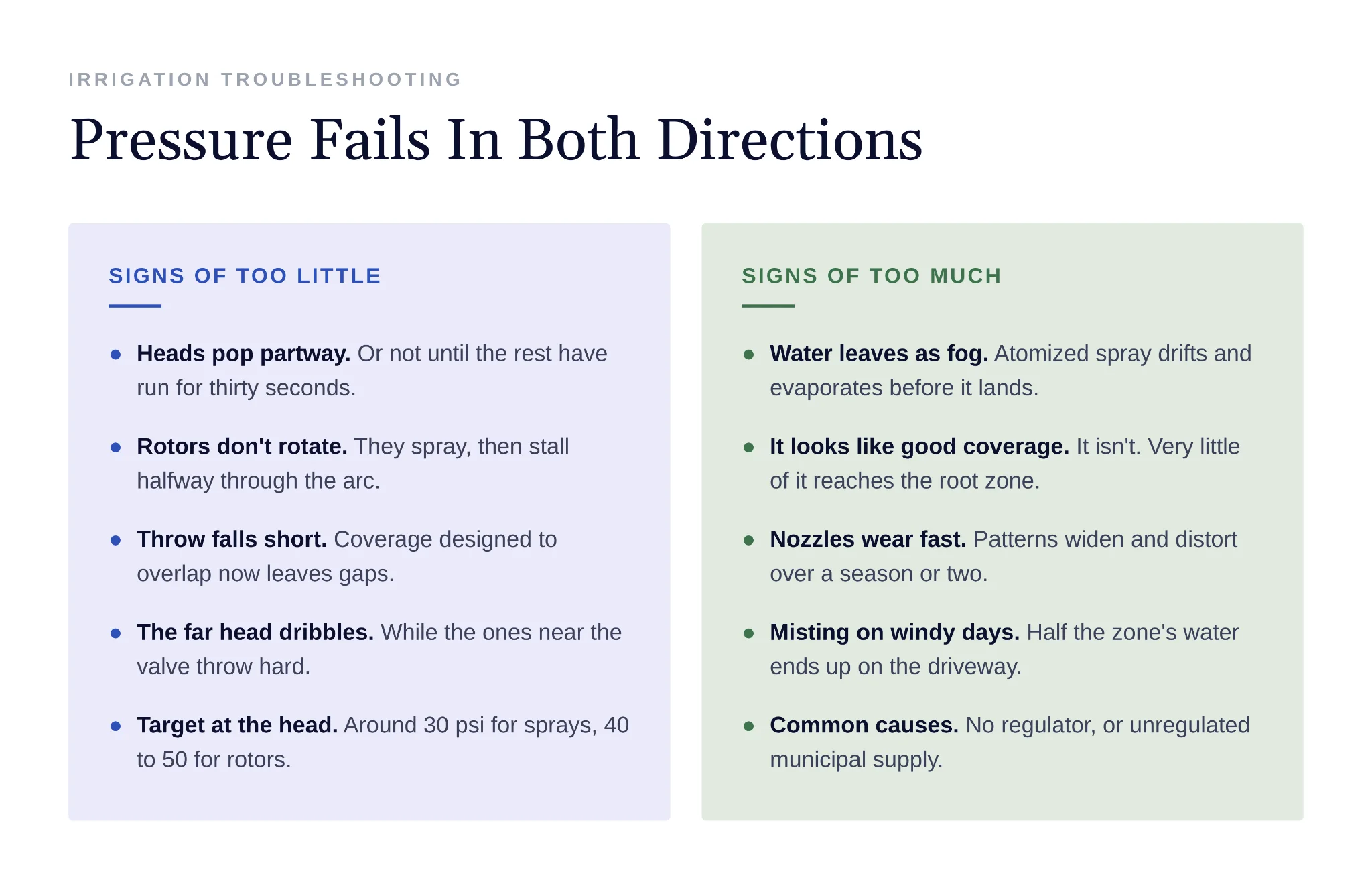
Too little. Heads don’t pop fully. Rotors don’t turn. Throw falls short by several feet, and the overlap the zone was designed around disappears.
Too much. The water atomizes into fog, which drifts and evaporates instead of landing. Looks like strong coverage. Isn’t.
Measure at the head, not the tap: sprays want around 30 psi, rotors 40 to 50. Gauge the last head in the run while the zone is going, since that’s the worst-case point in the system.
Then find where the pressure went, in this order:
- Backflow ball valve. Half open since spring startup. The most common cause by a wide margin, and it weakens every zone at once. Both handles should sit in line with the pipe.
- Flow control stem on the valve. Cranked down years ago to stop a misting problem, never reset.
- Filter screen under a head. Clogs with grit after any water main repair.
- Lateral leak. A spongy patch that stays wet after everything else has dried, starving every head downstream of it.
- Too many heads. A zone that got extended now wants more gallons per minute than the pipe delivers. Split the zone or move to lower-flow nozzles.
Nozzles And Arcs
Pull a few heads and look at what’s in them.
It’s almost always a replacement. A head got run over, somebody swapped in whatever was on the truck, and the new nozzle throws eight feet where the old one threw fifteen. Or a full-circle nozzle went into a corner head, so half the water hits the fence, and the corner stays dry. Or two brands ended up on one zone with nozzles that put down water at different rates.
That last one matters more than it sounds. If one head delivers water twice as fast as its neighbor, no run time satisfies both. Something drowns, or something starves, permanently.
While the head is out, check the screen, check that the arc hasn’t drifted, and check that the head sits level. Ten degrees off vertical throws the whole pattern into the wrong place.
Inside The Valve Box
If pressure at the head is low but pressure at the source is fine, the valve is the next stop.
A valve that opens partway runs the zone at reduced pressure without announcing anything is wrong. Grit under the diaphragm seat, a diaphragm gone stiff, a weak solenoid that pulls enough to open but not to hold.
Common tell: the zone starts strong and fades a minute in, or runs noticeably weaker than an identical zone across the yard. Take the bonnet off, pull the diaphragm, look for debris and for cracking or hardening in the rubber. Kits are cheap and rebuilding beats replacing.
Two things to check in the same trip. Whether the valve closes fully, since a weeping valve keeps the low point soggy and confuses everything else. And whether the wiring is what you think it is, because zones get mislabeled, and testing the wrong zone means fixing something that was never broken.
The Catch Can Test
This is the step that turns opinion into measurement, and almost nobody does it.
Set straight-sided containers across the zone in a rough grid, including one beside a head, one at the midpoint between two heads, and one at the far edge. Tuna cans work. Run the zone for fifteen minutes, then measure the depth in each with a ruler.
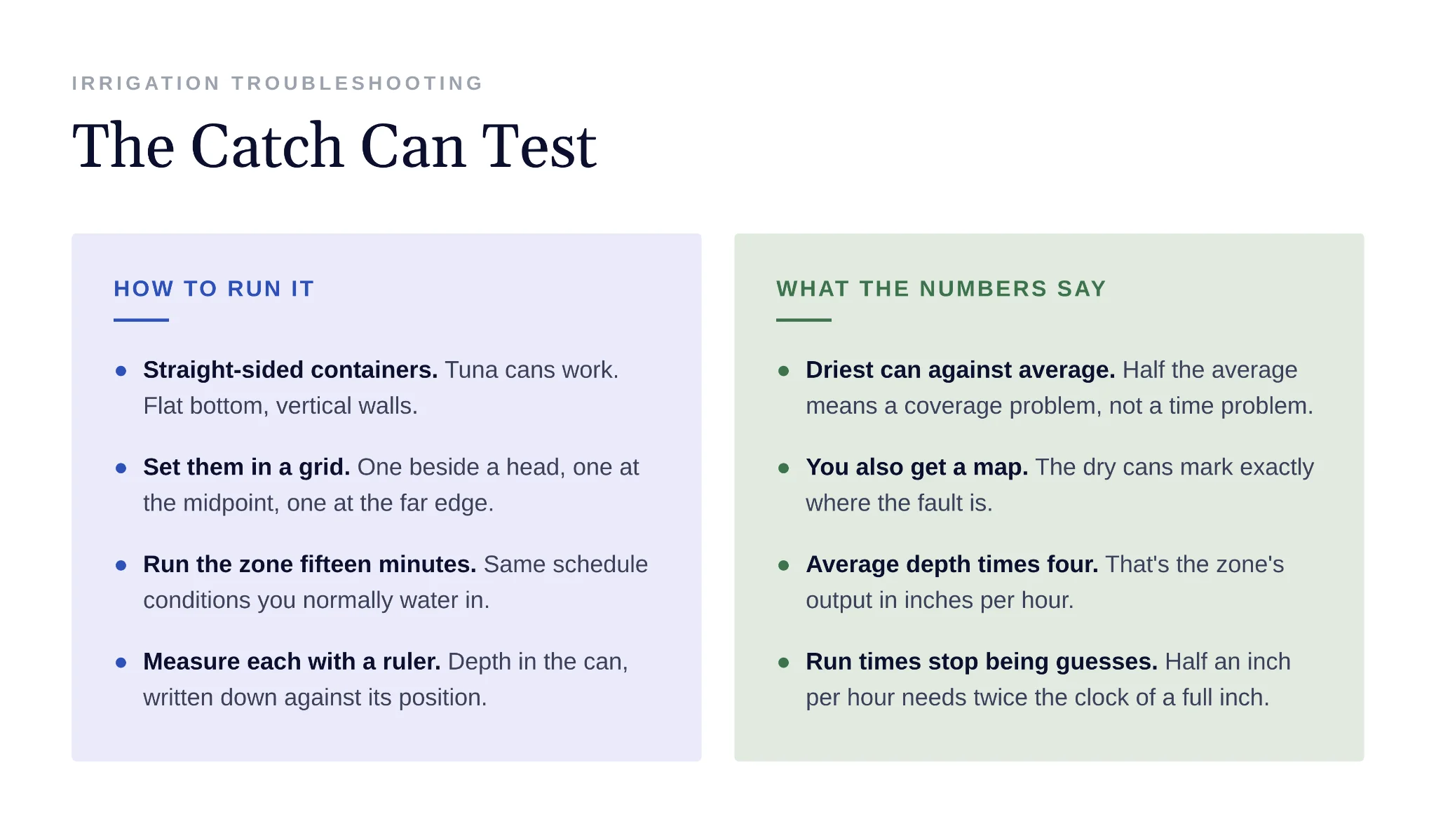
Two numbers come out of it.
The first is how evenly the zone waters. Compare the driest can to the average. If the low can holds half of what the average holds, this isn’t a run time problem, and you now have proof plus a map of the dry spots. That map is often the difference between replacing one nozzle and re-plumbing a section.
The second is how fast the zone puts water down. Multiply the average depth by four for inches per hour.
Once that’s known, run times stop being a guess. A zone putting down half an inch per hour needs twice the clock time of a zone putting down a full inch, and if every zone has been running the same twelve minutes because that’s what the previous owner set, this is where you find out why one of them has been starving for three years.
Twenty minutes of work. It answers more than anything else you can do without digging.
When The Soil Is The Problem
Sometimes the irrigation checks out and the grass still fails.
Push a long screwdriver into the middle of the bad area, then into a healthy zone. Easy in one place and dead stop in the other means compaction, and compacted soil can’t accept water fast enough to matter. Aeration fixes it, slowly.
Dig a plug six inches deep about twenty minutes after the zone finishes and look at the profile. Top inch wet, everything under it dry and dusty, means water isn’t moving down. That’s either a thick thatch layer holding it or soil gone water-repellent after drying out hard, which is common in sand and on south-facing slopes. Both are treatable, but not with the controller.
Other things living under a chronically bad patch: buried construction debris, an old walkway, a driveway edge radiating heat into the root zone, a maple that’s grown enough in ten years to take both the water and the light. The zone was designed for conditions that no longer exist.
Mixed Heads On One Line
If a zone has spray heads and rotors on it, stop diagnosing. That’s the answer.
Sprays put down water several times faster than rotors, so on the same clock, the spray section floods while the rotor section stays dry every cycle. It gets built this way when someone extends a lawn area and ties into the nearest line. Separate zones are the real fix. Converting the rotors to matched-rate nozzles is the cheaper one.
Run Time Comes Last
Adjust the schedule after the hardware is right. Otherwise, you’re tuning the clock around a defect and re-tuning it once the defect is gone. Once the hardware checks out, comparing weather-based and soil-moisture-based controllers can settle how the schedule should run.
Longer and less often beats short and daily. On slopes or heavy clay, split the total into two or three shorter cycles with a soak between them so the water goes into the soil instead of onto the sidewalk.
One thing to expect. When the cause finally turns up, whether it’s a half-open backflow valve or a nozzle somebody swapped in 2021, the grass doesn’t come back that afternoon. Give it two to three weeks of correct watering before deciding the fix didn’t work, and keep the cans in the garage.
If the system is old enough that you’re chasing a different fault every season,Aiper’s IrriSense 2 is worth a look before you commit to the repair. It’s a 4-in-1 unit that handles controller, sprinkler, valve, and nutrient feeding in one place, covers up to 4,800 square feet across 10 separately scheduled zones, and pauses itself when it rains.
Get more pool and lawn care guides from Aiper on Google