How to Winterize a Lawn (Including the Irrigation System)

Winterizing your lawn means preparing both the grass and irrigation system for freezing temperatures. The irrigation system needs attention first: water left in sprinkler lines can freeze, expand, and damage expensive components such as the backflow assembly.
The lawn is more forgiving. Turf preparation can usually take several weeks in the fall, but the irrigation system has a tighter deadline.
This guide covers when to shut down the irrigation system, how to prepare the lawn, and what to do before winter sets in.
Timing The Two Shutdowns
Look up the average first hard freeze for your area, meaning a night at 28 degrees or lower held for several hours, and treat that as the outside limit for anything involving water in a pipe. Aim to have the irrigation system drained one to two weeks before it.
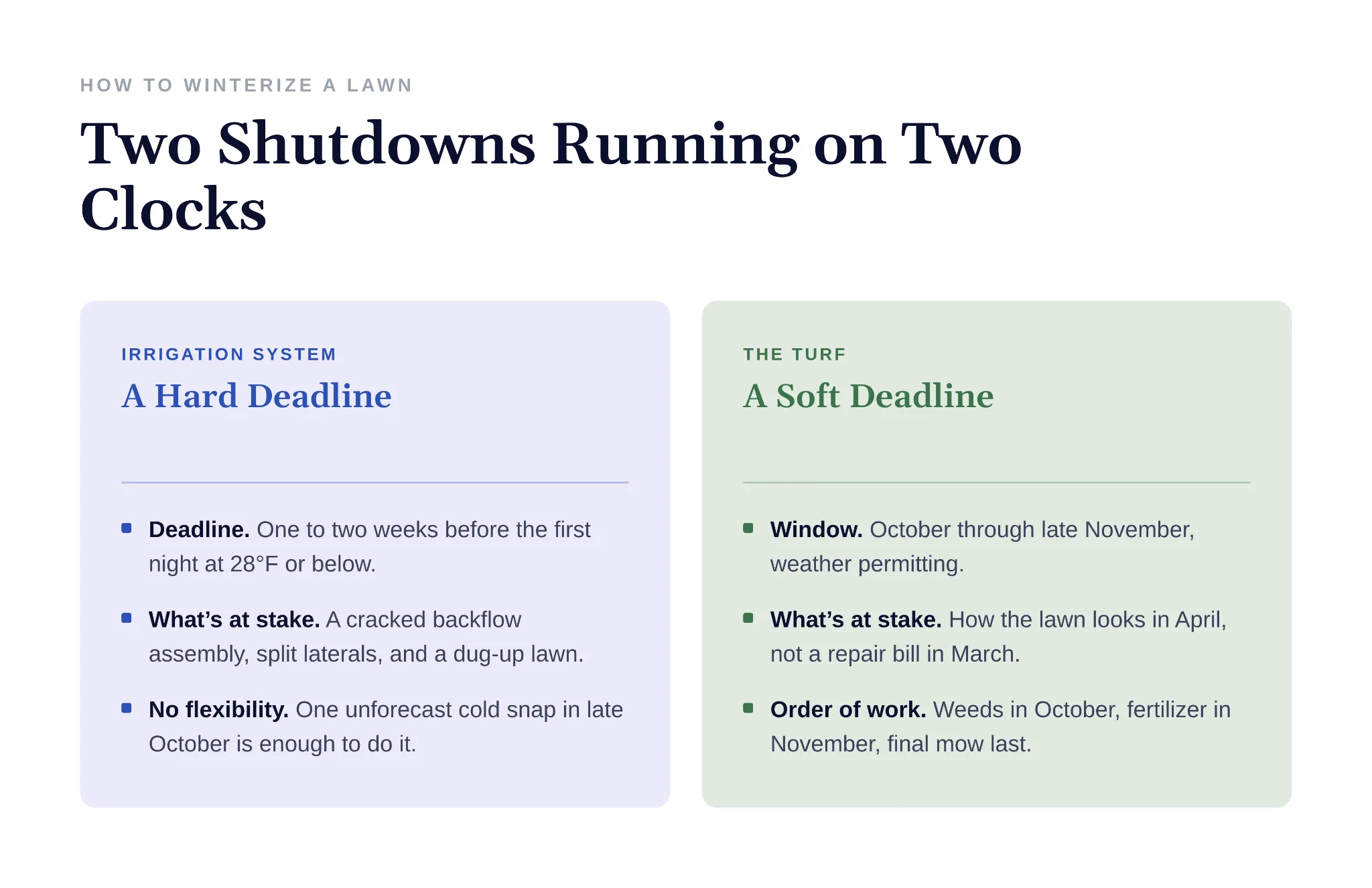
Turf work runs later. The last fertilizer application wants top growth to have stopped while the soil is still above 40 degrees, which, in most of the cool-season range, falls in the first three weeks of November.
The final mow comes after that.
One Last Pass At Weeds
If you’re doing anything about broadleaf weeds this year, October is when it pays off.
Dandelions, clover, and ground ivy are moving sugars down into their root systems ahead of winter, and a systemic herbicide travels with them.
One application on ground ivy in late October accomplishes what three summer sprays won’t.
Apply above 50 degrees and before a hard freeze. Once the plants stop translocating, you’re only wetting leaves.
If You Still Need To Aerate Or Overseed
Winterizing and aeration don’t happen in the same window.
Core aeration and overseeding need soil that’s still warm enough to drive germination, and that closes out by late September in most of the cool-season range, well before anything else in this guide.
If you missed it, don’t force it now: grass seeded in November won’t establish roots before the ground freezes, and it dies over winter instead of filling in.
Patch bare spots with a light mulch layer to protect the soil over winter, and plan the full pass for next fall.
See our guides to aeration and overseed for the complete process.
The Last Fertilizer Of The Year
This is the most valuable feeding you’ll do, and it’s the one most homeowners skip because the lawn has stopped looking like it needs anything.
When top growth ceases, but the soil hasn’t cooled below 40 degrees, the roots are still working while the leaves have gone quiet. Nitrogen applied in that window gets stored in the crown and root system instead of being spent on shoot growth, which produces an early, even green-up the following spring without the flush of soft tissue that spring fertilizing causes.
Timing matters more than product here. Go too early, while the lawn is still growing, and you push tender growth into freezing weather. Go too late, after the soil has cooled past the low forties, and the roots can’t take it up.
A bag labeled “Winterizer” isn’t a special formula. It’s a quick-release nitrogen fertilizer with a little extra potassium, usually in a ratio like 32-0-10 or 10-0-14.
The high nitrogen feeds the roots. The potassium helps the plant handle cold stress. The near-zero phosphorus is there because most established lawns don’t need more of it.
Look for a fast-release source such as urea or ammonium sulfate. Skip slow-release or organic products this late in the year, since the soil microbes that break those down are already shutting down for winter and won’t convert the nutrients in time.
Apply roughly 0.5 to 1 pound of actual nitrogen per 1,000 square feet, and water it in if rain isn’t in the forecast.
For the basics of reading a label and calculating your rate, see our guide to fertilize.
The Final Mow
The last cut of the year should land around two and a half to three inches. The reasoning is straightforward: grass left long over winter mats down under snow and stays wet against the soil for months, which is the condition snow mold needs, while grass cut too short loses the crown protection it needs and heaves in freeze-thaw cycles.
Step down gradually over the last two or three mows rather than dropping the deck all at once. Taking a four-inch lawn to two and a half in a single pass in November removes more leaf tissue than the plant can afford at a point when it can’t regrow.
Keep mowing until growth genuinely stops. Most people quit two or three weeks early, and the lawn keeps growing.
Leaves, Debris, And Everything Left Out
You can mulch leaves with the mower as long as the shredded material disappears into the canopy, and it returns real organic matter to the soil. The limit is visual. If you can still see grass after the pass, you’re fine. If there’s a brown layer sitting on top, you’ve exceeded what the lawn can absorb, and you need to bag or blow the rest.
The same applies to anything else left on the lawn over winter. Hoses, a forgotten kiddie pool, a stack of patio furniture, a tarp, a pile of firewood. Each one comes off in spring with a dead shape underneath that takes most of the season to fill in.
Shutting Down The Irrigation System
Start by shutting off the water supply to the system at the main irrigation valve, which is usually inside the house or in a valve box near the meter. Then set the controller to its off or rain position rather than unplugging it. Before spring, it’s worth comparing how weather-based and soil-moisture-based controllers decide when to water.
How you clear the water depends on how the system was built.
- If it has manual drain valves at the low points, open them along with the drain on the backflow assembly and let gravity do the work.
- If it has automatic drain valves, they’ll open on their own once pressure drops below about 10 psi.
- Most systems in freezing climates need a compressed air blow-out regardless.
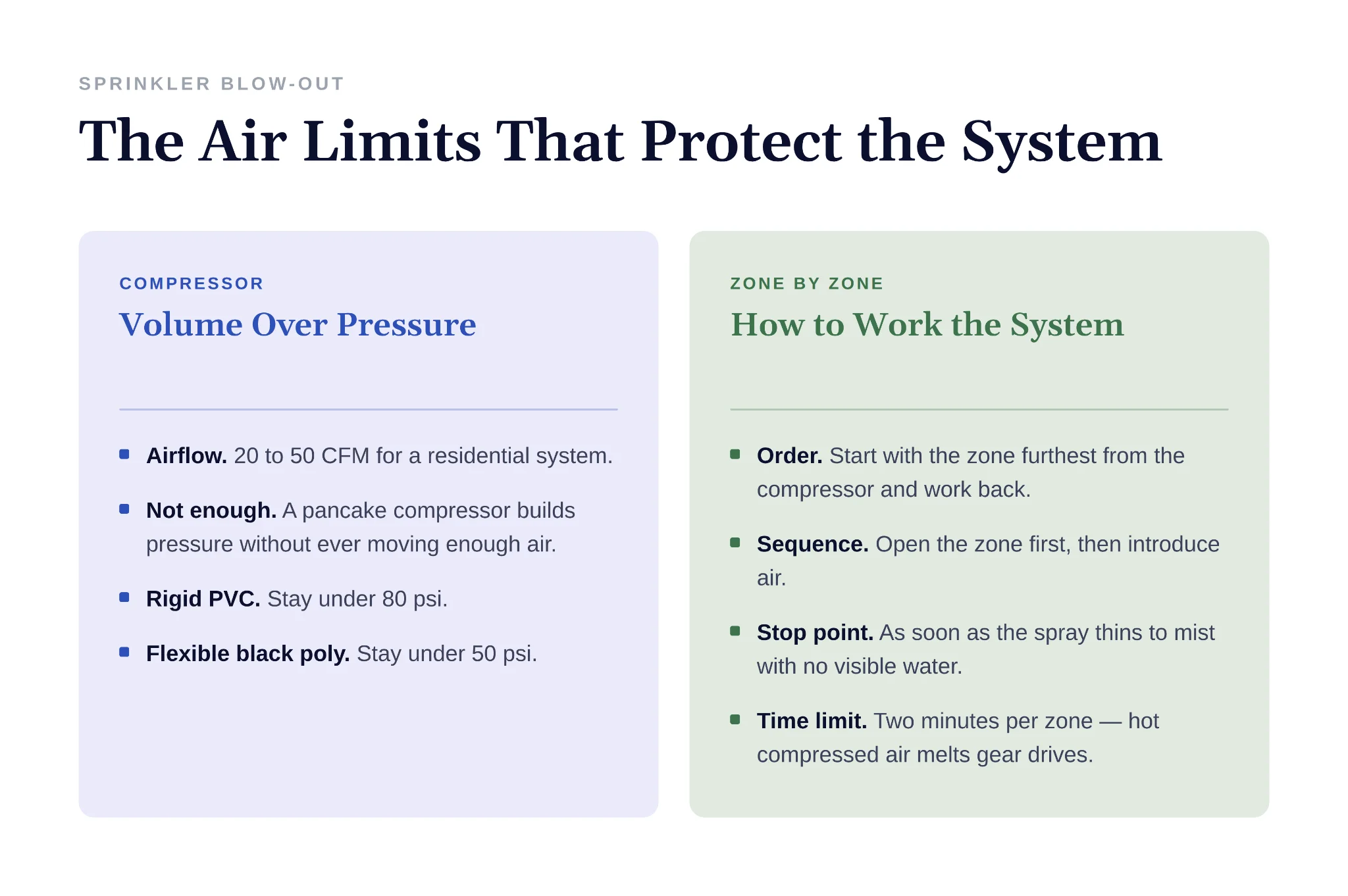
For a blow-out, airflow volume matters more than pressure. A residential system needs somewhere in the range of 20 to 50 CFM to actually push water out of the laterals, and the pancake compressor in your garage moves a fraction of that.
Pressure limits are not flexible:
- Stay under 80 psi on rigid PVC.
- Stay under 50 psi on flexible black poly.
Work one zone at a time:
- Start with the zone furthest from the compressor and move back toward it.
- Open the zone first, then introduce air.
- Stop as soon as the spray thins to a light mist with no visible water.
- Two minutes is an outside limit for any single zone.
Finish at the backflow preventer:
- Close both isolation valves.
- Then open the test cocks partway, leaving them at roughly 45 degrees so any water trapped in the assembly has somewhere to go.
- If it sits above ground, insulate it or remove the assembly entirely and store it indoors.
Drip zones need separate attention. Pull the filters and pressure regulators, drain them, and store them somewhere that doesn’t freeze.
If you don’t own a compressor big enough and don’t want to rent one, hire it out. A professional blow-out generally costs less than a single replacement backflow assembly. Whoever you hire, check what lawn care and maintenance mean on an invoice before agreeing to a scope.
None of the above applies to an above-ground system. The Aiper IrriSense 2 shuts down through the app: run Drainage Mode to clear residual water, unscrew the hose and the connectors at the water port, unplug the power supply, back the garden pegs out, and carry the unit indoors.
Hoses And Outdoor Spigots
Disconnect every hose from every spigot. A hose left attached traps water against the valve, and that will burst a frost-free sillcock even though the whole point of a frost-free sillcock is that it shouldn’t burst. This is one of the most common cold-weather plumbing failures, and it happens inside the wall.
Drain the hoses fully, coil them, and store them somewhere out of direct sun. If there are interior shutoff valves for the outdoor spigots, close them and then open the spigot outside to let the remaining water in the line drain.
Snow, Salt, And Traffic
Decide now where the shoveled snow is going, because it’ll be the same place all winter.
Salt is the reason for that dead strip along the driveway every spring. It isn’t cold damage. Sodium chloride pulls moisture out of roots and displaces calcium in the soil, and the grass in the splash zone dies while the lawn ten feet away is fine. Sweeping excess off the pavement before it melts helps, and so does switching to a calcium- or magnesium-based product near the turf edge or using plain grit where you only need traction. If a strip along the driveway is already showing damage, an application of gypsum helps flush the excess sodium out of the root zone faster than rain alone.
Keep traffic off frozen grass. Walking on turf when the crowns are frozen fractures them, and the damage doesn’t appear until March. If you need a route across the lawn, put down boards or a mat.
Voles work under snow cover, and if you get long-lasting snow, you may find surface tunnels in spring. Keeping the lawn cut short in late fall and pulling mulch back from the base of trees and beds gives them less to hide in.
Snow Mold
Two versions show up on cool-season lawns:
- Gray snow mold needs extended snow cover, generally more than a month, and appears as matted straw-colored circles when the snow pulls back.
- Pink snow mold doesn’t need snow at all and can develop through any cool, wet, extended period, showing a faint pink or salmon cast at the edges of the patch.
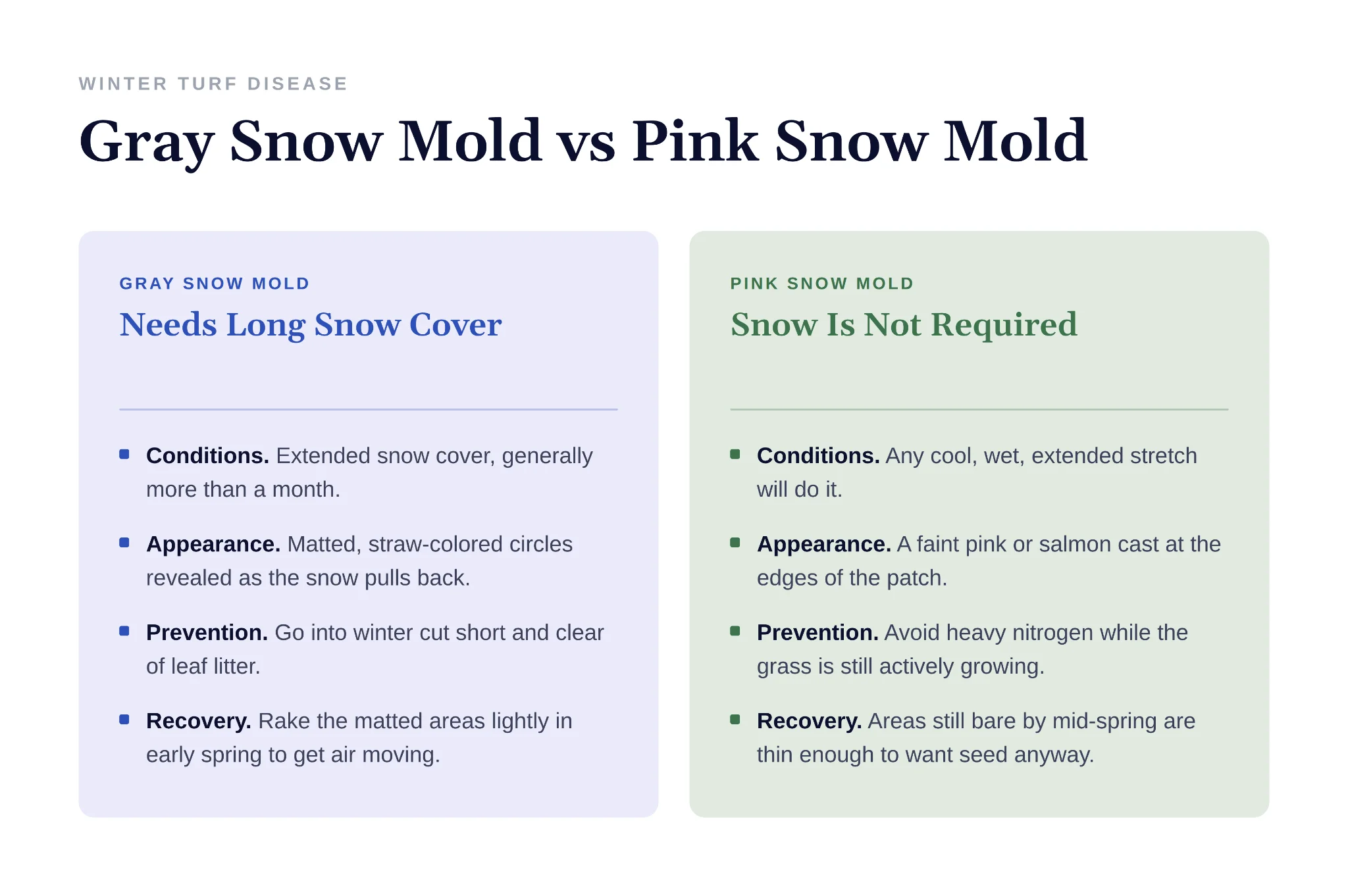
Almost everything that prevents it happens before winter. Mow late enough that the lawn goes into snow cover, avoid a heavy nitrogen application while the grass is still actively growing, clear the leaf litter, and don’t pile snow in the same spot on the lawn all season if you can help it.
When it does appear, rake the matted areas lightly in early spring to break up the crust and get air moving. Most home lawns grow out of it without a fungicide, and the areas that don’t recover by mid-spring are usually thin enough to want seed anyway.
Frequently Asked Questions
Not strictly. A lawn with no fall attention still greens up on its own in spring, just slower and thinner. The fall fertilizer application and final mow make the difference between an early, dense green-up and an average one. Skipping them doesn’t kill the lawn. It just leaves recovery to chance.
If your ground never freezes solidly enough to burst a pipe, you can skip the compressed-air blow-out. Just drain what you can through the low-point valves instead. Check your local frost depth data before deciding: a few nights in the high 20s isn’t the same as a hard freeze that holds for hours.
No. By the time top growth stops for fertilizing, soil is too cold for seed to germinate. Aerating a dormant lawn does less good too, since the point of aeration is to let an active root system use the loosened soil. Wait for next fall.
Most home lawns recover from snow mold without one. Consider it only if you get extended snow cover of a month or more every year, and have had a bad outbreak before. In that case, a preventive application of propiconazole before the first snow is the standard approach.
Get more pool and lawn care guides from Aiper on Google