Why You Get Brown Spots on Your Lawn (and How to Fix Each Type)

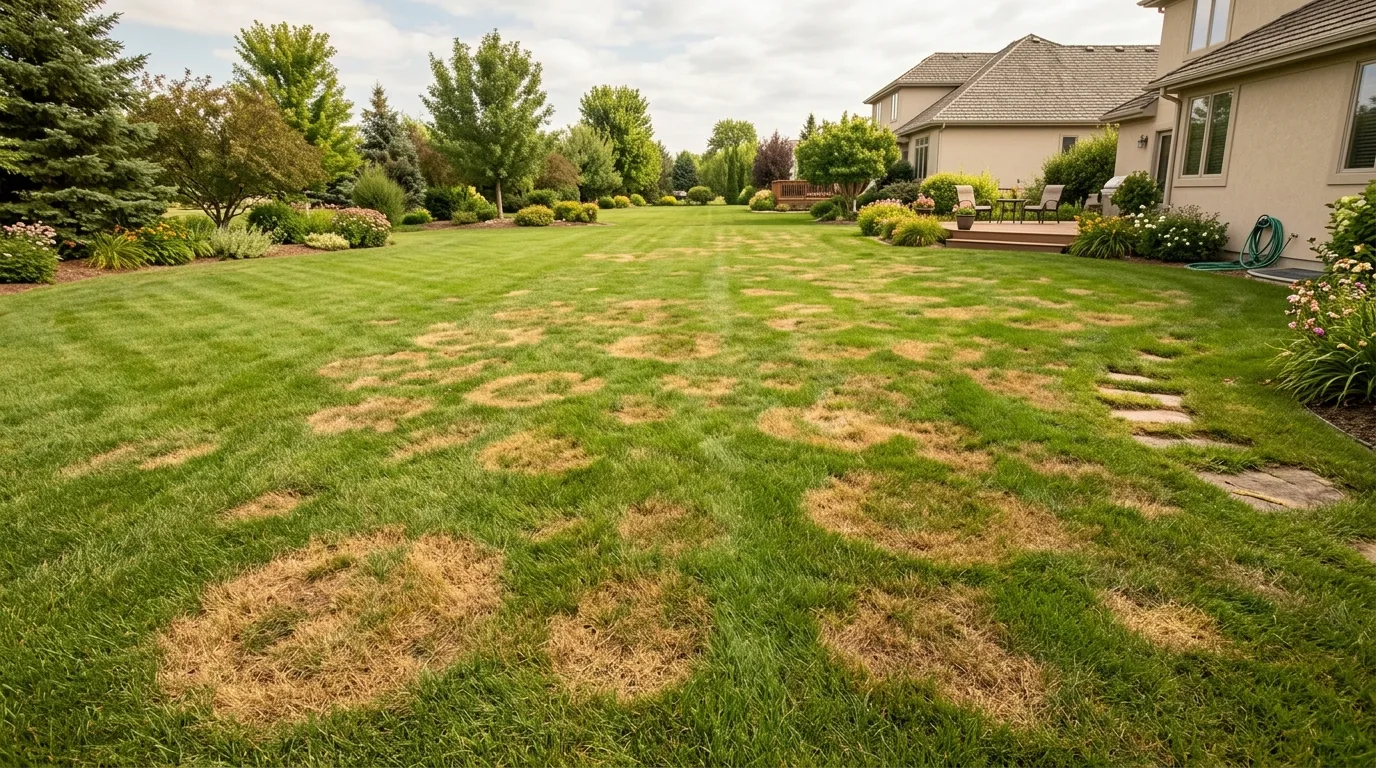
Almost everybody diagnoses a brown spot by its color, and color is the least useful thing about it.
Dead grass is dead grass. What actually tells you what happened is the shape of the edge, whether the patch is spreading, whether the grass pulls up or holds, and where on the property it decided to appear.
Geometry is the fastest read. Straight lines and sharp corners mean a person or a machine did it. Circles mean fungus. A patch creeping outward from the hottest strip along the driveway in July means insects. Irregular blotches with a ring of unusually dark green around them mean the dog.
The Pull Test: Grubs, Disease, or Drought
Grab a handful at the edge of the patch, where dying meets living, and pull steadily.
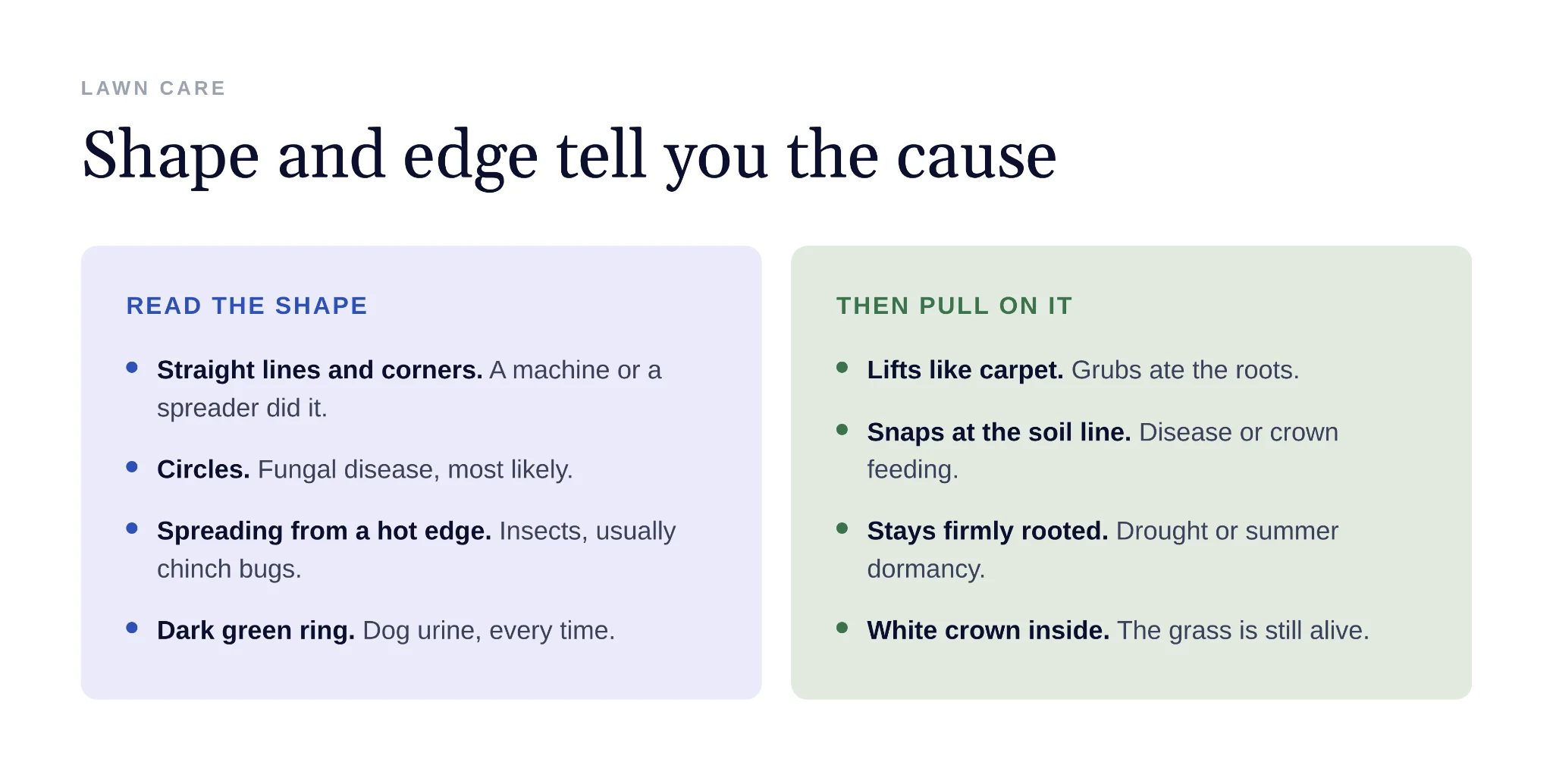
If the turf lifts away in a sheet with no root system attached, like peeling back a rug, you have grubs, and you can stop looking.
If the blades snap off at the soil line but the roots stay anchored, you’re looking at a disease or something feeding at the crown. If it’s brown and still firmly rooted and you have to work at it, the grass is either drought-stressed, dormant, or heat-damaged, and there’s a decent chance it isn’t dead at all.
That last case is worth a second before you order sod.
Split a few crowns open at the base. White and firm means alive. Cool-season lawns go dormant in serious heat as a survival strategy, and a lawn that looks catastrophic in mid-August can come back green in October with nothing done to it except a half inch of water every couple of weeks to keep the crowns from desiccating.
Dog Urine: Dead Center, Dark Green Ring
Distinct pattern, and once you know it, you can’t unsee it: dead center, ring of aggressively dark green around the outside.
That ring is the giveaway. Urine is essentially concentrated nitrogen plus salts. In the middle of the spot, the load is high enough to burn; at the diluted margins it acts as fertilizer. Nothing else on this list produces that combination.
The fix is water and timing, not chemistry. A hose or a full watering can dumped on the spot within a few hours of the dog using it dilutes the salt load before it does real damage. That’s tedious, and most people won’t do it consistently, so the realistic version is a designated area, or accepting the reseeding. If the dog is the cause, this guide to keeping dogs off your lawn, yours or the neighbor’s covers barriers and deterrents.
Rake out the dead material, loosen the top half inch, and reseed. It fills in.
Fertilizer Burn: Straight Edges and Spreader Stripes
Look at the edges. If they’re crisp, if the patch has a corner, if it repeats in parallel stripes across the yard at roughly the width of a spreader pass, you fertilized badly.
Overlapping stripes mean the passes doubled up. A perfect rectangle means the spreader sat open on the grass while somebody went to answer the door. A wandering trail means the hopper leaked.
Flush it. Heavy water, repeatedly, for several days, to move the salts down past the root zone. Do it early, within a day or two, and a lot of it recovers. Wait a week, and you’re reseeding.
Lawn Disease: Fix Your Watering Time, Then Identify the Patch
This is where the real money gets wasted, because people buy fungicide for problems that were caused by a sprinkler timer.
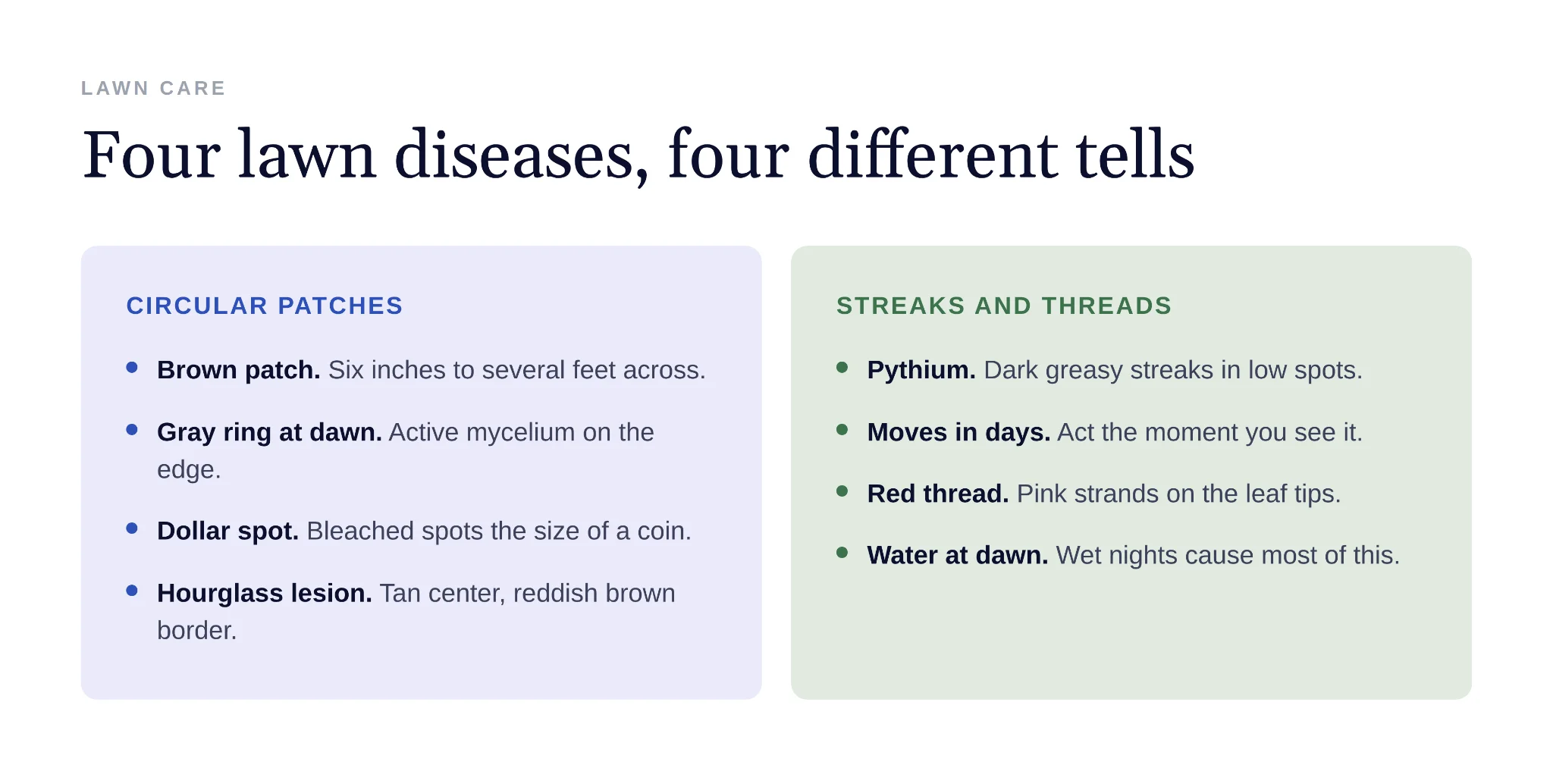
Identifying which disease matters, because they’re not treated identically:
Brown patch shows up as roughly circular areas anywhere from six inches to several feet across, usually in tall fescue, usually when nighttime lows stay above about 68°F with humidity. Excess nitrogen makes it dramatically worse, so this is not the moment to fertilize.
Dollar spot is the opposite nutritionally. Small bleached spots about the size of a coin, sometimes merging into larger areas. It’s associated with low nitrogen and heavy dew. A light feeding often does more than a spray.
Pythium doesn’t look circular. It looks like dark, greasy, water-soaked streaks that follow drainage paths and low spots, and it moves fast enough to take out large areas in a couple of days in hot, saturated weather.
Red thread puts fine pinkish-red strands on the leaf tips. It looks alarming, and it’s the least serious thing here. It’s a nitrogen deficiency signal more than a disease emergency, and it rarely kills the crown. See our full guide to treating red thread disease safely for a step-by-step diagnosis.
The single cheapest fix here is moving irrigation to somewhere between 4 and 8 in the morning, so the grass dries as the sun comes up instead of sitting wet until midnight. The Aiper IrriSense 2 handles that scheduling from soil moisture data rather than a fixed timer, which also keeps you from watering the day after a storm.
Grubs: Why the Timing of Treatment Decides the Outcome
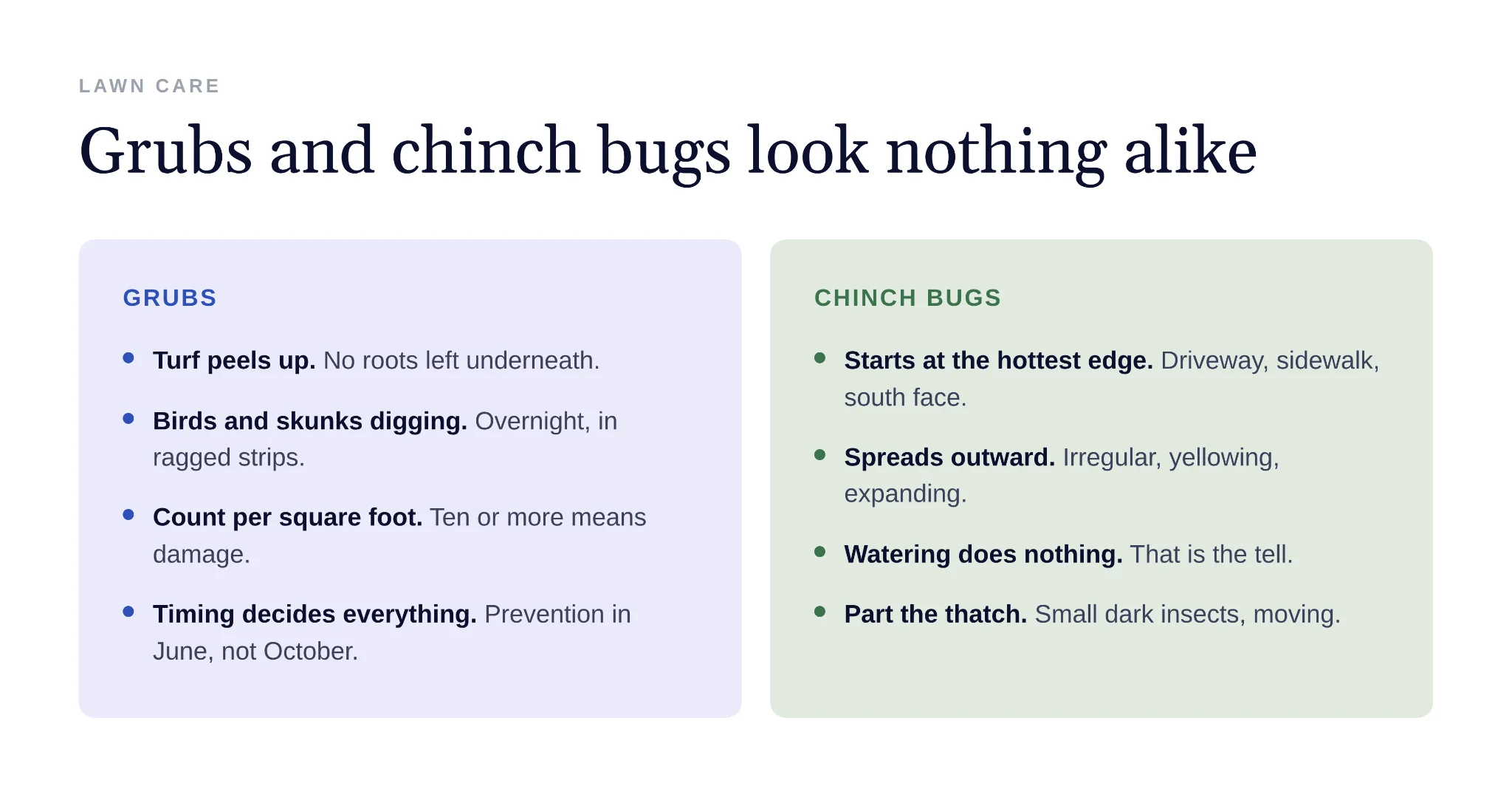
Grub damage is easy to spot once you know what to look for. Turf that peels up in a sheet. Birds tearing at the lawn, or skunks and raccoons digging it up overnight in ragged strips. Areas that stay wilted no matter how much you water, because there are no roots left to take the water up.
Peel back a square foot and count. Under five per square foot in a healthy lawn is generally tolerable. Ten or more and you’re seeing damage.
Here’s the part that trips everyone up, and it’s about timing rather than product.
So: noticed damage in late summer, treat curatively right away and water it in heavily. Noticed damage in October, you’ve largely missed the window, and the real move is to repair the turf now and mark next June on the calendar for prevention.
Chinch Bugs: Damage That Spreads From the Hottest Edge
Chinch bug damage has a different pattern entirely, and it’s often confused with drought because it looks exactly like drought at first.
Irregular yellowing that expands outward, starting in the hottest, driest, sunniest areas: along the driveway apron, the strip beside the sidewalk, the south-facing edge. It doesn’t respond to watering, which is the tell.
Part the grass at the boundary between green and damaged and look at the thatch line for small dark insects moving.
Same Spot Every July: Check for Buried Debris and Shallow Soil
Not a disease. Not an insect. Almost always something under it.
A buried slab of construction debris. A boulder. The gravel apron of the driveway extending further than anyone remembers. Six inches of soil over hardpan.
Push a long screwdriver into the ground inside the patch and then into healthy turf ten feet away and compare. If it goes eight inches in one place and stops at three in the other, that’s your answer, and no amount of watering fixes shallow soil in a heat wave.
Either dig it out and backfill properly, or accept that this section needs its own irrigation schedule, or plant something there that isn’t turf.
How to Repair the Area Once You Know the Cause
Repairing before diagnosing is how the same patch comes back in the same place the following year with fresh seed in it.
Reseeding into ground that still has grubs feeds the grubs. Fungicide on a scalped ridge does nothing at all.
If the pattern looks fungal rather than mechanical, our guide on identifying and treating the most common lawn fungus walks through the next steps.
Figure out which one you have, deal with the cause, then rake out the dead material, break the surface, seed or plug with the same grass type you already have, and keep the top layer damp until it establishes. Late summer into early fall is the window for cool-season repair. Late spring for warm-season.
Get more pool and lawn care guides from Aiper on Google