The BBB Pool Method Explained: Bleach, Baking Soda, and Borax

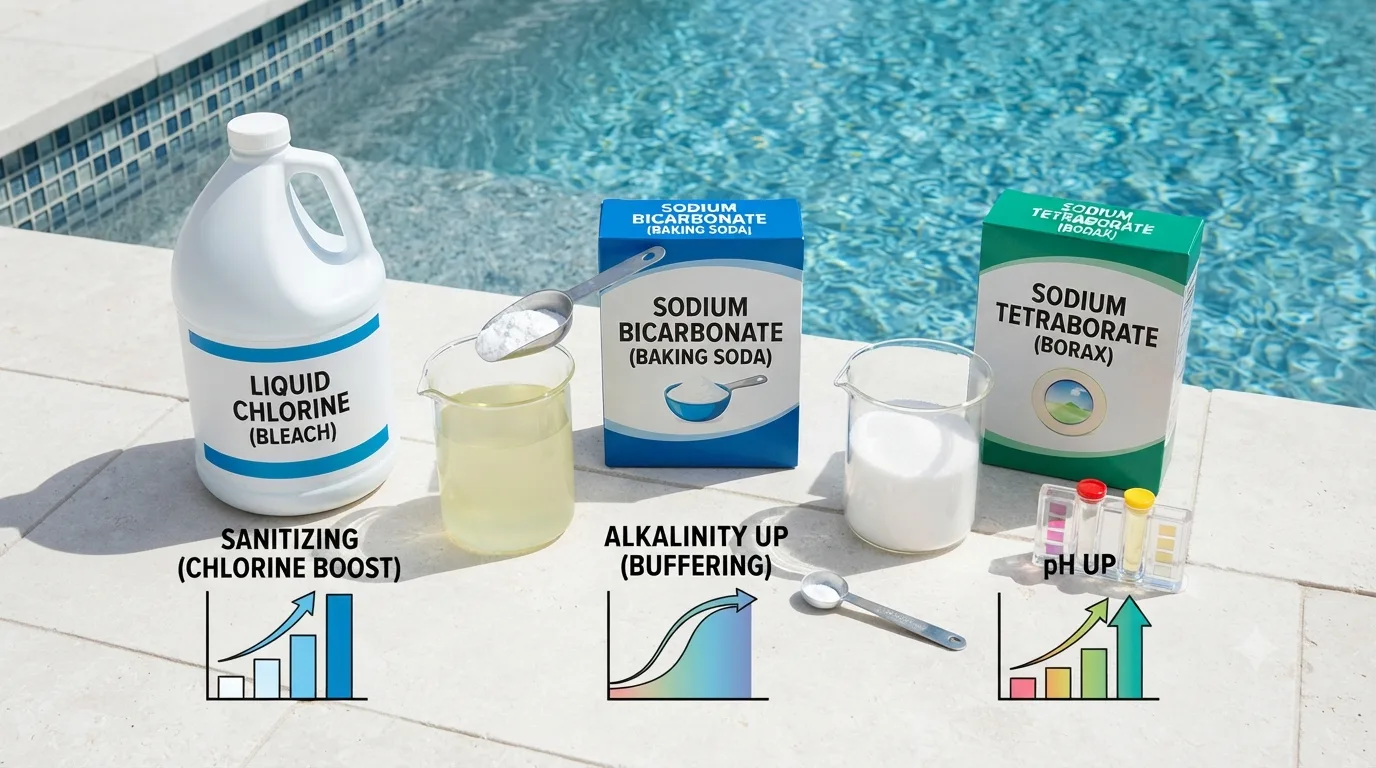
The BBB pool method’s biggest point of confusion isn’t what the acronym stands for — it’s how much of each ingredient to actually add. That confusion over quantities is the single biggest reason first-time BBB users either under-dose and get cloudy water, or over-dose and swing their chemistry the other way. The short version: one gallon of 6% bleach per 10,000 gallons raises chlorine about 6 ppm, 1.5 pounds of baking soda per 10,000 gallons raises alkalinity about 10 ppm, and 20 ounces of borax per 5,000 gallons raises pH by roughly 0.2 — dosed separately and tested between steps, not all at once. The full breakdown, including when BBB doesn’t apply, is below. It complements the stabilizer side of pool chemistry too, covered in our guide to cyanuric acid, since BBB doesn’t include a CYA component on its own.
BBB is a pool chemistry system built around three supermarket ingredients: bleach, baking soda, and borax. Each one replaces a specific branded pool chemical, and each one has a precise, testable dosing rate — not a guess.
What Does BBB Stand For in Pool Care?
BBB stands for Bleach, Baking Soda, and Borax. Bleach is the sanitizer, replacing liquid chlorine or chlorine tablets — and either way, the residue it leaves in swimmers’ hair is worth understanding, starting with how long chlorine can stay in hair. Baking soda raises total alkalinity, replacing commercial alkalinity increaser. Borax raises pH and adds a small buffering and algae-inhibiting effect, replacing pH increaser.
A 5-pound box of baking soda costs around $3. The commercial alkalinity increaser it replaces costs closer to $15 for the same effective dose — the core reason pool owners switch to BBB in the first place.
What Do Baking Soda and Borax Actually Do for a Pool?
Baking soda (sodium bicarbonate) dissolves and raises total alkalinity (TA) without moving pH much on its own. TA acts as a buffer that keeps pH from swinging every time you add chlorine. Borax (sodium tetraborate) raises pH directly and contributes its own separate buffering reserve, distinct from TA — which is why BBB routines use the two ingredients for two different jobs rather than interchangeably.
Bleach itself is a solution of sodium hypochlorite, the same active compound sold as liquid pool chlorine. Unscented, additive-free bleach at 6% to 8.25% concentration is chemically equivalent to what’s on a pool store shelf at a markup. If you’re weighing halogen options, a bromine vs chlorine comparison for pools explains where each one fits.
How Much Bleach, Baking Soda, and Borax Do You Actually Need?
These are the dosing rates that make BBB workable without guesswork:
| Ingredient | Dose | Effect | Target Range |
|---|---|---|---|
| Bleach (6%) | 1 gallon per 10,000 gallons | Raises free chlorine (FC) ~6 ppm | FC 2-4 ppm daily; higher for shock treatment |
| Baking soda | 1.5 lbs per 10,000 gallons | Raises total alkalinity ~10 ppm | TA 80-120 ppm |
| Borax | 20 oz per 5,000 gallons | Raises pH ~0.2 | pH 7.2-7.8 |
Add borax in small increments and retest rather than dosing the full amount at once.
Cyanuric acid (CYA) isn’t part of BBB itself but has to be tracked separately, since unstabilized chlorine burns off quickly in sunlight. Keep CYA in the 30-50 ppm range.
Can You Shock a Pool and Add Baking Soda at the Same Time?
Yes. Shocking a pool (a large dose of chlorine) and adding baking soda address two different parameters — sanitizer level and total alkalinity — and don’t chemically interfere with each other. The only practical caution is testing both FC and TA before combining doses, since a pool that’s already low on alkalinity and gets shocked without a baking soda correction can see more pH drift than usual over the following day.
What Problems Come Up With the BBB Method (and How Do You Fix Them)?
Cloudy water usually means free chlorine is too low relative to CYA — retest FC and dose bleach to bring it back into range before assuming a filtration problem.
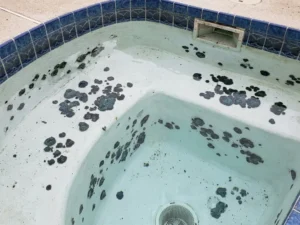
Algae growth signals insufficient sustained chlorine, not a BBB-specific failure — a shock dose of bleach followed by consistent daily FC maintenance clears it.
pH swings that won’t settle almost always trace back to low total alkalinity. Fix TA with baking soda first; pH stabilizes once the buffer is in place.
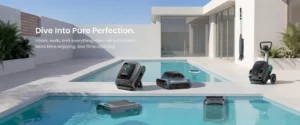
Time-consuming cleaning isn’t a chemistry problem at all — it’s a circulation and debris problem, and it’s the one BBB issue that a robotic pool cleaner solves directly rather than through a chemical adjustment.
Does the BBB Method Work With Salt Water Pools?
Salt water pools generate their own chlorine through electrolysis, so the bleach component of BBB is unnecessary in normal operation. Baking soda and borax still apply directly, since salt systems need the same alkalinity and pH management as any other pool. Owners often keep bleach on hand anyway as a manual chlorine boost if the salt cell needs servicing or algae outpaces what the cell produces.
Frequently Asked Questions
Do you need special “pool-grade” borax, or does regular laundry borax work?
Plain 20 Mule Team-style laundry borax (sodium tetraborate decahydrate) is the same compound sold as pool pH increaser — the only thing to avoid is a scented or additive version marketed for laundry use.
Does BBB work in a vinyl-liner or fiberglass pool, or only plaster and gunite?
Yes. None of the three BBB ingredients affect calcium hardness, so vinyl-liner and fiberglass pools handle bleach, baking soda, and borax the same as plaster pools. The only caution applies to cal-hypo shock, not bleach, since concentrated cal-hypo granules can bleach a liner on direct contact.
What if pH overshoots after adding borax?
Borax’s own buffering reserve resists drifting back down on its own, so an overshoot above 7.8 needs a small dose of dry acid (sodium bisulfate) rather than waiting it out. Retest a few hours after dosing before adding more.
Keeping the pool clean between chemistry adjustments reduces how much chlorine demand you’re fighting in the first place. An Aiper robotic pool cleaner handles the debris removal side of BBB maintenance automatically.
Get more pool and lawn care guides from Aiper on Google