

Every one of these has to clear the same bar, and it’s worth naming before getting into them.
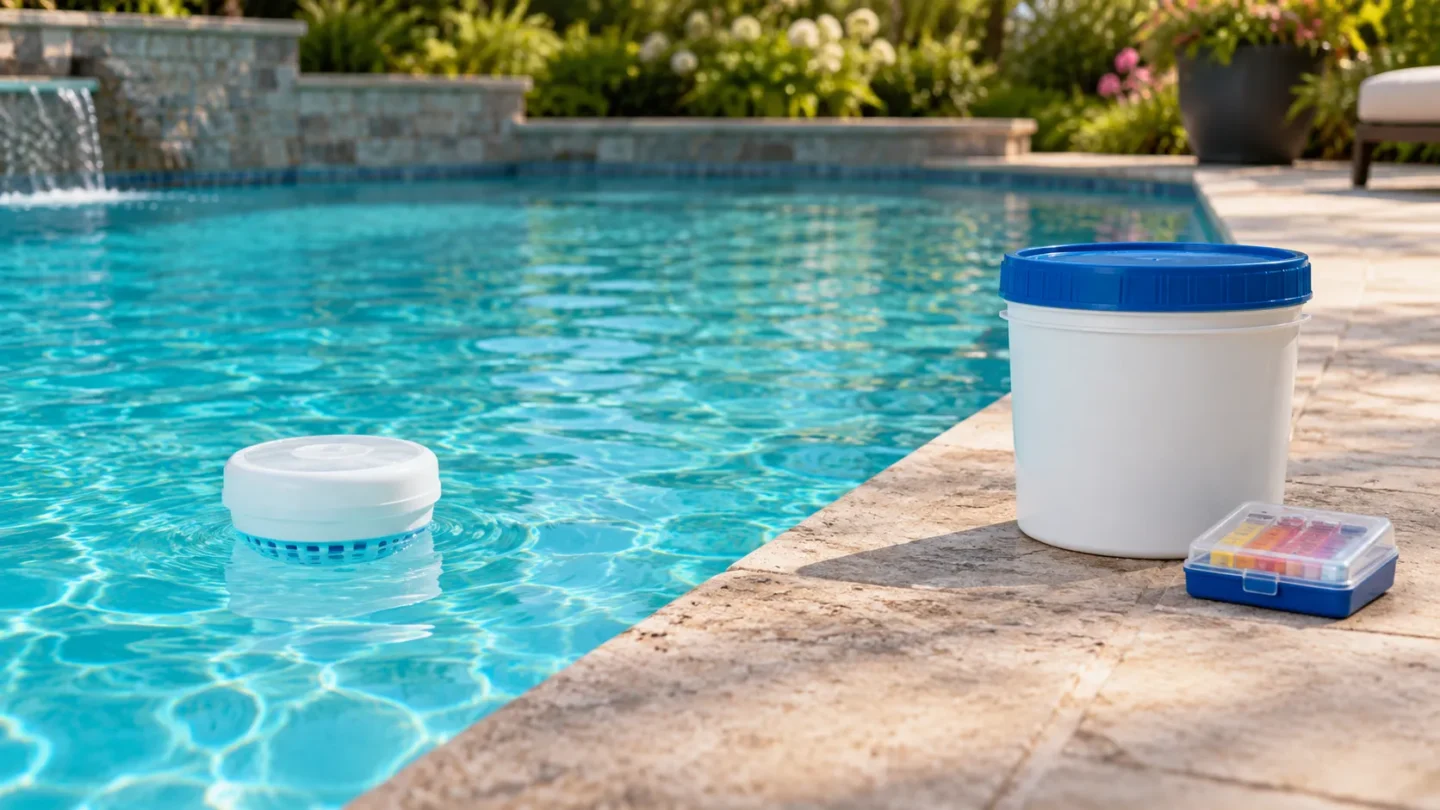
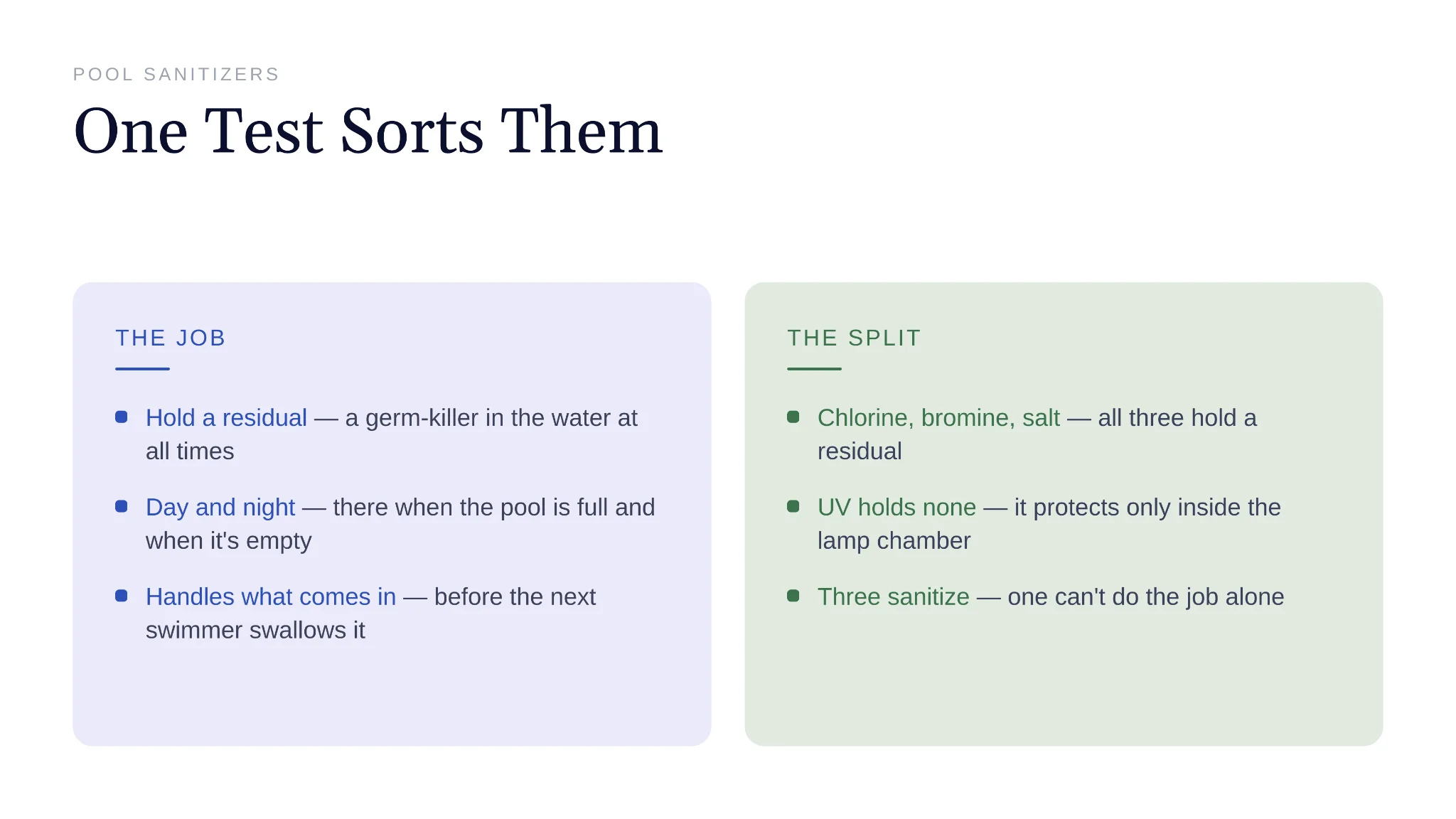
A sanitizer keeps a germ-killing agent sitting in the water at all times, a measurable residual, there at three in the afternoon when the pool’s full and there at midnight when it’s empty, so that whatever the next swimmer tracks in gets handled before anyone swallows it.
For an individual water-chemistry adjustment, the Pool Chemical Calculator lets you select a parameter and estimate its dose from your pool volume and test readings.
Three of the four options clear that bar.
The fourth doesn’t, and most of the confusion in this whole debate comes from not seeing which is which.
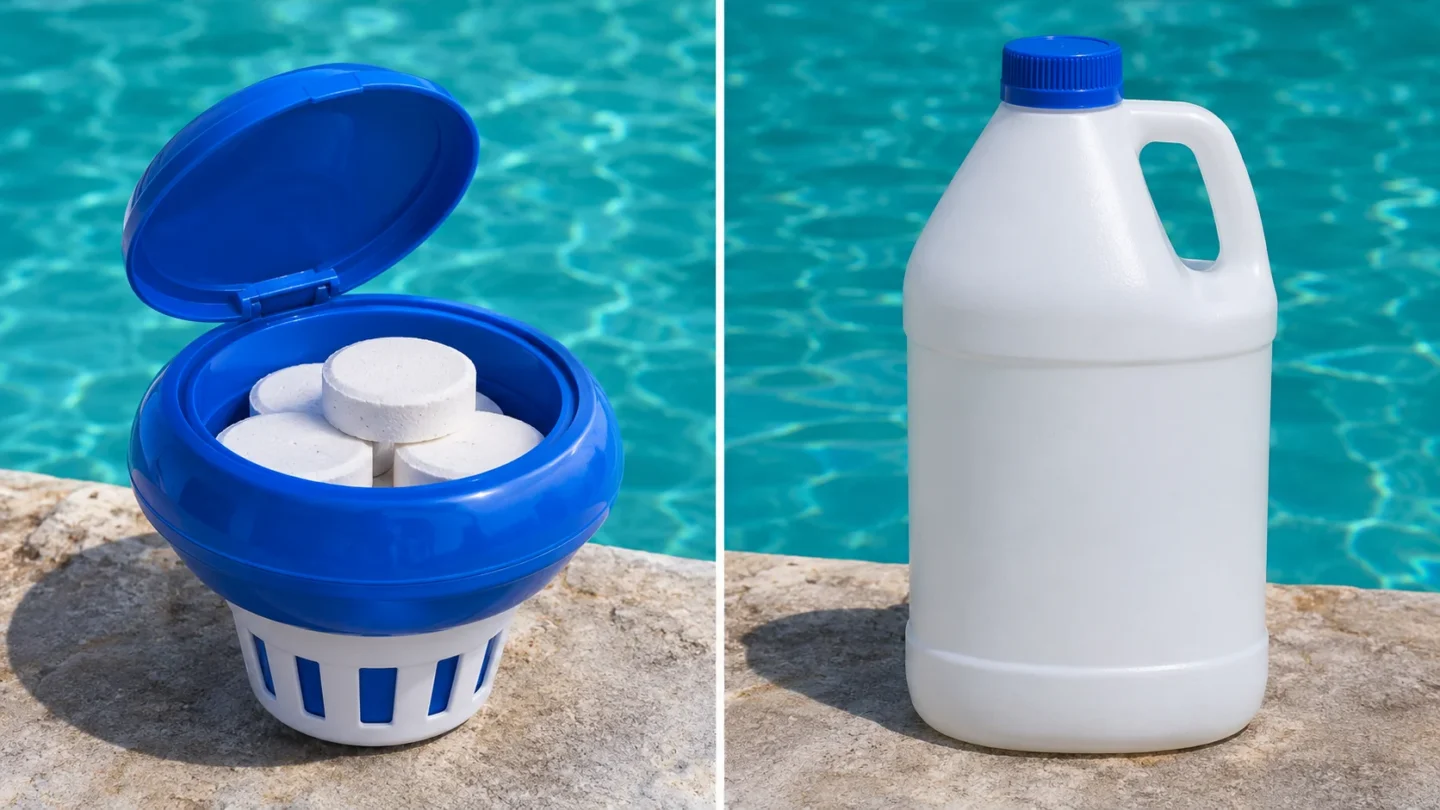
Chlorine
When you dissolve chlorine in water, it splits into two forms: hypochlorous acid, which is the fast, effective killer, and a second, sluggish form that works a fraction as hard.
What decides the split between them is pH, and that’s the part a lot of owners never connect.
Let the pH climb and the chlorine slides over to the weak form, so a pool can show a perfectly respectable chlorine number on the test strip and still be doing a mediocre job of disinfecting, purely because nobody watched the pH.
Chlorine kills much better below pH 7.8 than above. Hold the water in the 7.2 to 7.8 range the CDC calls for with free chlorine at 1 ppm or better, and most of what gets into a pool is dead within minutes.
There’s one bug chlorine won’t catch. Cryptosporidium, a parasite that comes in through fecal contamination and causes most of the outbreaks linked to pools, shrugs off chlorine at the levels any backyard pool runs and lasts for days in the water.
Normal chlorination simply doesn’t reach it. Hold that thought, because it’s the one reason UV has any claim to a place here.
Bromine and Salt Are Both Chlorine’s Relatives
Neither of these is a departure from chlorine so much as a variation on it, which is why they don’t each need their own long treatment.
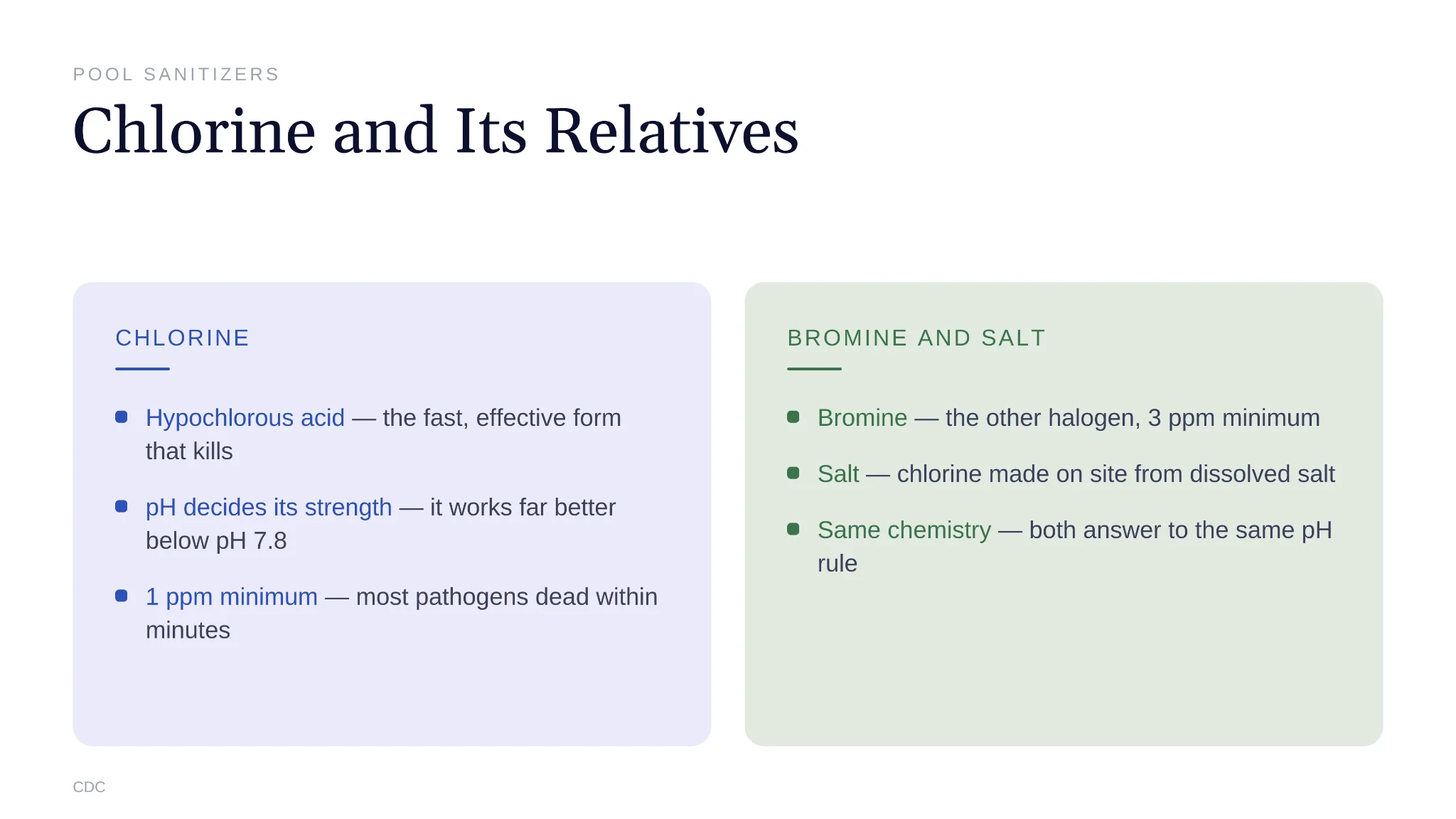
Bromine is the other halogen. Same idea: a residual held in the water, disinfecting around the clock, but with two practical differences: the target level runs higher, since the CDC minimum is 3 ppm against chlorine’s 1, and it rides out pH swings better.
On a backyard pool, it usually costs more than chlorine and buys nothing decisive for the money, so it tends to stay on spas.
Salt is chlorine wearing a different label. A cell plumbed into the line runs current through the water and makes chlorine out of the dissolved salt, on the spot, all day, instead of chlorine showing up in a bucket.
The water ends up with the same hypochlorous acid in it, answering to the same pH rule as any other chlorine pool. What people are really buying is the convenience: no tablets to handle, steadier levels, water that feels softer on the skin, paid for with the generator up front and a cell that wears out and needs replacing every few years.
UV
Here’s where the residual bar earns its keep. A UV unit sits in the return plumbing and blasts the water with ultraviolet light as it flows past the lamp, wrecking the organisms caught in the beam, and that includes the Cryptosporidium chlorine can’t deal with. That’s a real capability, and it’s the whole reason UV belongs in the conversation.
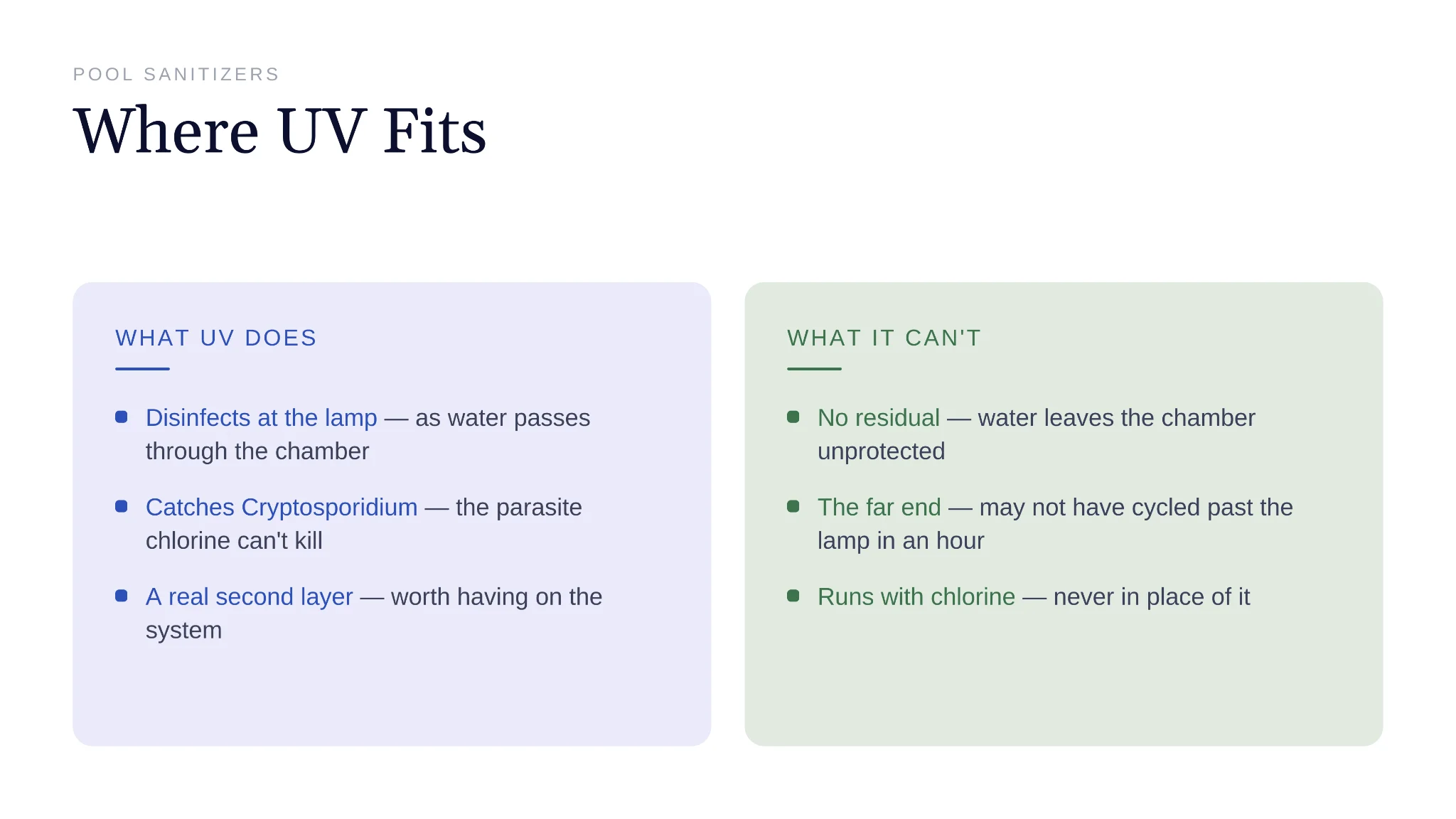
The limit is just as real. Whatever gets disinfected, gets disinfected inside that chamber and nowhere else.
Water leaves the lamp carrying no protection at all, and the swimmer down at the shallow end is sitting in water that might not have passed the bulb in an hour. Nothing is left behind in the pool to handle what lands in it between trips through the plumbing.
That makes UV a second layer rather than a sanitizer. It runs with chlorine or bromine, closing the one gap they leave, while the halogen does the standing job of keeping the whole body of water covered. A UV system sold as the way to quit chlorine is a system with no residual, as if that didn’t matter.
For routine free-chlorine adjustment, use the Pool Chlorine Calculator with your pool volume, test reading and product concentration to estimate how much to add.
| Method | What it is | Holds a residual | Standalone sanitizer |
|---|---|---|---|
| Chlorine | Halogen; hypochlorous acid in water | Yes | Yes |
| Bromine | The other halogen; higher ppm target | Yes | Yes |
| Salt | Chlorine generated on site from salt | Yes (it is chlorine) | Yes |
| UV | Light that disinfects water passing the lamp | No | No — runs with chlorine or bromine |
Keep the Demand Down
Whatever’s sanitizing the water loses ground fast when the pool itself is filthy.
Leaves breaking down on the floor and a film of biofilm creeping across the walls both feed on the disinfectant, pulling chlorine or bromine out of solution and burning through the residual quicker, which turns into more product added more often just to hold the same reading.
Less grime, less demand. Keeping the floor and walls clear of settled debris is the cheapest way to stretch whatever chemistry is in the water, and it’s the kind of repetitive job a robot is built for.
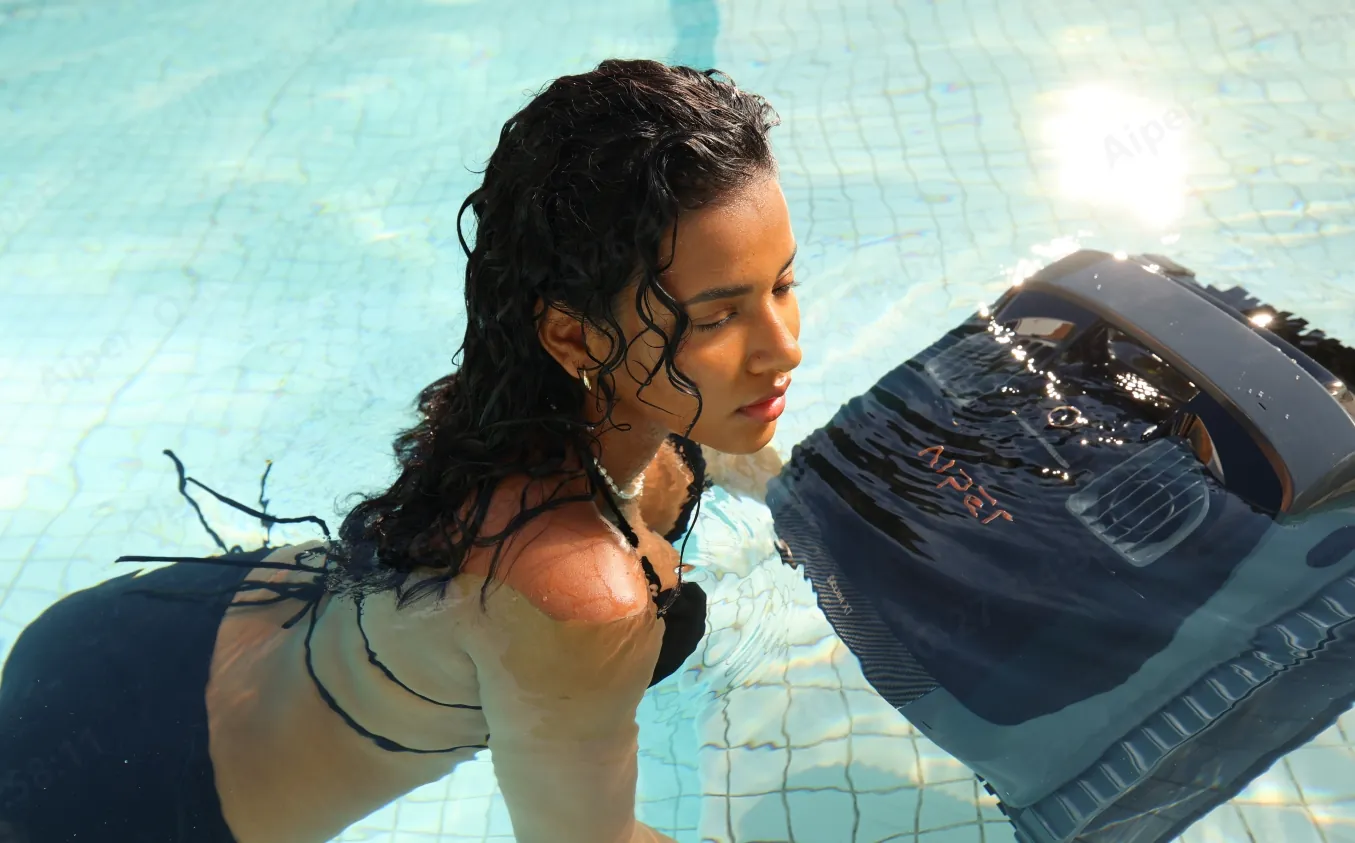
An Aiper robotic pool cleaner scrubs the surfaces and clears the debris that would otherwise sit there consuming chlorine, running off its own power so it never touches the circulation pump. Sanitizing the water isn’t its job, and no cleaner does that.
If CYA is low rather than high, the Pool Stabilizer Calculator estimates how much stabilizer to add. Adding stabilizer will not correct excessive CYA.
Get more pool and lawn care guides from Aiper on Google