Bromine vs Chlorine: When Bromine Actually Makes Sense

Bromine is better than chlorine at several specific things, and one of its weaknesses is severe enough to disqualify it outright for most residential pools in the country.
What matters is which set of conditions you actually have: roof or no roof, water temperature, pH behavior, bather load, and then the answer follows without much argument.
Get that ordering wrong and the result is a pool that costs three times what it should to sanitize and never holds a reading.
What Each One Does in the Water
Both are halogens, and both work the same way at the chemical level. Chlorine added to water forms hypochlorous acid. Bromine forms hypobromous acid. Each one kills bacteria and oxidizes organic material by attacking cell walls and breaking down contaminants.
Chlorine is the stronger oxidizer. Bromine is the more stable sanitizer.
That distinction runs underneath everything below. Chlorine hits harder and burns out faster. Bromine works more slowly and stays active longer under conditions that would destroy chlorine’s effectiveness.
Bromine Keeps Working When pH Drifts Up
This is bromine’s most useful property, and it’s the one most often left out of the sales pitch.
Chlorine’s killing power depends heavily on pH. At 7.2, roughly two-thirds of your free chlorine exists as hypochlorous acid, the form that actually sanitizes. At 7.8, that drops to about a third. At 8.0, it’s down near a quarter. The test kit still reads 3 ppm, and most of it is doing very little.
Bromine barely cares. Hypobromous acid stays largely intact across that entire range, and at pH 8.0 the great majority of your bromine is still in active form.
For a pool that holds pH well, this is a footnote. For a pool that doesn’t, it’s the whole argument.
Pools that fight pH constantly tend to have a specific cause: a fresh plaster surface curing over its first year, fill water with high alkalinity, or an aerating water feature that drives carbon dioxide out of solution and pushes pH up every day it runs.
In those pools, chlorine performance swings all week while the operator chases acid additions, and bromine simply removes the variable.
Heat Destroys Chlorine
Chlorine at 104°F dissipates fast. Push a spa to normal operating temperature and free chlorine can be gone within hours, which means a hot tub on chlorine needs dosing before nearly every use and holds nothing between sessions.
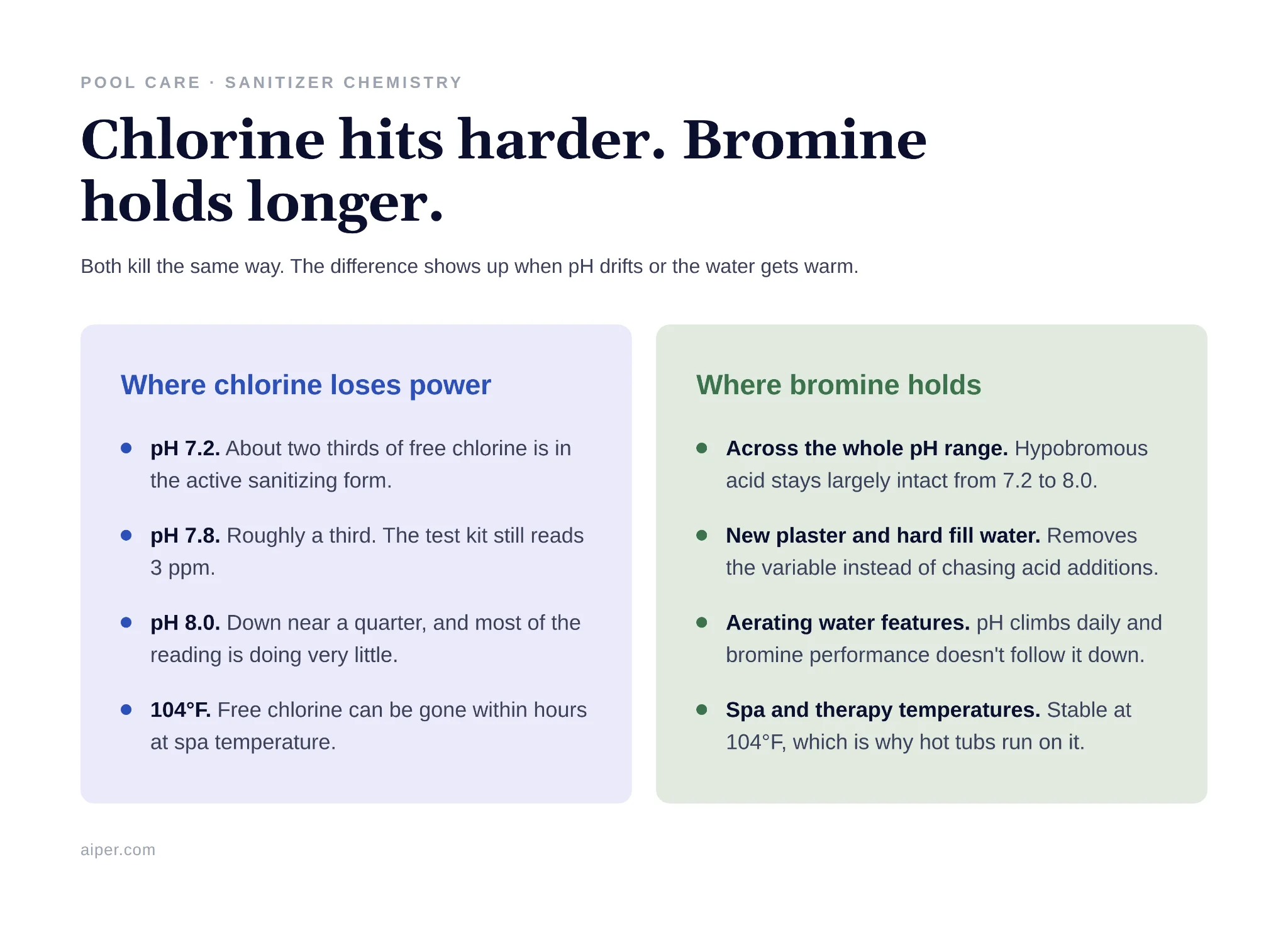
Bromine is stable at spa temperatures. It’s the reason nearly every hot tub in the country runs on it, and it isn’t a close call.
The same logic extends to warm therapy pools at 90 to 94°F, and to any indoor pool kept above the mid-80s.
Sunlight Destroys Bromine, and Nothing Prevents It
Here’s the disqualifier.
Ultraviolet light breaks down both halogens. Chlorine has an answer: cyanuric acid, the stabilizer that binds to free chlorine and shields it from UV, extending its life in an outdoor pool from a couple of hours to most of a day.
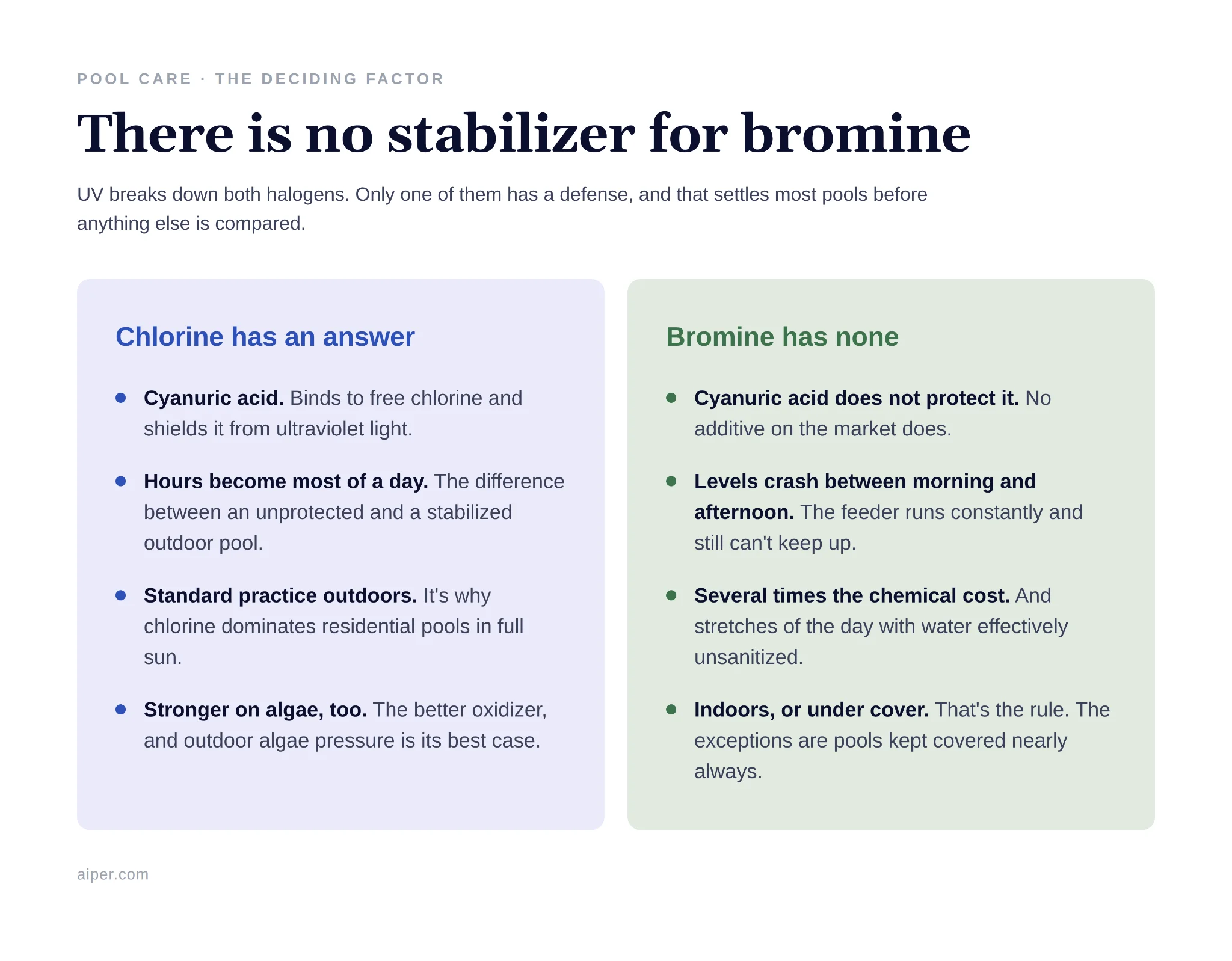
There is no equivalent for bromine. Cyanuric acid does not protect it. No additive does.
An outdoor pool in direct sun on a bromine system loses sanitizer at a rate that has to be seen to be understood. Levels crash between morning and afternoon.
The feeder runs constantly. The tablet consumption is high enough that the annual chemical bill runs several times a chlorine pool of the same size, and the water still spends stretches of the day effectively unsanitized.
People do it anyway, usually because a spa dealer sold them a bromine system and they extended the same thinking to the pool. It doesn’t work, and no amount of adjustment makes it work.
Bromine is an indoor sanitizer. That’s the practical rule, and the exceptions are pools kept under a solid cover almost all of the time.
Combined Forms Are Where Bromine Wins on Comfort
When chlorine reacts with sweat, urine, and body oils, it forms chloramines. Chloramines are poor sanitizers. They cause eye irritation and the heavy smell people associate with over-chlorinated pools, and they off-gas into the air above the water.
In an enclosed indoor pool with weak ventilation, that accumulation is a genuine air quality problem, it’s the source of the respiratory complaints common among indoor pool staff and competitive swimmers.
Clearing chloramines requires shocking to breakpoint, which means a large chlorine addition and a pool that’s out of service for a while.
Bromine forms bromamines instead, and bromamines are still effective sanitizers. They don’t need to be broken apart to restore water quality, and they don’t produce the same airborne irritation.
For a hotel pool, a school pool, a rehab facility, or any indoor body of water with unpredictable bather load and imperfect ventilation, this alone justifies the higher chemical cost.
Shocking a Bromine Pool Recharges It
Once hypobromous acid is used up, it doesn’t leave the water. It reverts to bromide ion and stays in solution, inert, waiting.
Add an oxidizer, potassium monopersulfate, or chlorine, and those bromide ions convert straight back into active hypobromous acid. The pool essentially reloads itself from a reserve it already has.
Two consequences follow that surprise people coming from chlorine.
The first is that shocking a bromine spa isn’t a corrective measure for a problem. It’s routine reactivation, part of normal operation.
The second is that adding chlorine to a pool carrying bromide doesn’t give you a chlorine pool. It gives you bromine. The chlorine is consumed converting bromide, and what remains in the water is hypobromous acid.
Bromine Costs More
Per unit of sanitizing capacity, bromine runs roughly two to three times what chlorine costs, and that’s before accounting for the faster consumption of an outdoor installation.
The gap narrows on a spa, where total volume is small, and the numbers stay modest either way. On a pool, it’s real money every season.
Worth weighing against what it buys: fewer pH-driven swings, no chloramine management, no breakpoint shocking cycle.
The other lever on that number is demand rather than price. Sanitizer gets consumed oxidizing whatever is in the water, so leaves, silt, and the film that builds along the waterline are all drawing down a chemical that costs two to three times what chlorine does.
Running a robotic pool cleaner on a regular cycle pulls that debris out before it dissolves, which matters more on a bromine pool than it ever did on a chlorine one.
Switching Back Means Draining the Pool
Bromide ion is persistent. It doesn’t gas off, it doesn’t degrade in sunlight the way active bromine does, and there’s no practical chemical that removes it.
So a pool converted to bromine stays a bromine pool. Any chlorine added afterward gets consumed regenerating bromide, and this continues until the bromide concentration has been diluted below the level where it dominates the chemistry.
The only reliable way is a drain and refill, sometimes more than one.
Which makes the decision heavier than it looks at the counter. Going from chlorine to bromine takes an afternoon. Going the other direction takes a truckload of water.
Test Bromine on the Right Scale
Standard DPD test kits detect bromine, but they’re calibrated for chlorine, and the reading needs converting. Multiply a chlorine reading by roughly 2.25 to get the bromine value, or use test strips and reagents sold specifically for bromine so the scale is already correct.
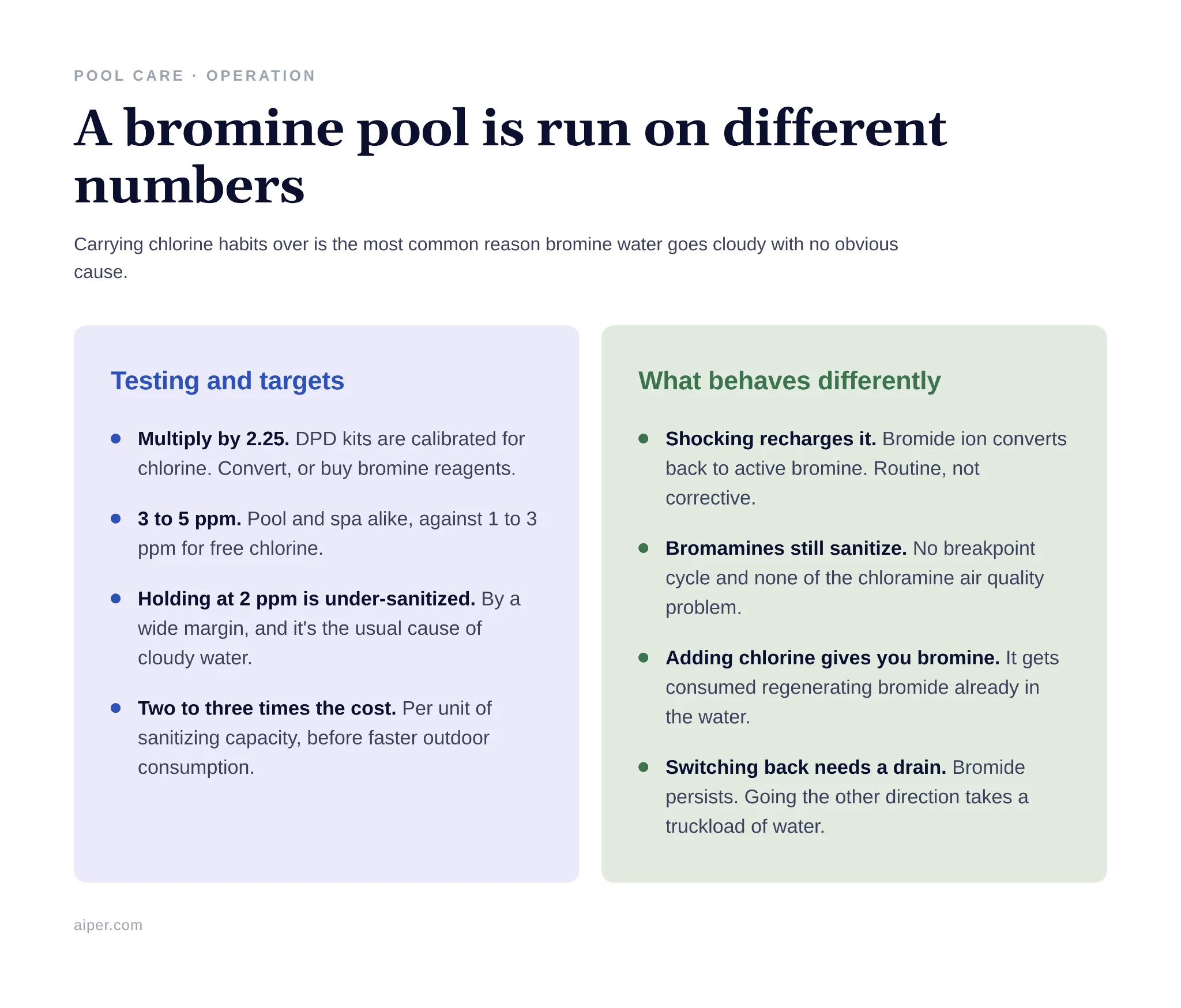
Target range for bromine is 3 to 5 ppm in a pool and 3 to 5 in a spa, against 1 to 3 ppm for free chlorine.
The common error is running a bromine pool against chlorine numbers and holding it at 2 ppm, which is under-sanitized by a wide margin. It’s a frequent cause of cloudy bromine water that nobody can explain.
Where Bromine Is the Right Call
Indoor pools, especially with heavy or variable bather load and ventilation that isn’t excellent.
Hot tubs and spas, essentially without exception.
Warm therapy and rehab pools.
Pools with a genuine, documented pH problem, like new plaster, hard fill water, and aggressive aeration, are where chlorine effectiveness is being lost to alkaline drift faster than acid additions can correct it.
Where It Isn’t
Any outdoor pool in normal sun exposure.
Pools with persistent algae pressure, since bromine is the weaker algaecide of the two and outdoor algae control is chlorine’s strongest suit.
Households where somebody reacts to it. Bromine rash is a real and reasonably common complaint in spas, bromine binds to skin and hair more stubbornly than chlorine, and the smell holds in swimsuits through a wash cycle. Anyone who has had a reaction in a hot tub should not have it in the pool as well.
Any pool where the budget is tight enough that a two-to-three-fold sanitizer cost changes what else gets maintained.
Public pools in jurisdictions that restrict it, which some health departments do. Worth checking the code before ordering a feeder.
The Question That Settles It
Before comparing anything else, look at whether the water sees direct sun for most of the day.
If it does, the comparison is over regardless of how the pool behaves on pH or how much you dislike chloramines. Everything bromine offers gets consumed by UV before it can offer it.
If the water is indoors, or under a spa cover, or under a roof, then bromine’s advantages are real. They’re worth paying for, and the operating routine is simpler than the one chlorine demands.
Get more pool and lawn care guides from Aiper on Google