The Month-by-Month Lawn Care Calendar for Cool-Season Grass

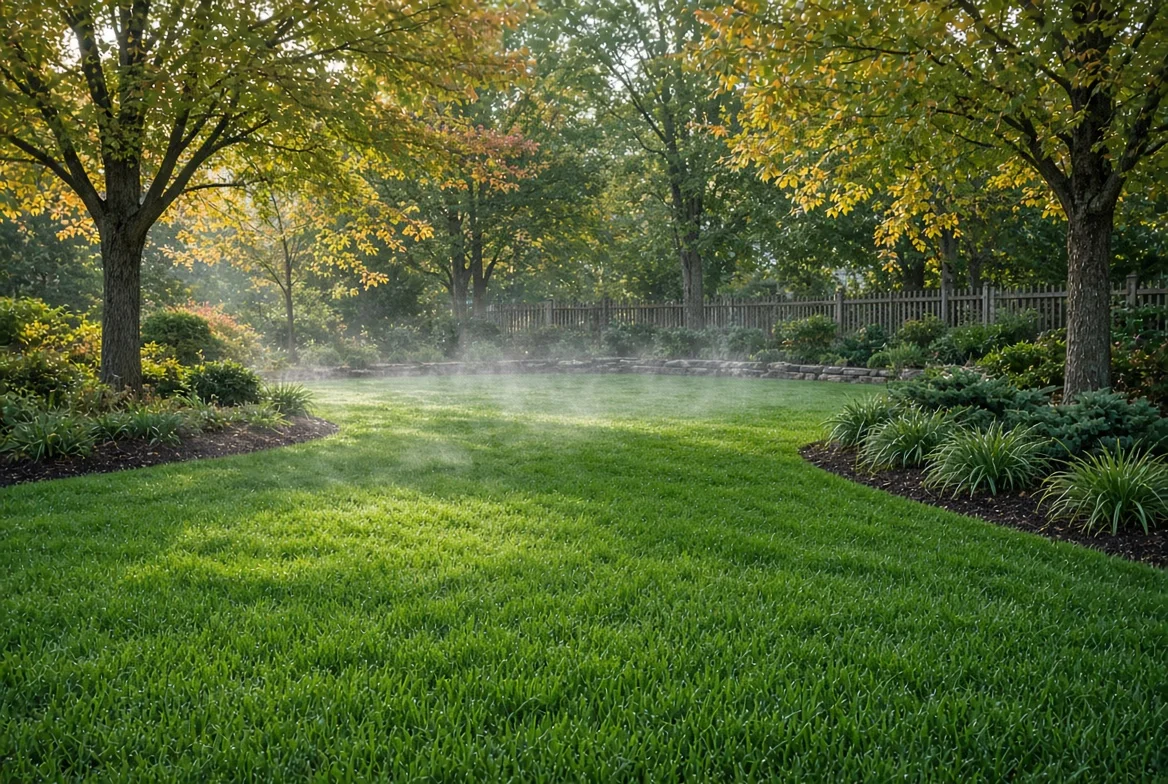
Cool-season grass needs different care throughout the year. Mow, fertilize, water, aerate, and overseed at the wrong time, and you can stress the lawn instead of helping it. If you hire help for these tasks, lawn care versus lawn maintenance terms explained for invoices shows what each visit covers.
The exact timing depends on soil temperature, not the calendar. Even university extension calendars run into this: a Minnesota sheet and a Kansas sheet are pinned to different fixed dates, and neither will match your yard exactly. Use the months below as a guide, then adjust based on your local conditions — a soil thermometer can help you know when it’s time to act. You’re not copying someone else’s calendar; you’re reading your own lawn.
This guide covers what to do each month, with the most important work concentrated in late summer and fall. That’s when cool-season grass builds the roots it will rely on through the following summer.
| Window | Primary Task | Trigger Signal | Skip If |
|---|---|---|---|
| Late Winter (Feb–Mar) | Light raking only | Canopy greening after dormancy | Soil is saturated or half-frozen |
| Pre-Emergent Window | Apply prodiamine or dithiopyr | Soil at 2 in. holds 50–55°F, 4 days straight | Crabgrass has already sprouted |
| April | First mow, light nitrogen (0.5 lb N/1,000 sq ft) | Grass reaches 3.5 in. | — |
| May | Frequent mowing, spot-spray weeds | Growth peaks | Blanket-spraying (save for fall) |
| June | Raise deck to 4 in., grub prevention | Soil warms consistently | Grubs already large and feeding |
| July–August | Deep, infrequent watering or managed dormancy | Nights stay above 68°F | Fertilizing, aerating, or seeding |
| Late Aug–September | Aerate, overseed, soil test | Soil still warm, air cooling, weeds dropping off | — |
| October | Broadleaf weed control | Above 50°F, before hard freeze | Temps below 50°F |
| November | Final fertilizer, final mow, blow out irrigation | Soil above 40°F, top growth stopped | — |
| December–January | No traffic, watch for salt damage | Ground frozen | — |
Soil signal checker
Answer one question to find your current task window.
Choose an option above first.
February Into March
The lawn looks bad in early March, and there is very little you can safely do about it. It comes out of winter matted and grey in patches, and most of that grey will grow out on its own within a few weeks once air starts moving through the canopy.
Rake it lightly with a leaf rake to lift the flattened crowns, and leave the dethatcher in the shed. The crowns are alive and fragile right now.
Stay off the lawn when it’s saturated or half-frozen. Frozen soil under a thawed top inch is the worst possible condition for compaction.
The Pre-Emergent Window
This is the one spring task where being a week late costs you the entire summer.
Crabgrass germinates once soil at two inches holds around 55 degrees for several days running, and pre-emergent has to be down and watered in before that happens. It does nothing to crabgrass that has already sprouted, and there is no way to catch up afterward.
Watch for 50 to 55 degrees at two inches, four days straight. Prodiamine gives the longest residual, while dithiopyr is more forgiving because it also kills crabgrass that’s already up but still in the one-to-three-leaf stage. Whichever you choose, water it in with a half inch, because a pre-emergent sitting dry on the surface does nothing at all.
There’s a trap here that catches people every year: pre-emergent doesn’t distinguish between crabgrass seed and grass seed. If you put prodiamine down in April and then try to seed a bare patch in May, nothing comes up, and you’ll blame the seed. If you have to seed in spring, either skip the pre-emergent in that area or use mesotrione, which can go down at seeding.
April
Let the grass reach three and a half inches before the first mow, then take it back to three. Cutting it low to clean it up is warm-season advice, and on fescue and bluegrass it removes the leaf area the plant needs to rebuild roots after winter.
Sharpen the blade before you start.
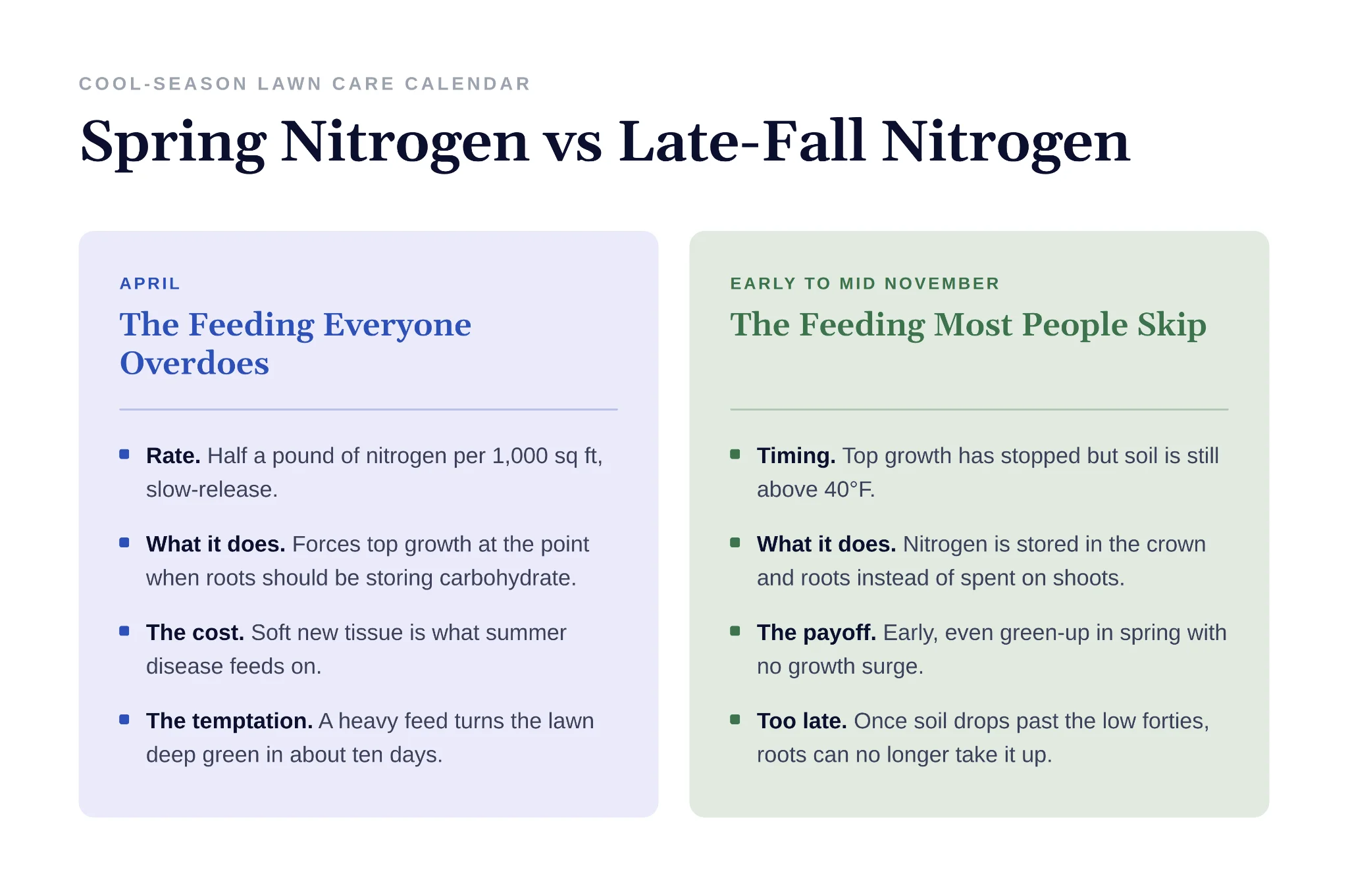
The heavy early-spring nitrogen push is the mistake almost everyone makes. It’s satisfying, because the lawn goes deep green in about ten days, but you’re forcing top growth at the exact point when the plant should be putting carbohydrate into roots, and that soft new tissue is what summer disease feeds on. Half a pound of nitrogen per thousand square feet, slow-release, is plenty this early.
May
Growth peaks now, and you’ll be mowing twice a week for a few weeks even though it feels excessive.
Never take more than a third of the blade in a single pass. Cutting six inches down to three at once stalls the plant, and a lawn that stalls in May is a thin lawn in July. Leave the clippings on the ground, since they return most of a fertilizer application over a season and aren’t what causes thatch.
Spot-spray broadleaf weeds rather than blanket-spraying, because fall does that job far better anyway.
June
Raise the deck to four inches and leave it there until September. Taller grass shades the soil, which keeps the root zone cooler and slows crabgrass germination in the thin spots, and it’s the cheapest thing you can do for summer performance.
If grubs have been a problem in past years, and you’d know because the turf lifted like a rug, a preventive product goes down now to line up with egg-laying and hatching. These products only work as prevention. Applying one in September, on top of grubs that are already large and feeding, accomplishes very little.
July and August
Almost everything in these two months comes down to water, and most people water in the way that does the least good.
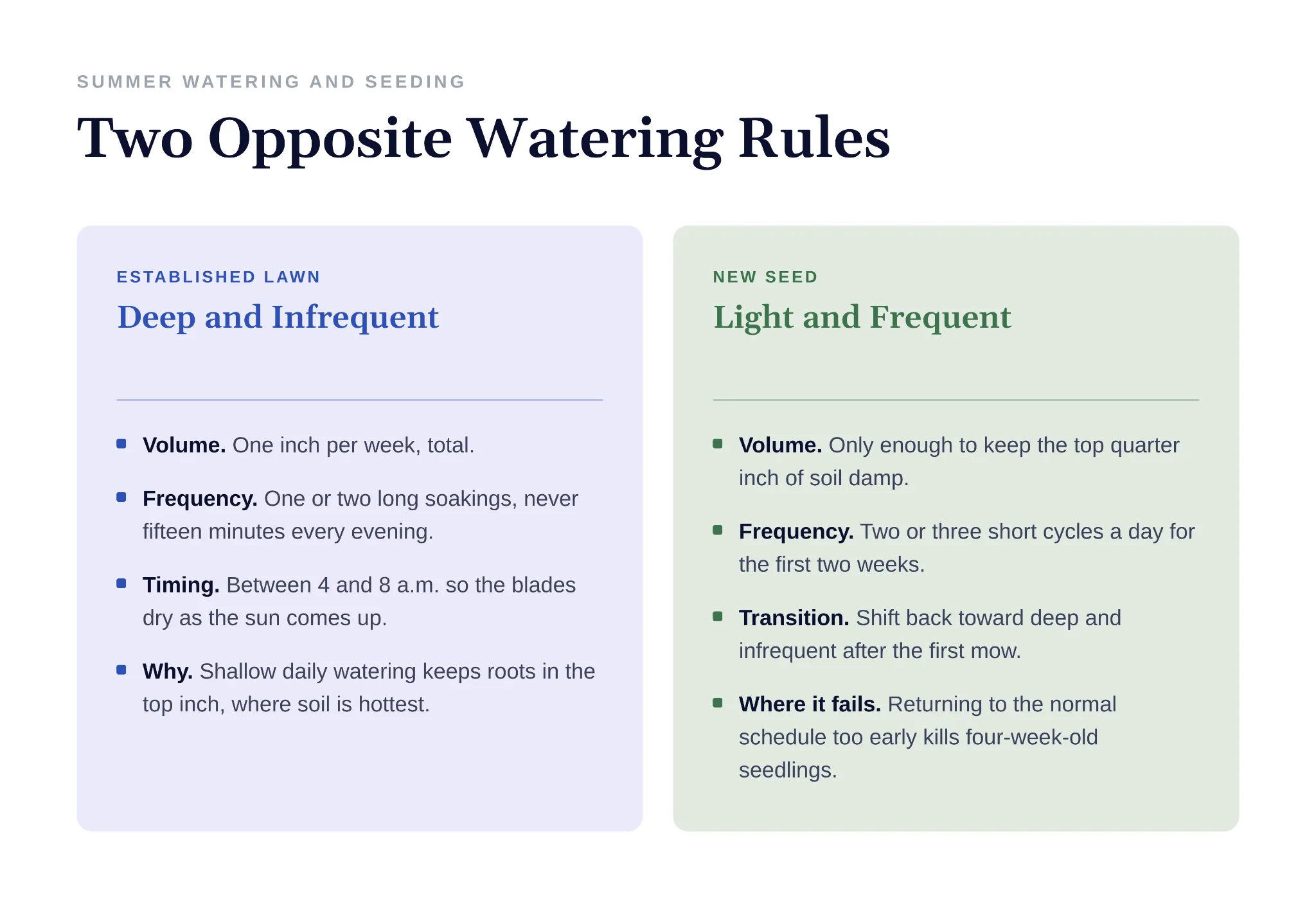
Put down one inch a week in one or two long soakings rather than fifteen minutes every evening. Light daily watering trains roots to stay in the top inch of soil, where it’s hottest and dries out first, which is how a lawn that gets watered constantly still collapses in a heat wave.
Measure what you’re actually applying. Set three straight-sided cans out on the lawn, run the sprinkler for twenty minutes, and check them.
Hitting an inch a week in one or two soakings, in the four-to-eight window, is mostly a scheduling problem. The Aiper IrriSense 2 packages four irrigation components into one unit, so the schedule runs whether or not anyone is home. Zones are mapped in the app, and the weather response stops a cycle once the rain sensor registers five minutes of steady rainfall and reschedules planned watering when rain is forecast.
Water between four and eight in the morning so the blades dry as the sun comes up. A canopy that stays wet through a warm night is exactly the condition brown patch needs, and in tall fescue it will show up as irregular tan patches once nights stay above 68 degrees.
Dormancy is not death. A browned-out cool-season lawn has pulled its resources into the crown and will green back up when the weather breaks. What actually kills it is being brought partway out of dormancy and dropped back into it repeatedly, so pick one approach and hold to it: either keep it watered through the summer, or let it go brown and give it a half inch every two or three weeks to keep the crowns alive.
This is not the time to fertilize, aerate, or seed.
Late August Through September
These eight to ten weeks do more for the lawn than everything else in the year combined. The soil is still warm enough to drive germination, air temperature is falling, and weed pressure has dropped off, which gives new grass a long runway to establish roots before the ground closes down.
Start with core aeration, using hollow tines that pull real plugs. Spike shoes compress the soil around each hole and make compaction worse, so they aren’t a substitute. Make two or three passes in different directions on a lawn that’s never been done, and leave the plugs on the surface to break down over a couple of weeks.
Seed immediately afterward, directly into the open holes, because seed-to-soil contact is what determines whether any of it takes. Broadcasting seed over unaerated turf mostly feeds birds.
Overseeding rates per thousand square feet run as follows:
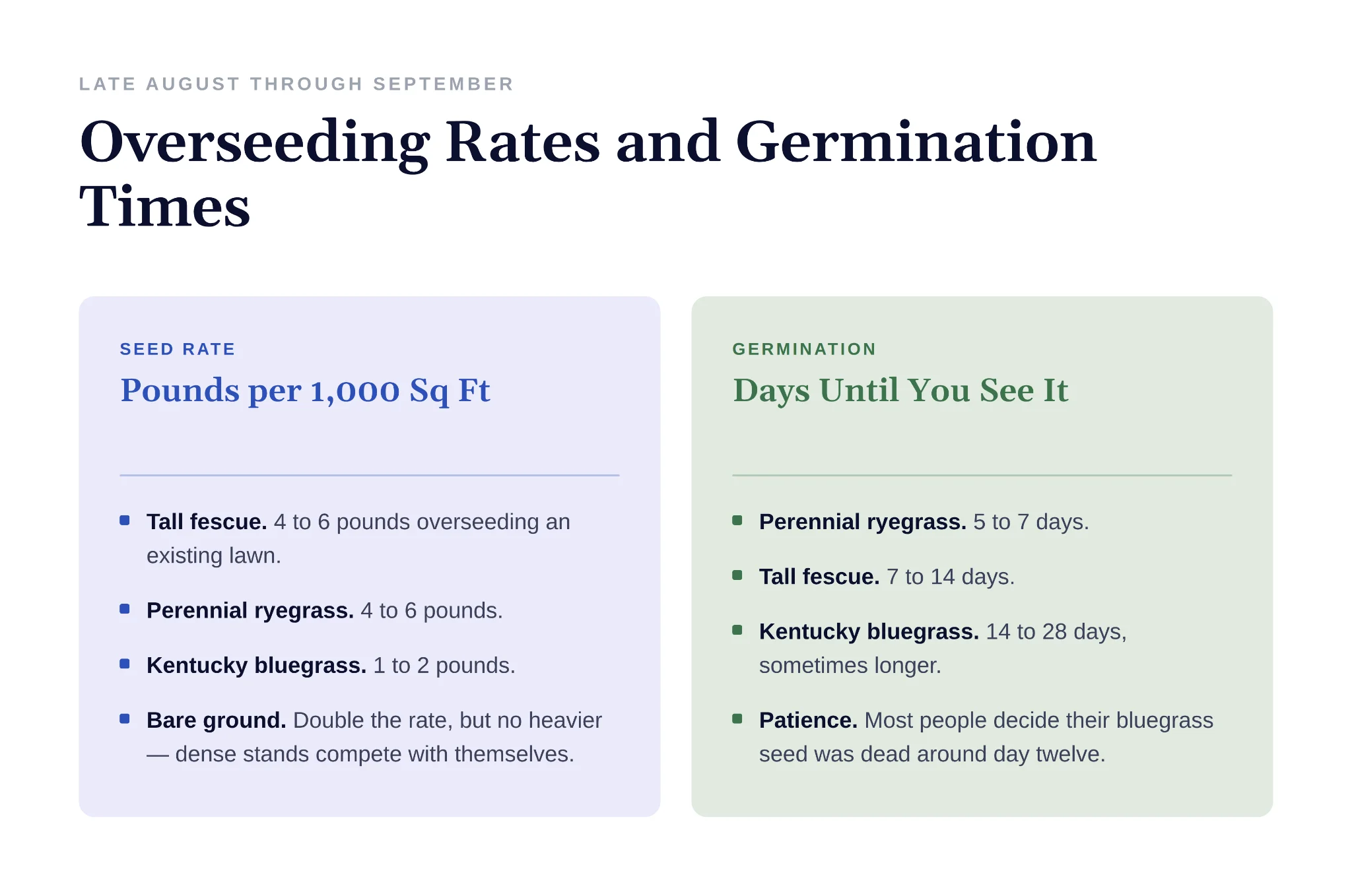
- Tall fescue: 4 to 6 pounds
- Perennial ryegrass: 4 to 6 pounds
- Kentucky bluegrass: 1 to 2 pounds
Double those for bare ground, and don’t go heavier on the assumption that more seed produces thicker turf. Overseeded stands compete with themselves and thin out in the first hot spell.
Germination timing is worth knowing so you don’t give up early. Ryegrass comes up in five to seven days, tall fescue in seven to fourteen, and Kentucky bluegrass anywhere from fourteen to twenty-eight.
Watering new seed is the opposite of watering an established lawn.
It needs to be light and frequent, because the top quarter inch of soil can’t be allowed to dry out, which usually means two or three short cycles a day for the first couple of weeks. Once the seedlings have been mowed once, shift gradually back toward deep and infrequent watering. That transition is where most overseeding jobs fail. The seed germinates beautifully, the homeowner declares it a success and returns to the normal schedule, and half the seedlings die at four weeks old with roots an inch long.
Apply starter fertilizer at seeding and a regular feed four to six weeks later, though it’s worth checking your state rules first, since several restrict phosphorus applications without a soil test.
Fall is also the right time to test the soil, which is worth doing every three years through an actual lab. Cool-season grass wants a pH between 6.0 and 7.0, and below that range some of the fertilizer you’re paying for never reaches the plant. Lime corrects the problem over six months to a year, so don’t expect a fall application to show results by spring.
October
October is the best month of the year for killing broadleaf weeds, and hardly anyone uses it. Dandelions, clover, and ground ivy are all pulling sugars down into their root systems for winter, and systemic herbicide travels down with them.
One late-October application on ground ivy does what three summer sprays won’t. Apply it above 50 degrees and before a hard freeze, since colder plants stop translocating and you’re just wetting leaves.
Keep mowing through the month. Letting the lawn go long into November invites snow mold.
You can mulch leaves with the mower as long as the layer disappears into the canopy, and shredded oak leaf is free organic matter for the soil. A wet three-inch mat of maple left sitting for two weeks will smother the grass underneath, and you’ll find the dead patch in April. The judgment call is whether you can still see grass after the pass.
November
The last fertilizer application of the year is the most valuable one you’ll make. Once top growth has stopped but the soil is still above 40 degrees, the roots are active while the leaves have quit, so nitrogen applied then gets stored rather than burned on shoot growth. The result is an early, even green-up in spring without the growth surge. In most of the cool-season range that window falls somewhere in the first three weeks of November.
Take the final mow down to two and a half or three inches, which reduces the long floppy tissue that mats under snow without scalping the plant.
Drain the hoses and blow out the irrigation before the first hard freeze. A cracked backflow preventer is a spring expense nobody budgets for.
December And January
Keep traffic off the lawn entirely once it freezes, because walking on frozen grass fractures the crowns and the tracks won’t show until March.
Pay attention to where the salt goes as well. That dead strip along the driveway every spring is sodium damage rather than winter kill, and moving the shovel pile off the same six feet of lawn does more good than anything you can apply afterward.
Frequently Asked Questions
Watch what’s blooming instead. Forsythia in full bloom lines up closely with the pre-emergent window; lilacs fully leafed out signal soil has warmed past the crabgrass danger zone. These aren’t as precise as an actual reading, but they track the same soil temperature curve extension offices use for the same purpose.
Mostly, with one caution: don’t run a broadleaf herbicide pass until any warm-season patches have fully greened up, since some products can set back bermuda or zoysia that’s still breaking dormancy. Everything else — mowing height, watering, fall aeration — follows the cool-season calendar as written.
You can, but expect a lower success rate. Spring-seeded grass competes with crabgrass pre-emergent timing and hits summer heat before its roots are established. Treat spring seeding as bare-spot patching, not a full renovation, and plan the real overseeding for the following fall.
A few signs override the calendar entirely: footprints that don’t spring back within a few hours (water stress), sudden brown circular patches in humid weather (disease), or turf that lifts like a loose rug (grubs). Any of these need action the day you notice them, regardless of month.
Get more pool and lawn care guides from Aiper on Google