How to Dethatch a Lawn: Diagnose Thatch, Then Treat It

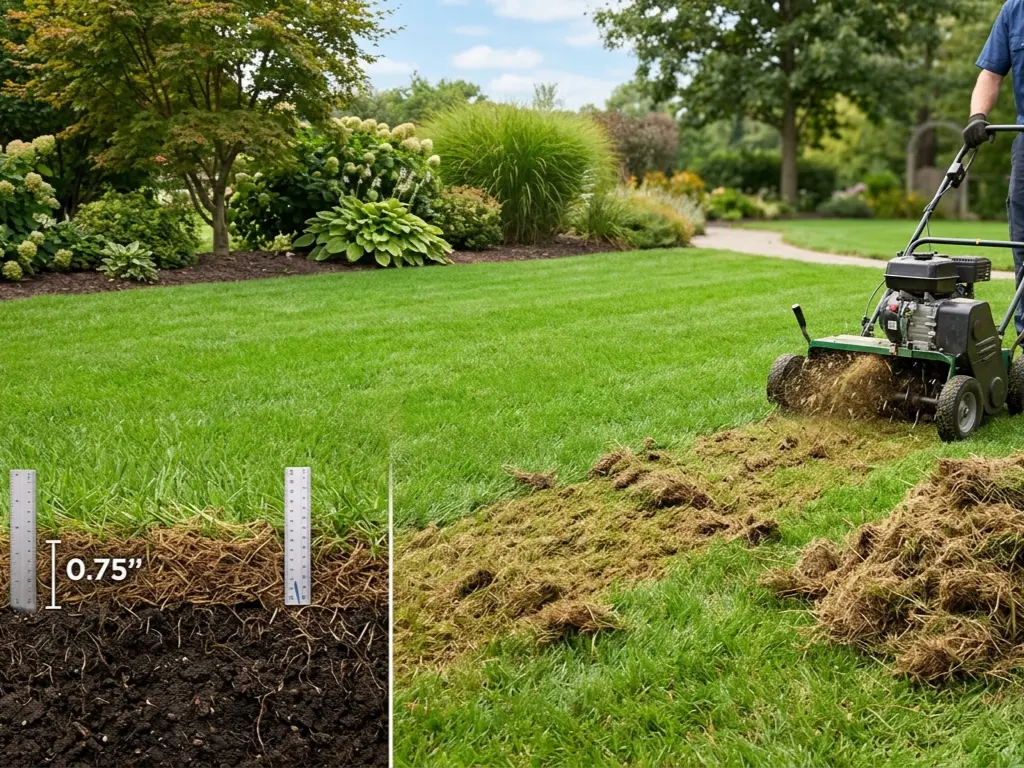
Most lawn problems that get blamed on other things, like poor fertilizer uptake, dry patches that never fully green up, fungal issues that keep coming back no matter what you spray, are thatch problems in disguise. Confusing that diagnosis with a straight choice between aeration and dethatching is another common mistake — our comparison of lawn aeration versus dethatching explains when to use each.
The thatch layer sits between the green grass blades and the soil surface, and once it gets thick enough, it starts intercepting everything you put down. Water. Nutrients. Air. None of it gets where it needs to go.
The fix isn’t complicated. But the diagnosis is more important than most people realize, because dethatching a lawn that doesn’t need it can set you back a whole season.
What Thatch Actually Is
There’s a persistent myth that thatch comes from leaving grass clippings on the lawn. It doesn’t. Clippings are mostly water, and they break down fast.
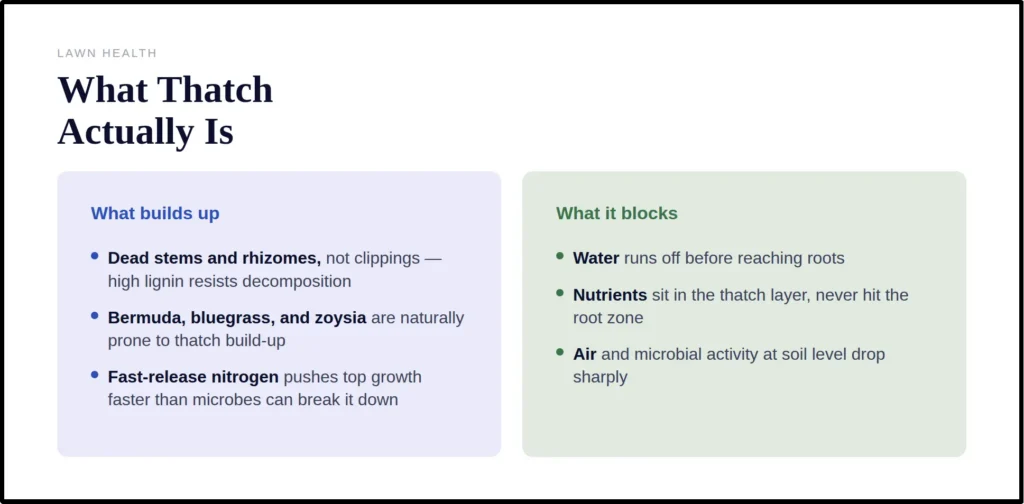
Thatch is dead and decaying grass tissue, specifically the stems, roots, and rhizomes that don’t decompose quickly because of their high lignin content.
It builds up when the turf produces organic matter faster than soil microbes can break it down.
That imbalance happens for a few reasons: soil that’s too acidic or too compacted for microbial activity, overuse of fast-release nitrogen that pushes aggressive top growth, and grass species that are genetically predisposed to thatch.
Bermudagrass. Kentucky bluegrass. Zoysia. These run fast and mat up. Tall fescue, by contrast, rarely gives you a thatch problem.
A thin layer is actually fine. It insulates the soil, buffers temperature, and reduces moisture loss. The problems start above that.
How to Actually Measure It
Don’t guess. You need a cross-section.
Cut a small plug from an inconspicuous area of the lawn. A trowel works or a soil coring tool, if you have one. You want to pull out something that shows distinct layers: brown spongy material on top, then the soil beneath.
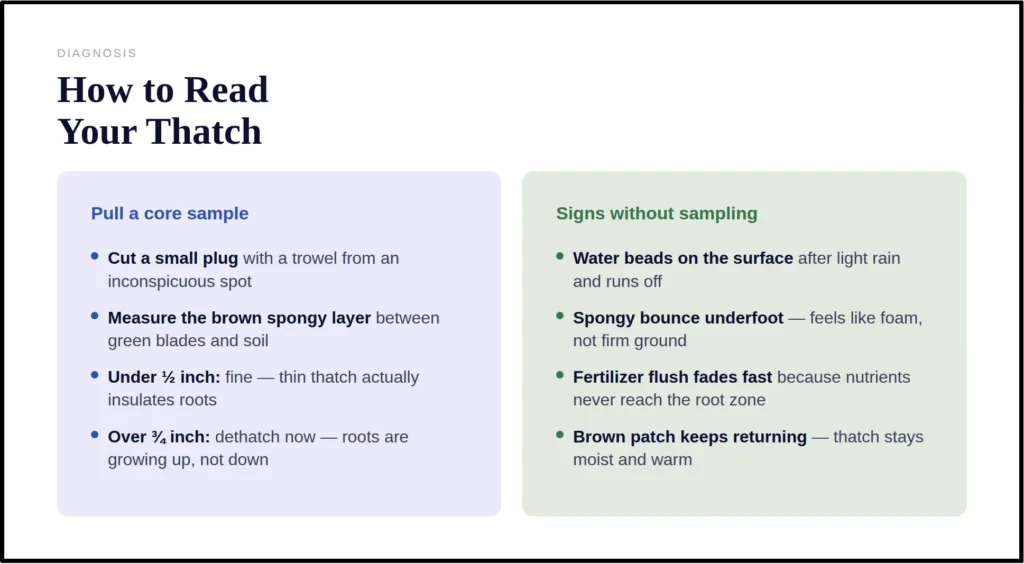
That brown spongy layer is your thatch. Measure it with a ruler.
Under half an inch: you’re fine, don’t dethatch.
Half an inch to three-quarters: light to moderate accumulation. You might notice early symptoms, water beading on the surface after rain, fertilizer sitting ineffectively even when applied correctly, turf that feels slightly springy underfoot, like you’re walking on foam.
Over three-quarters of an inch, closer to an inch or more: this is where the lawn is in real trouble.
Roots are growing up into the thatch layer instead of down into the soil because that’s where the moisture is being held.
You’ll see drought stress earlier than neighbors with similar grass, because the root system is shallow and the water isn’t infiltrating. Fungal disease shows up more readily because the thatch stays moist and warm. Mushrooms in your lawn are a similar story — that same damp, decaying organic matter feeds the underground fungi that produce them. If they are already popping up after rain, see our guide on how to get rid of mushrooms in your lawn.
Check a few spots. Thatch accumulation isn’t always uniform across a lawn, especially on sloped or irregularly irrigated yards.
The Signs Before You Even Pull a Plug
Sometimes you don’t need the plug to suspect a problem. The lawn tells you.
Water pools briefly after light rain and then runs off, even on flat ground. You water for twenty minutes, and nothing penetrates more than half an inch down.
The lawn looks green enough from a distance, but spongy and dense when you’re actually on it, that bounce underfoot that feels satisfying but shouldn’t.
Fertilizer applications deliver a quick flush of growth that fades fast because the nutrients never made it to the root zone. Grubs and other soil insects are harder to treat because the product can’t penetrate to where the larvae are feeding.
Any one of these isn’t definitive. Several of them together, especially in a lawn that’s been managed aggressively for years, and you already know what the core sample is going to show you.
Timing Matters More Than Method
This is the part people get wrong more than anything else.
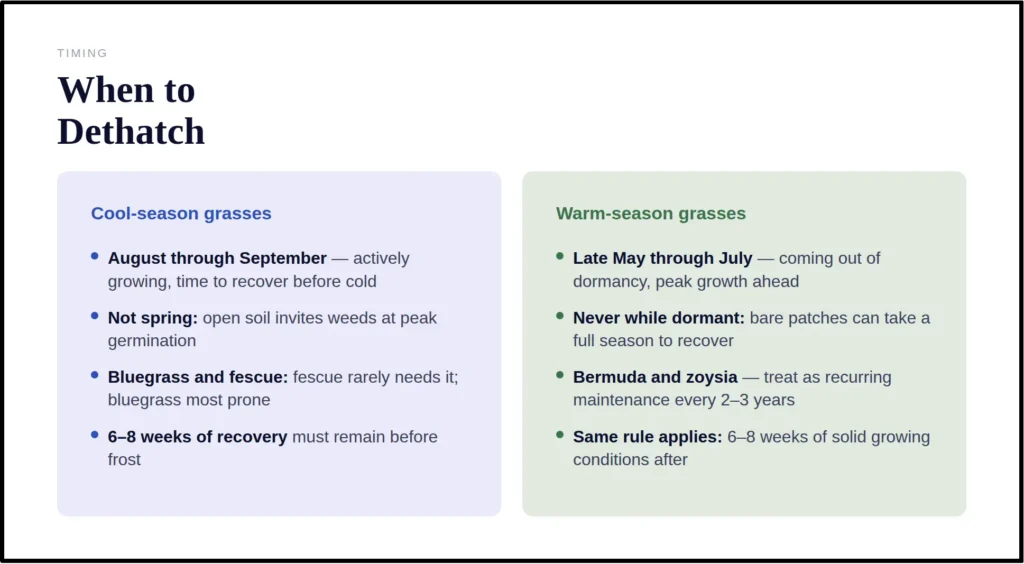
Dethatch when the grass is actively growing and has enough time to recover before stress sets in. For cool-season grasses like fescue, bluegrass, and ryegrass, that’s late summer into early fall, roughly August through September, depending on your region.
Spring dethatching on cool-season turf pulls up grass that’s already under transition stress and gives weeds an open window into bare soil right before peak germination season.
For warm-season grasses like Bermuda, zoysia, and St. Augustine, late spring through early summer is correct. These grasses are coming out of dormancy and heading into peak growth. They’ll recover.
The window isn’t wide. You need six to eight weeks of solid growing conditions after the work is done. If your region goes dry or cold before that recovery period closes, the lawn pays for it.
Power Raking vs. Core Aeration vs. Vertical Cutting
Three tools. Different situations. Not interchangeable.
Power raking
Sometimes called a dethatching machine or lawn dethatcher uses flail blades or spring tines that spin and physically pull thatch out of the turf. It’s aggressive. It works well for moderate thatch accumulation, and the results are immediate.
You’ll end up with piles of dead material to remove. The lawn will look rough for a week or two before it fills back in. That’s expected.
Vertical cutting
Verti-cutting goes deeper and more aggressively than power raking. The blades slice down through the thatch layer into the top of the soil.
For severe thatch that’s over an inch, this is the right tool. It’s also used on dormant overseeding prep because it creates seed-to-soil contact. But it’s punishing on the turf, and if the grass isn’t in a strong growth phase with time to recover, you’ll damage more than you help.
Core aeration
This is different in nature. It pulls plugs of soil and creates channels that let water, nutrients, and air reach the root zone. Over time, the increased microbial activity in those soil cores works on the thatch from below.
Aeration is often the better first step for lawns with moderate thatch and significant compaction because it addresses both problems simultaneously without the surface trauma of power raking.
For a lot of lawns, the right answer is aeration in the fall with a light power rake rather than a full vertical cut. Deep vertical cutting is for severe cases or turf renovation situations.
Running the Equipment
Rent a power rake or vertical mower from an equipment rental yard if you don’t own one.
Don’t bother with the small manual tine rakes sold at garden centers. They’re not effective on anything beyond cosmetic thatch, and they’ll wear you out before the job is done.
Set the cutting depth correctly before you start. For power raking, tines should just be contacting the thatch layer, not digging into the soil. On most machines, you adjust this with a roller height adjustment at the back.
Make a single test pass in an inconspicuous area, check the depth by seeing what’s coming up, and adjust from there.
Run in parallel rows, overlapping slightly. On a heavily thatched lawn, run a second pass perpendicular to the first.
Then comes the tedious part: all of that material has to come off the lawn. Rake it, bag it, haul it. Don’t compost thatch from a lawn that’s had fungicide or herbicide applications, that material goes in the trash.
The lawn will look like it lost a fight. That’s fine.
What You Do After
The dethatching itself is only part of the work.
If you’ve pulled out a serious amount of thatch and the lawn looks thin, overseed immediately, within a day or two, because you now have excellent seed-to-soil contact and the turf is open enough for seeds to establish.
Use a starter fertilizer, not your standard maintenance blend. Starter fertilizer is high in phosphorus to support root development, which is exactly what you need at this stage.
Water carefully for the first few weeks. You want consistent moisture in the top inch of soil without puddling. Daily light watering until the seed germinates if you’ve overseeded, then move to deeper, less frequent irrigation once the new grass establishes.
If you aerate, leave the cores on the surface. They’ll break down and work back into the turf. Mowing over them speeds this up.
Address whatever caused the thatch in the first place. If it’s a grass species predisposed to thatch, you’ll be doing this every few years as part of regular maintenance, that’s just the reality of growing Bermuda or bluegrass intensively.
If it’s management-driven, look at your nitrogen rates and sources. Slow-release nitrogen doesn’t push the kind of rapid top growth that outpaces decomposition. If soil pH is low, lime application will increase microbial activity over time and reduce future accumulation.
What You Shouldn’t Do
Don’t dethatch a lawn going into heat or drought stress without a reliable irrigation system.
The exposed soil and weakened turf won’t recover, and you’ll be reseeding bare patches in September.
Don’t apply pre-emergent herbicide right after dethatching if you’re overseeding. Pre-emergent doesn’t distinguish between crabgrass seeds and desirable grass seed. One blocks the other.
Don’t assume dethatching is a cure for thin turf if the underlying problem is soil compaction, pH imbalance, or shade. Thatch may be contributing, but removing it won’t fix a lawn that isn’t getting what it needs at the root level. Soil test first if you haven’t in the last two or three years.
Don’t dethatch warm-season grass while it’s dormant.
Dormant grass can’t recover from the physical damage, and you’ll end up with bare areas that may take the entire following growing season to fill back in.
Reading the Recovery
Four to six weeks out, you should be seeing the lawn fill in and the color normalize.
If it’s been three weeks and growth looks patchy or slow, check soil moisture first, dry soil stalls recovery faster than anything else.
If moisture is adequate, consider whether the soil pH is working against you, especially if you’ve limed before dethatching and the lime hasn’t had time to work.
Dethatching fixes what’s already wrong. Keeping it from coming back is mostly a water problem.
The Aiper IrriSense 2 maps up to 10 independent zones across 4,800 square feet, so sun-exposed turf and shaded beds get watered on their own schedules.
Weather-Sense adjusts automatically. The same logic as everything in this guide: consistency at the root level beats intervention after the fact.
Get more pool and lawn care guides from Aiper on Google