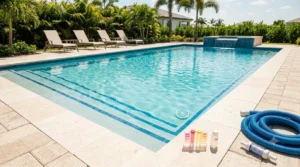
Gunite vs Fiberglass: Construction, Durability, and Maintenance

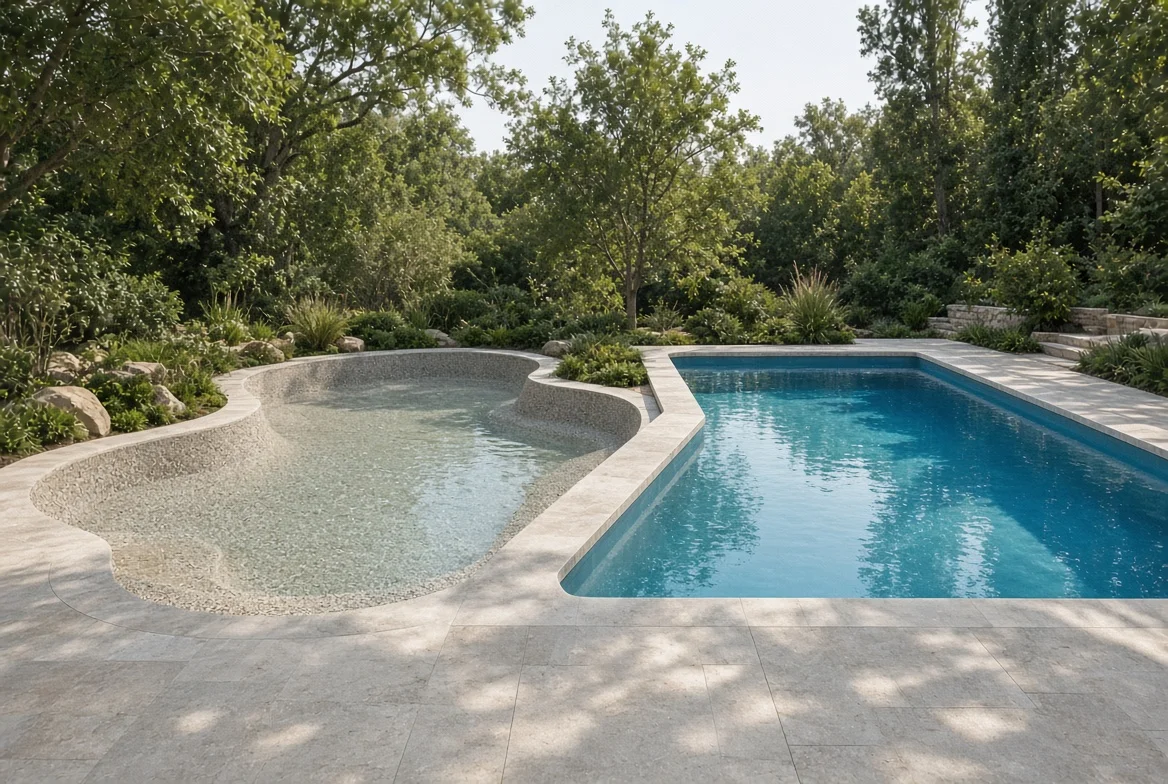
Two contractors can walk the same backyard and quote two fundamentally different objects. One is a steel-reinforced concrete structure built in place, shaped to whatever you can draw. The other is a molded shell made in a factory four states away, hauled in on a lowboy, and craned into a hole in about ninety minutes.
Both hold water. That’s roughly where the overlap ends.
Most of what determines the condition of a pool in year fifteen happens during a short window in construction that the homeowner is usually not around to watch. What follows is what happens in that window, and what each decision costs later.
How Gunite Is Built
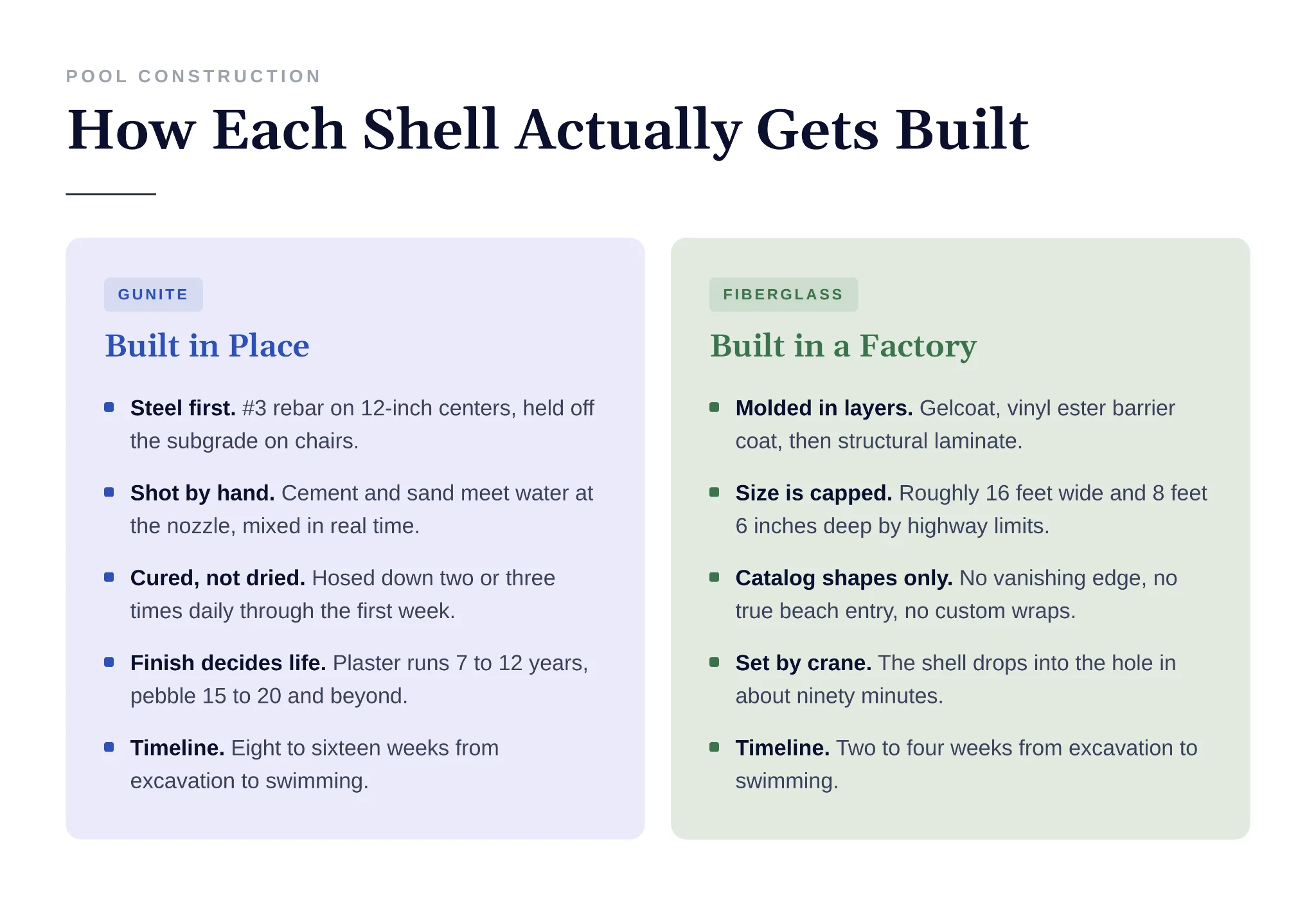
Gunite is built on site. Crews dig the hole, tie a steel rebar cage inside it, and spray concrete over the steel to form the shell. The concrete has to fully surround the rebar. Where it doesn’t, the steel rusts, and rusting steel expands and cracks the shell from the inside, usually about ten years later.
The shell cures for roughly a month before tile, coping, and an interior finish go on. Plaster is the cheapest finish and lasts 7 to 12 years. Pebble costs more and lasts 15 to 20 years or longer.
Because the shell is formed in the ground, it can be any shape, any size, and any depth.
How Fiberglass Is Built
A fiberglass pool is a single piece made in a factory. The manufacturer sprays gelcoat into a mold, adds a waterproof barrier coat behind it, then builds up the fiberglass layers that give the shell its strength. The finished shell is trucked to the site and lowered into the hole with a crane.
It travels by highway, so it cannot be wider than about 16 feet or deeper than about 8 feet 6 inches, and you choose from the shapes the manufacturer already makes.
Gunite takes eight to sixteen weeks to build. Fiberglass takes two to four.
Why Backfill Matters
A fiberglass shell is not rigid on its own. It holds its shape because of the material packed around it, so what the installer backfills with decides whether the pool is still straight in ten years.
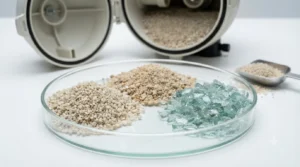
It should be clean crushed stone, three-quarter inch, underneath the shell and all the way around it. Sand shifts every time it gets wet and washes out from under the steps, which lets the shell settle unevenly and pulls the deck away from the coping. Backfilling with the clay dug out of the hole is worse, and installers do it because hauling that clay away costs money.
The stone and the water go in at the same time, a little at a time, so the pressure stays even on both sides of the wall. Fill the outside faster than the inside, and the wall bows, and a bowed wall cannot be fixed. Neither can a shell set out of level, because the coping and deck get poured against it.
Ask any fiberglass installer what they backfill with before signing.
How Each One Fails
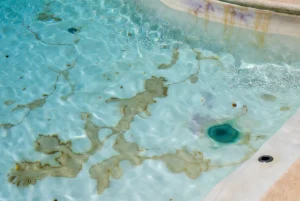
Hairline surface cracks in plaster are normal and not worth worrying about. One crack that runs from the tile line down the wall and across the floor is a real problem, because it means the shell itself moved.
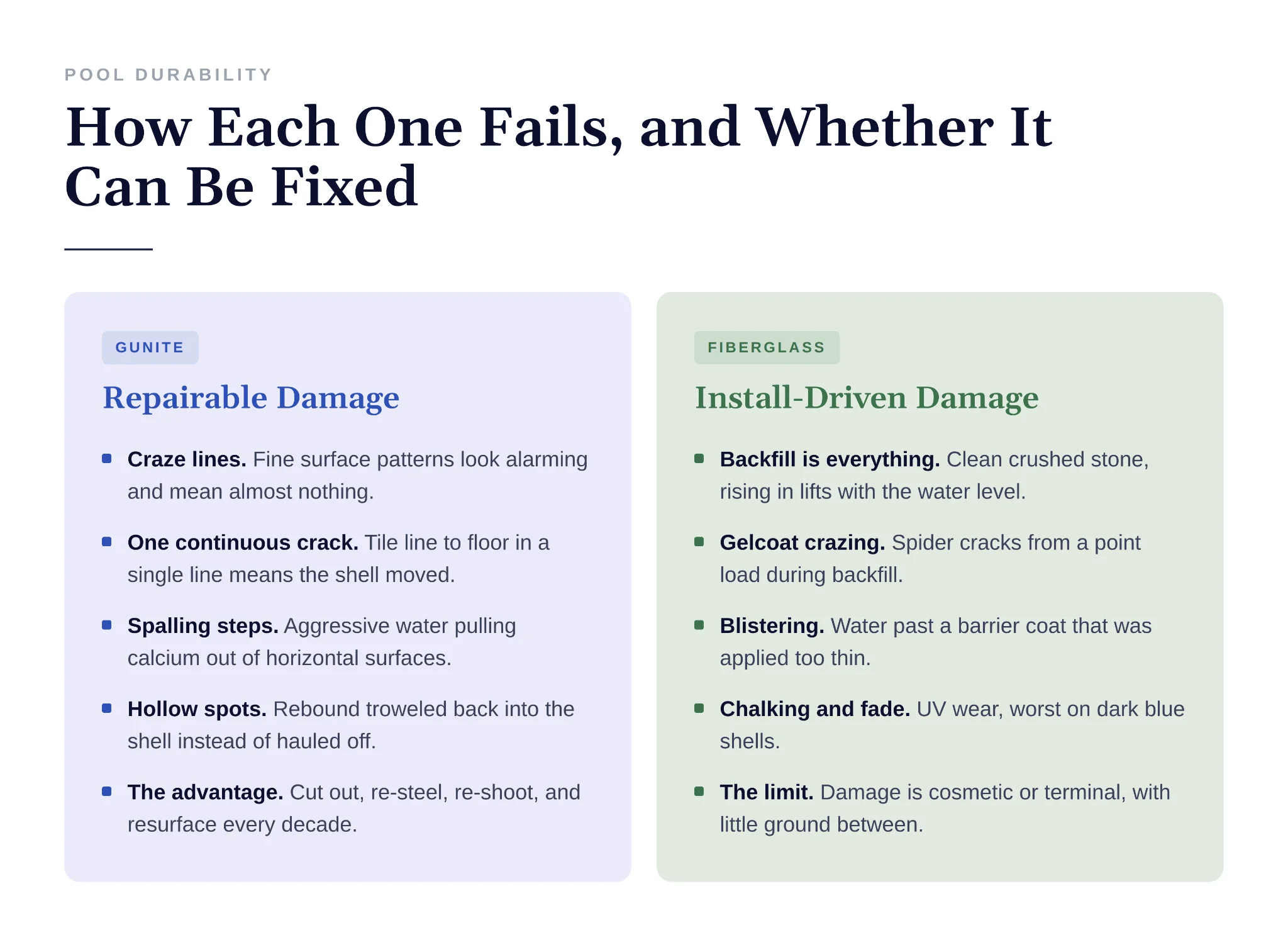
Steps and benches that turn rough or start flaking are a water chemistry problem rather than a construction problem. Water low in calcium pulls calcium out of the plaster, and the shallow surfaces go first.
Fiberglass problems are usually either cosmetic or permanent, with little in between. Spider cracks in the gelcoat come from stress during installation. Small blisters under the surface mean the barrier coat was applied too thin, which is a warranty claim. Gelcoat also fades and chalks as it ages, worst on dark blue shells, and refinishing costs a lot and never matches the original.
The bigger difference is repairability. A gunite shell can be patched and completely resurfaced every ten years or so. A fiberglass shell cannot.
Both types can float out of the ground if you drain them when the water table is high. Drain either one only in dry weather.
Water Chemistry
Plaster contains calcium, and water that is low in calcium pulls it back out of the surface. If calcium hardness drops too low, or pH sits around 7.0, or alkalinity runs low, the plaster etches. That damage builds up and does not reverse, so plaster pools need calcium hardness kept between 200 and 400 ppm.
Gelcoat contains no calcium, so none of that applies. The safe range is wider, which helps if your fill water is hard.
The tradeoff is acid washing. A plaster pool can be drained and acid washed to take off a thin layer and expose a clean finish, which is worth doing maybe twice over the life of the plaster. A fiberglass pool can never be acid washed, because acid strips gelcoat.
Salt systems work well with fiberglass. On a gunite pool, the shell handles salt fine, but natural stone coping and untreated flagstone will flake at the waterline within a few seasons.
Cleaning and Chemical Load
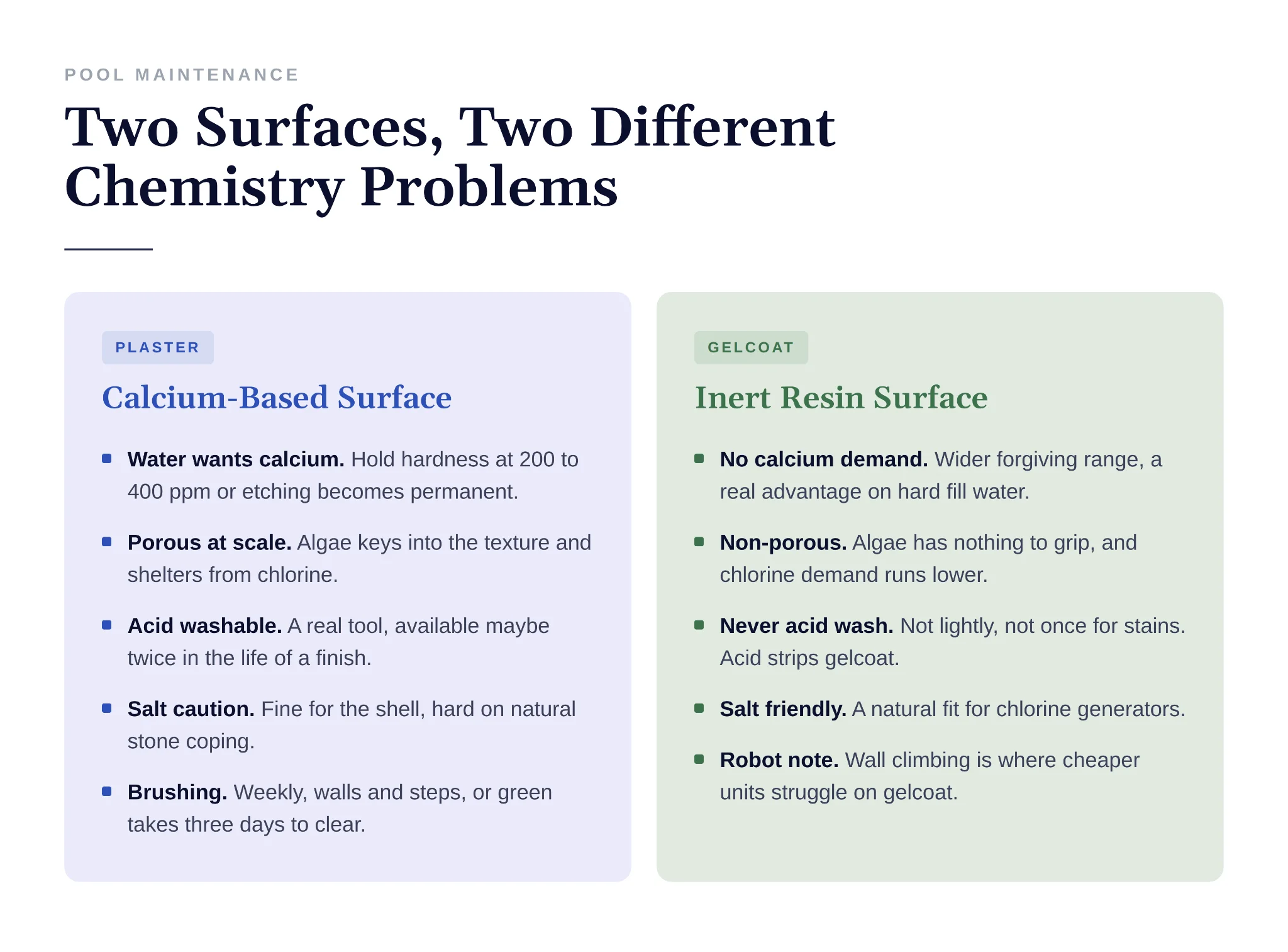
Plaster is porous at a microscopic level, so algae keys into the texture and shelters there from chlorine, which is why a plaster pool that goes green takes three days and a lot of shock to bring back. Gelcoat gives algae nothing to hold onto. Two pools with the same sun exposure and the same bather load will show measurably different chlorine demand.
Robotic cleaners work on both surfaces, though wall climbing is where cheaper units struggle on gelcoat, since the drive system has less to grip.
Cost Over Ten Years
Gunite installs at roughly $60,000 to $120,000 depending on region, size, and how much stonework is involved, and then a replaster lands somewhere in year eight to twelve at $6,000 to $12,000 for standard finish and more for pebble. Chemical spend runs higher every year in between.
Fiberglass installs at roughly $45,000 to $85,000 with no scheduled resurfacing, which is the number that makes the spreadsheet look good. The offset is the risk column. A bad install means the shell is a total loss, and that bill includes removing 15,000 pounds of composite from the backyard.
Almost all of that risk sits with the installer rather than the product.
Choosing By Soil and Shape
On expansive clay that swells and shrinks by season, on a lot with real slope, or in a freeze-thaw climate where the ground heaves, fiberglass flexes with the movement and concrete does not. A shell that flexes is worth more in those conditions than a shape drawn from scratch.
On stable soil with a low water table, where the plan calls for a tanning ledge and a raised spa with a spillway across 40 feet, the answer was always gunite, and there was never a second option.
Get more pool and lawn care guides from Aiper on Google