Fiberglass vs Concrete Pools: Long-Term Costs, Feel, and Flexibility

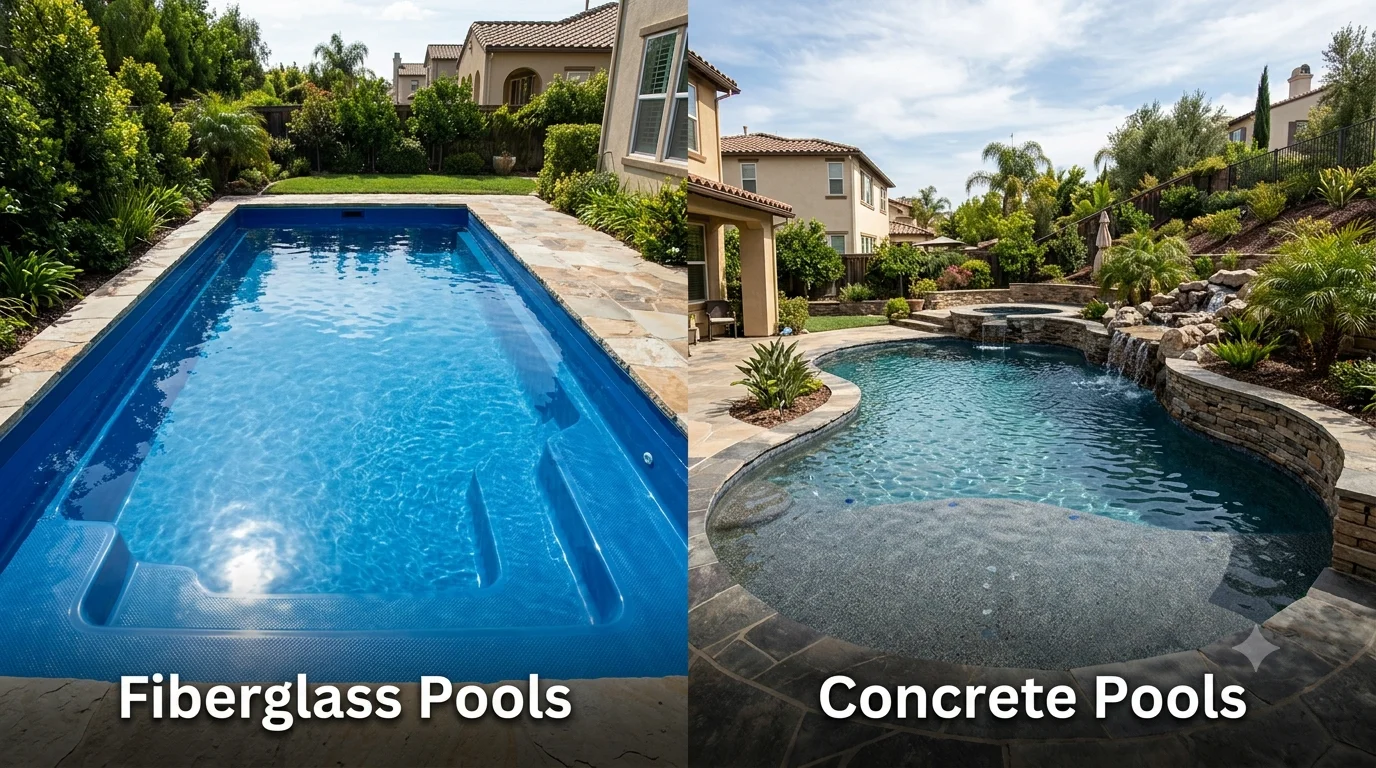
Most people comparing fiberglass and concrete pools are comparing the wrong numbers.
They get two quotes, see that concrete runs maybe $15,000 to $30,000 higher, and start negotiating from there. The install price is the least interesting number in this decision.
What separates these two pools is everything that happens after the water goes in, the resurfacing bill in year twelve, the acid you pour in every week, the way the floor feels on the bottom of your foot in August, and whether the shape you sketched on a napkin can actually be built at all. That same long-term-cost lens applies to choosing between a gunite shell and a vinyl liner — our comparison of gunite pools versus vinyl liners covers the tradeoffs in full.
Here’s the honest frame going in: fiberglass is the cheaper pool to own and the more restrictive pool to design. Concrete pools carry that same tradeoff one level deeper in their choice of surface finish — see our comparison of pebble finish versus plaster for the long-term differences.
Concrete is the opposite on both counts. Almost every real-world tradeoff falls out of those two sentences.
The Bill That Shows Up in Year Ten
The install quote is one number. Owning the pool is three separate cost streams, and they don’t run in fiberglass’s and concrete’s favor equally.
Resurfacing
A concrete pool is not finished when it’s finished. The plaster is a wear surface, sacrificial by design.
Standard white plaster gives you ten to fifteen years if your water chemistry is disciplined, less if it isn’t, and then you’re draining the pool, chipping off the old surface, and replastering.
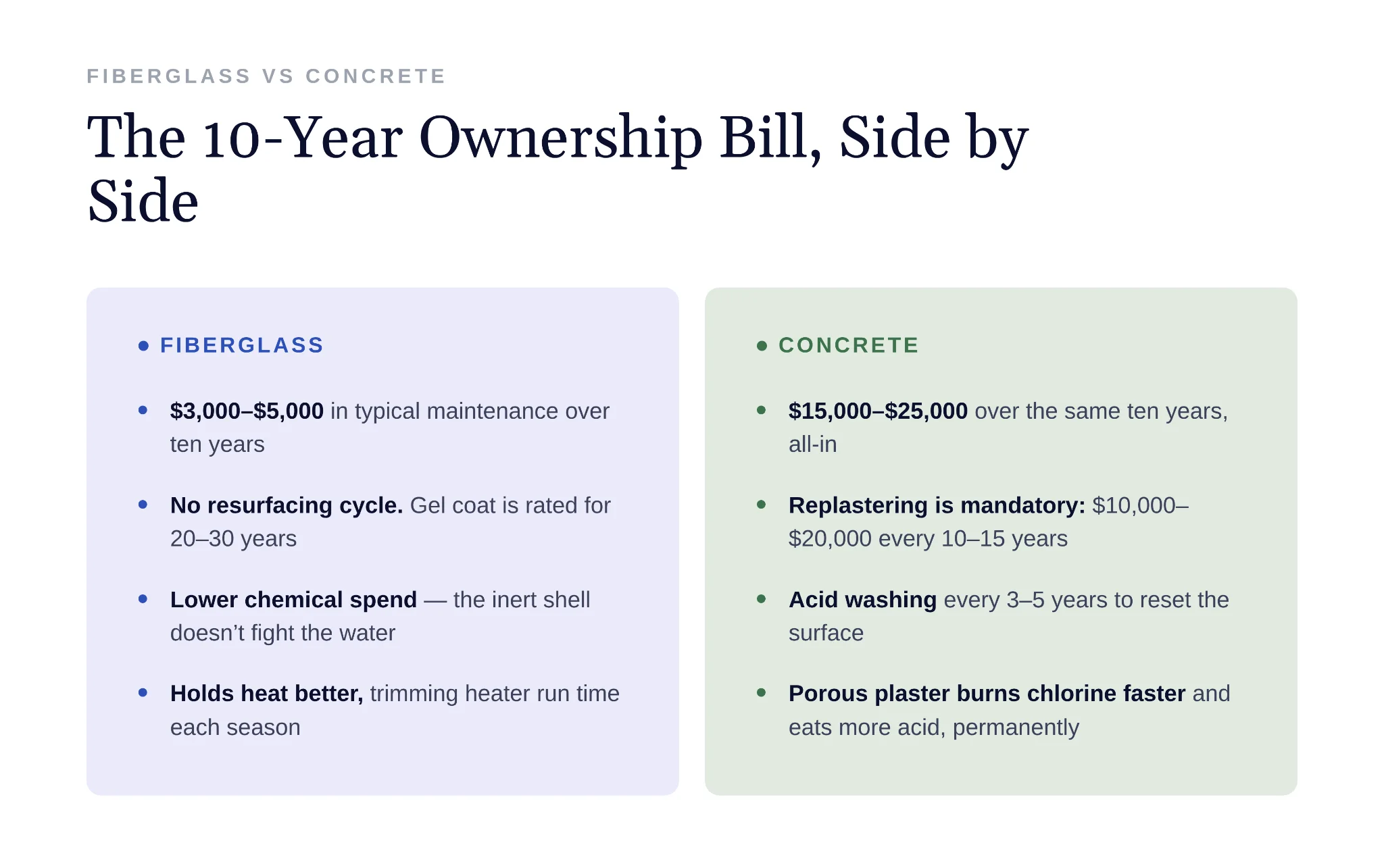
That job runs $10,000 to $20,000, and it is not optional. Own a concrete pool for thirty years, and you’ll pay for the interior two or three times.
Fiberglass has no equivalent line item. A vinyl liner is the opposite, since it carries a built-in replacement schedule, and our guide to fiberglass and vinyl liner pools compared for durability covers that tradeoff. The gel coat is rated for twenty to thirty years, and plenty of shells from the nineties are still running their original surface. You might refinish once. Maybe never.
Chemicals
Concrete pools eat more chemicals. The surface is porous, so it harbors algae and burns chlorine faster. It’s also alkaline by nature, pushing your pH up continuously, so you’re adding muriatic acid on a schedule that never really ends.
A fiberglass shell is chemically inert. It doesn’t push pH anywhere, and the non-porous gel coat gives algae almost nothing to grip. Owners routinely report chemical costs at half to two-thirds of a comparable concrete pool. Heating tilts the same way: concrete bleeds heat into the surrounding earth, while fiberglass holds it.
What ten years total
A fiberglass pool might cost you $3,000 to $5,000 in maintenance over ten years.
A concrete pool over the same stretch with chemicals, acid washing every three to five years, and amortizing the inevitable resurface, it lands somewhere between $15,000 and $25,000.
The pool that cost less on day one usually costs less on day 7,300 too.
What It Feels Like, Which Nobody Puts in the Quote
Fresh plaster feels fine.
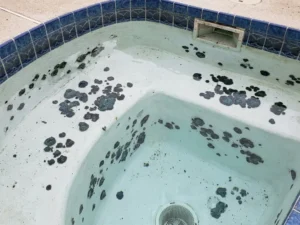
Three-year-old plaster is where the trouble starts, it etches, roughens, and eventually you get the classic concrete-pool signature: scraped toes.
Kids who spend a whole afternoon in a plaster pool come out with the pads of their feet sanded pink.
Pebble finishes are more durable but frankly rougher from day one; some people love the texture, some people find it borderline unpleasant to sit on the steps.
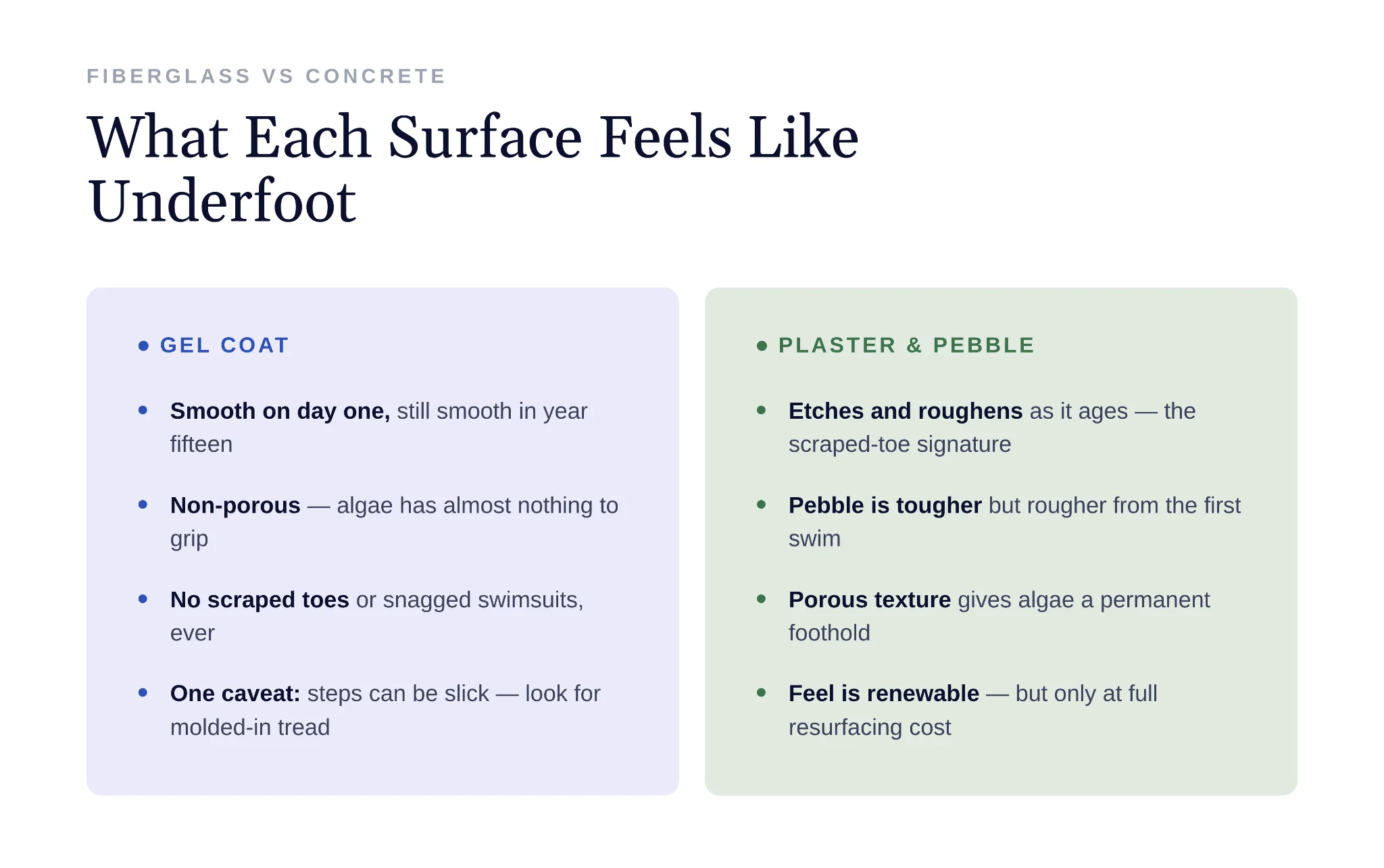
Gel coat is smooth. That’s it, that’s the whole story: smooth on day one, smooth in year fifteen. No scraped feet, no snagged swimsuits, nothing for algae to root into.
There’s one honest caveat: smooth cuts both ways.
Fiberglass steps and tanning ledges can be slick, particularly for older swimmers, which is why most manufacturers now mold in textured tread surfaces. Worth checking on the specific shell you’re looking at rather than assuming.
Water temperature feels different too.
Fiberglass pools warm up faster in spring and hold heat better into the evening. In a cool climate, that can mean two or three extra weeks of comfortable swimming on each end of the season without touching the heater. That’s a shell-material effect, separate from whatever the thermometer outside says — our breakdown of why pool and air temperature disconnect covers the rest of that lag.
The Chemistry Never Sleeps in Concrete
This deserves its own space because it’s the part people underestimate most.
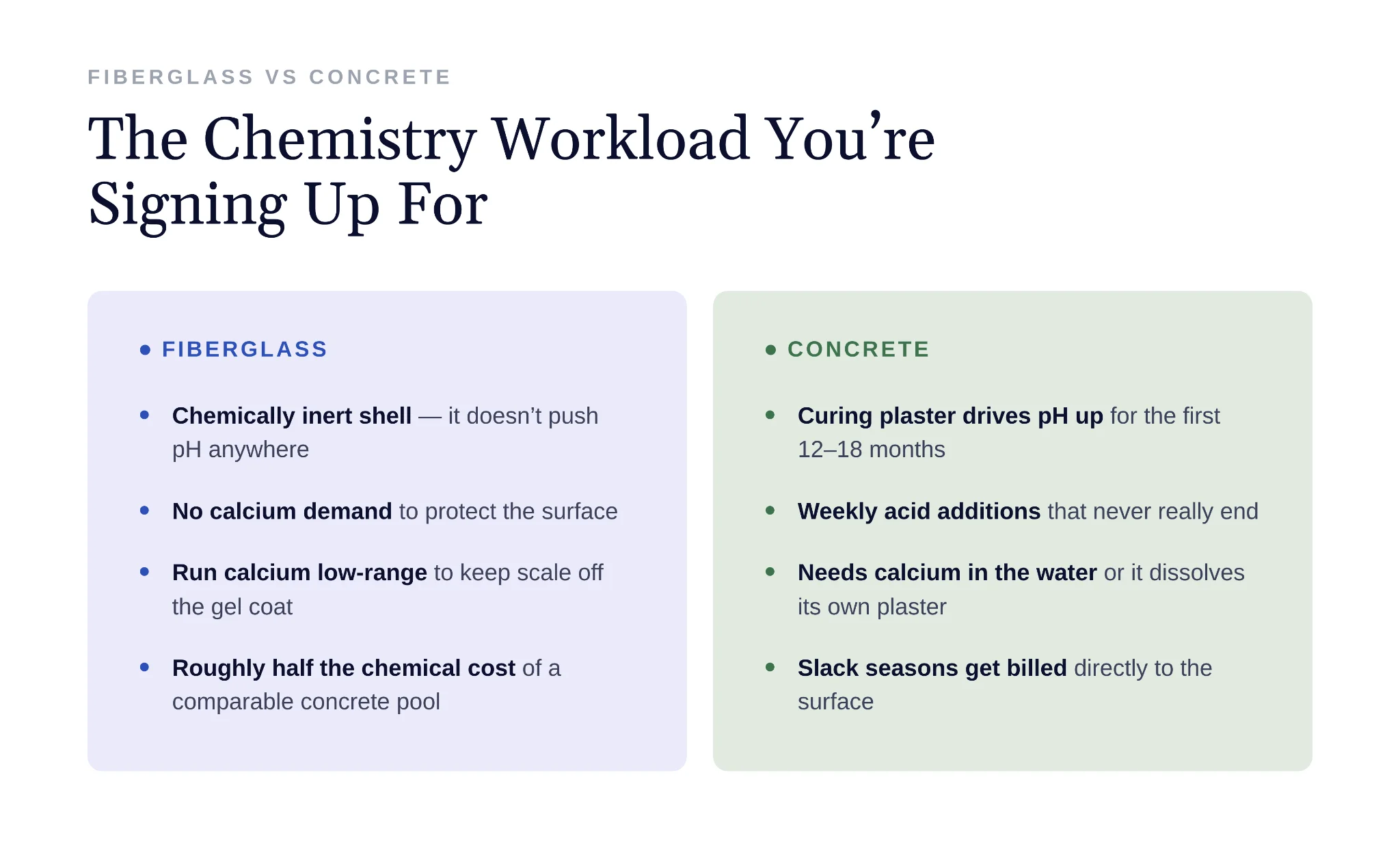
A concrete pool is an active participant in its own water chemistry. Curing plaster leaches calcium hydroxide for twelve to eighteen months, driving pH up week after week.
You correct with acid. The acid, over years, contributes to etching. The etched surface gets more porous. The more porous surface holds more algae, which demands more chlorine, which stresses the surface further.
It’s a slow loop, and disciplined owners manage it fine, but it is management, permanently, and every season you slack off gets billed to the plaster.
Fiberglass asks much less.
Balance it, sanitize it, done. The one thing gel coat genuinely dislikes is high calcium, as the scale deposits on a smooth surface are visible and stubborn, so you keep calcium hardness on the lower end of range rather than the higher end you’d run in concrete.
That’s the whole inversion. Otherwise the shell just sits there, inert, not fighting you.
Where Concrete Wins Outright
Design. There is no second answer.
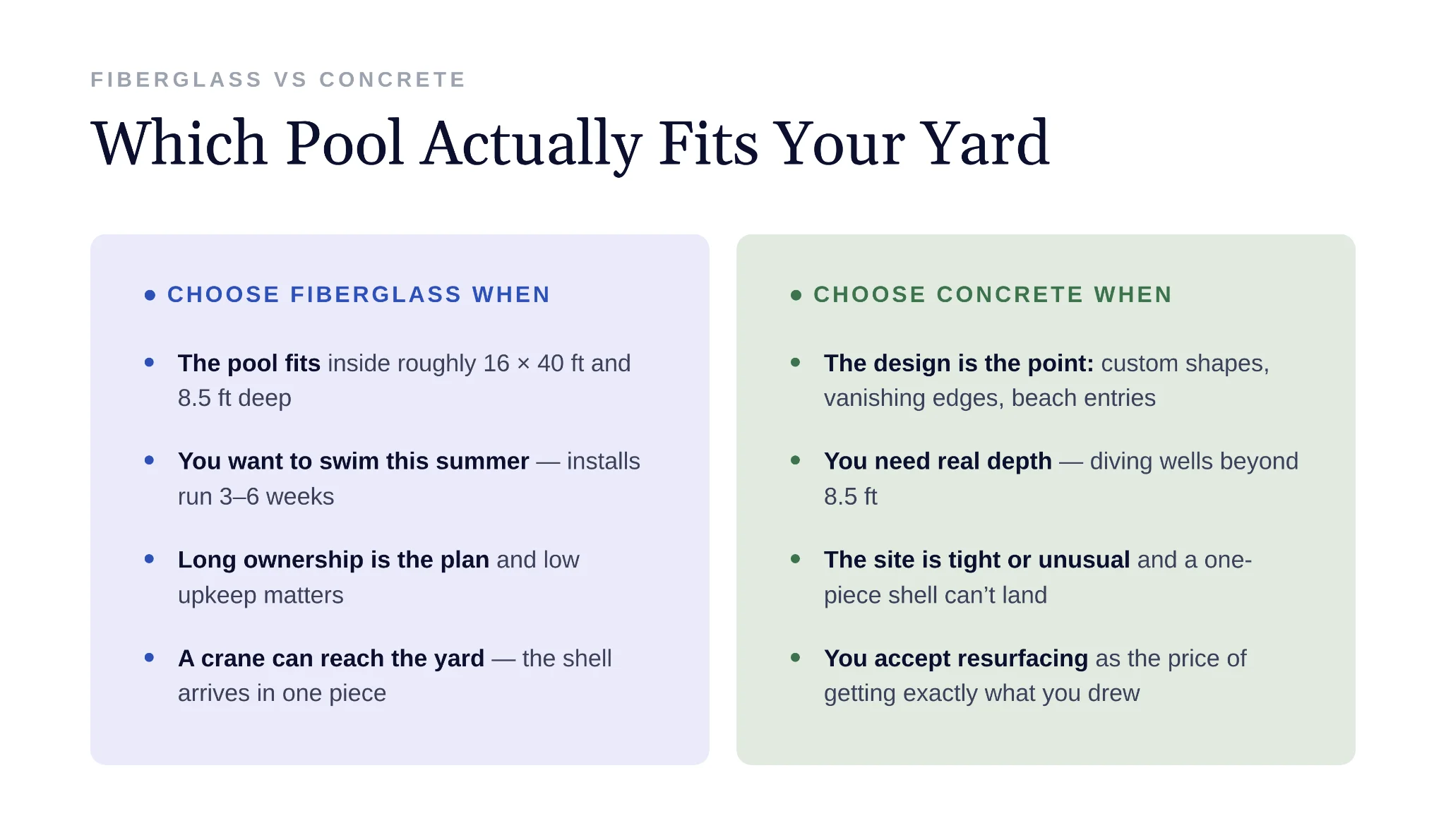
But the same fact that gives concrete its freedom, formed in place versus shipped in one piece, is what hands fiberglass the speed advantage, so both sides belong here.
Concrete is formed in place, so the constraint is your yard and your budget, full stop. Forty meters of lap lane. A vanishing edge falling off a hillside. A nine-foot diving well, a beach entry, a shape that traces the curve of your house. If you can draw it and pay for it, a good builder can shoot it in gunite.
A fiberglass pool is a shell built on a factory mold and delivered by truck. That one fact generates every limitation:
Width caps at roughly sixteen feet: Highway transport, not engineering, sets the limit
Lengths top out around forty feet: Depths rarely pass eight and a half, so a true diving pool is mostly off the table
You’re choosing from a catalog: Far better one than fifteen years ago, but if the mold doesn’t exist, the pool doesn’t exist
Delivery needs crane access: Tight lots, power lines, or no side access can kill the project before a shovel hits dirt
The shell arrives as one piece: No adjusting it three inches to clear a setback line on site
The trade is speed. Fiberglass installs in three to six weeks; the shell can be in the ground two days after excavation.
Concrete is a three-to-six-month project with a curing period you cannot rush. Sign in spring, fiberglass swims that summer — and if a full pool is more than you need, our guide to pool spas and hot tubs compared side by side covers the smaller-scale option. Concrete might not.
What Actually Goes Wrong With Each
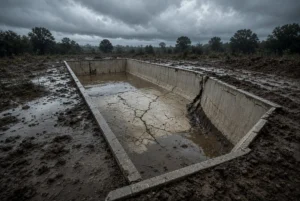
Concrete cracks. Ground movement, poor compaction, or a hard freeze can produce real structural cracks that need injection or, worst case, partial reconstruction.
Concrete pools in expansive clay soils are a known headache, and repair costs scale with how bad it gets.
Fiberglass shells flex instead of cracking, which is mostly a virtue. Their failure modes are different: osmotic blisters in the gel coat on older or poorly made shells, spider cracking around high-stress points.
A fiberglass pool is only as good as the backfill around it. Improperly compacted backfill lets the shell shift or bulge, and fixing a shifted shell means excavation.
This is why the installer matters more than the brand with fiberglass; the shell itself is factory-consistent, but the hole it sits in is not — and leveling the ground for an above-ground pool matters just as much.
Gel coat repairs carry one permanent annoyance: color matching. A patched spot on a fifteen-year-old sun-faded shell will read as a patch.
Plaster repairs blend badly too, but a concrete pool can always be fully resurfaced back to uniform; a fiberglass shell mostly can’t, not economically.
How to Decide
If your yard is straightforward, your desired pool fits inside sixteen by forty feet, and you plan to own the thing for a long time, choose fiberglass.
You’ll pay slightly less or about the same upfront, dramatically less over the years, spend fewer weekends fighting the water, and the surface will still feel good under bare feet a decade in.
If the design is the point, a specific shape, a serious deep end, an infinity edge, a pool that’s architecture rather than equipment, concrete is the only material that can do it. You have to accept the resurfacing cycle and the chemistry workload as the price of getting exactly what you drew.
That’s a legitimate trade. Plenty of people make it with their eyes open and never regret it.
The people who regret their choice are almost always the ones who bought concrete for a rectangle. They paid the flexibility premium for a shape fiberglass ships by the thousands, and then paid it again at every resurface.
The Part of Ownership That’s the Same Either Way
Whichever shell you choose, the water doesn’t clean itself. Leaves, pollen, dirt, and sunscreen film land in both pools alike, and all of it feeds the chlorine demand that makes concrete chemistry spiral and puts scale-forming stress on a gel coat.
The pools that stay easy to own, in either material, are the ones where debris never gets to sit.
That’s the job Aiper’s robotic pool cleaners take off your plate entirely.
The Scuba series climbs walls, scrubs the waterline, and maps the floor on its own schedule, which matters more in concrete, where a porous surface hands algae a foothold the moment circulation slacks, and keeps a fiberglass gel coat looking like it did on delivery day.
Whichever pool ends up in your yard, the difference is between owning it and working for it.
Get more pool and lawn care guides from Aiper on Google