Pool Plaster Repair: When to Patch, When to Resurface

Plaster is a wear surface.
That’s the first thing to get straight, because most owners treat it like the pool itself: permanent, structural, supposed to last forever.
It isn’t. It’s a half-inch cementitious skin troweled over a gunite shell, and its whole job is to be sacrificial.
Water chemistry chews on it so the shell underneath stays intact. A well-maintained plaster job gives you somewhere between eight and fifteen years. A pool run soft and acidic for two summers can look twenty years old at year five.
Patch a pool that needed resurfacing, and you’ll be back in the water with a chisel every spring.
Resurface a pool that needed one honest patch, and you’ve spent eight to twelve thousand dollars solving a two-hundred-dollar problem. If you are unsure whether a quote means plaster or another finish, see the difference between pool resurfacing and replastering.
Figure Out What Kind of Failure You’re Looking At
Not all plaster damage means the same thing, and this is where most people go wrong: they see damage as one category. It’s at least five.
Check cracking
This is a network of fine hairlines that looks like a dropped windshield. It shows up early, sometimes within the first year, and it’s almost always a curing artifact: plaster that dried too fast, got troweled too hard, or went in on a hot, windy day.
This is ugly but structurally meaningless. You don’t patch crazing because there’s nothing to patch; the plaster is still bonded and still doing its job.
Spot etching
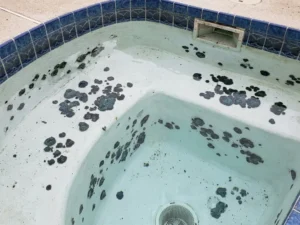
This is different. Aggressive water, like low pH, dissolves the cream at the surface and leaves rough, whitish, slightly recessed spots that catch your toes.
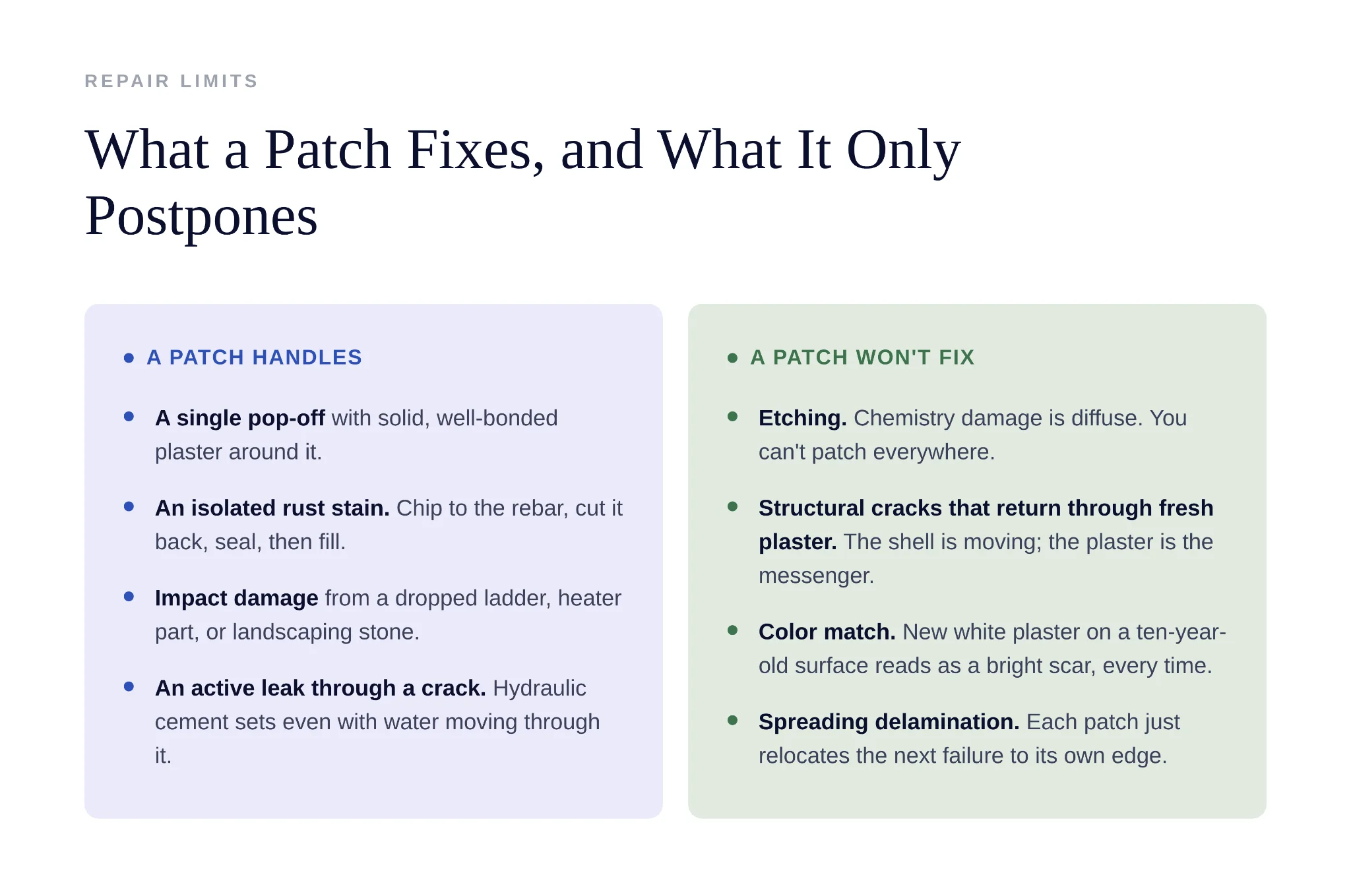
Etching is chemistry damage, and it’s diffuse. You cannot patch it, because it isn’t in one place. It’s everywhere, in varying stages.
Delamination
Delamination means the plaster has separated from the gunite behind it. Sometimes it announces itself as a pop-off, a chunk lets go, and you’re looking at raw grey shell. Sometimes it hides as a calcium nodule, a little volcano of white deposit growing out of the surface.
People grind nodules off and think they fixed something. They didn’t. The nodule is calcium hydroxide migrating through a crack from a void behind the plaster. Grind it flush, and it grows back, because the void is still there.
Structural cracks
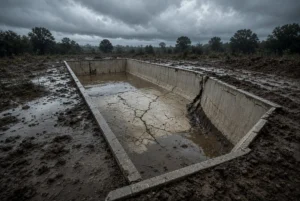
Cracks that go through the shell are their own animal. If a crack keeps returning through fresh plaster in the same line, the plaster is the messenger, not the problem. The shell is moving. Soil, groundwater, a plumbing leak washing out fill under the deep end.
No plaster repair fixes that, and anyone who quotes you one is quoting you a recurring appointment.
Rust stains
Small brown dots with a hard center usually mean rebar too close to the shell surface, corroding and expanding. Those get chased individually: chip to the steel, cut it back, seal, patch. For a broader read on what’s actually staining your plaster before you start chipping into it, see our pool stain diagnosis guide.
Annoying but manageable, unless there are dozens, in which case the shotcrete crew shot the steel shallow across the whole pool, and you have a longer conversation ahead.
Sound the Surface Before You Decide Anything
Here’s the twenty-minute step that most owners skip and no honest contractor does.
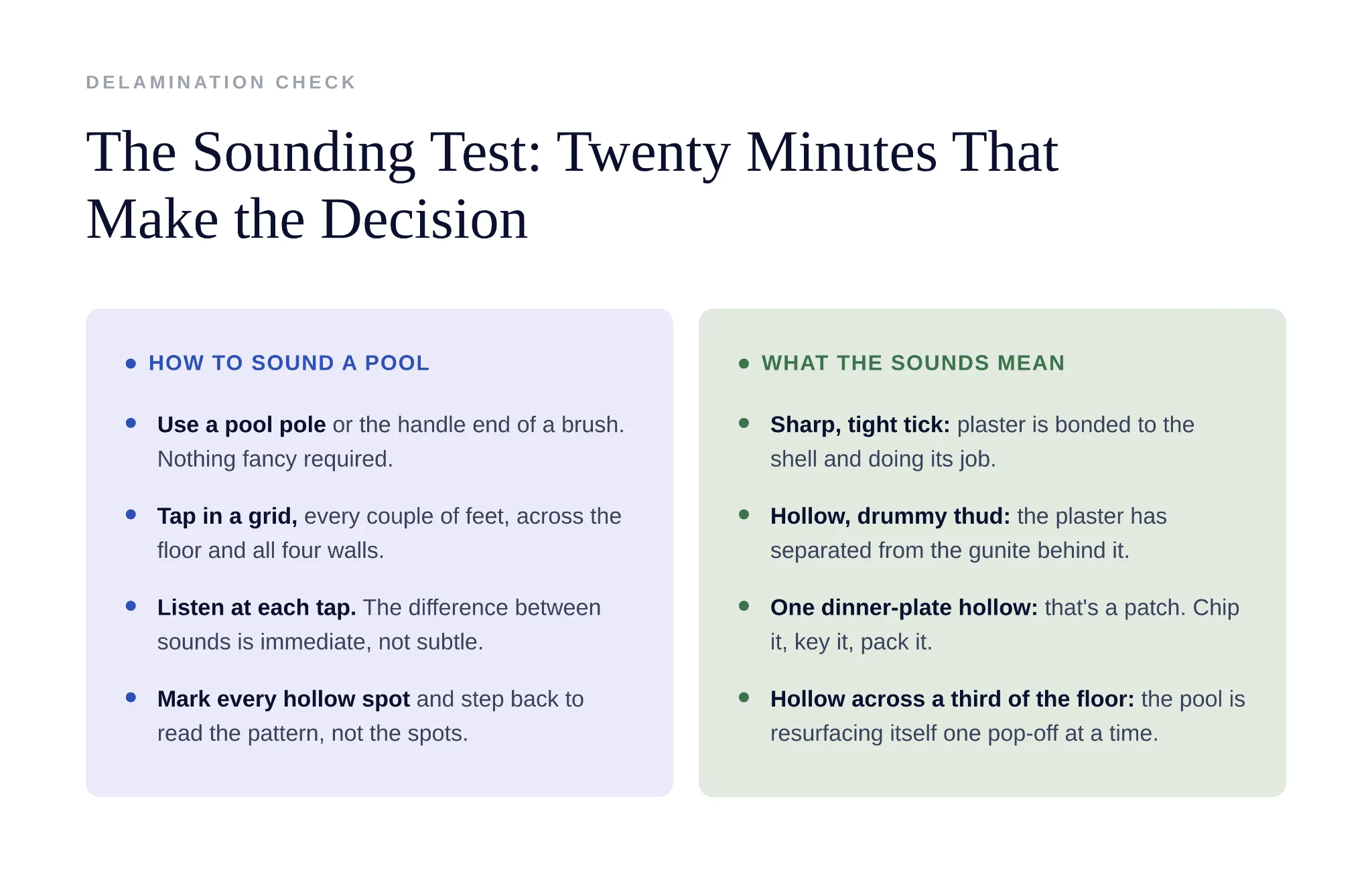
Take a pool pole, or the handle end of a brush, and tap your way across the plaster. Walls and floor, in a grid, every couple of feet.
Well-bonded plaster sounds tight and solid, a sharp tick.
Delaminated plaster sounds hollow. Drummy. You will hear the difference immediately; it’s not subtle.
Now map it. A hollow spot the size of a dinner plate near the tile line is a patch.
Hollow returns from a third of the floor, or a wall that drums along its whole length below the waterline, that pool is already resurfacing itself, one pop-off at a time, and you’re just choosing whether to schedule the work or let it schedule you.
The sounding map is the decision. Everything else is detail.
What a Patch Can Honestly Do
A patch works when the failure is local and the surrounding plaster is sound. One pop-off. A rust spot. A gouge from a ladder that got dropped in wrong. A hollow area you can cover with two hands.
Doing it right matters more than the material:
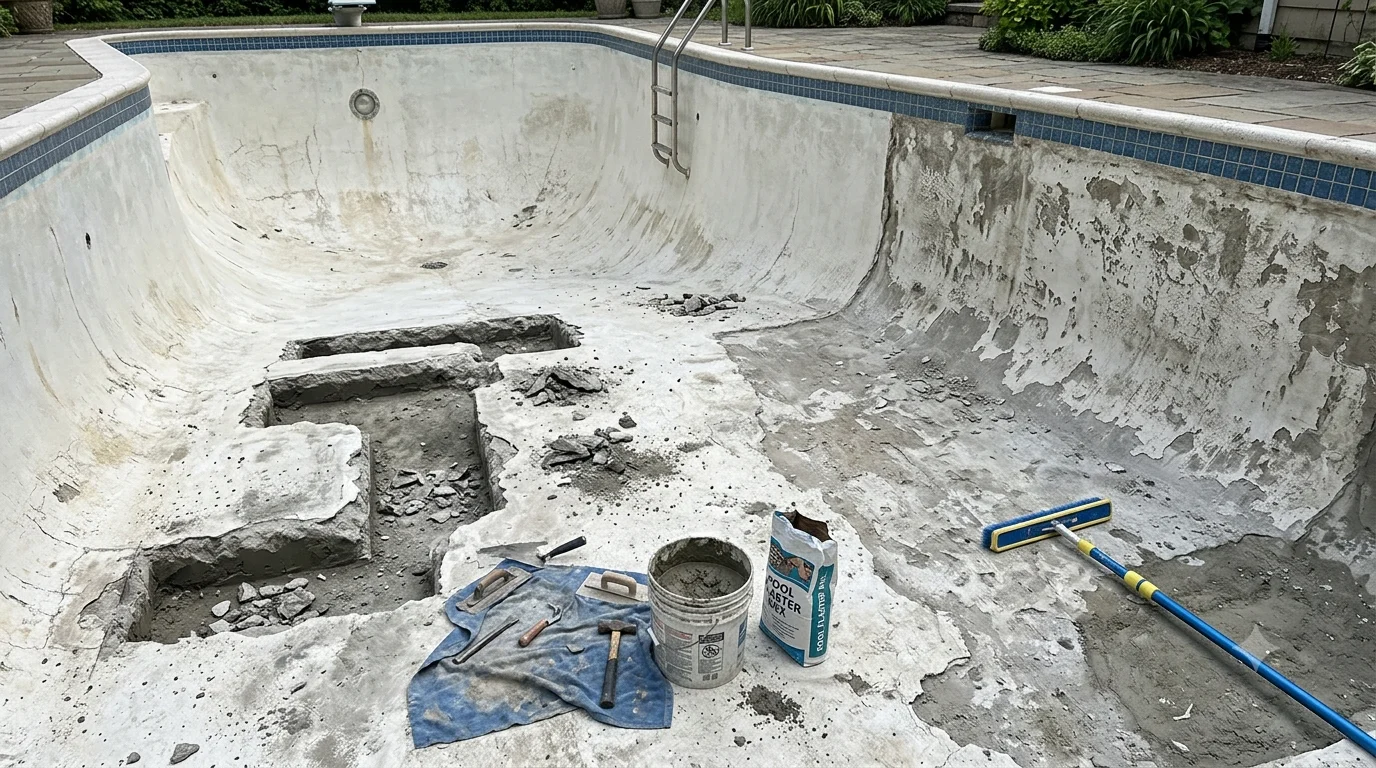
Chip back past the loose stuff until you hit plaster that rings solid, the visible damage is never the whole damaged area, and the most common patch failure is bonding new material to old material that was already letting go.
Undercut the edges so the hole is wider at the bottom than at the top, a dovetail, so the patch is mechanically keyed in and not just glued on. Never feather plaster to zero thickness.
A feathered edge is a flake waiting for a season.
Wet the substrate, use a bond coat or an acrylic-fortified mix, pack it, trowel it, keep it damp while it cures. Underwater epoxy putties and hydraulic cement have their place. Hydraulic cement will stop an active leak through a crack while water is still pouring through it, which is genuinely useful, but treat underwater patches as tourniquets. They hold. They don’t heal.
Now the part nobody likes hearing: the patch will not match. Ever.
New white plaster against ten-year-old plaster looks like a bright scar, because the old surface has a decade of mineral uptake and micro-etching that a fresh trowel of white portland and marble dust does not.
Colored and quartz finishes are worse, the pigment lot is different, the aggregate blend is different, the exposure is different. A good patch on an aged pool is a structural success and a cosmetic compromise, full stop.
If a contractor promises an invisible patch on old plaster, that tells you something about the rest of their promises.
Also worth knowing: mobilization is most of the cost.
A crew showing up, setting up, mixing a bag, and leaving costs nearly the same whether they fix one spot or six. If you’re paying someone to come out, walk the pool and sound everything first, and have them do all of it in one visit.
When Patching Stops Making Sense
Some thresholds, learned the hard way rather than pulled from a chart.
If more than roughly a quarter of the surface is compromised, you’re past patching. Not because a patch can’t be done, but because the failure mode is systemic. The bond is going, or the chemistry already ate the cream everywhere, and each patch just relocates the next failure to its own edge.
If the whole pool feels like 80-grit sandpaper on your feet, that’s etching, and etching is a resurface.
If you’re on your second or third generation of patches, patches next to patches, patches on patches, stop. Every dollar from here forward is a dollar you’ll spend again, plus the resurface you were avoiding.
If calcium nodules keep appearing in new locations, the delamination is spreading behind the surface where you can’t see it. The nodules are the map.
And if the pool has already been replastered once before, know that most plasterers will only bond one new coat over an existing one.
Two layers of finish over the original is the practical ceiling; past that, the whole sandwich comes off in a chip-out or hydro-blast, which changes the price of the job considerably. Worth asking what’s on your shell before assuming.
The Resurface Itself, and the Two Ways It Goes Wrong
A resurface is straightforward in outline. Drain, prep, replaster, refill, start up — that’s the full resurface, though stained plaster sometimes only needs an acid wash to remove plaster stains instead. The failures cluster at the first step and the last one.
Draining a pool is not a neutral act. An in-ground shell in an area with a high water table is essentially a boat, and the water inside it is ballast.
Pull that ballast out after a wet spring, and hydrostatic pressure can lift the entire shell out of the ground. Floated pools are real, they are catastrophic, and they happen to people who drained on the wrong week.
This is what the hydrostatic relief valve in the main drain sump is for.
It’s also why draining and dewatering belong to the contractor’s insurance policy, not your Saturday.
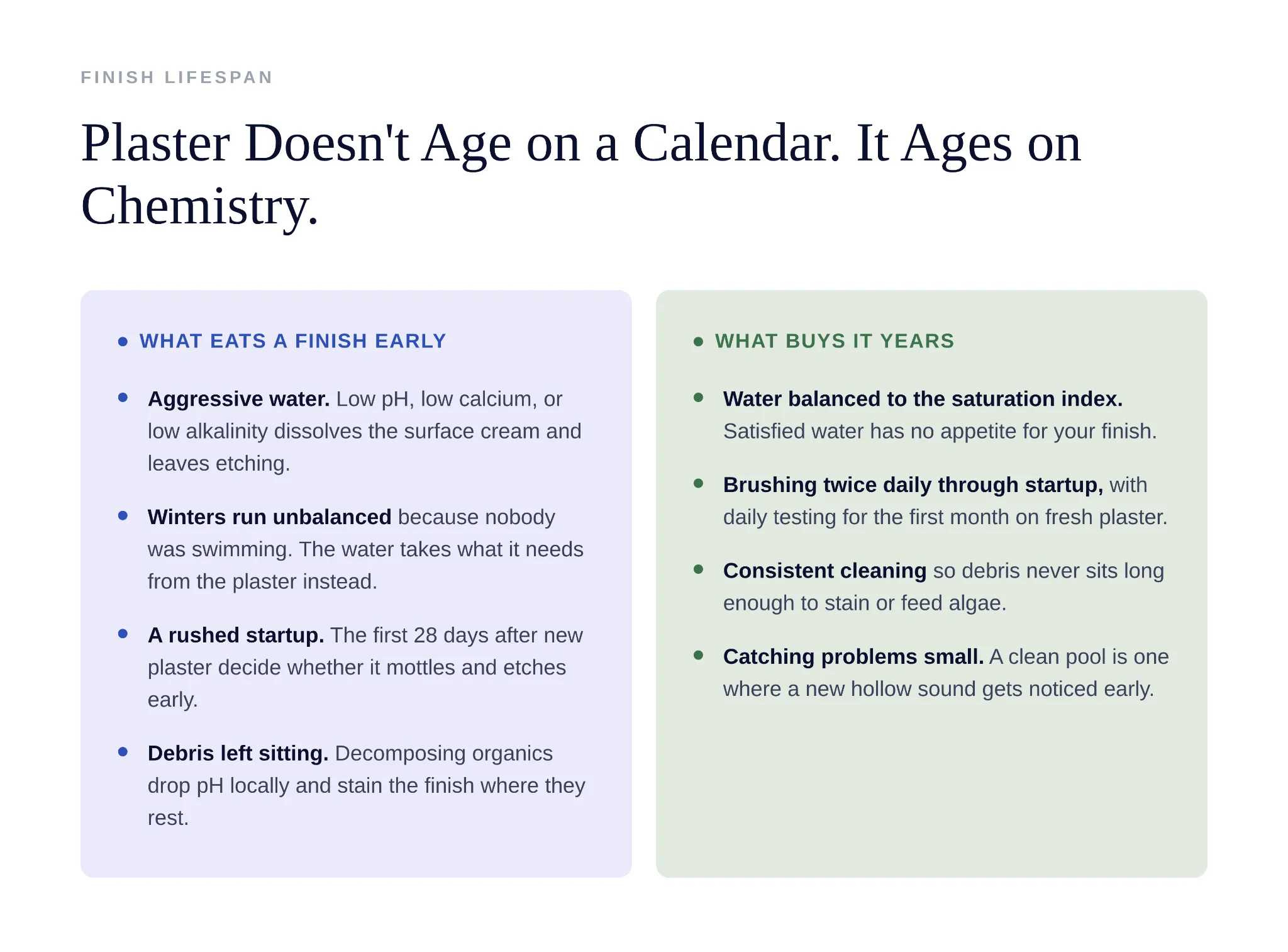
The other place resurfacing dies is the startup. Fresh plaster is chemically alive for about a month: shedding plaster dust, throwing off calcium hydroxide, driving pH upward daily.
The first 28 days decide what that finish looks like at year eight. That means:
Brushing twice a day
Testing daily
Keeping the water balanced the whole way through
A perfect plaster job with a lazy startup will mottle, streak, and etch early, and there is no fixing a bad startup after the fact. If you paid for the resurface, protect it. This is the cheapest month of diligence you’ll ever spend on the pool.
Chemistry is also, not coincidentally, why the plaster failed in the first place more often than not. Plaster doesn’t wear out on a calendar. It wears out on an LSI curve.
Keep calcium, pH, and alkalinity where the saturation index wants them, and the water has no appetite for your finish.
Let the pool run aggressive all winter because nobody was swimming, and the water eats plaster instead. It takes what it wants from whatever’s available.
Keeping the Next Surface Alive Longer
Whichever way you go, the surface you end up with lasts as long as the water touching it stays balanced and the plaster stays clean.
A pool that gets cleaned consistently is a pool where you notice a new rough patch or a hollow sound early, when it’s still a patch and not a project.
That’s the practical case for taking the daily cleaning off your own plate.
A robotic cleaner like an Aiper runs the floor and walls on its own schedule, keeps debris from sitting on the finish, and does the low-glamour maintenance that decides whether your plaster gets its full fifteen years or taps out at nine. The chemistry is still your job. The scrubbing doesn’t have to be.
Get more pool and lawn care guides from Aiper on Google