

Before any of the fixing, one question decides whether the work lasts or wastes a weekend: why is it uneven?
A lawn that settled unevenly after the house was built stays put once you fix it.
A lawn going bumpy because voles are tunnelling under it, or a buried stump is rotting down and the soil above is collapsing into the void, will be back to being bumpy within a year, as the cause is still running underneath.
Figure out what you’re dealing with first. Sometimes the fix isn’t leveling at all.
Topdressing Fixes Minor Unevenness
For the normal case, a lawn that’s generally fine but wavy, topdressing is the fix, and it’s the only one on this page that reliably works without tearing anything up.
Spread a thin layer of material over the low spots, let the grass grow through it, and repeat until the surface evens out. That’s it. The grass is never buried or killed, just slowly lifted level as material fills in underneath and around it.
The material matters:
- A sand-heavy mix flows into dips and firms up well
- Straight topsoil works but can hold its lumps
- Compost feeds the grass but breaks down and settles, so you’re chasing the level longer.
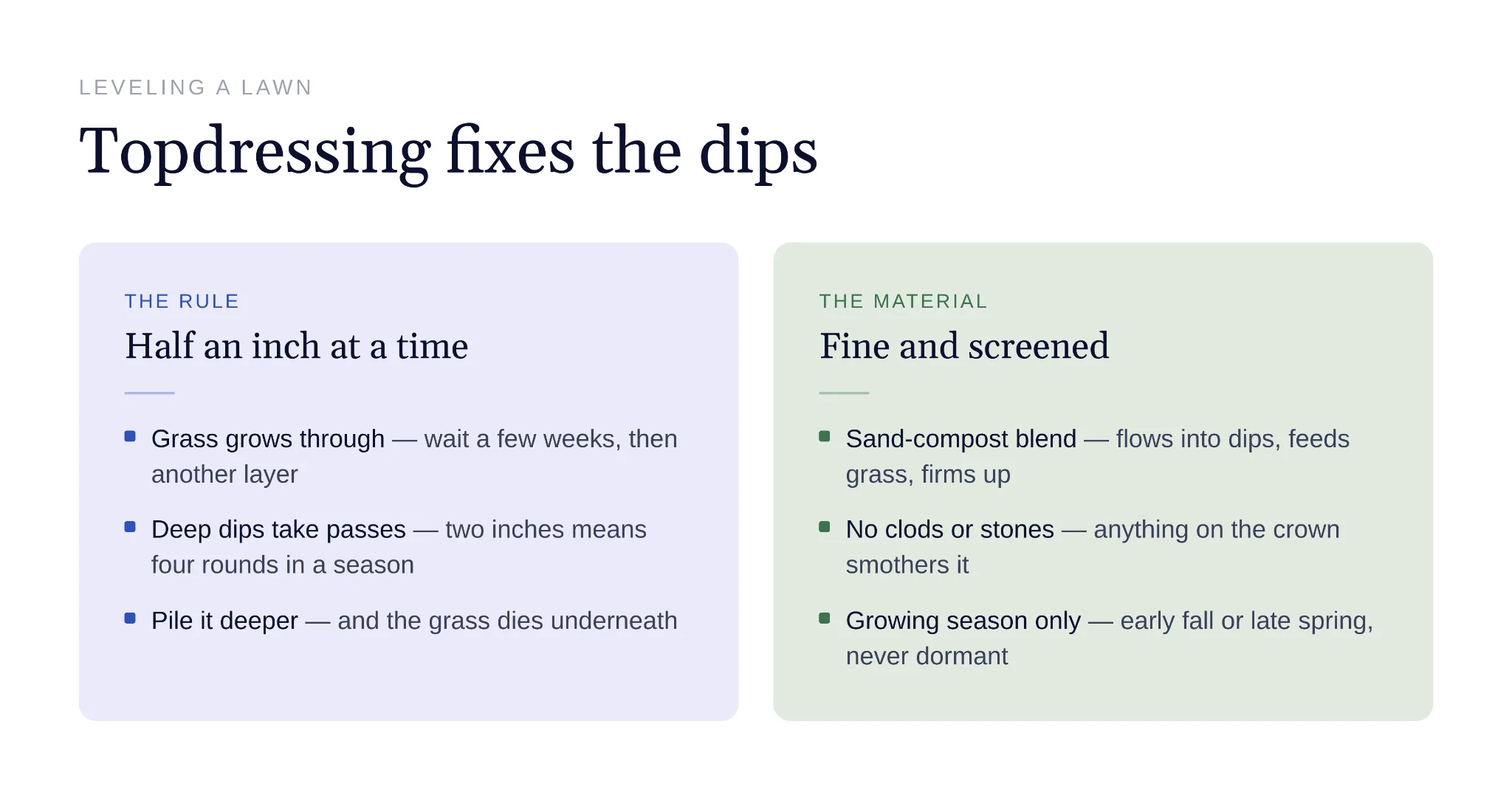
A lot of people use a sand-and-compost blend to get flow and nutrition at once. Whatever you use, it has to be fine and screened, with no clods or stones. Nothing that’ll sit on the crown of the grass and smother a patch.
Here’s the rule that makes or breaks it: half an inch at a time, maximum.
Pile topdressing deeper than that, and you bury the grass faster than it can grow through, and it dies under there.
A deep dip you want to raise two inches doesn’t get two inches of sand in one go. It gets half an inch, then you wait for the grass to grow up through it and knit back in, a few weeks in growing season, then another half inch. Four passes across a season. Slow is the only way that doesn’t kill the lawn you’re trying to save.
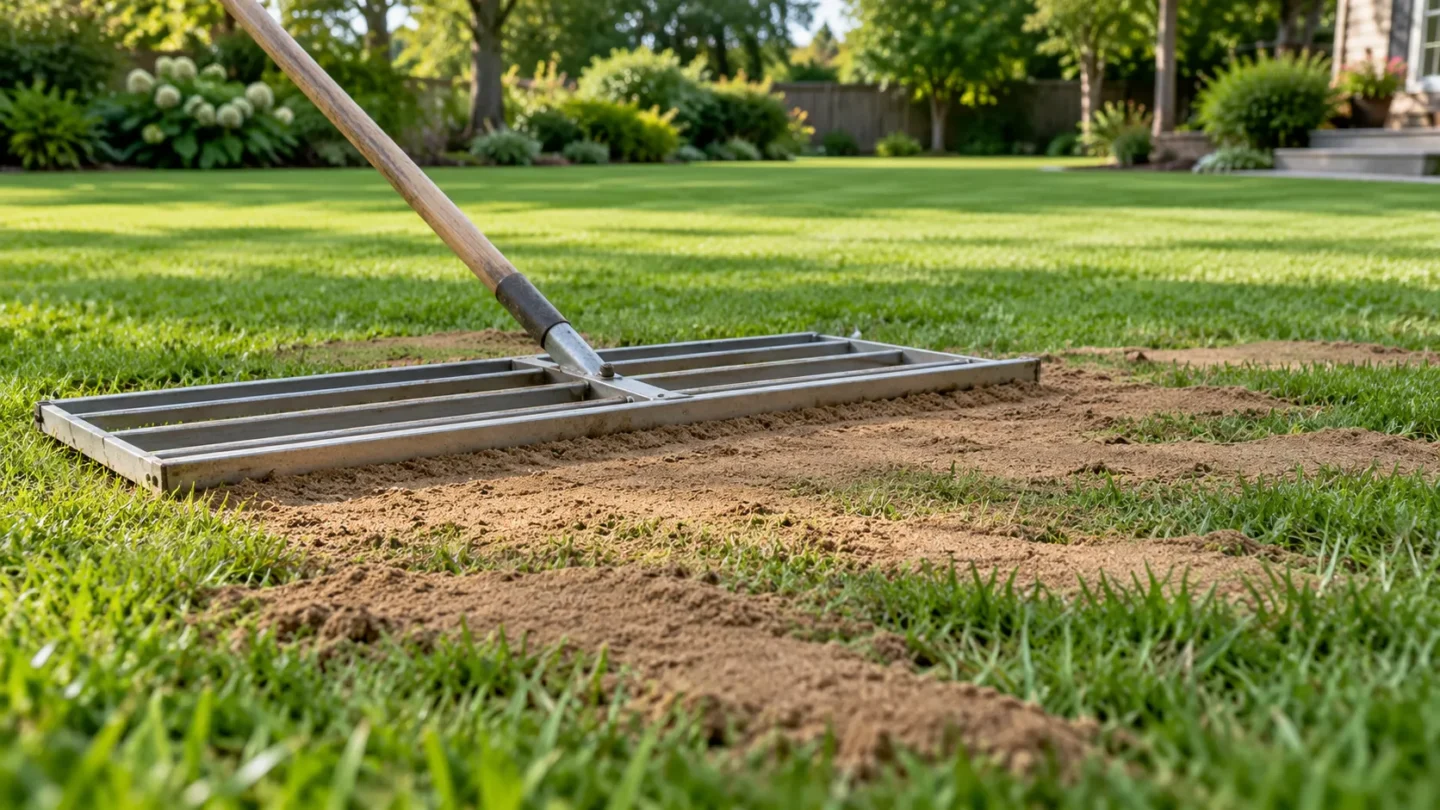
Spread it, then work it in with the back of a rake or a leveling rake or a dragged piece of chain-link, pushing material into the low spots and off the high ones until the grass tips show through evenly. Then water it.
Do it when the grass is growing hard enough to recover, the same windows as aeration: early fall for cool-season grass, late spring for warm-season. Topdress a dormant lawn and the material just sits there on top of grass that can’t grow through it.
Watering a Leveled Lawn Evenly
Topdressing and sod-flap repairs only hold if the new growth fills in at the same rate across the whole patch. A dip that gets watered harder than the grass around it recovers faster, the surface rises unevenly again, and the level you worked for drifts back. Even water over the entire area is what sets the repair.
The Aiper IrriSense 2 covers that part. It’s a 4-in-1 smart sprinkler that maps the lawn into zones and waters each one to a set depth, using EvenRain technology to lay water down like steady rainfall rather than soaking some spots and skipping others. Schedule it once in the app, and the repaired sections get the same water as the rest on every cycle. The built-in weather response cancels a run after rain, so freshly topdressed ground doesn’t flood and wash out.
One unit covers up to 4,800 sq ft and installs in about 15 minutes, with no buried pipe.
Using Rollers
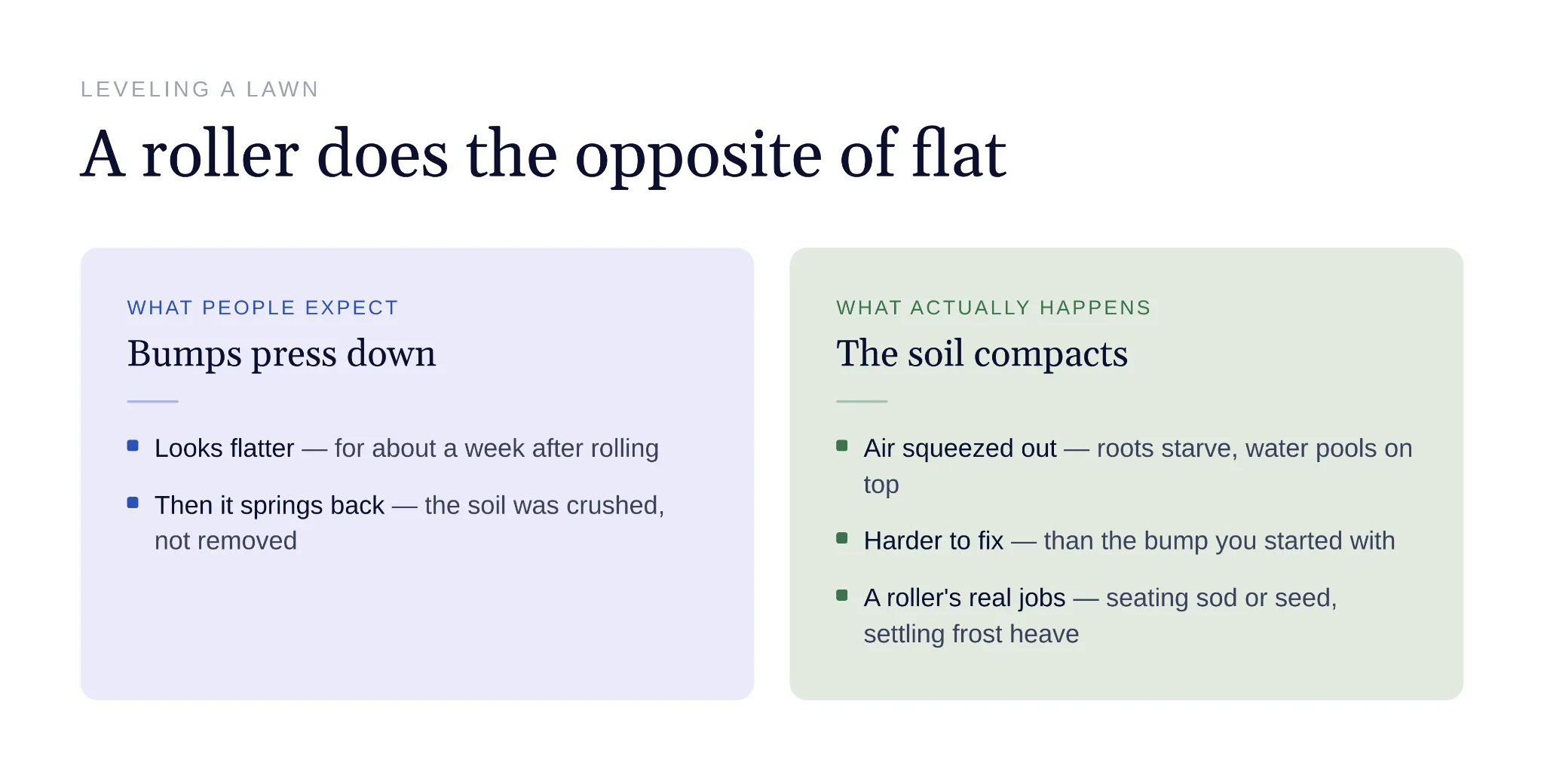
The lawn roller is the most misunderstood tool in the shed, and the belief attached to it causes real damage.
The belief is that you fill a big drum with water, roll it over a bumpy lawn, and the bumps press flat. It’s intuitive but wrong.
A roller does not flatten a lawn in any way that lasts. What it does is compact the soil — it presses the particles together, squeezes the air out, and hands you the exact problem that starves grass of oxygen and makes water pool instead of soak.
You roll a bumpy lawn, and for about a week it looks a little flatter. Then it springs back, except now the soil underneath is packed, the grass is struggling, and you’ve traded a cosmetic bump for a drainage and root problem that’s genuinely harder to fix than what you started with.
Bumps aren’t the surface sitting high. They’re soil sitting high. A roller doesn’t remove soil. It just crushes the grass and the top layer for a moment. The soil’s still there.
So when is a roller the right call?
Narrow cases. Pressing newly laid sod into contact with the soil beneath it, so the roots bridge the seam — light pass, once. Pressing seed into the surface after overseeding, same idea. And in spring, in cold regions, gently rolling turf that frost-heaved over winter, while the ground is still soft from thaw, to settle it back down.
If someone tells you to roll your lawn flat, they’re repeating something that sounds right and isn’t. Topdress the dips. Leave the roller.
High Spots Need Soil Taken Out, Not Pressed Down
A dip you fill from the top. A bump works the other way. You can’t topdress a high spot. There’s nothing to add. The problem is excess soil, and it has to come out.
For a distinct mound, cut an H-shape or an X through the turf over the bump with a flat spade, peel the flaps of sod back like opening a book, and remove soil from underneath until the ground sits level.
Then fold the sod back down, press it into contact, and water it well for a couple of weeks while the cut edges heal. The grass survives because you never killed it. You simply lifted it, took soil out below, and set it back.
This is more work than topdressing, and it’s worth doing right only on bumps too tall to fix any other way. A mound that’s an inch proud, leave it — topdressing the area around it over a couple of seasons brings the surroundings up, and the bump stops reading as a bump. Only the genuinely tall ones, the ones the mower scalps to dirt every pass, earn the spade.
When the Lawn Is Beyond Leveling
Some lawns are not uneven. They’re wrong.
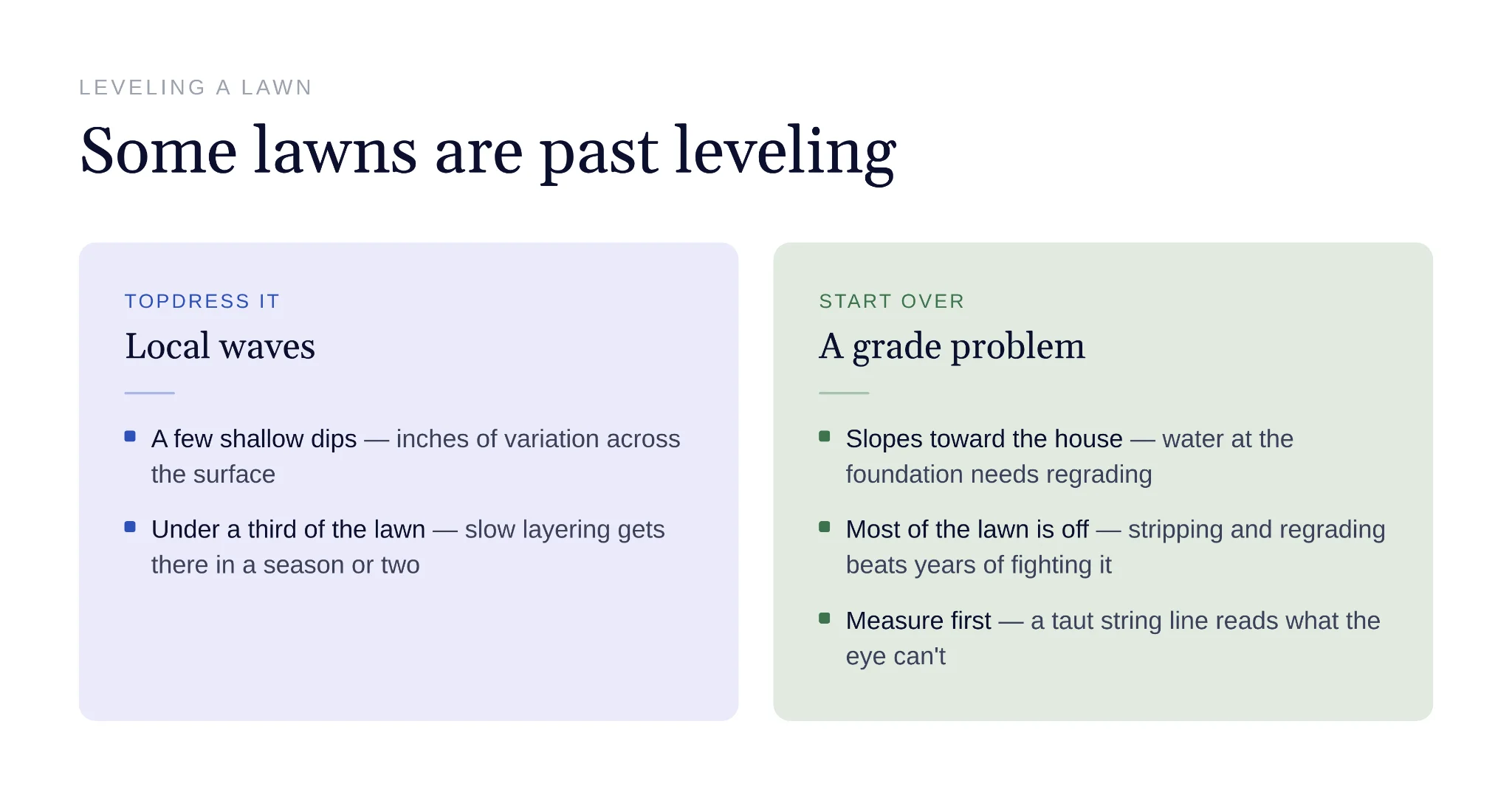
A whole yard that slopes the wrong way — toward the house instead of away from it — is not a bumpiness problem. It’s a grade problem, and no amount of topdressing fixes it because the issue is the entire plane the lawn sits on.
Water running toward a foundation is a problem worth real money to fix and worth fixing properly, which means regrading, which means starting over on that section or the whole thing.
The other start-over case is sheer extent. If more than a third of the lawn needs raising, if the surface is so broken that you’d be topdressing half of it four times a season for two years, the slow method stops making sense.
At that point you strip the turf or kill it off, bring in soil, grade it properly with the fall running away from the house and the structures, roll it then — this is the one legitimate flat-the-whole-thing roll, on bare graded soil before planting, to firm it and reveal the dips you missed — and reseed or re-sod onto a surface that’s right from the start.
The screwdriver-and-string test tells you which camp you’re in before you commit either way.
Measure before you decide. The eye is a bad judge of grade, and the difference between a season of topdressing and a full teardown is exactly the thing you can’t see by looking.
Get more pool and lawn care guides from Aiper on Google