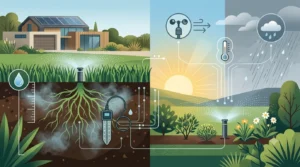
How to Topdress a Lawn: The Pro-Level Soil Health Move

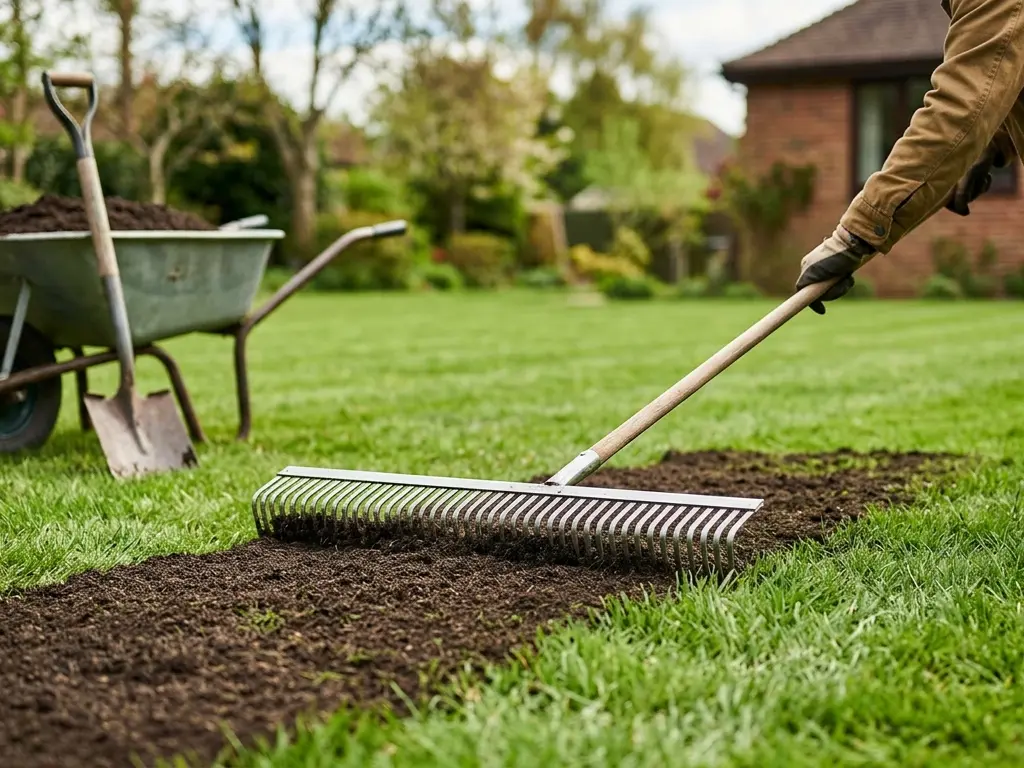
Topdressing is the practice of spreading a thin layer of material directly over existing turf and working it into the surface.
Golf courses do it routinely. Sports fields do it. Residential lawns rarely do it, which is part of why residential lawns tend to perform worse than those environments over time despite similar inputs.
It’s not complicated. But there’s enough specificity to the material choice and timing that doing it wrong either does nothing or actively makes things worse.
What Topdressing Actually Does
Thin layers of organic material incorporated into the top inch of soil change the biology and structure of that layer over time.
Compost introduces microbial activity.
That microbial activity breaks down thatch, improves the soil’s ability to hold and release water, and creates the kind of loose, well-aggregated structure that grass roots move through easily. If the thatch layer is thick enough to feel spongy underfoot, scarifying to remove the thatch layer first gives the topdressing a cleaner surface to work into.
One application doesn’t transform your lawn. Two or three years of annual topdressing, a quarter inch each time, worked in well compounds. The soil profile changes incrementally. The turf response follows the soil, not the application — and increasing soil microbial activity in your lawn is what turns a topdress into lasting improvement.
There’s also a leveling function.
Lawns develop minor surface irregularities over time, low spots from settling, shallow ruts, and uneven areas from freeze-thaw cycles.
Topdressing fills them without disruption. Not a fix for major grade problems, but consistent annual applications will smooth a lawn that’s developed subtle undulations that make mowing uneven and standing water more likely.
The Material Question
This is where most people get it wrong, usually because they grab whatever bagged product is at the garden center without thinking about what their soil actually needs.
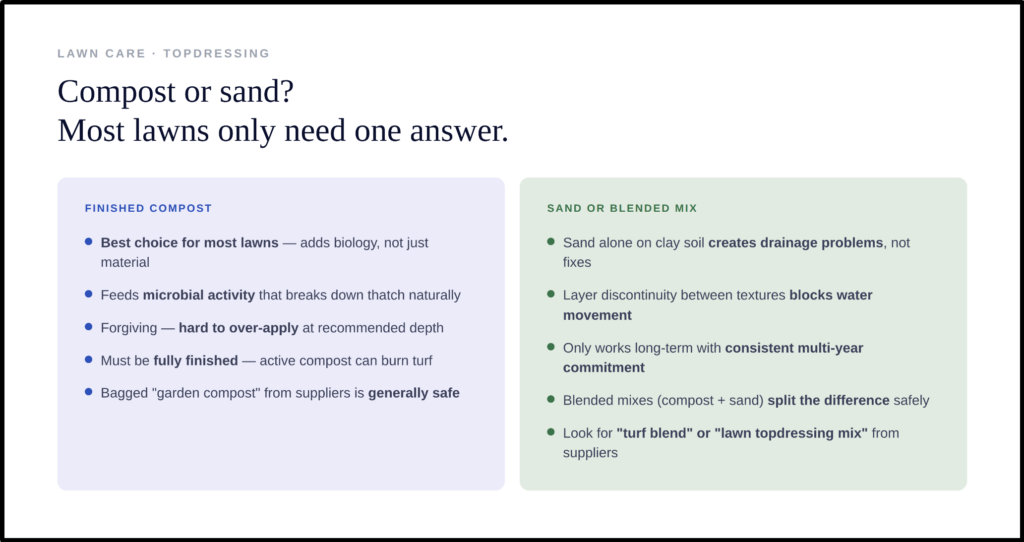
Straight compost is the right choice for most lawns. It adds organic matter, feeds soil biology, and is forgiving, you’re not going to damage turf by applying well-finished compost at a quarter inch.
The caveat is that it needs to be finished. Hot, active compost can burn. Bagged compost sold as garden compost is usually fine. Unfinished homemade compost is not, unless you’re certain it’s past the active phase.
Sandy topdressing, straight sand, or a sand-heavy blend, is what golf course superintendents use on greens and tees.
The logic is that sand over time creates a consistent, non-stratified profile that drains well and stays firm under traffic.
The problem is that the logic only works if you’re committed to doing it long-term and consistently.
A single application of sand on a clay lawn doesn’t improve drainage. It can actually impede it, because you’ve created a layer discontinuity with two different soil textures sitting on top of each other, so water doesn’t move through uniformly.
Proceed with sand only if you understand this and are prepared for the multi-year program it requires.
Blended mixes, compost plus sand, sometimes with a small proportion of topsoil, split the difference and are often the most practical choice for residential use. Some suppliers sell these as lawn topdressing mix or turf blend. The ratios matter, you want enough organic content to feed the biology without creating a soft, thatch-prone surface layer.
Timing
Fall is ideal. The soil is still warm, which means microbial activity is still running, which means the material starts breaking down and integrating rather than just sitting on the surface through winter.
Grass in the cool-season growth window is actively sending roots down, and loose, amended soil near the surface facilitates that.
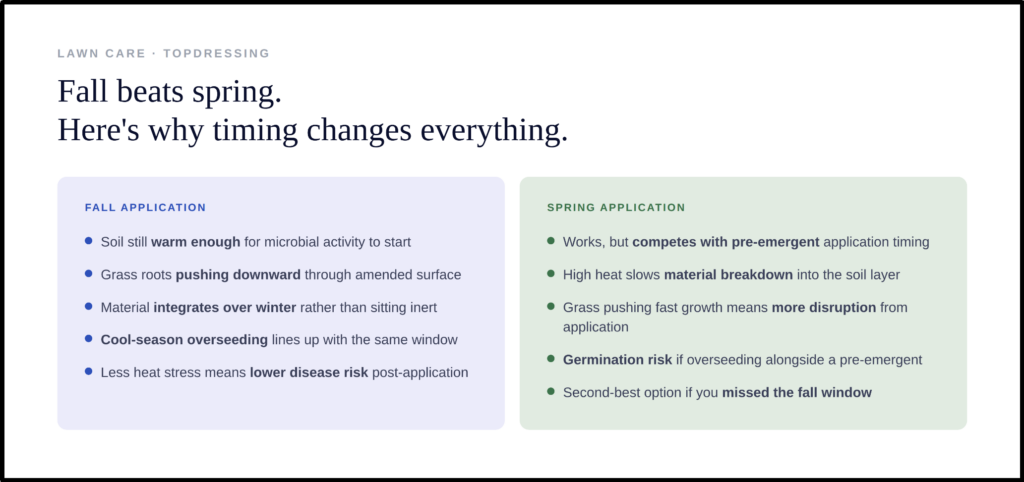
You can topdress in spring. A lot of people do. It’s not wrong.
The issue is that spring applications compete with everything else happening at once: pre-emergent applications, early fertilizer, and potential overseeding.
If you’re doing all of those, adding topdressing makes the schedule complicated and risks working material into your pre-emergent barrier before it’s done its job.
One timing constraint that’s absolute: don’t topdress on dormant grass. The material needs to work down into the canopy and make contact with the soil.
Dormant grass is dense and dry, and the topdressing just sits on top of it, doing nothing until spring. Worse, it can mat the grass down and create conditions for disease.
How to Actually Do It
Aerate first. Core aeration creates channels for the topdressing material to fall into and reach the root zone faster.
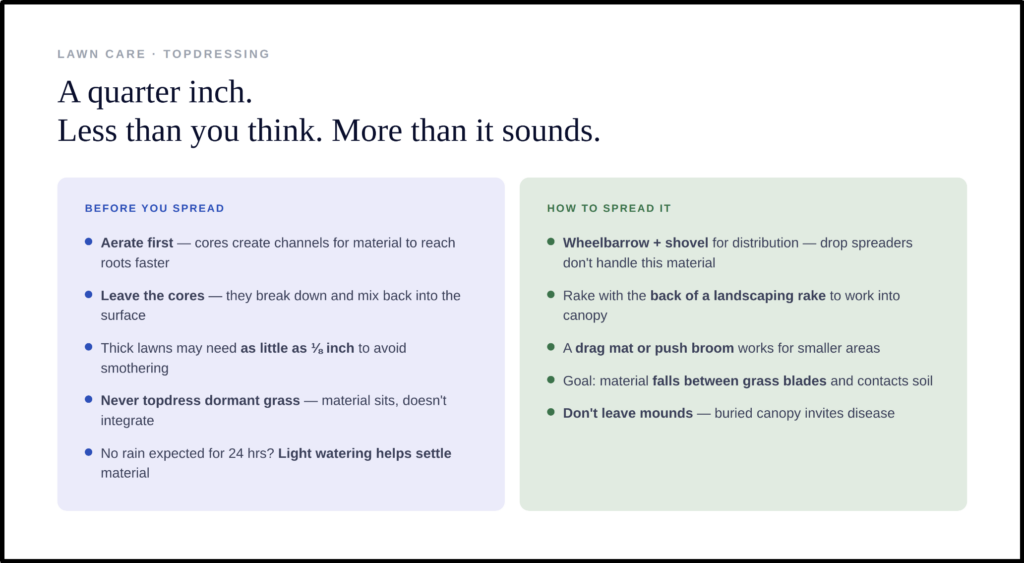
Without aeration, you’re still doing something useful, but it’ll take longer for the material to incorporate, and you’ll need to be more careful about applying so much that you’re smothering the grass.
Leave the cores. People want to rake them up. Don’t. They break down and mix back into the surface, which is part of the point.
Apply a quarter inch of material. A quarter inch is roughly what you can work into turf without smothering it, and on a thick, established lawn, you might go thinner just to make sure light is still reaching the grass blades.
Over-application is the most common mistake. The material needs to fall between the grass blades and reach the soil, not sit on top of the canopy.
Spread it with the back of a landscaping rake or a drag mat. A push broom works on smaller areas. The goal is to work the material down into the canopy, not leave it mounded on the surface.
On a larger lawn, a drop spreader isn’t going to work well for this, the material is too wet and irregular. A wheelbarrow and a shovel for distribution, then raking, is the low-tech method that actually gets material where it needs to go.
Water lightly after application if there’s no rain coming. Not a deep soak, you’re just helping settle the material.
Overseeding Into Topdressing
Topdressing and overseeding done together is more effective than either done alone, and fall timing makes both work well simultaneously.
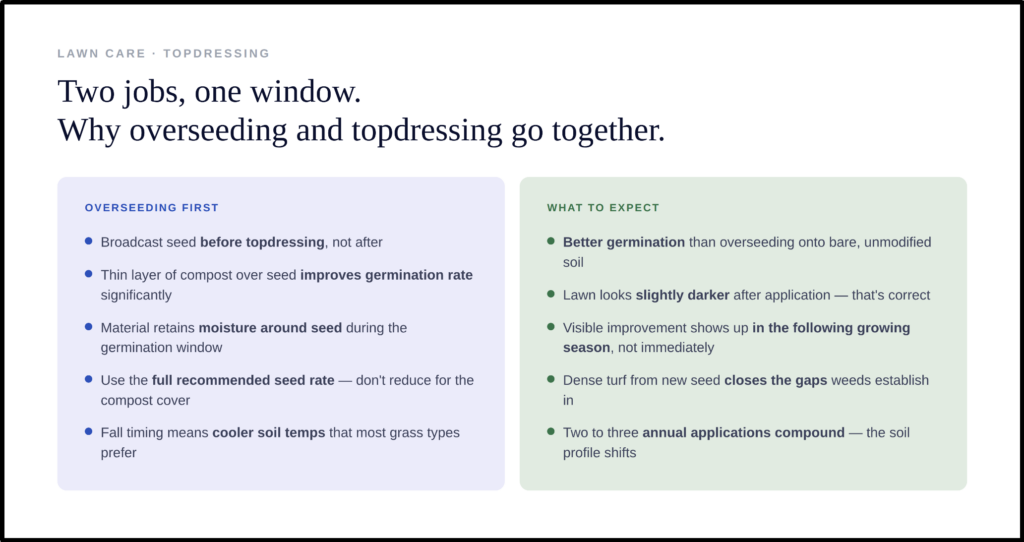
Overseed first, then topdress over the seed.
The thin layer of material covers the seed lightly, improves seed-to-soil contact, and retains moisture during germination. You get better germination rates than broadcasting seed onto bare or unmodified soil, and the topdressing does its soil-building work at the same time.
The seed rate matters here. Don’t reduce it because you’re covering with topdressing, use the full recommended rate for your grass type and situation.
Overseeding is already an exercise in accepting that a lot of seed won’t establish; you don’t need to compound that with a light application.
What You’ll See
After the first application, if you did it right, not much, immediately.
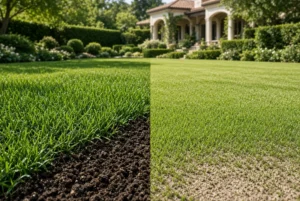
The material will have settled into the canopy, the lawn will look slightly darker and more uniform, and in a week or two, you won’t be able to tell you did anything.
Better moisture retention during dry stretches. Improved color without extra nitrogen input. Thicker turf density over the following season as roots move through a more hospitable soil layer.
If you’re overseeding, germination will be noticeably better than overseeding without topdressing.
After two or three annual applications, the improvement in the soil profile is measurable. You can feel it when you push a screwdriver into the soil, it goes in more easily. You’ll see it in how the lawn holds up under stress.
The Last Variable
Topdressing improves the soil’s ability to hold and release water. What it can’t control is what goes in from the top.
Uneven watering works against everything topdressing is building.
The Aiper IrriSense 2 maps up to 10 independent zones across 4,800 square feet, so different areas of the lawn get watered on their own schedule rather than a single timer treating the shaded corner the same as the south-facing slope.
Weather-Sense adjusts automatically based on conditions like no cycle after rain, longer runs through a heat stretch. The soil you’ve spent two or three seasons improving gets water delivered in a way that the soil can actually use.
Get more pool and lawn care guides from Aiper on Google