How to Get Rid of Johnsongrass in a Lawn

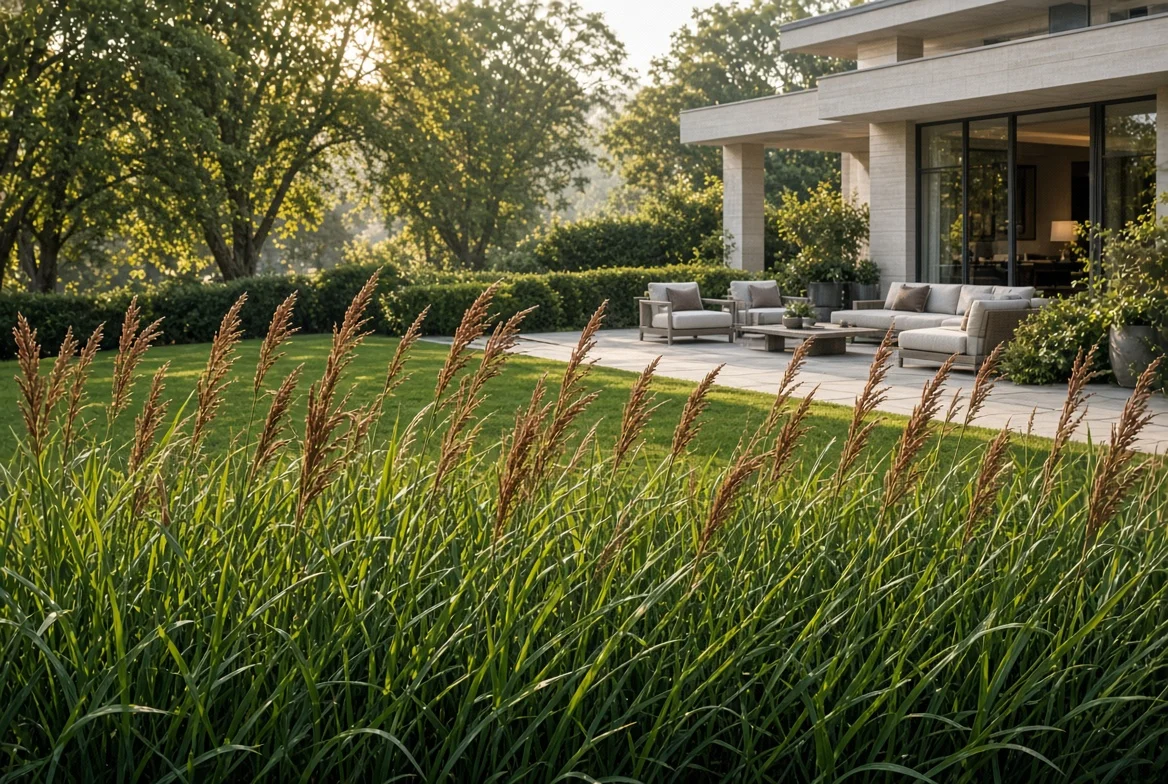
Johnsongrass is a coarse, warm-season perennial that spreads through thick underground rhizomes and heavy seed production. In a mowed lawn, it stays short, but it keeps coming back from the rhizomes no matter how often it is cut.
Warm-season lawns such as Bermuda, zoysia, St. Augustine, and centipede have a selective herbicide option that removes johnsongrass without killing the turf. Tall fescue lawns don’t, so you have to spot-kill each clump and reseed the gap.
Either way, plan on two treatments and a season of follow-up.
How to Identify Johnsongrass
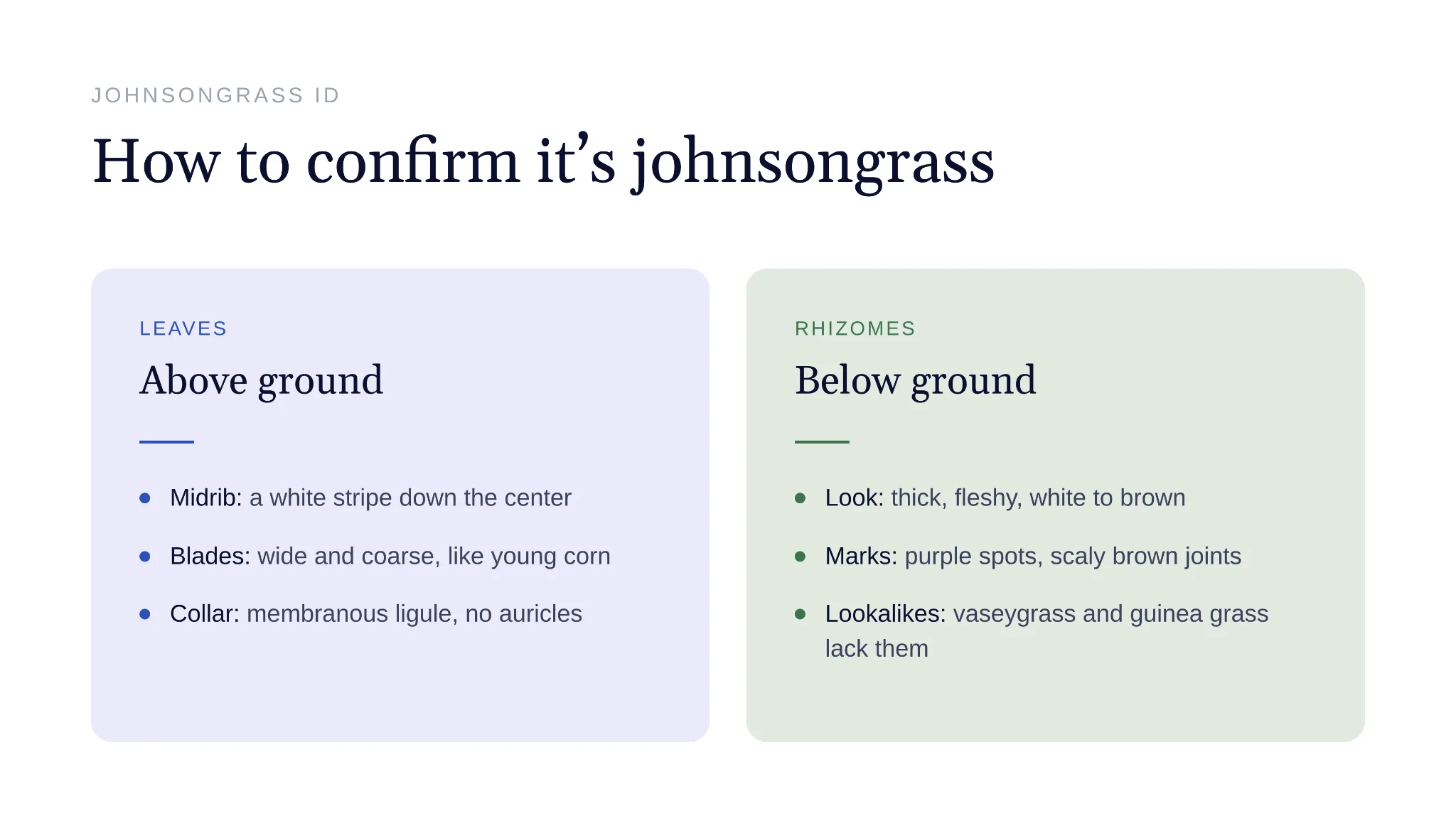
Young Johnsongrass in a lawn looks a lot like corn seedlings, with wide, coarse blades that stand out against finer turf. Check these features before buying a herbicide, since several lookalikes need different treatment.
- White midrib. A prominent white midrib runs down the center of each leaf, and it is visible at every growth stage.
- Collar. Pull the leaf back from the stem. Johnsongrass has a membranous ligule, sometimes fringed with hairs, and no auricles.
- Rhizomes. Dig under an established clump. The rhizomes are thick, fleshy, and white to brown, often with purple spots and brown scaly sheaths at the joints.
Vaseygrass and guinea grass also have a white midrib and are often misidentified as johnsongrass. Neither has a creeping rhizome system; both grow as individual bunches rather than spreading patches.
Why It’s Hard to Kill
Most of johnsongrass lives underground. A single plant can produce up to 60 feet of rhizomes and more than 80,000 seeds in one growing season, and any rhizome piece left in the soil can send up a new shoot.
Seed adds a second problem. Johnsongrass seed can stay dormant in the soil for long periods, so new seedlings appear for years after the original plants are gone.
Some johnsongrass populations are also resistant to glyphosate. If a glyphosate spot treatment fails on healthy, actively growing plants, resistance may be the cause.
Choose a Treatment for Your Lawn Type
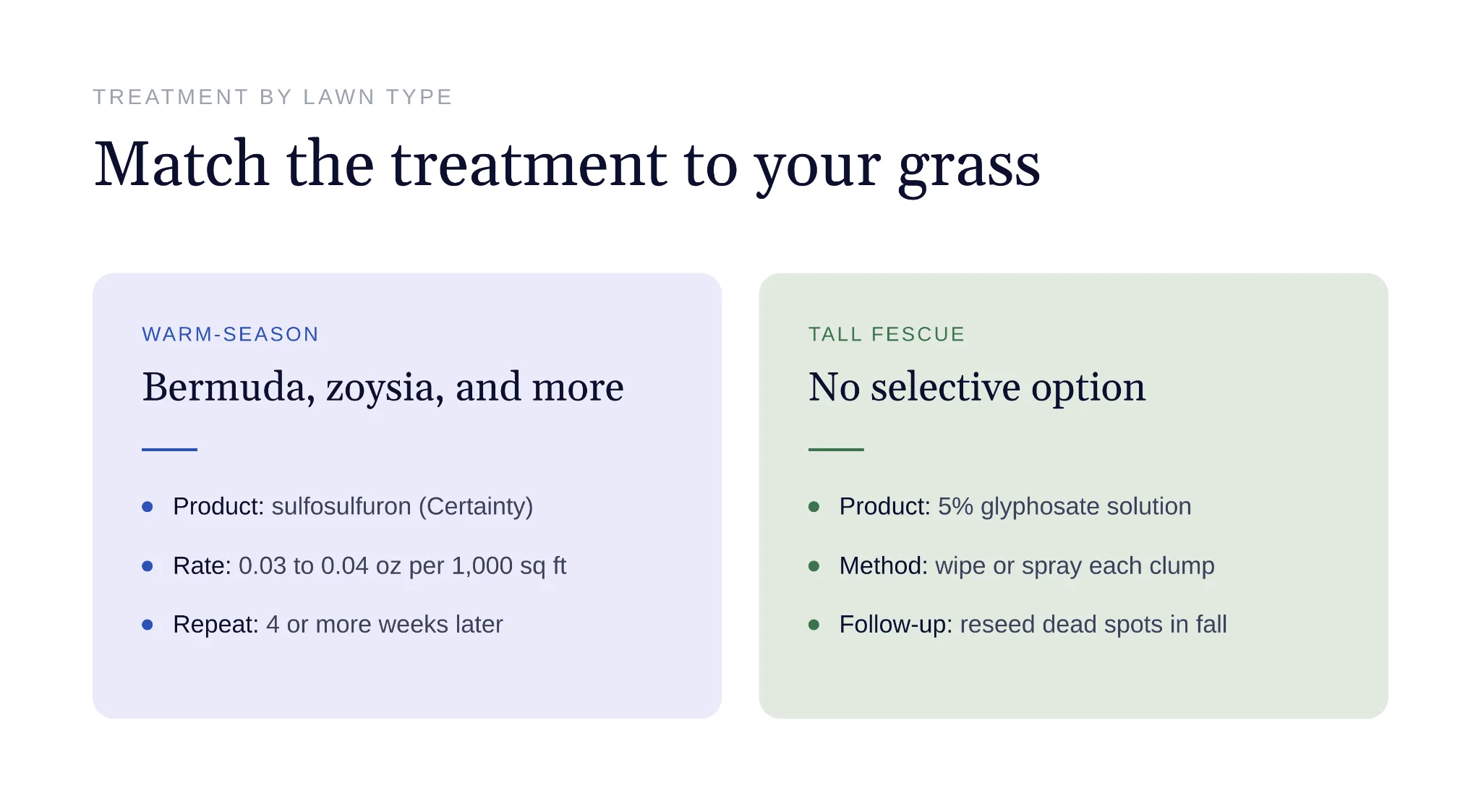
The right product depends on the grass you want to keep. Sulfosulfuron, sold for turf as Certainty, is the main selective option extension services list for johnsongrass in warm-season lawns.
| Lawn grass | Treatment | Rate |
|---|---|---|
| Bermudagrass, zoysiagrass, St. Augustinegrass, centipedegrass, bahiagrass | Sulfosulfuron (Certainty) | 0.03 to 0.04 oz per 1,000 sq ft |
| Tall fescue | Glyphosate spot treatment or wick application | 5% solution |
| Kentucky bluegrass, perennial ryegrass | Glyphosate spot treatment | 5% solution |
LSU AgCenter lists sulfosulfuron as safe on all warm-season turfgrasses. It cannot be applied to tall fescue, and it kills other cool-season grasses as well.
When to Spray
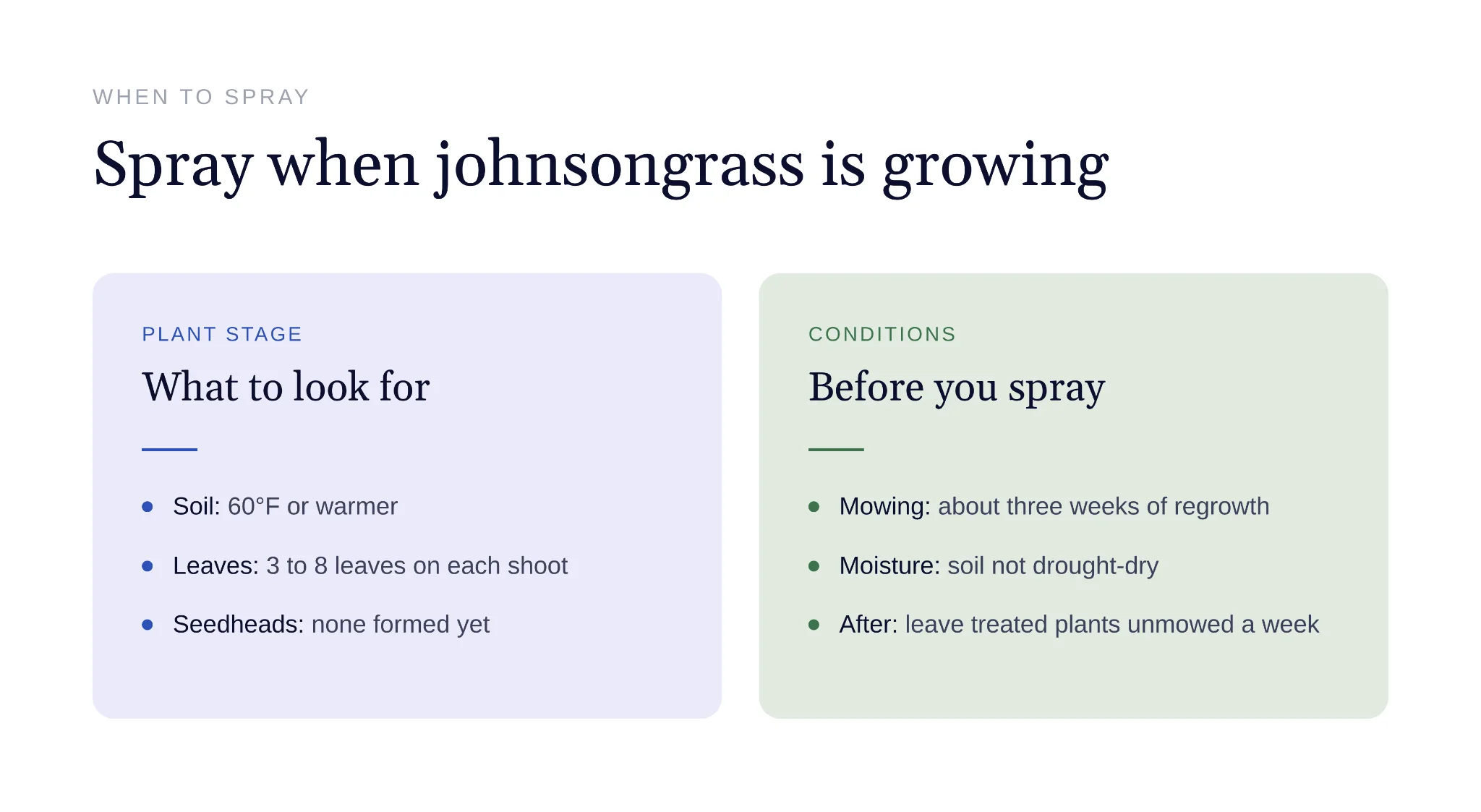
Timing matters more with johnsongrass than with most weeds, because the herbicide has to move down into the rhizomes. Spraying too early or too late leaves the underground system alive.
New shoots from rhizomes start emerging when soil temperatures reach 60°F, and seedlings follow at around 70°F. Treat once plants have leafed out and are growing well, and before seedheads form.
Spray when these conditions line up:
- The johnsongrass is actively growing and has reached the 3- to 8-leaf stage.
- It has regrown for about three weeks since the last mowing, so there is enough leaf to absorb the spray.
- No seedheads have formed yet.
- The soil has moisture. Drought-stressed plants take up less herbicide.
How to Spray a Warm-Season Lawn
Sulfosulfuron rates are very low, so measuring the lawn and the product carefully matters more than anything else in this process.
- Measure the treatment area. Calculate the square footage of the infested areas so you know exactly how much product to mix.
- Measure the product. At 0.03 to 0.04 ounces per 1,000 square feet, that is roughly 0.85 to 1.1 grams. Use a digital scale that reads to 0.1 gram.
- Mix with surfactant. Add a nonionic surfactant at 0.25% by volume, about 2 teaspoons per gallon of water.
- Spray the johnsongrass evenly. Wet the leaves without runoff.
- Hold off on mowing. Leave treated plants alone for at least a week so the herbicide can move into the rhizomes.
- Repeat if needed. A second application can be made four or more weeks after the first. Johnsongrass usually needs one.
Treated plants yellow and die back slowly over two to four weeks.
How to Spot-Treat Tall Fescue and Other Cool-Season Lawns
With no selective option, the goal is to kill each johnsongrass clump while damaging as little of the surrounding lawn as possible. The University of Georgia recommends a 5% glyphosate solution, sprayed on the clump or wiped on with a wick applicator.
- Mix a 5% solution. Using a 41% glyphosate concentrate, add about 6.4 fluid ounces to 1 gallon of water.
- Wipe or spray only the johnsongrass. Wiping with a sponge-tipped applicator or a gloved hand keeps glyphosate off the fescue. If you spray, shield the surrounding turf with cardboard.
- Wait for regrowth and treat again. New shoots from rhizomes usually appear within a few weeks.
- Reseed the dead spots in fall. Early fall is the best seeding window for tall fescue.
Digging and Mowing
Digging works on young plants that haven’t built up much rhizome yet. Dig at least 8 inches deep and remove every piece of white rhizome you find, since any fragment left behind can regrow.
Frequent mowing also weakens johnsongrass over time. Oklahoma State notes that continuous mowing is one of the most effective ways to control it in pastures, because it drains the food reserves in the rhizomes. Regular mowing also stops seedheads from forming.
Keep Johnsongrass From Coming Back
Johnsongrass seedlings establish most easily in thin turf and bare soil. A dense lawn gives them little room.
Mow on a regular schedule. Keep the lawn at the recommended height for your grass type and don’t let any area go uncut long enough to set seed.
Fill bare spots quickly. Sod or seed thin areas as soon as they appear, before johnsongrass seed in the soil has a chance to germinate.
Water deeply when the lawn needs it. UF/IFAS notes that many homeowners leave the irrigation timer on the same schedule all year, even though plant water needs change through the season. Watering too often keeps roots shallow and thins the lawn during dry spells.
The Aiper IrriSense 2 adjusts watering based on the weather and runs separate schedules for up to 10 zones. Sunny areas that dry out faster can get more water than shaded ones, and the schedule changes as the season does.
Get more pool and lawn care guides from Aiper on Google